
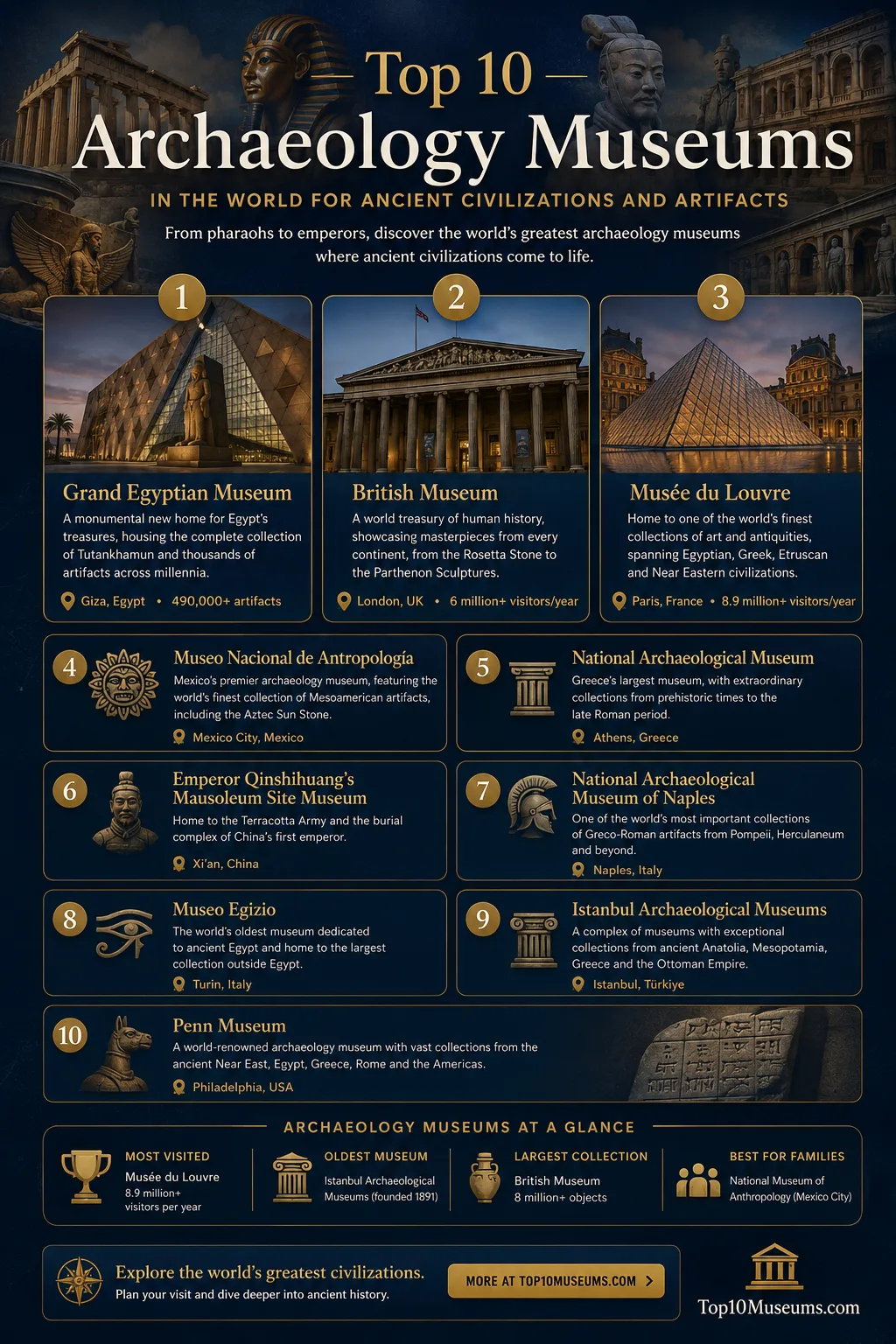
The best archaeology museums do different jobs. Some place several civilizations side by side, allowing an Assyrian palace relief, an Egyptian royal statue and a Greek temple sculpture to be compared within a few rooms. Others stay close to one culture or excavation site, preserving the relationship between an object, its landscape and the people who made it. This ranking weighs the strength of permanent collections, the quality of archaeological interpretation, the range of civilizations represented, current visitor access and the amount of time each museum rewards.
[ayaz_safe_content id=”3157″ key=”p3157b1fhhntdg8″]
| Rank | Name | Founded | Collection Type | Website |
|---|---|---|---|---|
| 1 | Grand Egyptian Museum | 2025 | Ancient Egypt and Tutankhamun | Official website |
| 2 | British Museum | 1753 | Global antiquities | Official website |
| 3 | Musée du Louvre | 1793 | Near Eastern, Egyptian and classical antiquities | Official website |
| 4 | Museo Nacional de Antropología | 1964 | Mesoamerican archaeology and Mexican ethnography | Official website |
| 5 | National Archaeological Museum | 1829 | Greek prehistory and classical antiquity | Official website |
| 6 | Emperor Qinshihuang’s Mausoleum Site Museum | 1979 | Qin imperial burial archaeology | Official website |
| 7 | National Archaeological Museum of Naples | 1816 | Pompeii, Herculaneum and Roman art | Official website |
| 8 | Museo Egizio | 1824 | Egyptology and material culture | Official website |
| 9 | Istanbul Archaeological Museums | 1869 | Anatolian, Near Eastern and classical archaeology | Official website |
| 10 | Penn Museum | 1887 | Excavated collections and field archaeology | Official website |
Ten Museums, Ten Ways to Read the Ancient Past
No single institution can represent archaeology as a whole. The Grand Egyptian Museum and Museo Egizio focus closely on one civilization but tell different stories: one is built around scale, royal collections and a new national museum campus; the other gives more space to writing, craft, excavation records and ordinary materials. The British Museum and the Louvre allow cross-cultural comparison, though many objects are now far from the places where they were excavated or collected. Xi’an offers the reverse experience, with an imperial burial landscape preserved around the pits where the Terracotta Army was found.
The ranking also avoids treating archaeology as a Mediterranean subject. Mexico City’s Museo Nacional de Antropología is essential for understanding the Mexica, Maya, Olmec, Teotihuacan and other Mesoamerican cultures on their own terms. Penn Museum enters the list for another reason: its galleries make excavation history, field records and the original location of finds part of the visitor’s understanding.
1. Grand Egyptian Museum, Giza
The Grand Egyptian Museum changed the archaeology-museum landscape when it opened fully on November 1, 2025. Its ticketed route now includes the Tutankhamun Galleries, Main Galleries, Grand Hall, Grand Stairs and Khufu’s Boats Museum. That matters because older travel material often describes only trial access or a partly open complex.
Tutankhamun is the central draw, with more than 5,000 objects from the young king’s tomb presented together. The gold burial mask is only one part of the story. Chests, furniture, sandals, weapons, ritual equipment and food containers reveal how royal life and the imagined afterlife were furnished in practice. Looking beyond gold produces a fuller picture of the court, its craftspeople and the labor behind a royal burial.
The museum begins at monumental scale. A colossal statue of Ramesses II anchors the Grand Hall, while the Grand Stairs place royal sculpture and architectural elements along an ascending route. The Main Galleries cover Egyptian culture from prehistory through the Roman period and can be followed by chronology or theme. This is not a sensible two-hour stop for a first visit. A half day is more realistic, especially when the Tutankhamun rooms and boat museum are included.
The Giza location also changes the reading of the collection. The museum is close to the pyramid complex rather than isolated from Egypt’s most famous royal landscape. That relationship does not restore every artifact to its exact archaeological setting, but it places dynastic monuments, burial culture and the modern museum within the same broad geography.
Best for: Visitors seeking the broadest single-museum account of pharaonic Egypt and the full Tutankhamun collection
Nearby alternative: The Egyptian Museum in Tahrir — across greater Cairo rather than next door, it offers an older display style and many objects tied to the history of Egyptology itself.
2. British Museum, London
The British Museum’s main archaeological advantage is comparison. A visitor can move between Egyptian sculpture, Assyrian palace reliefs, Greek temple art, Roman objects and material from early Mesopotamian cities without changing institutions. The result is especially useful for tracing how rulers used stone, writing, warfare and religious imagery in different societies.
The Rosetta Stone remains the most recognizable object. Its importance comes from the same text appearing in hieroglyphic, Demotic and Greek scripts, which helped scholars decipher Egyptian hieroglyphs. It should not become the entire Egyptian visit. Nearby royal sculpture, funerary objects and inscriptions show how writing functioned in temples, administration and commemoration rather than only as a puzzle solved in the nineteenth century.
The Assyrian galleries provide one of the museum’s strongest sequences. Reliefs made for royal palaces show military campaigns, hunting, tribute and controlled ceremony. They were designed as architecture and political messaging, not as separate framed artworks. The Parthenon Sculptures require a different reading: they belong to a specific Athenian building and religious setting, while their present display makes close viewing and comparison easier.
That tension should remain visible. An encyclopedic museum can connect distant cultures, but an object displayed far from its original landscape may lose part of its architectural, religious or local meaning. The ownership and future of the Parthenon Sculptures remain disputed, and the museum’s collecting history cannot be separated from empire, diplomacy, excavation agreements and older systems of acquisition.
A focused visit can cover the Rosetta Stone, Assyrian reliefs and Parthenon galleries in two to three hours. A broader archaeology day can easily fill most of the museum’s opening period. Families may find object trails easier than attempting every gallery in numerical order.
Best for: Comparing several ancient civilizations within one building
Nearby alternative: Petrie Museum of Egyptian and Sudanese Archaeology — a short walk away, its dense university collection is better suited to visitors interested in excavation typologies and everyday objects.
3. Musée du Louvre, Paris
The Louvre is often approached as a painting museum, yet its Near Eastern, Egyptian, Greek, Etruscan and Roman departments form a major archaeology visit on their own. The palace layout can make those collections feel dispersed, so choosing a civilization before arrival is more productive than trying to combine every famous artwork with every antiquities room.
The stela associated with Hammurabi contains 282 legal judgments carved around 1750 BCE. Calling it the first law code is misleading: earlier legal collections survive, and the text does not operate like a modern statute book. Its value lies in the relationship between law, royal authority, class, property, labor and family life in Babylonian society. The image at the top also turns legal judgment into a statement about divinely sanctioned kingship.
Finds from Susa connect Mesopotamia and ancient Iran, while monumental guardians and relief sculpture show how palaces controlled movement and visual attention. Egyptian galleries add royal, religious and funerary material; the classical departments shift toward the Greek and Roman treatment of the body, myth and civic display. Few museums allow these subjects to be compared on this scale within a former royal palace.
Two practical choices improve the visit. First, reserve a large block of time for one or two departments rather than treating the Louvre as a checklist. Second, confirm booking rules before arrival. The official ticketing system requires reservations during the peak period from July 1 through August 31, 2026, and later policies may change.
Best for: Visitors interested in Mesopotamian law, ancient Iran and Mediterranean art in the same museum
Nearby alternative: Musée de Cluny — across the Seine, it shifts the timeline toward late antiquity and the medieval period inside a site that includes Roman baths.
4. Museo Nacional de Antropología, Mexico City
Mexico City’s Museo Nacional de Antropología prevents a global archaeology list from collapsing into Egypt, Greece and Rome. Its ground-floor archaeology rooms separate major cultural regions and periods, including Teotihuacan, Toltec and Epiclassic cultures, Mexica, Oaxaca, Gulf Coast societies, Maya areas and northern Mexico. The upper floor turns to the lives and cultures of Indigenous peoples in more recent periods.
The Piedra del Sol is often called the Aztec Calendar, but that shorthand creates the wrong expectation. The carved disk is better understood through Mexica ideas about cosmic eras, ritual time, solar imagery and political-religious authority. It belongs within the wider Mexica gallery, where sculpture, offerings, warfare, agriculture and the scale of Tenochtitlan help explain the society that produced it.
The museum is equally valuable for correcting another common error: Mesoamerica was not one civilization. Olmec centers, Maya kingdoms, Teotihuacan, Zapotec societies and the Mexica state emerged in different places and periods, with distinct languages, political systems and visual traditions. A colossal Olmec head, a Maya funerary object and a Mexica state monument should not be read as variations of the same culture.
Architectural reconstructions and full-scale displays help establish the size of temples, tombs and carved monuments. They also require care. A reconstruction is a modern interpretation based on archaeological evidence, not the original structure transported intact. Labels, room plans and the sequence of galleries make this distinction easier to follow.
The museum can fill a day. Visitors with three hours should choose two or three archaeology halls rather than moving quickly through every civilization. Families benefit from the large courtyard and the visual scale of the displays, though the depth of the collection still rewards older children and adults who can spend time with maps and chronology.
Best for: Understanding Mesoamerican civilizations without treating them as a single culture
Nearby alternative: Museo Nacional de Historia at Chapultepec Castle — within Chapultepec Park, it continues the story into colonial and national history from a very different type of museum building.
5. National Archaeological Museum, Athens
Athens’ National Archaeological Museum is the strongest single collection for following Greek material culture across prehistory, the Bronze Age, the Archaic and Classical periods, Hellenistic kingdoms and Roman rule. Its founding dates to 1829, while the present building opened to the public in 1889. The rooms therefore reflect both ancient history and the formation of archaeology in the modern Greek state.
The gold funerary mask traditionally called the Mask of Agamemnon comes from Grave Circle A at Mycenae. The name should not be taken as an identification. Heinrich Schliemann connected excavated objects to Homeric figures with more confidence than the evidence permits, and the mask predates the conventional setting of the Trojan War. Its real value lies in Mycenaean burial practice, elite display and metalworking.
The Antikythera Mechanism shifts the visit from royal graves to scientific practice. Recovered from a shipwreck, the first-century BCE instrument used interlocking gears for astronomical and calendar calculations. It is often described as the first computer, but that phrase works only as a modern analogy. Seeing the surviving fragments beside reconstruction work makes its mechanical complexity easier to grasp without forcing it into a present-day category.
The bronze galleries deserve equal time. Large bronze statues survive less often than marble because metal could be melted and reused. Shipwreck finds and excavated bronzes therefore offer rare evidence for casting, surface finish and movement in Greek sculpture. A three-hour visit can cover Mycenae, the Antikythera material and selected sculpture; a half day allows the vase and Egyptian collections to be added.
Best for: Bronze Age Greece, original Greek bronzes and the Antikythera Mechanism
Nearby alternative: Epigraphic Museum — housed beside the National Archaeological Museum, it focuses on inscriptions and rewards visitors interested in how stone texts record laws, dedications and civic life.
6. Emperor Qinshihuang’s Mausoleum Site Museum, Xi’an
The Terracotta Army is powerful because it remains within the wider mausoleum landscape rather than appearing as an isolated group of statues. The burial pits lie about 1.5 kilometers east of the emperor’s tomb mound. Pit 1 alone was estimated to contain roughly 6,000 warriors and horses, arranged as part of an underground military formation rather than as individual display sculptures.
Differences in armor, hair, headgear, stance and role allow infantry, archers, cavalry and officers to be distinguished. It is safer to describe the figures as highly varied products of an organized workshop system than to claim that every face is a portrait of a specific soldier. Standardized parts, skilled finishing and large labor teams could produce both repetition and individuality.
The warriors were originally painted. Excavation exposed fragile lacquer and pigments to air, causing much of the color to curl or disappear quickly. That loss explains why conservation methods affect the pace of excavation: uncovering more objects is not automatically better when exposure may destroy evidence that has survived underground for two millennia.
The museum opened to the public in 1979, five years after local farmers encountered fragments while digging a well. The present institution also includes the mausoleum site park. Visitors should allow at least half a day and reserve before traveling from central Xi’an. The current system uses advance, real-name online booking with timed entry and matching identification.
This site provides the clearest contrast with the British Museum or Louvre. Here, distance between artifact and burial landscape is reduced. The trade-off is narrower cultural range: the visit goes deeply into the Qin imperial project rather than comparing many civilizations under one roof.
Best for: Seeing excavation, conservation and imperial burial design within the original archaeological landscape
Nearby alternative: Shaanxi History Museum — back in central Xi’an, it broadens the visit beyond the Qin dynasty to the longer archaeological history of the region.
7. National Archaeological Museum of Naples
The National Archaeological Museum of Naples is the essential museum companion to Pompeii and Herculaneum. Many mosaics, frescoes, bronzes, furnishings and domestic objects were removed from Vesuvian sites for protection and study. Their museum setting makes close viewing possible, yet visitors should keep imagining the rooms, walls and floors for which they were made.
A framed mosaic on a museum wall may once have been walked around in a dining room or reception space. A fresco fragment may have belonged to a decorative scheme designed around doorways, sight lines and social use. The museum works best when paired with an archaeological site because each supplies context the other lacks: Naples protects and compares the objects, while Pompeii or Herculaneum restores their urban scale.
The Farnese Collection adds another layer. Monumental works such as the Farnese Bull and Farnese Hercules show Roman collecting, copying and reinterpretation of Greek artistic traditions. Their later history as part of an elite Renaissance collection also demonstrates how ancient sculpture acquired new settings and meanings long after antiquity.
The Secret Cabinet contains material with sexual themes from Pompeii and Herculaneum. Its display history is as informative as the objects: later authorities restricted access or hid works according to changing moral rules. Families can treat it as an optional room rather than the center of the visit.
Two current conditions affect planning. The Alexander Mosaic is undergoing restoration and is not on normal display, though observation points allow visitors to see conservation activity. Building work has also shifted the entrance and ticket office to the western door. The permanent strengths remain the Vesuvian collections, Farnese sculpture, frescoes and objects of daily life, so the museum still merits three to four hours.
Best for: Roman houses, Pompeian wall painting and objects from daily life around Vesuvius
Nearby alternative: Museo dell’Opera di Santa Chiara — a manageable walk away, it combines a smaller museum with archaeological remains beneath the monastic complex.
8. Museo Egizio, Turin
Museo Egizio offers a different Egyptian experience from Giza. Its scale is smaller, but the galleries give sustained attention to excavation history, writing, material analysis, craft and the lives of communities outside the royal court. The institution dates to 1824. Its online database describes roughly 40,000 objects, while a little over 4,000 antiquities appear along the main display route.
The Tomb of Kha and Merit is a defining group because furniture, clothing, personal possessions and funerary equipment survived together. Such an assemblage can reveal household choices and burial preparation more clearly than a display made from unrelated masterpieces. Deir el-Medina material adds the workers and artists who built and decorated royal tombs, shifting attention from pharaohs to skilled families and village life.
Papyri and inscribed objects turn writing into a physical practice. Material, ink, format, repair and findspot all shape how a text is understood. The Turin King List is famous for historical chronology, but the museum’s broader papyrus holdings also record ritual, administration and everyday concerns.
The permanent exhibition titled Materials: The Shape of Time organizes objects through wood, stone, ceramics, pigments and other substances. This makes production visible. A stone vessel is not only an image or type; it also records quarrying, tool marks, transport, workshop knowledge and changing surface treatment.
The Historic Rooms have been temporarily closed since December 12, 2025, so current notices should be checked before planning around a specific display. Even with that restriction, a focused visit needs three hours, while readers of labels and papyrus displays can use most of a day.
Best for: Egyptology, papyri, excavation groups and the material study of ordinary objects
Nearby alternative: Musei Reali — about ten minutes away, its archaeological collections extend the day into Greek, Roman and Piedmontese material.
9. Istanbul Archaeological Museums
Istanbul Archaeological Museums grew from the Ottoman Imperial Museum founded in 1869. The present complex brings together the Archaeological Museum, the Museum of the Ancient Orient and the Tiled Kiosk. Its collections were shaped by an empire that once governed archaeological sites across Anatolia, the eastern Mediterranean, Mesopotamia and parts of the Arabian Peninsula.
The Sidon royal necropolis finds form the best-known group. The Alexander Sarcophagus takes its name from reliefs showing Alexander the Great, not because it held his body. It was found at Sidon and is commonly associated with a local ruler. The Mourning Women, Lycian and Tabnit sarcophagi should be viewed with it, since their forms, carved programs and burial roles reveal different cultural connections across the eastern Mediterranean.
Osman Hamdi Bey is central to the institution’s history. As director, archaeologist and advocate for antiquities regulation, he linked excavations, museum building and the Ottoman state’s effort to control the removal of archaeological finds. The neoclassical main building opened in 1891 to house the Sidon sarcophagi, while the fifteenth-century Tiled Kiosk and the former fine arts school give the complex three distinct architectural settings.
Current access is limited. Official notices list several ground-floor rooms, all upper-floor halls and selected rooms in the annex as closed. This reduces the amount that can be seen and makes it unwise to promise a particular gallery without checking the museum’s latest notice. The open displays still justify a visit for the sarcophagi, Anatolian material and the history of Ottoman archaeology.
Best for: Sidon sarcophagi, Anatolian archaeology and the history of collecting under the Ottoman Empire
Nearby alternative: Museum of the History of Science and Technology in Islam — inside Gülhane Park, it offers a smaller, quieter museum visit focused on instruments, models and scientific traditions.
10. Penn Museum, Philadelphia
Penn Museum earns its place through field archaeology rather than a collection of universally recognized icons. Founded in 1887 alongside plans for an expedition to Nippur, it grew through university excavations and research. Its displays are especially useful for understanding how archaeologists move from a trench, layer and group of finds to an interpretation of a city or society.
The Middle East collections include material from Nippur and the joint British Museum–Penn Museum excavations at Ur between 1922 and 1934. Objects from the Royal Cemetery of Ur include Queen Puabi’s jewelry and the composite sculpture commonly called the Ram in the Thicket. The latter is actually a goat standing against a plant, built from gold, lapis lazuli, shell and copper. Its modern nickname is memorable but not a literal archaeological identification.
The Babylonian Section holds more than 35,000 cuneiform tablets, many connected to the early Nippur excavations. These are not merely examples of old writing. Administrative accounts, school texts, legal records, literature and religious compositions show how writing organized institutions and preserved memory.
Penn also helps clarify two terms often treated as interchangeable. Provenance describes an object’s ownership and collecting history. Provenience refers to its exact archaeological location: trench, layer, room, tomb or deposit. A beautiful object without provenience may still be studied, but much of its relationship to architecture, date and neighboring finds has been lost.
Two to three hours is enough for the Middle East and Egypt galleries, though specialists can spend much longer with object labels and excavation histories. The museum is easier to navigate than the Louvre or British Museum, making it a strong choice for readers who prefer depth without the fatigue of a vast national institution.
Best for: Field archaeology, Mesopotamian excavation records and the relationship between objects and provenience
Nearby alternative: Philadelphia Museum of Art — reached by a longer cross-city trip, it adds ancient Mediterranean and Asian art to a broader art-historical collection.
Choose by Civilization and Type of Evidence
- Ancient Egypt at monumental scale: Grand Egyptian Museum, especially for Tutankhamun, royal sculpture and a long chronological route.
- Egyptian writing, craft and excavated groups: Museo Egizio, where papyri, Deir el-Medina and material-based displays receive more attention.
- Mesopotamian law and royal monuments: The Louvre, led by the Hammurabi stela and finds from Susa.
- Mesopotamian excavation history: Penn Museum, particularly for Nippur, Ur and cuneiform tablets.
- Ancient Greece across several periods: National Archaeological Museum in Athens, with Mycenaean graves, bronze sculpture and the Antikythera shipwreck.
- Roman domestic life: National Archaeological Museum of Naples, best paired with Pompeii or Herculaneum.
- Mesoamerican cultures: Museo Nacional de Antropología, which gives separate space to Mexica, Maya, Olmec, Teotihuacan and regional traditions.
- Ancient China within an original burial landscape: Emperor Qinshihuang’s Mausoleum Site Museum.
- Anatolia and the eastern Mediterranean: Istanbul Archaeological Museums, particularly for the Sidon sarcophagi and Ottoman museum history.
- Cross-cultural comparison: British Museum, followed by the Louvre for visitors who want several civilizations in one institution.
When the Museum Setting Changes the Meaning of an Artifact
An object can reach the visitor through three broad settings. At an archaeological site, architecture, landscape and excavation area remain close together. The Qin mausoleum pits are the clearest example in this ranking. A site museum may move fragile finds into a nearby controlled building while retaining a close geographical link. An encyclopedic museum brings objects from many regions into one system of comparison, as the British Museum and Louvre do.
Each setting reveals something and hides something. A site visit explains distance, scale, orientation and the relationship between structures. A large collection allows materials, scripts and political images from different societies to be compared. A specialist museum can devote more room to excavation archives, conservation and small objects that would disappear among monumental displays.
The display mount also matters. The Alexander Mosaic belongs to a floor from the House of the Faun at Pompeii, though visitors usually encounter it vertically in Naples. Assyrian reliefs were architectural surfaces lining palace rooms, not independent pictures. A sarcophagus shown at eye level was made for burial and may originally have been viewed under very different conditions. Reading the object begins with asking where it was found, how it was used and what changed when it entered a museum.
Famous Names That Need Cautious Reading
- Mask of Agamemnon: a traditional name, not proof that the mask belonged to the Homeric king.
- Alexander Sarcophagus: named for its carved scenes of Alexander, not the burial of Alexander himself.
- Aztec Calendar: a familiar label for the Piedra del Sol, whose imagery cannot be reduced to a modern calendar.
- First computer: a useful analogy for the Antikythera Mechanism, but it was an ancient geared astronomical and calendrical instrument.
- First law code: an inaccurate claim for the Hammurabi stela, since earlier legal collections are known.
- Ram in the Thicket: a modern nickname for a composite sculpture depicting a goat against a plant.
- Terracotta warriors as portraits: the figures vary greatly, but complete one-to-one portraiture of named soldiers is not established.
A Realistic Archaeology Museum Route Across Regions
A 14- to 18-Day Egypt and Europe Route
Begin with two full museum days in greater Cairo: reserve one half or full day for the Grand Egyptian Museum and use a separate period for the Egyptian Museum in Tahrir or the Giza plateau. Fly to Athens and give the National Archaeological Museum at least half a day, keeping the Acropolis Museum or archaeological sites for another day rather than compressing them into the same afternoon.
Istanbul works as the next eastern Mediterranean stop, but current gallery closures mean the Istanbul Archaeological Museums may take less time than under normal conditions. From there, continue to Naples for the National Archaeological Museum and place Pompeii or Herculaneum on the following day. The museum-site pairing is more useful than visiting both at speed.
Turin needs one dedicated day for Museo Egizio if papyri and object histories are a priority. High-speed rail then makes Paris a practical next stop, followed by London on Eurostar. The Louvre and British Museum should each receive their own day. Attempting both as short stops after travel wastes the main advantage of these large collections: the ability to compare several ancient cultures slowly.
Destinations That Work Better as Separate Trips
Mexico City deserves at least two museum days. Museo Nacional de Antropología can occupy one day by itself, while the Templo Mayor Museum and other city collections belong on another. The Xi’an site also needs a dedicated half day plus transport from the city; combine it with Shaanxi History Museum on a separate day rather than racing back for a second large institution.
Penn Museum is the easiest single-day addition. It can anchor an archaeology-focused day in Philadelphia without the scale problems of London or Paris. Two to three hours at Penn leaves time for another city museum, but the pairing should be chosen by interest rather than distance alone.
Why Pergamonmuseum Is Not Ranked During Its Closure
Berlin’s Pergamonmuseum would normally compete for a place near the top because of the Pergamon Altar, the Market Gate of Miletus, the Ishtar Gate material and its Near Eastern collections. The main building is currently closed for renovation, so it cannot provide the full visitor experience expected from this ranking.
The planned partial reopening is June 4, 2027. The renovated north wing and central building are scheduled to restore access to the Pergamon Altar and selected collections. Other areas will remain under renovation for much longer. Pergamonmuseum. Das Panorama remains a separate temporary exhibition option, but it is not a replacement for the complete museum.