
[ayaz_safe_content id=”3125″ key=”p3125b1plkncozz”]
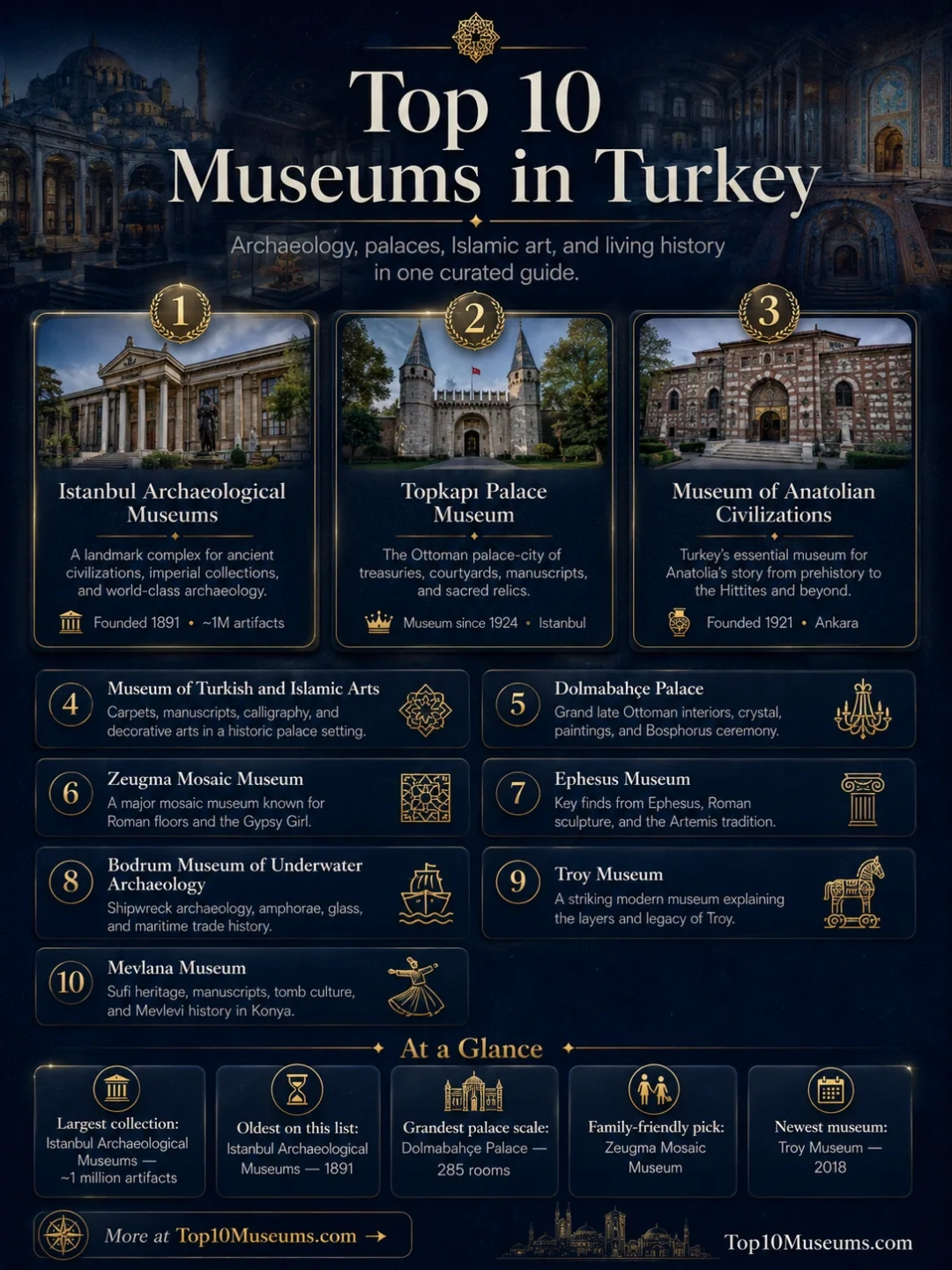
| Rank | Name | Founded | Collection Type | Website |
|---|---|---|---|---|
| 1 | Istanbul Archaeological Museums | 1891 | Archaeology, ancient Near East, Ottoman imperial collections | Official website |
| 2 | Topkapı Palace Museum | 1924 | Ottoman palace, treasury, manuscripts, sacred relics | Official website |
| 3 | Museum of Anatolian Civilizations | 1921 | Anatolian archaeology, Hittite, Phrygian, Neolithic collections | Official website |
| 4 | Museum of Turkish and Islamic Arts | 1914 | Islamic art, carpets, manuscripts, calligraphy, ethnography | Official website |
| 5 | Dolmabahçe Palace | 1984 as museum-palace | Ottoman palace interiors, paintings, crystal, porcelain | Official website |
| 6 | Zeugma Mosaic Museum | 2011 | Roman mosaics, frescoes, sculpture, Zeugma finds | Official website |
| 7 | Ephesus Museum | 1964 | Ephesus finds, Artemis cult, Roman sculpture, coins | Official website |
| 8 | Bodrum Museum of Underwater Archaeology | 1964 | Shipwreck archaeology, glass, amphorae, maritime trade | Official website |
| 9 | Troy Museum | 2018 | Troas archaeology, Troy layers, stone, metal, ceramic finds | Official website |
| 10 | Mevlana Museum | 1926 | Mevlevi history, Sufi material culture, manuscripts, tomb complex | Official website |
Why These Ten Made the List
The selection leans toward museums that help a visitor understand Turkey through objects, buildings, and place, not only through display labels. Istanbul carries the Ottoman and imperial museum story; Ankara gives the deeper Anatolian timeline; Gaziantep, Selçuk, Bodrum, Çanakkale, and Konya add regional collections that cannot be replaced by a single capital-city museum.
Another reason is range. The list includes archaeology, palace life, Islamic art, maritime trade, Roman mosaics, Sufi heritage, and the Bronze Age. A family may choose the palace rooms and mosaics, while a visitor with a strong interest in ancient history may give more time to Anatolian Civilizations, Ephesus, Bodrum, and Troy.
Top 10 Museums in Turkey
1. Istanbul Archaeological Museums
The Istanbul Archaeological Museums are the natural starting point for serious museum travel in Turkey. Opened to visitors on 13 June 1891 under Osman Hamdi Bey, the complex brings together the Archaeological Museum, the Museum of the Ancient Orient, and the Tiled Kiosk Museum. Its collection is often described at around one million artifacts, with objects from the former Ottoman imperial lands as well as major works from Sidon, Mesopotamia, Anatolia, Egypt, and the classical Mediterranean.
The headline object is the Alexander Sarcophagus, found in the Royal Necropolis of Sidon in 1887 and displayed in a building designed for major archaeological finds. The Ancient Orient material is especially useful before visiting sites such as Troy, Ephesus, or Göbeklitepe because it gives the visitor a wider Near Eastern context. The setting also helps: the museum sits below Topkapı Palace and beside Gülhane Park, so it works well as part of a Sultanahmet history day.
Best for: archaeology-focused travelers, old-city walkers, university students, and visitors who want one museum that covers several ancient cultures.
Nearby alternative: Hagia Irene Museum — a short uphill walk inside the Topkapı Palace first courtyard, useful for visitors who want Byzantine architecture without leaving the same historic zone.
2. Topkapı Palace Museum
Topkapı Palace Museum is less a single building than a palace-city of courtyards, gates, kitchens, treasuries, pavilions, and harem spaces. Built after the Ottoman conquest of Constantinople and used as an imperial residence and administrative center for nearly four centuries, it became a museum in 1924. For first-time visitors, it is the clearest place to understand Ottoman court culture through rooms and objects still tied to their original setting.
The palace collections include Ottoman robes, weapons, manuscripts, porcelain, imperial treasury objects, miniatures, and sacred relics. Many visitors come for the Topkapı Dagger and the Spoonmaker’s Diamond, but the quieter rooms can be just as rewarding: the imperial kitchens, library spaces, and tiled pavilions show how administration, craft, ceremony, and daily palace life overlapped. Plan more time than expected, because the route is spread across several courtyards.
Best for: Ottoman history readers, palace lovers, first-time Istanbul visitors, and families with older children who enjoy rooms, courtyards, and treasury displays.
Nearby alternative: Hagia Sophia History and Experience Museum — close to Sultanahmet Square, it works as a nearby add-on for visitors who want more context on the area’s layered religious and imperial history.
3. Museum of Anatolian Civilizations
The Museum of Anatolian Civilizations in Ankara is one of Turkey’s strongest archaeology museums because it treats Anatolia as a long human story rather than a set of isolated ruins. Founded in 1921, it occupies two Ottoman-period buildings near Ankara Castle: Mahmutpaşa Bedesten and Kurşunlu Han. The collection begins with Paleolithic material and moves through Neolithic, Bronze Age, Assyrian trade, Hittite, Phrygian, Urartian, Roman, Byzantine, Seljuk, and Ottoman periods.
The museum is especially good for visitors interested in Çatalhöyük, Alacahöyük, Kültepe, Gordion, and Hittite culture. Look for sun discs, cuneiform tablets, mother-goddess figures, bronze standards, reliefs, and objects connected with Phrygian funerary culture. It was also restored and refreshed in 2014, with updated presentation, replicas, and digital elements that help non-specialists follow the chronology without needing a textbook beside them.
Best for: archaeology learners, Ankara visitors, Hittite-history fans, and travelers who want Turkey’s pre-Ottoman story explained in one place.
Nearby alternative: Rahmi M. Koç Museum Ankara — close to Ankara Castle, it offers a lighter technology-and-industry visit after a dense archaeology session.
4. Museum of Turkish and Islamic Arts
The Museum of Turkish and Islamic Arts is one of the best museum choices in Istanbul for visitors who want carpets, manuscripts, calligraphy, woodwork, metalwork, and sacred objects in a single historic building. It opened in 1914 as the Museum of Islamic Endowments and moved in 1983 to the Ibrahim Pasha Palace, a 16th-century Ottoman civil architecture landmark on the old Hippodrome side of Sultanahmet.
The carpet collection is the reason many specialists make time for it, but the museum is not only for textile lovers. Qur’an manuscripts, carved doors, tiles, ethnographic displays, Seljuk material, and Ottoman-period works make it a useful counterpoint to Topkapı Palace. Because it sits directly beside Sultanahmet Square, it also gives visitors a calm indoor stop between the Blue Mosque, Hagia Sophia area, and the old Roman-Byzantine Hippodrome.
Best for: Islamic art readers, carpet and calligraphy lovers, design students, and travelers who want a focused museum near Sultanahmet’s main sights.
Nearby alternative: Great Palace Mosaics Museum — a compact museum behind the Blue Mosque area, useful for visitors who want Byzantine floor mosaics within the same walking zone.
5. Dolmabahçe Palace
Dolmabahçe Palace shows a later Ottoman world than Topkapı: more European-facing, ceremonial, waterfront, and 19th-century in taste. Built under Sultan Abdülmecid and inhabited from 1856, the palace was opened to the public as a museum-palace in 1984 with its original furnishings preserved. The main building has 285 rooms, 44 halls, 68 toilets, and 6 Turkish baths, making it Turkey’s largest palace by its main monoblock structure.
The interiors mix Ottoman court planning with Baroque, Rococo, and Neoclassical decoration. Hereke carpets, Baccarat crystal, Sèvres and Yıldız porcelain, paintings, gifts, and ceremonial rooms show how the late Ottoman court presented itself to diplomats and guests. The palace is also tied to Mustafa Kemal Atatürk, who stayed there during visits to Istanbul and died there on 10 November 1938.
Best for: palace-interior fans, Ottoman modernization readers, Bosphorus walkers, and visitors who prefer guided room-by-room history.
Nearby alternative: National Palaces Painting Museum — located in the Crown Prince Apartments beside Dolmabahçe, it is the easiest art-focused add-on in the same palace complex.
6. Zeugma Mosaic Museum
The Zeugma Mosaic Museum in Gaziantep is the museum to choose when Roman domestic art is the priority. Opened on 9 September 2011, the museum complex covers a 30,000 m² site with 25,000 m² of indoor area. Its collection includes 2,248 m² of Roman and Late Antique mosaics, 140 m² of frescoes, Roman fountains, columns, limestone statues, sarcophagi, tomb steles, and the bronze Mars statue.
The famous Gypsy Girl mosaic has become the symbol of the museum, but the wider collection is the real reason to visit. Scenes of Achilles, Europa, Euphrates, Oceanus, gods, animals, banquets, and geometric floors show how wealthy Roman villas at Zeugma used imagery across domestic spaces. The museum layout gives enough room to stand back from large mosaic floors, which makes it more comfortable than many older archaeology displays.
Best for: mosaic lovers, Roman-history travelers, families with teens, and visitors adding Gaziantep to a food-and-culture route.
Nearby alternative: Gaziantep Archaeology Museum — a useful city-center companion for visitors who want more local archaeological context before or after seeing Zeugma’s mosaics.
7. Ephesus Museum
The Ephesus Museum in Selçuk is the best museum pairing for a visit to the ancient city of Ephesus. Opened in 1964, it displays finds from Ephesus and nearby sites rather than trying to cover all of western Anatolia. Its rooms include Fountain Findings, Terrace Houses Findings, Ancient Coins, Ephesus Through the Ages, the Inner Garden, the Cybele Cult, Artemis Temple Findings, Ephesus Artemis, and Imperial Cult displays.
The museum’s best-known objects include the Ephesus Artemis statues, Roman portraits, fountain sculptures, objects from the Terrace Houses, coins, and finds linked with the Temple of Artemis. The official museum material presents the visit as a journey of about 8,500 years, from early settlement layers to Roman and later history. It is not a huge museum, but it adds the missing close-up detail after walking marble streets, the theatre, and the library area at Ephesus.
Best for: Ephesus visitors, classical archaeology fans, Roman sculpture watchers, and travelers who like smaller museums with site-specific objects.
Nearby alternative: Ephesus Experience Museum — inside the ancient site area, it works well for visitors who want a digital storytelling layer after seeing the original ruins and museum objects.
8. Bodrum Museum of Underwater Archaeology
The Bodrum Museum of Underwater Archaeology brings archaeology into the sea lanes of the Aegean. Established in 1964 inside Bodrum Castle, the museum uses the castle’s towers and halls to present shipwreck finds, amphorae, glass, cargo, anchors, and trade material. The castle itself was built by the Knights of St. John between 1406 and 1523, so the building adds another historical layer before visitors even reach the underwater finds.
The museum is especially valued for its shipwreck displays, including material connected with ancient trade and the famous Uluburun wreck tradition. Official museum information notes 14 exhibition halls, although restoration phases may affect which halls are open at a given time. Even with partial access, the setting is strong: harbor views, castle walls, maritime archaeology, and Aegean trade all sit in the same visit.
Best for: maritime-history fans, Bodrum visitors, families with curious kids, and archaeology travelers who want shipwrecks rather than temple ruins.
Nearby alternative: Bodrum Mausoleion Memorial Museum — a short local trip from the castle area, useful for visitors who want the story of Halicarnassus and the Mausoleum of Mausolus.
9. Troy Museum
The Troy Museum stands near the entrance to the archaeological site of Troy in Tevfikiye Village, Çanakkale. Its construction was completed in 2018, and the museum was officially opened in 2019 after the older Çanakkale Archaeology Museum collection was moved into the new building. The museum has 3,000 m² of exhibition space and 11,200 m² of enclosed area, with displays arranged to help visitors understand Troy, Troas, and the region around the Dardanelles.
The museum is useful because Troy can be hard to read on-site without context. Here, layers, dating methods, pottery, metal objects, sculpture, grave stones, inscriptions, altars, milestones, glass, jewelry, weapons, coins, and interactive displays prepare visitors for the archaeological mound. The ramped interior route gives a gradual introduction before the main galleries, which is helpful for families and first-time visitors.
Best for: Troy-site visitors, Bronze Age readers, families planning a Çanakkale stop, and travelers who want mythology separated from archaeology in a clear way.
Nearby alternative: Çanakkale Ceramic Museum — a city-center option for visitors staying overnight in Çanakkale and wanting a smaller local museum after the Troy route.
10. Mevlana Museum
The Mevlana Museum in Konya is the main museum for understanding the public memory of Jalal ad-Din Rumi, known in Turkey as Mevlana, and the Mevlevi tradition. The former lodge was opened to visitors as Konya Asar-ı Atika Museum in 1926 and renamed Mevlana Museum in 1954. Its core monument is the tomb complex, with the mausoleum structure tied to the period after Mevlana’s death in 1273 and the tomb construction completed in 1274.
The museum includes the tomb, dervish cells, semahane-related spaces, manuscripts, calligraphy, prayer rugs, ritual objects, and Mevlevi material culture. It is different from the archaeology museums on this list because the experience is quieter and more devotional in tone. For visitors who want Islamic history beyond palace display cases, it gives a direct look at Sufi heritage, Seljuk-era memory, and Konya’s identity.
Best for: Islamic culture readers, Konya visitors, Sufi-history learners, and travelers who prefer reflective museums over large object-heavy galleries.
Nearby alternative: Karatay Madrasa Tile Works Museum — a strong Seljuk art stop in Konya, useful for visitors who want tilework, madrasa architecture, and a compact museum after Mevlana.
How to Tour These Museums
Best Istanbul Museum Cluster
Start early with Topkapı Palace Museum, because its courtyards and main rooms take energy. Walk down to the Istanbul Archaeological Museums next, then keep the Museum of Turkish and Islamic Arts for the late afternoon around Sultanahmet Square. Put Dolmabahçe Palace on a separate morning, since it sits in Beşiktaş and works better with a Bosphorus-side plan than with a rushed old-city route.
Best Classic Archaeology Route
Use Ankara as the deeper timeline stop: spend a half day at the Museum of Anatolian Civilizations before heading to western Turkey. Then pair the Ephesus Museum with the ancient site of Ephesus, and add the Troy Museum if Çanakkale is on the itinerary. This route works best over several days, not as a single-city museum sprint.
Best Family-Friendly Mix
For families, choose museums with strong visual objects: Zeugma Mosaic Museum, Bodrum Museum of Underwater Archaeology, Topkapı Palace Museum, and Troy Museum. These places give children and teens floors, ships, palace gates, weapons, mosaics, and models rather than only label-heavy cases. Keep visits shorter and split big museums with outdoor breaks.
Best Two-Region Plan
A practical two-region route is Istanbul plus Western Anatolia: Topkapı, Istanbul Archaeological Museums, Turkish and Islamic Arts, Dolmabahçe, then Ephesus, Bodrum, and Troy. A second option is Central and Southeast Turkey: Ankara’s Anatolian Civilizations Museum, Konya’s Mevlana Museum, and Gaziantep’s Zeugma Mosaic Museum. Both routes give variety without forcing every stop into one exhausting loop.
Who Will Love These Museums?
- Old-city Istanbul travelers: Istanbul Archaeological Museums, Topkapı Palace Museum, and the Museum of Turkish and Islamic Arts make Sultanahmet feel more readable.
- Old-master and palace-interior fans: Dolmabahçe Palace and Topkapı Palace Museum give two very different Ottoman palace experiences.
- Archaeology-first visitors: Museum of Anatolian Civilizations, Ephesus Museum, Troy Museum, and Bodrum Museum of Underwater Archaeology provide stronger object context than site visits alone.
- Families with older kids: Zeugma Mosaic Museum, Troy Museum, Bodrum Museum of Underwater Archaeology, and Topkapı Palace Museum offer visual displays that are easier to follow.
- Islamic art and calligraphy readers: Museum of Turkish and Islamic Arts and Mevlana Museum are the most focused choices on this list.
- Travelers building a Turkey-wide culture route: Istanbul, Ankara, Konya, Gaziantep, Selçuk, Bodrum, and Çanakkale together show how regional museum collections differ across the country.