
[ayaz_safe_content id=”3121″ key=”p3121b1ms0dmrvo”]
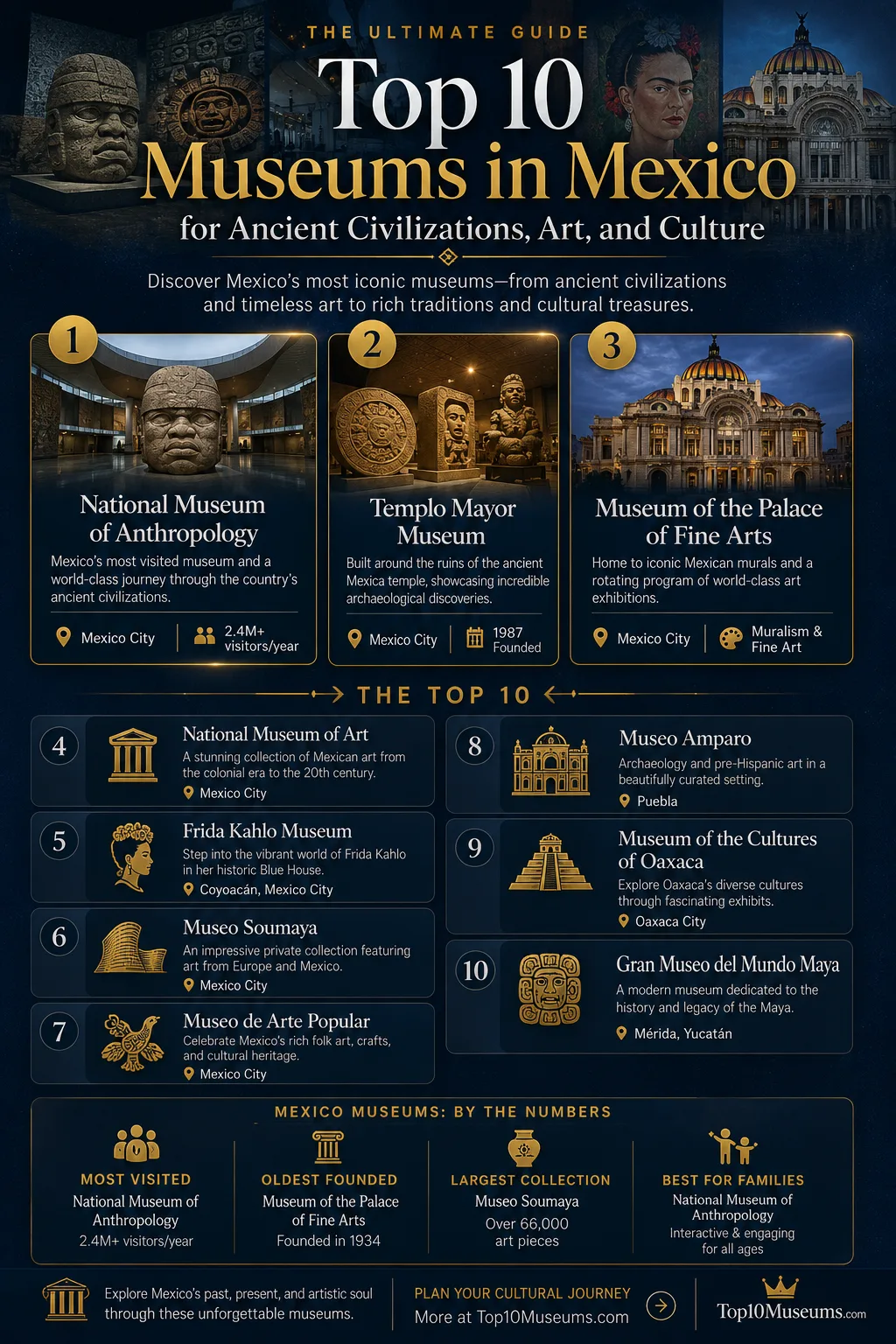
| Rank | Name | Founded | Collection Type | Website |
|---|---|---|---|---|
| 1 | National Museum of Anthropology | 1964 | Archaeology, ethnography, ancient Mexico | Official website |
| 2 | Templo Mayor Museum | 1987 | Mexica archaeology and sacred-site finds | Official website |
| 3 | Museum of the Palace of Fine Arts | 1934 | Mexican muralism and temporary art exhibitions | Official website |
| 4 | National Museum of Art | 1982 | Mexican art from the colonial period to the 20th century | Official website |
| 5 | Frida Kahlo Museum | 1958 | Artist’s home, personal objects, paintings, photographs | Official website |
| 6 | Museo Soumaya | 1994 | Private art collection, sculpture, European and Mexican art | Official website |
| 7 | Museo de Arte Popular | 2006 | Mexican folk art, crafts, textiles, alebrijes | Official website |
| 8 | Museo Amparo | 1991 | Pre-Hispanic, viceregal, modern, and contemporary Mexican art | Official website |
| 9 | Museum of the Cultures of Oaxaca | 1972 | Oaxacan archaeology, Mixtec treasures, regional history | Official website |
| 10 | Gran Museo del Mundo Maya | 2012 | Maya archaeology, culture, language, and regional heritage | Official website |
Why These Ten Museums Work So Well Together
This selection gives Mexico a balanced museum route: major national collections, one archaeological site museum, two art anchors in the historic center, one artist’s house, one folk-art museum, and three strong regional institutions outside Mexico City. The result is useful for travelers who want ancient civilizations and art in the same trip, not a list made only from famous names.
The Mexico City museums are practical for short stays because several sit near the Centro Histórico, Chapultepec, Coyoacán, and Polanco. Puebla, Oaxaca, and Mérida add regional depth—especially for visitors who care about Maya, Mixtec, Zapotec, and broader Mesoamerican culture beyond the capital.
1. National Museum of Anthropology
The National Museum of Anthropology is the clearest first stop for anyone trying to understand Mexico’s ancient civilizations. Its permanent galleries cover archaeology and ethnography, with famous pieces such as the Piedra del Sol, the colossal Olmec heads, and Maya works connected to Palenque and other major sites.
The museum’s current Chapultepec building opened in 1964, and its large courtyard, umbrella-like central column, and room-by-room layout make it easier to move through vast material without losing the thread. Visitors short on time should prioritize the Mexica, Maya, Teotihuacan, Oaxaca, Gulf Coast, and Toltec rooms.
Best for: first-time Mexico visitors, archaeology lovers, families with older kids, museum-focused travelers, and anyone building a trip around ancient civilizations.
Nearby alternative: Chapultepec Castle — a strong follow-up for national history, city views, and an easy move within the same park area.
2. Templo Mayor Museum
Templo Mayor Museum sits beside the excavated remains of the main sacred precinct of Mexico-Tenochtitlan, so it does something a normal gallery cannot: it lets visitors connect objects with the ground where they were found. The museum opened in 1987 to display finds from the Templo Mayor Project.
The collection includes the Coyolxauhqui monolith, discovered in 1978, along with offerings, sculptures, ritual objects, and material tied to Huitzilopochtli and Tlaloc. Because it is next to the Metropolitan Cathedral and the Zócalo, it is one of the best places to feel how the old Mexica capital and colonial city still overlap.
Best for: Mexica history readers, archaeology fans, travelers staying in the historic center, and visitors who prefer site museums over large all-day institutions.
Nearby alternative: Antiguo Colegio de San Ildefonso — a good nearby stop for murals, colonial architecture, and cultural exhibitions just a short walk from the archaeological zone.
3. Museum of the Palace of Fine Arts
The Museum of the Palace of Fine Arts is the art stop most visitors remember because the building itself is part of the experience. Opened in 1934, the palace combines an ornate exterior with an Art Deco interior and a permanent mural collection that includes Diego Rivera, José Clemente Orozco, David Alfaro Siqueiros, Rufino Tamayo, and Jorge González Camarena.
The museum is especially useful for understanding Mexican muralism as public art, political image-making, and national storytelling. Rivera’s Man, Controller of the Universe is a major draw, while rotating exhibitions often bring international and Mexican art into the same central space.
Best for: muralism fans, architecture lovers, first-time Mexico City visitors, and travelers who want a high-impact art museum without spending a full day indoors.
Nearby alternative: Museo Nacional de Arquitectura — an easy option inside the same cultural complex for visitors who want more context on Mexican architecture and design.
4. National Museum of Art
The National Museum of Art, usually called MUNAL, is one of the best places to follow Mexican art across several centuries. Founded in 1982, it occupies the former Palace of Communications on Tacuba Street and focuses on art from the 16th century to the first half of the 20th century.
Its collection includes more than 3,000 works, with colonial painting, 19th-century academy art, landscapes, portraits, religious works, and early modern pieces. Pair it with Bellas Artes and you can see the shift from church and academy art toward modern national image-making in a very walkable part of the historic center.
Best for: art-history readers, slow museum visitors, colonial art fans, architecture lovers, and travelers who want a quieter counterpoint to Bellas Artes.
Nearby alternative: Museo Franz Mayer — a useful nearby choice for decorative arts, design, silver, furniture, ceramics, and a calm courtyard break.
5. Frida Kahlo Museum
The Frida Kahlo Museum, also known as Casa Azul, is not a neutral white gallery. It is the Coyoacán house where Frida Kahlo lived for much of her life, and it opened as a museum in 1958, four years after her death.
The museum displays paintings, personal belongings, photographs, documents, furniture, traditional art objects, and pre-Hispanic pieces that shaped the atmosphere around Kahlo and Diego Rivera. Tickets often sell out ahead of time, so this is one museum where booking early is not just helpful—it can decide whether the visit happens at all.
Best for: Frida Kahlo readers, Coyoacán day-trippers, art-and-biography travelers, couples, and visitors who prefer intimate houses over large museum halls.
Nearby alternative: Museo Anahuacalli — Diego Rivera’s volcanic-stone museum is the natural follow-up for pre-Hispanic objects, architecture, and a stronger Rivera connection.
6. Museo Soumaya
Museo Soumaya brings a very different museum model into the list: a private collection with free public access, housed in a reflective modern building in Plaza Carso. The institution began in 1994, while the current Plaza Carso building opened in 2011.
The collection is often described at more than 66,000 works, ranging from pre-Hispanic objects and Mexican art to European painting and sculpture. Many visitors come for Rodin and Dalí, but the better reason to include it here is its broad mix of Mexican and international art in a district that pairs easily with contemporary art spaces.
Best for: travelers on a budget, sculpture fans, Polanco visitors, families, and anyone who likes large private collections with mixed periods.
Nearby alternative: Museo Jumex — a close Polanco-area choice for contemporary art, rotating exhibitions, and a sharper modern gallery feel.
7. Museo de Arte Popular
Museo de Arte Popular is the best Mexico City stop for folk art treated as design, craft, identity, and living tradition. Opened in 2006, it focuses on Mexican popular art through textiles, ceramics, woodwork, masks, paper art, toys, and regional craft traditions.
The museum is especially strong for visitors who want something more tactile than paintings behind glass. Alebrijes, Day of the Dead imagery, and handmade objects help explain how local materials and regional styles become cultural memory, family practice, and public celebration.
Best for: families with kids, craft lovers, design-minded travelers, gift shoppers, and visitors who want color, texture, and regional variety.
Nearby alternative: Museo del Estanquillo — a nearby collection of prints, photographs, popular culture, and urban memory in the historic center.
8. Museo Amparo
Museo Amparo in Puebla is one of Mexico’s strongest museums outside the capital, especially for travelers who want pre-Hispanic art without skipping colonial and contemporary material. Founded in 1991, it sits in the historic center and uses restored old buildings with a modern museum layout.
The museum is known for a large pre-Hispanic collection, often cited at more than 1,700 pieces, plus viceregal, 19th-century, modern, and contemporary Mexican art. It works well because Puebla itself adds context: churches, tiles, colonial streets, and food culture sit just outside the museum doors.
Best for: Puebla visitors, pre-Hispanic art fans, colonial-history travelers, design lovers, and people who want one polished museum outside Mexico City.
Nearby alternative: International Museum of the Baroque — a strong Puebla add-on for architecture, exhibition design, and a very different museum atmosphere.
9. Museum of the Cultures of Oaxaca
The Museum of the Cultures of Oaxaca occupies the former convent of Santo Domingo de Guzmán, one of the most memorable museum settings in the country. Its galleries move through regional history, but the headline collection is the Treasure of Tomb 7 from Monte Albán.
That Tomb 7 group includes Mixtec objects made with gold, silver, turquoise, obsidian, greenstone, rock crystal, and other materials, discovered by Alfonso Caso in 1932. The museum is especially rewarding when paired with Monte Albán itself, because the site explains the landscape while the museum explains the objects in close detail.
Best for: Oaxaca travelers, Monte Albán visitors, Mixtec and Zapotec history readers, architecture lovers, and anyone who wants a museum with a strong sense of place.
Nearby alternative: Museo Textil de Oaxaca — a close and thoughtful option for textile traditions, regional techniques, and a softer follow-up after archaeology.
10. Gran Museo del Mundo Maya
Gran Museo del Mundo Maya in Mérida gives the Yucatán Peninsula a museum built around Maya history, language, daily life, and continuing culture. Opened in 2012, it is a useful indoor stop before or after major sites such as Uxmal, Chichén Itzá, Dzibilchaltún, or Mayapán.
The museum displays more than 1,000 Maya-related pieces, with galleries that move through ancient society, colonial change, nature, and living Maya communities. Its architecture is often linked to the ceiba tree, giving the building a regional identity that fits the Yucatán setting better than a generic museum box.
Best for: Mérida visitors, Maya-site travelers, families, school groups, and anyone who wants cultural context before visiting archaeological ruins.
Nearby alternative: Palacio Cantón — a central Mérida option for anthropology exhibitions in a historic mansion on Paseo de Montejo.
How to Tour These Museums
Best First-Time Mexico City Route
Start with the National Museum of Anthropology in the morning, when attention is fresh and the archaeology rooms are easier to absorb. Move later to Museo Soumaya in Polanco if you want a second museum that feels lighter and more mixed in subject. Keep this as a two-museum day; Anthropology alone can take three to five hours.
Best Historic Center Art and Archaeology Day
Begin at Templo Mayor Museum, then walk toward MUNAL and the Palace of Fine Arts. This route works because it moves from Mexica foundations to colonial and modern art in the same urban core. Add Museo de Arte Popular only if the group still has energy after lunch.
Best Coyoacán Culture Day
Book the Frida Kahlo Museum first and build the day around that timed entry. After Casa Azul, walk Coyoacán slowly, then add Museo Anahuacalli if Rivera, architecture, and pre-Hispanic objects are part of the plan. This is better as a neighborhood day than a rushed stop between far-apart museums.
Best Two-Day Mexico City Museum Plan
Use Day 1 for Anthropology and Soumaya, keeping the route around Chapultepec and Polanco. Use Day 2 for Templo Mayor, MUNAL, Bellas Artes, and Museo de Arte Popular in the historic center. Add Frida Kahlo on a third day if possible, because Coyoacán deserves its own rhythm.
Best Mexico Culture Trip Beyond the Capital
After Mexico City, choose one regional direction instead of trying to cover everything. Puebla with Museo Amparo is the easiest add-on, Oaxaca gives the strongest archaeology-and-city pairing, and Mérida with Gran Museo del Mundo Maya is best for travelers planning Maya ruins. Each deserves at least one full day around the museum, not just a quick stop.
Who Will Love These Museums?
- Ancient civilization fans: National Museum of Anthropology, Templo Mayor Museum, Museum of the Cultures of Oaxaca, and Gran Museo del Mundo Maya.
- Mexican art lovers: Museum of the Palace of Fine Arts, National Museum of Art, Frida Kahlo Museum, and Museo Soumaya.
- Families with kids: Museo de Arte Popular, Museo Soumaya, Gran Museo del Mundo Maya, and selected rooms at the National Museum of Anthropology.
- First-time Mexico visitors: National Museum of Anthropology, Templo Mayor Museum, Bellas Artes, and Frida Kahlo Museum.
- Architecture-focused travelers: Bellas Artes, MUNAL, Museo Soumaya, Museo Amparo, and the Museum of the Cultures of Oaxaca.
- Regional culture travelers: Museo Amparo for Puebla, Museum of the Cultures of Oaxaca for Oaxaca, and Gran Museo del Mundo Maya for Yucatán.
- Short-stay visitors: Templo Mayor Museum, Bellas Artes, MUNAL, and Museo de Arte Popular because they cluster well in Mexico City’s historic center.