
[ayaz_safe_content id=”3115″ key=”p3115b1dfr6zlta”]
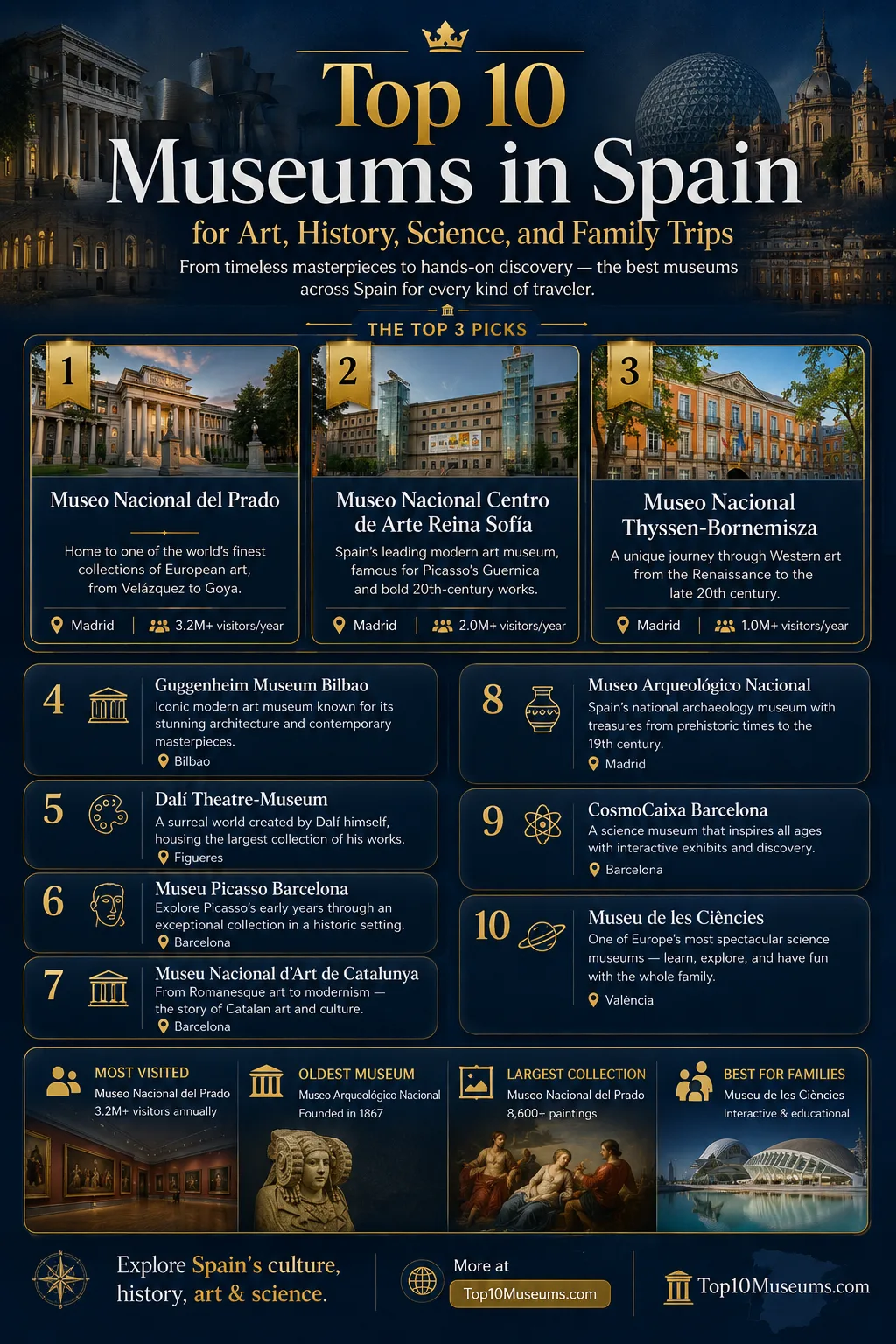
| Rank | Name | Founded | Collection Type | Website |
|---|---|---|---|---|
| 1 | Museo Nacional del Prado | 1819 | European painting, royal collections, old masters | Official website |
| 2 | Museo Nacional Centro de Arte Reina Sofía | 1992 | Modern and contemporary art | Official website |
| 3 | Museo Nacional Thyssen-Bornemisza | 1992 | Western painting, 13th to 20th century | Official website |
| 4 | Guggenheim Museum Bilbao | 1997 | Modern and contemporary art, architecture | Official website |
| 5 | Dalí Theatre-Museum | 1974 | Surrealism and Salvador Dalí | Official website |
| 6 | Museu Picasso Barcelona | 1963 | Picasso, early work, drawings, paintings | Official website |
| 7 | Museu Nacional d’Art de Catalunya | 1990 / 2004 | Catalan art, Romanesque murals, modernisme | Official website |
| 8 | Museo Arqueológico Nacional | 1867 | Archaeology, Iberian history, ancient objects | Official website |
| 9 | CosmoCaixa Barcelona | 1981 / 2004 | Science, nature, planetarium, family exhibits | Official website |
| 10 | Museu de les Ciències | 2000 | Interactive science and technology | Official website |
Why These Ten Earn a Place on the Route
Spain has hundreds of good museum choices, so this list favors places with clear visitor value: strong collections, reliable public access, location logic, and enough variety for travelers who do not want ten similar art stops. Madrid takes four places because the Prado, Reina Sofía, Thyssen, and Archaeological Museum can shape a full cultural trip without leaving the city center.
Barcelona adds a different rhythm: Picasso’s early years, Catalan Romanesque murals, and one of Spain’s best family science museums. Bilbao and Figueres are included because each gives visitors a museum experience that is tied to a place, a building, and a single strong identity — Gehry in Bilbao, Dalí in Figueres.
The result is not a popularity-only ranking. It is a practical Spain museum route for art lovers, history readers, architecture fans, STEM-curious kids, and first-time visitors who want the country’s museum scene to feel organized rather than random.
1. Museo Nacional del Prado, Madrid
Best for: old-master painting lovers, first-time Madrid visitors, and travelers who want Velázquez, Goya, Bosch, and Rubens in one stop.
The Prado opened in 1819 and remains the museum that most clearly explains how Spanish royal collecting shaped European art. Its online collection includes more than 19,000 digitised works, while the galleries concentrate on paintings that many visitors have seen in books long before arriving in Madrid: Velázquez’s Las Meninas, Bosch’s The Garden of Earthly Delights, and Goya’s darker late works.
Plan this museum slowly. The Prado is not ideal for racing through every room; it works best when visitors choose a few high-value sections and leave space to look properly. Families with older children can make it easier by building the visit around dramatic images — royal portraits, mythological scenes, animals, armor, and Goya’s black paintings — instead of treating the museum like a school checklist.
Nearby alternative: Real Academia de Bellas Artes de San Fernando — a strong painting and print collection near Puerta del Sol, useful if the Prado is crowded or the day needs a shorter Madrid art stop.
2. Museo Nacional Centro de Arte Reina Sofía, Madrid
Best for: modern art travelers, Picasso readers, Spanish Civil War context, and visitors who want a serious 20th-century art museum.
The Reina Sofía is the modern counterweight to the Prado. Its collection is made up of around 25,000 pieces, and the museum’s central draw is Picasso’s Guernica, one of the most discussed political paintings of the 20th century. The permanent collection was inaugurated in 1992, giving Madrid a national museum focused on modern and contemporary art rather than royal painting.
This museum rewards visitors who like context. Around Guernica, the rooms connect Picasso, Miró, Dalí, Juan Gris, photography, film, and Spanish modernism in a way that feels much less decorative than the Prado. It is also practical: the museum sits close to Atocha station, so it can fit neatly into a travel day if luggage storage and train timing are planned in advance.
Nearby alternative: CaixaForum Madrid — a short walk away on the museum corridor, good for temporary exhibitions and a lighter cultural stop after Reina Sofía.
3. Museo Nacional Thyssen-Bornemisza, Madrid
Best for: visitors who want an easier art history route, couples, solo travelers, and anyone linking Prado classics with modern painting.
The Thyssen-Bornemisza Museum opened in Madrid in 1992 and holds almost 1,000 paintings that move from the 13th century to the 20th. Its real advantage is sequence: visitors can pass from early Italian and Netherlandish works into Impressionism, Expressionism, American painting, and modern European art without the mental jump required between the Prado and Reina Sofía.
For first-time visitors, the Thyssen often feels more manageable than Madrid’s bigger museums. It is still serious, but the route is easier to read, and the collection gives a clean bridge between old-master art and modern color, landscape, and portrait painting. It is also close enough to the Prado that both can be paired on the same day, although a long lunch break between them helps.
Nearby alternative: Museo Naval — located across the Paseo del Prado area, it adds maps, ships, and maritime history when the day needs a break from painting.
4. Guggenheim Museum Bilbao, Bilbao
Best for: contemporary art fans, architecture travelers, Bilbao first-timers, and visitors who enjoy large-scale installations.
The Guggenheim Museum Bilbao opened in 1997, and Frank Gehry’s titanium-clad building is part of the visit before anyone reaches the galleries. Inside, the collection focuses on art from the mid-20th century onward, with large works that suit the building’s scale. Richard Serra’s The Matter of Time is one of the museum’s most memorable installations because visitors walk through the steel forms rather than simply view them from a distance.
This is a museum where architecture and exhibition design matter as much as the label text. Even visitors who are unsure about contemporary art usually find enough to hold attention: outdoor sculpture, river views, changing exhibitions, and the way the galleries open into one another. It is also a good choice for teenagers because the building feels physical, not just quiet and academic.
Nearby alternative: Bilbao Fine Arts Museum — an easy walk through the Abandoibarra and Doña Casilda area, useful for visitors who want a broader art collection after the Guggenheim.
5. Dalí Theatre-Museum, Figueres
Best for: Surrealism fans, Barcelona day-trippers, visual learners, and visitors who prefer immersive single-artist museums.
The Dalí Theatre-Museum was inaugurated in 1974 in Figueres, Dalí’s hometown, and it holds the world’s most extensive collection of his work. The museum is not just a building containing paintings; Dalí shaped it as a theatre of rooms, optical jokes, objects, and staged viewpoints. Works and spaces such as the Mae West Room show why this museum is better experienced in person than through reproductions.
For travelers based in Barcelona, Figueres can work as a full day trip by train, but it should not be treated as a short errand. The museum is dense, strange, funny, and sometimes disorienting, so younger visitors often respond well if adults let them notice details rather than explain everything. It is also one of the best choices in Spain for people who usually say they do not like traditional museums.
Nearby alternative: Museu de l’Empordà — a short walk in central Figueres, useful for adding Catalan art and regional context before returning to Barcelona or Girona.
6. Museu Picasso Barcelona, Barcelona
Best for: Picasso followers, Barcelona first-timers, art students, and visitors interested in how a famous artist developed early.
Museu Picasso Barcelona opened in 1963 and contains more than 4,000 artworks, with special strength in Picasso’s formative years. That matters because many museums show Picasso after he is already Picasso; this one lets visitors see his academic skill, Barcelona connections, and early experiments. Works such as Science and Charity help explain why the young artist was not simply breaking rules — he had learned them very well first.
The setting also helps. The museum occupies medieval palaces on Carrer de Montcada, so the walk through the building feels tied to the old city rather than sealed off from it. Book timed entry when possible, keep bags light, and consider visiting early or later in the day because the rooms can feel tight during peak hours.
Nearby alternative: Museu Frederic Marès — a short Gothic Quarter walk away, good for sculpture, collecting culture, and a quieter Barcelona museum experience.
7. Museu Nacional d’Art de Catalunya, Barcelona
Best for: Catalan art travelers, medieval art fans, architecture-minded visitors, and families who want space, views, and variety.
The Museu Nacional d’Art de Catalunya was formed under Catalonia’s museum law in 1990 and officially completed its full museum opening in 2004. Its holdings are often described at around 290,000 works, and the Romanesque mural galleries are the main reason serious art travelers make time for Montjuïc. The apse paintings from churches in the Pyrenees give the museum a character that cannot be copied by a standard painting gallery.
MNAC is also one of Spain’s better museums for visitors who want a sense of place. The Palau Nacional setting, Montjuïc views, Gothic art, Renaissance and Baroque works, modernisme, posters, photography, and coins allow different types of travelers to split up without losing the thread of the visit. For families, the larger rooms and outdoor approach can feel easier than Barcelona’s tighter old-city museums.
Nearby alternative: Fundació Joan Miró — another Montjuïc museum, easy to combine by bus, taxi, or a longer walk if the day is focused on Catalan modern art.
8. Museo Arqueológico Nacional, Madrid
Best for: archaeology readers, history-focused travelers, families with older children, and visitors who want Spain before the museum painting trail.
The Museo Arqueológico Nacional was founded in 1867 and gives Madrid a museum route that is not centered on canvas and court culture. Its best-known object is the Lady of Elche, an Iberian limestone bust from the 5th–4th centuries BC, but the galleries also move through prehistory, Roman Hispania, medieval material culture, coins, ceramics, and everyday objects that make history feel concrete.
This is a strong museum for visitors who want to understand Spain as a place of layered cultures rather than only a destination for Velázquez and Picasso. Families can use the models, replicas, and object-based displays to keep attention moving. It also pairs well with the Salamanca district, Retiro Park, and the National Library building next door, making it easier to plan a half-day that does not feel rushed.
Nearby alternative: Museo Lázaro Galdiano — a short ride north along the Serrano area, useful for decorative arts, paintings, jewelry, and a more intimate historic collection.
9. CosmoCaixa Barcelona, Barcelona
Best for: families with kids, STEM-curious teens, rainy-day Barcelona plans, and visitors who need a hands-on break from art museums.
CosmoCaixa began as Barcelona’s science museum in 1981 and reopened in its expanded CosmoCaixa form in 2004. The museum covers more than 30,000 square metres, and its most famous space is the Flooded Forest, a recreated Amazonian environment of more than 1,000 square metres. That single exhibit gives children something rare in a city museum: movement, sound, water, animals, and science in one place.
The museum also works well because it does not rely on passive reading. Visitors can move through geology, physics, astronomy, evolution, experiments, and planetarium-style programming, which makes it one of the easiest picks for mixed-age groups. It is away from the Gothic Quarter and beach routes, so build in transport time and avoid stacking it after a long walking day.
Nearby alternative: Monestir de Pedralbes — a calm medieval site a short taxi or bus ride away, good when a family day needs history without central Barcelona crowds.
10. Museu de les Ciències, València
Best for: family trips, science activities, architecture fans, school-age children, and travelers adding València to a Spain itinerary.
The Museu de les Ciències opened in 2000 inside València’s City of Arts and Sciences. The building has more than 42,000 square metres of built area, with about 26,000 square metres used for exhibitions, making it one of Spain’s strongest choices for interactive science. Its guiding idea is simple: touching, feeling, and thinking are part of the visit, not museum mistakes.
This museum is especially useful for families who want a day that does not depend on perfect weather or deep art knowledge. Exhibitions cover science, technology, the human body, space, and experiments, while the surrounding complex gives visitors room to walk, rest, and photograph the architecture. For a València trip, it pairs easily with the Turia Gardens and nearby family attractions, but the museum itself deserves enough time for children to test exhibits rather than hurry past them.
Nearby alternative: Museu Faller de València — a short walk or taxi ride away, good for understanding the city’s Fallas culture through colorful figures and local tradition.
How to Tour These Museums
Best Madrid Art and History Route
Start with the Prado in the morning, when attention is highest and the old-master galleries feel easier to absorb. After lunch, visit the Thyssen-Bornemisza because it is nearby and offers a smoother art-history sequence. Save the Reina Sofía for late afternoon or evening if opening hours allow, then give the Museo Arqueológico Nacional its own half-day rather than squeezing it into the same art corridor marathon.
Best Barcelona Museum Weekend
Use the first day for the old city and Montjuïc: visit Museu Picasso Barcelona early, take a proper lunch break, then move to MNAC in the afternoon for larger rooms and city views. Keep CosmoCaixa for the second day, especially with children, because it sits away from the central walking route. This order avoids too much cross-city travel and gives families a better mix of quiet looking and active science exhibits.
Best Seven-Day Spain Museum Route
A full Spain museum route works best in this order: Madrid for two days, Bilbao for the Guggenheim, Barcelona for Picasso, MNAC, and CosmoCaixa, Figueres as a Dalí day trip, and València for the Museu de les Ciències. This route reduces backtracking and keeps the heaviest museum days in Madrid and Barcelona, where public transport makes planning easier. Families may want to add one rest day between Barcelona and València.
Best Family-Friendly Plan
For children, start with CosmoCaixa or the Museu de les Ciències before attempting long art museums. Add the Guggenheim Bilbao if the trip includes northern Spain, because the building, outdoor sculpture, and large installations are easier for young visitors to process. In Madrid, choose the Museo Arqueológico Nacional over a third painting museum if the group needs objects, models, and a clearer story.
Who Will Love These Museums?
- Old-master lovers: Museo Nacional del Prado and Thyssen-Bornemisza give Madrid the strongest classic painting pairing.
- Modern art travelers: Reina Sofía and Guggenheim Bilbao work best for Picasso, postwar art, installations, and contemporary rooms.
- Surrealism fans: Dalí Theatre-Museum is the clear pick, especially for visitors who like theatrical spaces and optical tricks.
- Picasso-focused visitors: Museu Picasso Barcelona is strongest for early work, Barcelona context, and the artist’s development.
- Catalan art readers: MNAC gives the best route through Romanesque murals, Gothic art, modernisme, posters, and photography.
- Archaeology and history fans: Museo Arqueológico Nacional is the best Madrid stop for Iberian, Roman, medieval, and object-based history.
- Families with young kids: CosmoCaixa Barcelona and Museu de les Ciències are the safest choices for hands-on science and active learning.
- Architecture-minded travelers: Guggenheim Bilbao, MNAC, and the Museu de les Ciències all make the building part of the museum visit.