
[ayaz_safe_content id=”3131″ key=”p3131b1ie1el4ke”]
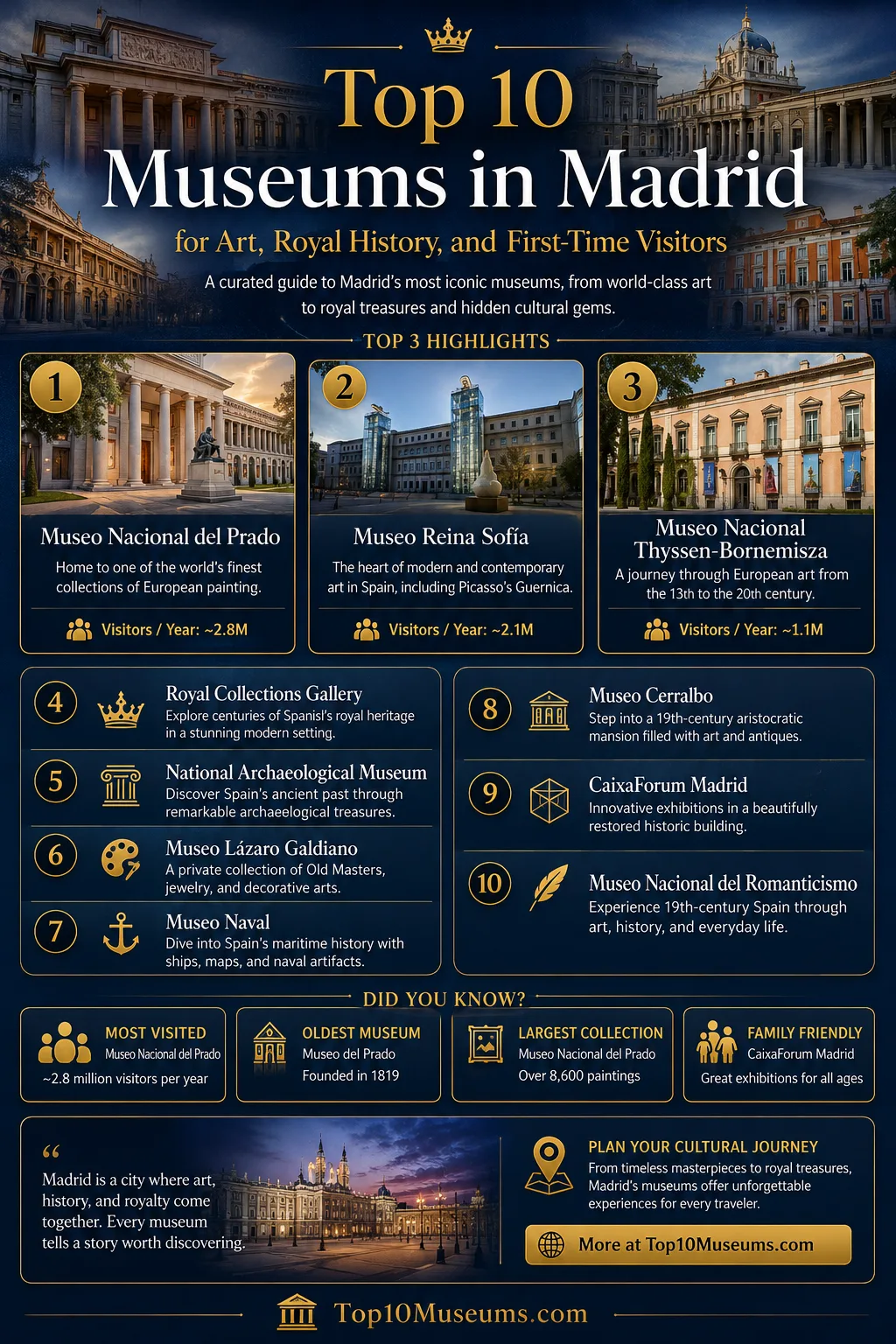
| Rank | Name | Founded | Collection Type | Website |
|---|---|---|---|---|
| 1 | Museo Nacional del Prado | 1819 | Spanish and European painting, royal art collection | Official site |
| 2 | Museo Reina Sofía | 1992 | Modern and contemporary art | Official site |
| 3 | Museo Nacional Thyssen-Bornemisza | 1992 | European painting from the 13th to 20th centuries | Official site |
| 4 | Royal Collections Gallery | 2023 | Spanish royal collections, Habsburg and Bourbon history | Official site |
| 5 | National Archaeological Museum | 1867 | Archaeology, Iberian art, coins, historic objects | Official site |
| 6 | Museo Lázaro Galdiano | 1951 | Private art collection, Old Masters, decorative arts | Official site |
| 7 | Museo Naval | 1843 | Naval history, maps, ship models, maritime science | Official site |
| 8 | Museo Cerralbo | 1944 | Aristocratic house museum, art, arms, furniture, coins | Official site |
| 9 | CaixaForum Madrid | 2008 | Temporary exhibitions, architecture, family workshops | Official site |
| 10 | Museo Nacional del Romanticismo | 1924 | 19th-century art, furniture, music, domestic culture | Official site |
Why These Ten Belong on a First Madrid Museum List
The selection favors museums that help visitors understand Madrid’s main cultural layers: royal collecting, Spanish painting, modern art, archaeology, maritime history, and private house collections. The Prado, Reina Sofía, and Thyssen form the city’s famous Art Walk, while the Royal Collections Gallery brings the court story closer to the Royal Palace area.
Smaller museums were included only when they add something a first visit can use. Museo Cerralbo shows aristocratic interiors in a way a standard gallery cannot, Museo Naval gives Madrid a global maritime angle, and CaixaForum works well for families who need a flexible stop near the Prado.
1. Museo Nacional del Prado
Best for: first-time visitors, old-master lovers, royal collection fans, Velázquez and Goya readers
Museo Nacional del Prado is the Madrid museum most travelers should place first, especially if they have time for only one major art stop. Opened in 1819, it holds more than 19,000 works, with unusually deep holdings of Velázquez, Goya, El Greco, Rubens, Titian, and Bosch.
The visit is not about seeing every room. A strong first route can focus on Las Meninas, Goya’s court portraits and dark later works, Bosch’s The Garden of Earthly Delights, and the Spanish royal collecting taste that shaped the museum. Families with older children can make it work by choosing 8–10 works before entering, rather than treating the Prado like a checklist.
Nearby alternative: Real Academia de Bellas Artes de San Fernando — a calmer Old Masters stop near Puerta del Sol, useful when Prado time slots or crowds do not fit the day.
2. Museo Reina Sofía
Best for: Picasso readers, modern art visitors, Spanish Civil War context seekers, older teens
Museo Reina Sofía is Madrid’s main modern and contemporary art museum, with a collection of almost 25,000 pieces spanning the late 19th century to the present. Its anchor work is Picasso’s Guernica, painted in 1937 and now shown with material that helps visitors read its political and artistic context.
The museum works best after the Prado, because the contrast is immediate: royal portraiture and court painting give way to Picasso, Dalí, Miró, abstraction, documentary material, and later Spanish art. It can be intense for young children, but curious teens often connect with the scale of Guernica and the museum’s former hospital building near Atocha.
Nearby alternative: La Casa Encendida — a short walk from Lavapiés and Atocha, good for contemporary exhibitions, talks, and a more local cultural rhythm.
3. Museo Nacional Thyssen-Bornemisza
Best for: first-time art visitors, couples, Impressionism fans, travelers who want one clear art timeline
Museo Nacional Thyssen-Bornemisza is the easiest of Madrid’s big three art museums to read in one visit. Its collection includes almost 1,000 paintings, moving from 13th-century Italian and Netherlandish works toward Impressionism, Expressionism, American painting, and 20th-century modern art.
For first-time visitors, the Thyssen fills gaps between the Prado and Reina Sofía. It offers Van Eyck, Caravaggio, Monet, Degas, Hopper, and many schools that are lighter at the Prado, all inside a route that rarely feels as physically demanding as the larger museums nearby.
Nearby alternative: CaixaForum Madrid — just down Paseo del Prado, useful when you want a shorter exhibition stop after the Thyssen.
4. Royal Collections Gallery
Best for: royal history visitors, palace-area walkers, design fans, travelers who want Habsburg and Bourbon context
Royal Collections Gallery opened in 2023 beside the Royal Palace, giving Madrid a focused museum for the objects managed by Patrimonio Nacional. Its inaugural display presented around 650 pieces, including paintings, tapestries, armor, furniture, religious art, and court objects tied to the Habsburgs and Bourbons.
This is the strongest royal-history choice on the list because it explains how Spanish monarchy used art, ceremony, interiors, and devotional objects across palaces and monasteries. The building itself also matters: its clean, layered descent beside the palace makes the visit feel different from the Prado’s gallery rhythm.
Nearby alternative: Royal Palace of Madrid — directly beside the gallery, best paired on the same morning if timed entry and walking energy allow it.
5. National Archaeological Museum
Best for: archaeology fans, families with school-age kids, ancient Iberia readers, visitors staying near Salamanca or Retiro
National Archaeological Museum was founded in 1867 by decree of Queen Isabella II, and it remains Madrid’s best museum for pre-modern material culture before a traveler turns to painting. The star piece is the Lady of Elche, one of the best-known Iberian works in Spain, joined by items such as the Guarrazar crowns.
The galleries work well for families because objects, not long wall labels, carry much of the story: coins, mosaics, sculptures, ceramics, tools, and funerary material. It is also a smart break from painting-heavy days, especially after the Prado and Thyssen.
Nearby alternative: National Library Museum — very close on Paseo de Recoletos, good for visitors who want books, maps, prints, and Spanish documentary history.
6. Museo Lázaro Galdiano
Best for: quiet art lovers, Goya fans, private-collection readers, visitors who prefer smaller rooms
Museo Lázaro Galdiano opened to the public in 1951 and displays about 4,820 pieces across four floors of the collector’s former residence. The wider collection includes more than 12,000 objects, with paintings, sculpture, jewelry, textiles, arms, ivories, and decorative arts.
The museum is especially good for visitors who like the feeling of a private collection shaped by one eye over decades. Look for works connected with Goya, Bosch, El Greco, Velázquez, Zurbarán, and Murillo, then pay attention to the ceilings and domestic rooms — they help the art feel less detached from its collecting history.
Nearby alternative: Museo Sorolla — also north of the center, best checked before visiting because renovation schedules can affect access.
7. Museo Naval
Best for: map lovers, maritime history readers, families with older children, visitors near Cibeles and the Prado
Museo Naval traces its origins to a 1792 initiative and opened to the public in the 1840s, making it one of Madrid’s older specialist museums. Its best-known object is the 1500 chart by Juan de la Cosa, widely noted as the first map on which America is depicted.
The museum is not only about ships. It connects cartography, navigation, scientific instruments, naval painting, models, and Spain’s long maritime presence, which gives the Prado area a very different historical angle. It is a practical 60–90 minute visit before or after the Thyssen.
Nearby alternative: Army Museum exhibits in Madrid’s military collections — better for visitors who want arms, uniforms, and military history beyond naval material.
8. Museo Cerralbo
Best for: house-museum fans, aristocratic interiors, decorative arts visitors, travelers staying near Plaza de España
Museo Cerralbo became a public museum in 1944 and preserves the collection of Enrique de Aguilera y Gamboa, the 17th Marquis of Cerralbo. The museum holds more than 50,000 objects, including paintings, sculpture, clocks, coins, furniture, armor, weapons, ceramics, and archaeological pieces.
Its value for first-time visitors is atmosphere. Instead of a neutral gallery, rooms feel arranged around a 19th-century aristocratic household where collecting, entertaining, and status all overlapped. It is also close enough to the Royal Palace zone to pair with the Royal Collections Gallery on a royal-history day.
Nearby alternative: Liria Palace — a short ride away, strong for visitors interested in noble collections and historic interiors.
9. CaixaForum Madrid
Best for: families, architecture fans, flexible exhibition visitors, travelers with limited time near the Prado
CaixaForum Madrid opened in 2008 inside a former power station, redesigned by Herzog & de Meuron. It is known for its lifted brick volume and the vertical garden by Patrick Blanc, making the building itself a clear visual stop along Paseo del Prado.
The program changes, but that is part of its usefulness: exhibitions can cover art, photography, archaeology, science, music, film, and family workshops. For parents, CaixaForum is often easier than one more large painting museum, especially when children need a shorter, more varied cultural stop.
Nearby alternative: Real Jardín Botánico — directly beside the Prado area, a calm outdoor option when children need space between museum visits.
10. Museo Nacional del Romanticismo
Best for: 19th-century culture fans, quiet museum visitors, literature readers, couples who like domestic interiors
Museo Nacional del Romanticismo opened in 1924 and recreates the rooms, tastes, and social codes of wealthy 19th-century Madrid. Its collection includes paintings, furniture, decorative art, miniatures, prints, dolls, jewelry, and even 15 pianos, giving the visit a strong domestic texture.
This is one of Madrid’s best smaller museums for slowing down. Works by artists such as Goya, Esquivel, Madrazo, Alenza, and the Bécquer brothers sit beside objects that explain mourning, music, reading, portraiture, and social life during the Romantic period.
Nearby alternative: Museo de Historia de Madrid — a few streets away on Fuencarral, useful for visitors who want the city’s own story from court capital to modern Madrid.
How to Tour These Museums
Best Classic Art Day
Start with Prado in the morning, when attention is fresh and the largest galleries feel easier to manage. After lunch, walk to the Thyssen-Bornemisza for a shorter, clearer art timeline, then finish with CaixaForum if the current exhibition suits your group.
Best Modern Art and Atocha Day
Begin at Museo Reina Sofía, especially if Guernica is a main reason for the trip. Keep the route focused, then use the nearby Atocha and Lavapiés area for food before adding CaixaForum or a light walk along Paseo del Prado.
Best Royal History Day
Use the morning for the Royal Collections Gallery, then pair it with the Royal Palace area before crossing toward Plaza de España for Museo Cerralbo. This order keeps the day geographically sensible and avoids jumping back to the Prado zone too soon.
Best Family Day
Choose National Archaeological Museum first, because children usually respond well to objects, coins, sculpture, and the Lady of Elche. Add CaixaForum later if there is a family workshop or a shorter exhibition, and skip a third indoor stop unless everyone still has energy.
Best Two-Day Route
Day one should stay around the Art Walk: Prado, Thyssen, Reina Sofía, with breaks between them. Day two can cover the Royal Collections Gallery, Museo Cerralbo, and either the National Archaeological Museum or Museo Lázaro Galdiano, depending on whether the group wants archaeology or a private art collection.
Who Will Love These Museums?
• Old-master lovers: Prado, Thyssen-Bornemisza, and Museo Lázaro Galdiano give the strongest painting route, from royal Spanish art to private collecting.
• Modern art visitors: Reina Sofía is the main stop, with Picasso’s Guernica, Dalí, Miró, and later Spanish and international work.
• Royal history readers: Royal Collections Gallery and Museo Cerralbo work well together because one explains monarchy and the other shows aristocratic domestic culture.
• Families with school-age kids: National Archaeological Museum, CaixaForum Madrid, and Museo Naval offer objects, maps, models, and workshops that break up painting-heavy days.
• Quiet museum seekers: Museo Nacional del Romanticismo, Museo Cerralbo, and Museo Lázaro Galdiano are better when the goal is slower looking rather than major crowds.
• First-time Madrid planners: Prado, Reina Sofía, Thyssen-Bornemisza, and the Royal Collections Gallery give the clearest base for understanding the city’s art and court history.