
[ayaz_safe_content id=”2733″ key=”p2733b1ksyudjle”]
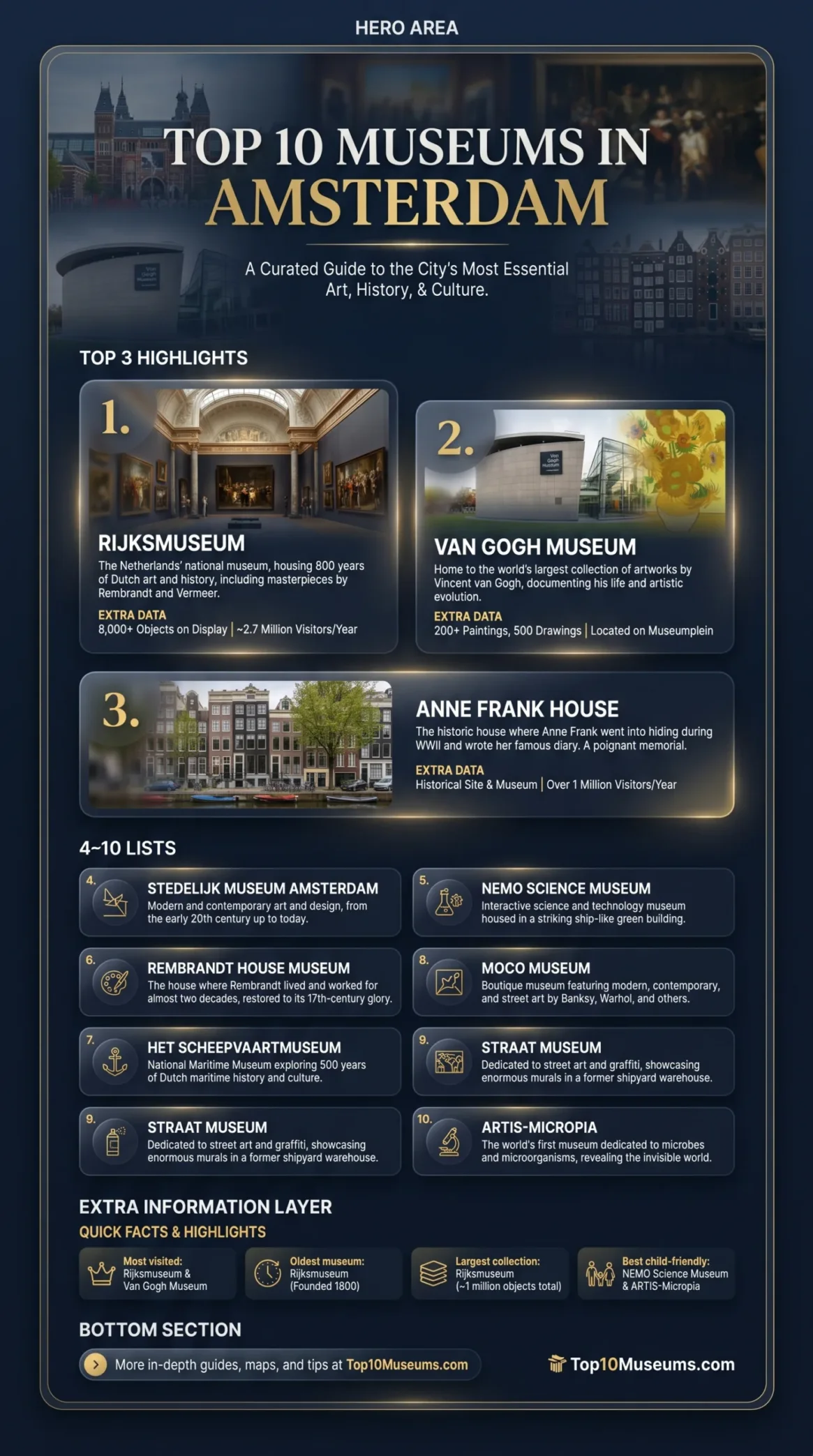
Amsterdam is one of those cities where a museum stop can shape the whole day. Within a short tram ride, you can move from Rembrandt and Vermeer to microbes, wartime memory, ship models, and warehouse-scale street art. This list favors places that reward real time on site, not just famous names, and it keeps a close eye on variety, walkability, and family appeal.
| Rank | Name | Founded | Collection Type | Website |
|---|---|---|---|---|
| 1 | Rijksmuseum | 1800 | Dutch art and history | Official website |
| 2 | Van Gogh Museum | 1973 | Van Gogh and 19th-century art | Official website |
| 3 | Anne Frank House | 1960 | Historic house and WWII memory | Official website |
| 4 | Stedelijk Museum Amsterdam | 1874 | Modern and contemporary art and design | Official website |
| 5 | NEMO Science Museum | 1923 | Interactive science and technology | Official website |
| 6 | Rembrandt House Museum | 1911 | Artist house, etchings, Dutch Golden Age | Official website |
| 7 | Het Scheepvaartmuseum | 1916 | Maritime history and ship models | Official website |
| 8 | Moco Museum | 2016 | Modern, contemporary, digital, and immersive art | Official website |
| 9 | STRAAT Museum | 2020 | Street art and graffiti | Official website |
| 10 | ARTIS-Micropia | 2014 | Microbiology and interactive science | Official website |
Why These Ten Made the Cut
A strong Amsterdam museum list should not feel like ten versions of the same afternoon. These picks cover Dutch master painting, modern art, wartime history, science, maritime culture, and street art, so a first-time visitor can build a trip that feels broad rather than repetitive. They also group well by neighborhood, which matters in a city where museum fatigue can sneak up on you.
Another test was simple: does the place stay in your head after you leave? Some of these museums win with canonical works, others with setting—the Secret Annex, a house where Rembrandt actually worked, a ship-shaped science museum, a former shipyard hall filled with giant murals. That mix is the real Amsterdam advantage: the city does not ask you to choose between prestige and personality.
1. Rijksmuseum
Rijksmuseum is the anchor stop for almost any first Amsterdam trip, and not because of name recognition alone. The museum presents 8,000 objects drawn from roughly 800 years of Dutch art and history, so you can move from medieval pieces to Vermeer, Frans Hals, and Rembrandt’s The Night Watch without feeling trapped inside one narrow lane. Even travelers who are unsure about old-master museums often find something that clicks here—dollhouses, ship models, Delftware, fashion, decorative arts, or the sheer drama of the Gallery of Honour.
Best for: First-time Amsterdam visitors, Dutch Golden Age fans, art-and-history travelers, and anyone who wants one museum to cover a lot of ground well.
Nearby alternative: Van Gogh Museum — just across Museumplein, it makes a smart second stop if you want a more intimate single-artist visit after the national big hitter.
2. Van Gogh Museum
This is where Van Gogh stops being a postcard figure and turns back into a working artist. The museum holds the largest Van Gogh collection in the world, including over 200 paintings, 500 drawings, and more than 750 letters, which means you do not just see the famous canvases—you see the experiments, the repetitions, the doubts, and the leaps. Sunflowers, Almond Blossom, and the self-portraits are only part of the appeal; the real draw is watching the development of his eye, stroke by stroke.
Best for: Van Gogh devotees, color-and-brushwork lovers, first-time art travelers, and visitors who prefer one artist studied properly rather than skimmed.
Nearby alternative: Moco Museum — a lighter, faster follow-up on the same square if you want contemporary names after a deeply focused art visit.
3. Anne Frank House
The emotional register here is different from the rest of the list, and that difference is exactly why it matters. Eight people hid in the Secret Annex for more than two years, and the museum’s power comes from how little it needs to overstate that fact; the rooms, the story, and Anne’s diary do the work on their own. This is not a stop for visual overload or casual browsing—it is a place for attention, restraint, and personal history that stays painfully close.
Best for: Travelers interested in WWII history, readers of Anne’s diary, reflective visitors, and anyone who values human-scale history over spectacle.
Nearby alternative: Amsterdam Museum — a short walk away, it broadens the city story if you want more civic history after the intensely personal focus of the Annex.
4. Stedelijk Museum Amsterdam
If Rijksmuseum is about long national memory, the Stedelijk feels sharper, more argumentative, and more present-tense. Its collection holds around 90,000 objects, with strong runs in modern art, contemporary art, and design, so a visit can jump from Malevich and Mondrian to furniture, graphic design, video, and installation work without losing momentum. The building itself helps sell the shift: old brick on one side, that smooth white bathtub-like extension on the other.
Best for: Modern-art regulars, design-minded travelers, architecture watchers, and visitors who want more edge after the Museumplein classics.
Nearby alternative: Moco Museum — practically next door, it offers a punchier, less theory-heavy art stop if your group wants something quicker and more playful.
5. NEMO Science Museum
NEMO is the reset button when too many quiet galleries start blurring together. The museum spreads interactive science across five floors inside Renzo Piano’s green, ship-like building, and it is one of those rare places where hands-on really means hands-on. Kids can stay busy for hours, but adults usually get drawn in too—bridges, light, chemistry, human perception, energy, technology, all handled in a way that feels lively without talking down to anyone. It is easily one of Amsterdam’s best family museums.
Best for: Families with children, science-curious teens, rainy-day planners, and adults who want a museum that invites touching, testing, and trying.
Nearby alternative: Het Scheepvaartmuseum — an easy waterside continuation if you want to keep the day interactive but swap science for ships and seafaring history.
6. Rembrandt House Museum
Few artist houses feel this close to the act of making. Rembrandt lived and worked here for 19 years, and the museum has built a visit that feels tactile rather than purely reverential, with reconstructed interiors, studio atmosphere, and a collection that includes almost all of Rembrandt’s etchings. That matters because you are not just standing in a famous address; you are seeing the techniques, the tools, and the daily working context behind one of painting’s biggest names. It feels smaller than the Rijksmuseum, but often more personal.
Best for: Rembrandt admirers, printmaking fans, Dutch Golden Age travelers, and visitors who prefer studio atmosphere over blockbuster scale.
Nearby alternative: Jewish Museum — close to the same eastern-center area, it adds a different historical layer without requiring a long cross-city detour.
7. Het Scheepvaartmuseum
If Amsterdam’s canals, warehouses, and trading history have started to raise questions, this is where many of the loose threads pull together. Het Scheepvaartmuseum explores roughly 500 years of maritime history and does it with a collection of around 400,000 objects, from maps and paintings to navigation instruments and ship models. The setting helps too: a grand former naval storehouse with a replica VOC ship outside gives the visit real physical presence, not just panels on a wall.
Best for: Ship lovers, map nerds, history-minded families, and travelers who want Dutch history explained through trade, travel, and the sea.
Nearby alternative: NEMO Science Museum — only a short walk away, it is a smart second stop if your group likes interactive displays more than long object-focused galleries.
8. Moco Museum
Not every museum day needs hush, chronology, and wall labels that read like homework. Moco leans into more than 100 modern, contemporary, digital, and immersive works, with familiar names such as Banksy, Warhol, Basquiat, Haring, and Kusama doing much of the heavy lifting. Purists may shrug at parts of it, but plenty of travelers have a genuinely good time here because the pacing is fast, the imagery lands quickly, and the mood is lighter than most art institutions nearby.
Best for: Casual art visitors, pop-art fans, younger travelers, mixed-interest groups, and people who want a shorter museum with instant visual payoff.
Nearby alternative: Stedelijk Museum Amsterdam — right in the same Museumplein cluster, it is the better pick if you want more depth in 20th- and 21st-century art and design.
9. STRAAT Museum
STRAAT gives Amsterdam-Noord a museum stop that feels nothing like the polished Museumplein triangle. Inside a former shipyard warehouse, the museum shows more than 180 artworks by 170+ artists, most of them created on site, and the scale is the whole point—murals and installations that would feel ordinary outdoors suddenly become overwhelming indoors. Street art can look flattened in books and on phones; here, it regains its size, swagger, and rough edges. The trip to NDSM is part of the appeal, especially if you take the ferry.
Best for: Street-art followers, repeat Amsterdam visitors, teens, creative travelers, and anyone bored by a full day of classical painting.
Nearby alternative: Eye Filmmuseum — across the IJ area, it adds film and architecture to the outing if you want to keep the north-side culture day going.
10. ARTIS-Micropia
Micropia is one of those museums people mention afterward with a slightly surprised smile. It opened in 2014, marked its 10th anniversary in 2024, and still stands out as the world’s first museum devoted to microbes. That premise sounds niche until you are inside and realize how cleverly it connects invisible life to your own body, food, health, and environment. It is smart, odd, and memorable in a city already full of strong museum competition.
Best for: Science-minded adults, curious kids, biology students, unusual-museum collectors, and travelers who want something more original than another painting gallery.
Nearby alternative: Groote Museum — in the same ARTIS area, it pairs well if you want a second stop about the relationship between humans, animals, and nature.
How to Tour These Museums
Best Museumplein Art Day
Start with Rijksmuseum in the morning, when your eyes are fresh enough for a large collection and the headline rooms feel easier to enjoy. Move to Van Gogh Museum after a break, then choose Stedelijk if you want more depth or Moco if you want something quicker and lighter. This route keeps walking close to zero and works especially well when the weather turns wet.
Best Kid-Friendly Science Day
Open with NEMO, because children usually want their most interactive stop first, not after two quieter museums. After lunch, continue to Het Scheepvaartmuseum for ships and maps, or switch to Micropia if the group likes biology more than maritime history. The eastern cluster is compact, so the day stays practical even with tired legs.
Best History Day
Anne Frank House should come first, with enough breathing room before and after the visit. Later in the day, move east for the Rembrandt House Museum if you want a very different but still deeply rooted Amsterdam story. The contrast works, but it is better not to crowd this day with too many extra stops.
Best Alternative Art Day
Begin around Museumplein with Stedelijk or Moco, then head north later for STRAAT. The free ferry to NDSM helps the transfer feel like part of the outing rather than dead travel time, and STRAAT’s warehouse scale lands best after smaller gallery rooms. This is the strongest route for teens, repeat visitors, and anyone who wants art without too much ceremony.
Best Two-Day Route
Day one: Museumplein—Rijksmuseum, Van Gogh Museum, and either Stedelijk or Moco depending on energy level. Day two: Anne Frank House in the morning, then choose between the east-side science-and-history cluster of NEMO, Micropia, and Het Scheepvaartmuseum, or the north-side run to STRAAT. Breaking the city this way keeps transit simple and makes each day feel like its own theme rather than a box-ticking exercise.
Who Will Love These Museums?
- Old-master lovers: Rijksmuseum and Rembrandt House Museum give you the clearest route into Dutch Golden Age painting and print culture.
- Single-artist devotees: Van Gogh Museum is the right pick for visitors who would rather study one artist properly than skim twenty rooms of mixed names.
- Travelers who want history to feel personal: Anne Frank House stays with readers, teachers, students, and anyone drawn to lived experience rather than broad timelines.
- Modern and design-minded visitors: Stedelijk Museum Amsterdam is the best fit for people who care about form, movement, furniture, typography, and visual ideas after 1900.
- Families with curious kids: NEMO and ARTIS-Micropia make science tactile, playful, and easier to remember than a standard gallery day.
- Ship, trade, and map enthusiasts: Het Scheepvaartmuseum connects Amsterdam’s canal city image to the sea routes and objects that helped build it.
- Street-art followers and repeat Amsterdam visitors: STRAAT Museum gives the city a fresh angle far from the usual Museumplein circuit.
- Casual art fans and mixed-interest groups: Moco Museum works well for people who want famous names, bold visuals, and a shorter visit with fast payoff.