
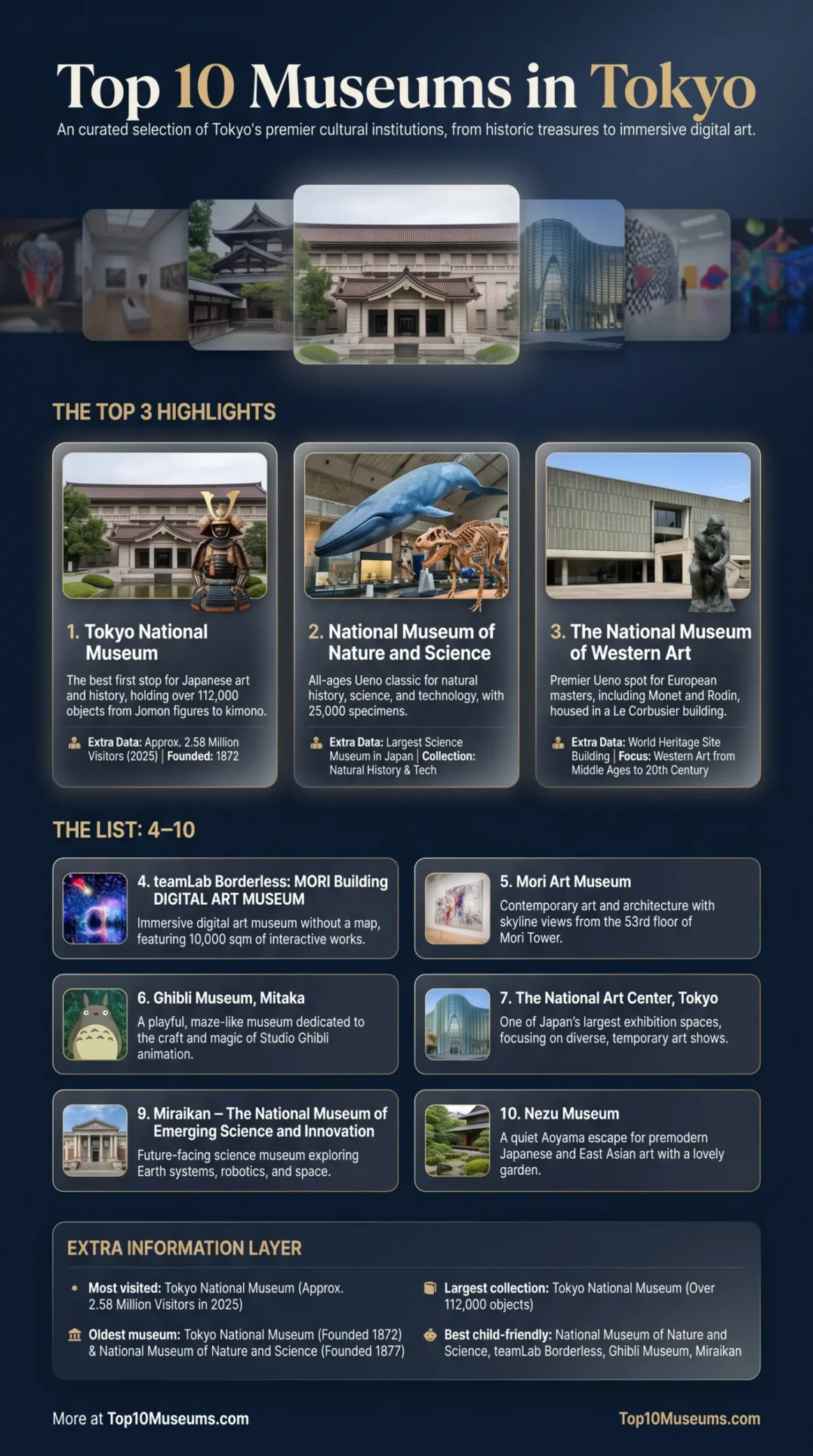
Tokyo does museum-hopping in its own way: one morning can mean samurai armor and National Treasures, and by late afternoon you might be walking through light, mirrors, robots or hand-drawn animation. This list of the top 10 museums in Tokyo leans toward places that work well for first-time visitors, but it also leaves room for quieter favorites, architecture-led stops and family-ready picks that are actually worth the train ride.
| Rank | Name | Founded | Collection Type | Website |
|---|---|---|---|---|
| 1 | Tokyo National Museum | 1872 | Japanese art, archaeology, Asian antiquities | Official website |
| 2 | National Museum of Nature and Science | 1877 | Natural history, science, technology, kid-friendly | Official website |
| 3 | The National Museum of Western Art | 1959 | European painting, sculpture, architecture | Official website |
| 4 | teamLab Borderless: MORI Building DIGITAL ART MUSEUM | 2018 / Tokyo relaunch 2024 | Immersive digital art, interactive, family-friendly | Official website |
| 5 | Mori Art Museum | 2003 | Contemporary art, architecture, design, photography | Official website |
| 6 | Ghibli Museum, Mitaka | 2001 | Animation, film, family, anime culture | Official website |
| 7 | The National Art Center, Tokyo | 2007 | Large-scale temporary exhibitions, architecture | Official website |
| 8 | Tokyo Metropolitan Art Museum | 1926 | Special exhibitions, Japanese and global art | Official website |
| 9 | Miraikan – The National Museum of Emerging Science and Innovation | 2001 | Future tech, space, robotics, kid-friendly | Official website |
| 10 | Nezu Museum | 1940 | Premodern Japanese and East Asian art, garden | Official website |
Why These Ten Museums Made the Cut
Tokyo has dozens of strong museum options, so a plain “best of” list often gets a bit lazy. This one favors places with clear visitor payoff: major collections, memorable buildings, unusual experiences, or a setup that fits a real trip rather than an abstract art syllabus. That is why the Ueno trio ranks high, why the Roppongi stops sit together, and why a west-Tokyo detour for Ghibli still earns its place.
It also helps to know what many short roundups skip. Some museums here work best because of their neighborhood cluster, not just the galleries inside. Some need advance planning—Ghibli is reservation-led, and teamLab Borderless is better when you allow wandering time rather than squeezing it between lunch and dinner. And some are brilliant for very specific travelers: kids who need motion, adults who want a calmer room pace, or visitors who care as much about the building as the works on the walls.
1. Tokyo National Museum — the best first stop for Japanese art and history
For a first museum in Tokyo, this is the one that makes the whole city click. Founded in 1872, Tokyo National Museum holds over 112,000 objects, with Japanese art at the center and Asian antiquities around it. It drew about 2.58 million visitors in 2025, which says plenty about its pull, but the real appeal is range: Jomon figures, Buddhist sculpture, screens, swords, kimono, lacquer, ceramics—the museum gives you the long arc without making it feel like homework.
If time is tight, start with the Honkan and treat it as your Japanese art anchor for the rest of the trip. The famous pieces matter, yes, but so does the pacing: big-name objects sit beside smaller works that show texture, daily life and craft skill. For travelers trying to choose just one museum in Ueno, this is still the safest, smartest first pick.
Best for: first-time Tokyo visitors, Japanese history fans, collectors at heart, travelers who want one museum to explain a lot of what they will see elsewhere in Japan
Nearby alternative: The National Museum of Western Art — if you want a shorter stop in the same Ueno museum zone, this gives you European masters and sculpture only a few minutes away on foot.
2. National Museum of Nature and Science — the all-ages Ueno classic for dinosaurs, blue whales and science
Founded in 1877, this is Japan’s only national museum with a full spread of natural history and the history of science and technology. The museum presents about 25,000 specimens and artifacts across the Japan Gallery and Global Gallery, so it never feels thin or one-note. You get dinosaur skeletons, animal specimens, geology, Japanese scientific history, and the sort of big visual objects—like the outdoor blue whale model—that make kids lock in before they even step inside.
It earns a high place because it works on more than one level. Families can move quickly and still have a great time; adults can slow down and notice how well the galleries connect evolution, ecology and invention. There is a solid sense of scale here, and when Tokyo weather turns hot or rainy, this museum is one of the easiest “we can all agree on this” choices in the city.
Best for: families with kids, science-loving teens, rainy-day planners, travelers who want a high-value museum that is easy to pair with other Ueno stops
Nearby alternative: Tokyo Metropolitan Art Museum — if your group wants a softer pace after fossils and science galleries, this nearby Ueno museum shifts the mood toward art and large rotating shows.
3. The National Museum of Western Art — the Ueno pick for Monet, Rodin and a Le Corbusier building
This museum lands high because it solves a very practical travel problem: where to see European art in Tokyo without losing half a day. Opened in 1959, it houses over 6,000 works centered on the Matsukata Collection and shows Western art from the Middle Ages to the mid-twentieth century. The building matters too—designed by Le Corbusier, it is one of those rare museum shells that is almost as discussed as the paintings inside.
Inside, the sweet spot is the late nineteenth and early twentieth century material, especially if you want familiar names after several days of Japanese art. There are around 60 Rodin sculptures, plus works linked to Degas, Van Gogh and Monet. It is one of the cleanest museum experiences in Tokyo: not too sprawling, not too slight, and very easy to fold into a Ueno day without museum fatigue setting in.
Best for: Impressionist fans, architecture-minded travelers, couples building a polished Ueno art day, visitors who want Western masters without a giant detour
Nearby alternative: Tokyo National Museum — stay in the same park and swap European painting for Japanese screens, ceramics and armor if you want the broader cultural stop.
4. teamLab Borderless — the interactive digital art museum that feels built for wandering
Not every traveler wants framed objects and label text all day, and that is exactly where teamLab Borderless earns its spot. The museum reopened in central Tokyo at Azabudai Hills in February 2024, and its defining trick still works: a 10,000-square-meter environment of digital works that move across rooms and react to bodies in motion. It calls itself a museum without a map, and that phrase is not fluff—you really do get more from it when you stop trying to “finish” it in a rigid order.
This is one of Tokyo’s strongest picks for people who want art as an experience rather than art as an archive. Children respond to the motion and color, but adults usually do too, especially in the quieter light-based rooms where you can slow down and just watch the space change. It is also a useful counterweight on a museum-heavy trip: after Ueno’s glass cases and wall labels, Borderless feels loose, playful and a bit surreal—in a good way.
Best for: families with older kids, digital art fans, couples, social-media-minded travelers, visitors who want one museum in Tokyo that feels unlike almost anything else
Nearby alternative: Suntory Museum of Art — if you want to stay in the same wider Roppongi area but switch from projection-based immersion to a calmer decorative-arts museum, it is an easy follow-up.
5. Mori Art Museum — late-hour contemporary art with a skyline mood
Mori Art Museum opened in October 2003 at the top of Mori Tower and still feels tuned to modern Tokyo rather than old museum habits. The main galleries sit on the 53rd floor, and the museum’s focus runs through contemporary art, architecture, design, photography and video. That alone would make it useful, but the real charm is how it fits the city: you can visit after dark, look out over Tokyo, and get a museum experience that feels urban rather than ceremonial.
It works best for travelers who like current ideas, changing shows and a bit of edge without losing polish. Mori is not the place for “must-see masterpiece” hunting; it is better for people who enjoy how art talks back to the present. In practice, that makes it one of the smartest museums in Tokyo for repeat visitors, design-minded travelers and anyone building an evening around Roppongi.
Best for: contemporary art followers, date-night museumgoers, architecture and design fans, repeat Tokyo visitors who want something current rather than historical
Nearby alternative: The National Art Center, Tokyo — it is a short ride or walk away, and it makes a strong same-area pairing if you want more temporary exhibitions and one of Tokyo’s most striking museum buildings.
6. Ghibli Museum, Mitaka — the anime museum that really is worth the reservation effort
Yes, it is outside central Tokyo. Yes, tickets need advance planning. And yes, it still belongs on this list. The Ghibli Museum opened to the public in October 2001, and its draw is not simply fandom; it is how well it turns animation into a lived space. The building is deliberately maze-like, the temporary exhibition room changes, and the Saturn Theater has about 80 seats for exclusive short films that you cannot watch in ordinary cinemas.
What keeps it from feeling like a fan-service trap is the craftsmanship. The museum is playful, but it is also deeply interested in how animation is made—movement, backgrounds, drawing, timing, tiny details. If Studio Ghibli means something to you, it is a no-brainer. If it does not, the trip still pays off for families and design-minded visitors who enjoy spaces with personality. Just do not treat it like a spontaneous add-on; reservation rules are part of the deal.
Best for: Studio Ghibli fans, families with school-age children, animation lovers, travelers happy to trade central convenience for a more personal museum experience
Nearby alternative: Edo-Tokyo Open Air Architectural Museum — if you are already in west Tokyo and want another culture stop, this one adds historic houses and a spacious open-air layout reachable by train and bus.
7. The National Art Center, Tokyo — the giant no-permanent-collection museum that changes with every visit
The National Art Center, Tokyo is unusual in the best way. Open since 2007, it has 14,000 square meters of exhibition space—one of the largest in Japan—yet it has no permanent collection. That can sound odd on paper, but in practice it means the museum is built around rotating shows, artist-association exhibitions and the kind of flexible programming that makes every visit feel different.
Even before you reach the galleries, the building does a lot of the work. Kisho Kurokawa’s sweeping glass facade and flowing interior make the place worth seeing on architectural terms alone. For travelers who like large-scale temporary exhibitions, or who have already done the fixed “masterpiece” museums, this is a very Tokyo sort of institution: ambitious, adaptable and open to many types of art audiences at once.
Best for: architecture fans, temporary-exhibition chasers, repeat visitors, travelers who enjoy museums that feel fresh each time rather than anchored to one permanent collection
Nearby alternative: Mori Art Museum — if you want to stay in the Roppongi art zone but move toward contemporary art with city views and later hours, this is the natural follow-up.
8. Tokyo Metropolitan Art Museum — a century-old Ueno institution with big rotating shows
Founded in 1926, Tokyo Metropolitan Art Museum was Japan’s first public art museum, and in 2026 it is marking its 100th anniversary. That long civic role still shapes the place. Instead of relying on one famous permanent collection, it operates as a major venue for special exhibitions and artist communities, which means the quality of your visit depends a little on timing—but when the schedule clicks, it can be superb.
It ranks here because it is such an easy, useful part of a Ueno museum day. The building has room to breathe, the programming tends to be strong, and it often feels less intimidating than the city’s national institutions. It is also good for travelers who like a museum with a local cultural role, not just a tourist reputation. Think of it as a flexible extra that can quietly become the highlight of your afternoon.
Best for: exhibition-first travelers, Ueno park walkers, visitors who want strong art without the intensity of a huge national collection, people happy to choose based on what is on now
Nearby alternative: National Museum of Nature and Science — still inside the Ueno cluster, this is the better switch if your group wants interactive galleries and a more family-friendly indoor stop.
9. Miraikan — the future-facing science museum for Earth systems, robots and space questions
Miraikan opened in July 2001 and remains one of Tokyo’s best museums for people who want tomorrow’s questions rather than yesterday’s treasures. Its signature object, the 6-meter Geo-Cosmos, now runs with 10,362 LED panels, turning Earth data into something you can actually feel in the room. Around that centerpiece sit galleries on space, computing, robotics and environmental systems, usually with a hands-on tone that keeps the museum from feeling too abstract.
This is a strong pick for families, but it is not only for kids. Miraikan works especially well for adults who enjoy museums that mix wonder with debate: what science can do, what it changes, and what kind of future people are building. Odaiba can be a bit out of the way depending on your route, but if your Tokyo trip has room for one science-forward stop beyond Ueno, this is the one.
Best for: STEM-curious teens, families, space and robotics fans, travelers who like interactive museums with a future-facing angle
Nearby alternative: teamLab Planets TOKYO — if you want another waterside stop after Miraikan, this nearby digital-art favorite adds immersion and movement rather than science interpretation.
10. Nezu Museum — the quiet Aoyama escape for premodern art and one of Tokyo’s loveliest museum gardens
Nezu Museum is the calmest entry on this list, and that is exactly why it belongs. Founded to preserve the collection of Nezu Kaichiro, it holds more than 7,600 objects, including seven National Treasures. The collection focuses on premodern Japanese and East Asian art, while the current building and approach sequence give the place a hushed, deliberate rhythm that feels miles away from the fashion streets just beyond the walls.
This is not the museum for a rushed “tick-the-box” visit. It is better for slow walkers, screen-painting lovers, tea-culture fans and anyone who likes the museum-garden combination done with real care. The galleries are not oversized, which is part of the charm. After a few high-energy Tokyo days, Nezu can feel like a much-needed exhale.
Best for: garden-and-art travelers, quieter museumgoers, lovers of Japanese screens, ceramics and calligraphy, visitors who prefer atmosphere over scale
Nearby alternative: Ota Memorial Museum of Art — if you want another art stop in the wider Harajuku-Omotesando area, this compact ukiyo-e museum is easy to reach and pairs well with a lighter afternoon.
How to Tour These Museums
Best Classic Art Day
Start in Ueno with Tokyo National Museum right at opening, when your focus is still fresh and the historical span feels exciting rather than heavy. Move next to the National Museum of Western Art for a shorter European counterpoint, then finish at Tokyo Metropolitan Art Museum if the current special show looks good. This order works because the walking is easy, the collections complement one another, and you avoid zigzagging across the city for no reason.
Best Family Day
Pick either Ueno or Odaiba/Azabudai, not both. In Ueno, do the National Museum of Nature and Science first, then leave room for a park break and one shorter museum later. On a more sensory day, pair teamLab Borderless with Miraikan on separate halves of the day—Borderless first if the kids need movement, Miraikan later if they are ready for hands-on science and a slower read-and-touch pace.
Best Anime and West-Tokyo Day
Build this one around a timed Ghibli Museum entry and keep the rest light. Arrive in Mitaka or Kichijoji early, spend unhurried time inside Ghibli, then decide whether the group still has energy for another culture stop such as Edo-Tokyo Open Air Architectural Museum. This route works best when you treat Ghibli as the main event rather than a side errand.
Best Two-Day Route
Day one: make Ueno your base and do Tokyo National Museum plus one of the other park museums depending on your mood—science, Western art or a current exhibition. Day two: shift to Roppongi and central Tokyo for The National Art Center, Mori Art Museum and, if you want a more playful counterpoint, teamLab Borderless. This split keeps geography sensible and saves your attention for the museums instead of the train transfers.
[ayaz_safe_content id=”2731″ key=”p2731b1zw1k6gel”]
Who Will Love These Museums?
- First-time Tokyo visitors: Tokyo National Museum is the best single starting point if you want Japan’s visual history in one place.
- Families with young or mixed-age kids: National Museum of Nature and Science gives you big visual payoffs and easier pacing than many art museums.
- Old-master and Impressionist lovers: The National Museum of Western Art is the cleanest fit, especially if Monet, Rodin and Le Corbusier all sound good in one stop.
- Travelers who want movement, light and interaction: teamLab Borderless works best for people who like to explore rather than follow a rigid room order.
- Contemporary art followers: Mori Art Museum is the strongest pick for current themes, skyline atmosphere and a more urban museum rhythm.
- Anime fans and creative families: Ghibli Museum is for people who care about animation craft, not just movie merchandise.
- Architecture fans: The National Art Center, Tokyo and The National Museum of Western Art both reward visitors who look closely at the building as well as the shows.
- Exhibition chasers: Tokyo Metropolitan Art Museum is ideal for travelers who like choosing by what is on now rather than by a fixed permanent collection.
- STEM-curious teens and future-tech fans: Miraikan brings Earth data, robotics and science ethics into one very approachable visit.
- Quiet-art travelers: Nezu Museum is the one for screens, ceramics, calligraphy and a calmer museum-garden mood in Aoyama.