
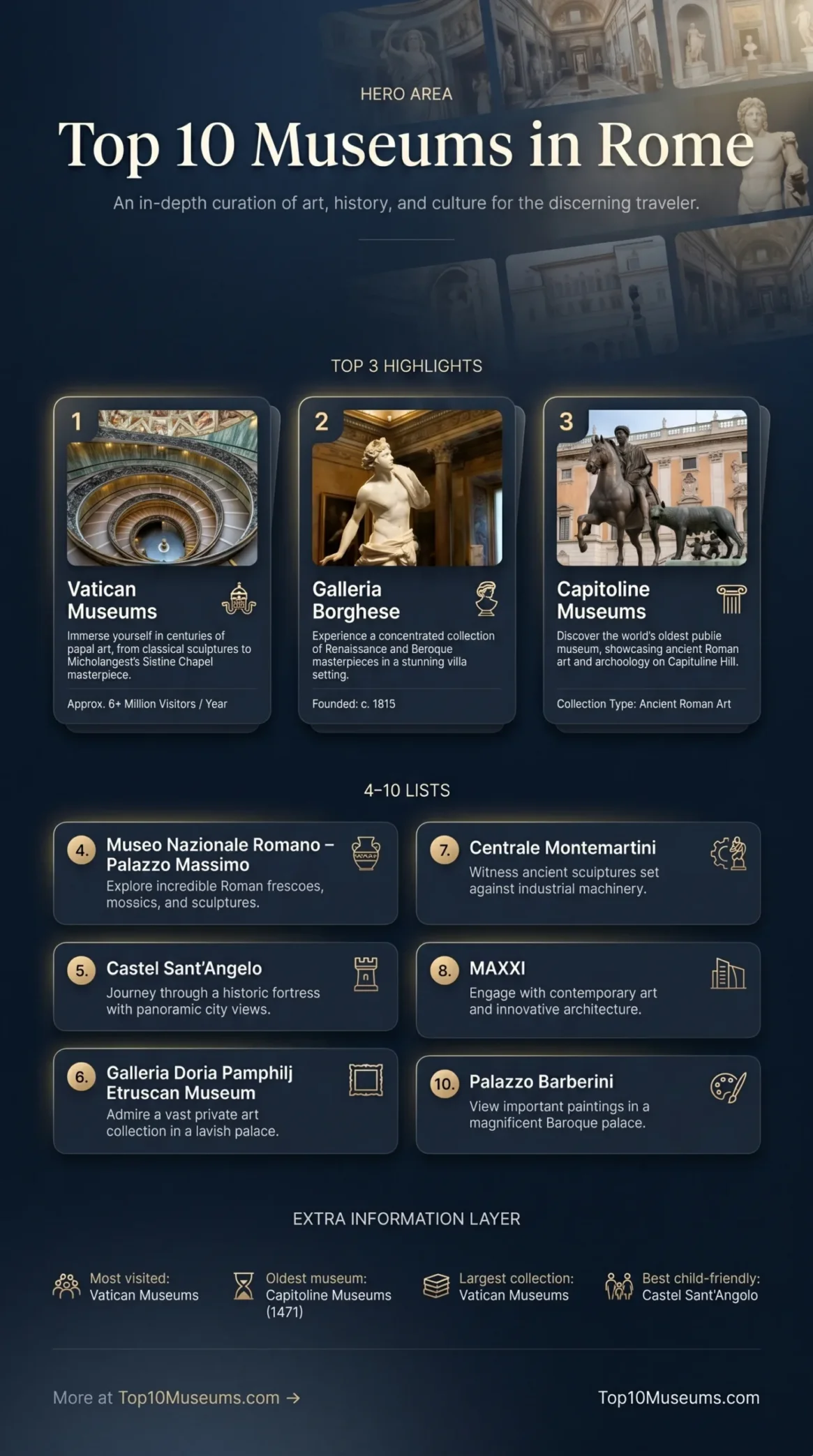
Rome does not do small-scale culture. One block can bring you face to face with a Roman emperor, the next with Bernini at full tilt, and a little later with a Zaha Hadid curve that feels almost weightless. This list of the Top 10 Museums in Rome keeps that range intact: the famous heavyweights are here, of course, but so are a few places that make a short city break feel smarter, calmer, and far more memorable. Whether the plan is a first visit, a family day out, or a museum run built around art, archaeology, and architecture, these ten are the ones most likely to earn a place in the schedule.
| Rank | Name | Founded | Collection Type | Website |
|---|---|---|---|---|
| 1 | Vatican Museums | 1506 | Renaissance art, classical sculpture, papal collections | Official site |
| 2 | Galleria Borghese | c. 1613 | Baroque sculpture, Renaissance and Baroque painting | Official site |
| 3 | Capitoline Museums | 1471 | Ancient Roman art, sculpture, archaeology | Official site |
| 4 | Museo Nazionale Romano – Palazzo Massimo | 1889 | Roman archaeology, frescoes, mosaics, sculpture | Official site |
| 5 | Castel Sant’Angelo | 135 CE | Fortress museum, papal rooms, military history | Official site |
| 6 | Galleria Doria Pamphilj | 1651 | Private palace collection, Baroque and Old Master painting | Official site |
| 7 | Centrale Montemartini | 1997 | Ancient sculpture in an industrial setting | Official site |
| 8 | MAXXI | 2010 | Contemporary art, architecture, design | Official site |
| 9 | ETRU National Etruscan Museum of Villa Giulia | 1889 | Etruscan and pre-Roman antiquities | Official site |
| 10 | Palazzo Barberini | 1953 | Old Master painting, Baroque palace interiors | Official site |
Why These 10 Museums Earn the Shortlist
Rome has dozens of museum-worthy stops, so fame alone was not enough. These ten were picked because they give a full picture of the city’s museum life: blockbuster collections, ancient Rome essentials, quieter palace galleries, a top-notch Etruscan stop, and two places that pull the story into the modern age. That mix matters. A list that only repeats the biggest names leaves out the part of Rome that feels most personal once the first rush of sightseeing settles down.
The other filter was practical value. Some museums are best for a first-timer, some work better for families with limited patience, and some reward travelers who have already seen the Forum and want something more textured. A museum list should help with choices, not just pile up names, so the notes below lean on what each place actually does best—art, archaeology, architecture, views, shorter visits, rain-proof afternoons, or a slower pace away from the thickest crowds.
Top Museums in Rome: The Full List
1. Vatican Museums
Best for: first-time Rome visitors, Renaissance art lovers, older kids who can handle a long museum route
The Vatican Museums are the obvious giant, but they still deserve the top spot because the visit is not just about fame—it is about sheer range. The museum system traces its public story back to 1506, and today the wider collection is often described in the tens of thousands, with roughly 20,000 works on display along the route. That route brings together the Pio-Clementino Museum, the Gallery of Maps, the Raphael Rooms, and the Sistine Chapel, which means one ticket covers classical sculpture, papal collecting, and high Renaissance painting in a single sweep. It is a long visit, sometimes a tiring one, but there is no other museum in Rome that lands so many world-known works in one afternoon.
What many short list articles miss is that this is also a museum of pacing. Go in expecting a slow, linear walk rather than a “pop in and wing it” stop. Early timed entry usually makes the day feel far less crowded, and older children often do better here than very young ones because the route keeps moving. Laocoön, the Raphael Rooms, and Michelangelo’s ceiling do the headline work, yet the side galleries and classical collections are where many visitors end up lingering longer than expected.
Nearby alternative: Castel Sant’Angelo — a much shorter museum stop with fortress rooms and rooftop views, easy to pair with a walk down Via della Conciliazione or across the Tiber.
2. Galleria Borghese
Best for: Baroque sculpture fans, couples, repeat visitors, travelers who prefer a focused museum over a huge one
Galleria Borghese feels like the anti-Vatican in the best possible way: smaller, tighter, and beautifully edited. The museum’s public rooms number 20 frescoed spaces, and the collection goes back to Cardinal Scipione Borghese, whose holdings had reached about 800 paintings by the late seventeenth century. The stars are easy to name—Bernini’s Apollo and Daphne, David, and Pluto and Proserpina, plus Caravaggio, Raphael, Titian, and Canova—but what makes the place special is the way the art and villa interior speak to each other. Nothing feels scattered. Room after room, the museum keeps a strong rhythm.
This is also one of the easiest major Rome museums to recommend to travelers who think they “don’t have time for another gallery.” The timed-entry structure keeps the visit shaped and manageable, and the museum can feel wonderfully contained rather than exhausting. If the Vatican is a full opera, Borghese is a chamber performance—sharper, more intimate, and often the museum people talk about with the most warmth afterward.
Nearby alternative: National Gallery of Modern and Contemporary Art — a good follow-up for anyone who wants to stay in the Villa Borghese-Flaminio area and switch from Bernini to later painting with minimal travel.
3. Capitoline Museums
Best for: ancient Rome lovers, travelers pairing museums with the Forum, families with school-age kids
The Capitoline Museums have one of the best claims to museum history anywhere in Europe. Their roots go back to 1471, when Pope Sixtus IV donated ancient bronzes to the Roman people, and that origin still gives the place a pleasing civic weight. You are not just entering another gallery; you are stepping into a museum built around the memory of Rome itself. The collection includes the Capitoline She-wolf, the equestrian statue of Marcus Aurelius, the Dying Gaul, and layers of sculpture, inscriptions, and painting spread across grand buildings on Michelangelo’s Campidoglio.
For travelers who want ancient Rome without another open-air ruins session, this is often the smartest move. It adds context after the Forum, and the views over the city are a bonus rather than a gimmick. There is also a nice breadth here: not only imperial symbols, but objects that help Rome feel lived in and argued over, not frozen under glass. That wider civic angle is exactly why the museum keeps pulling in both first-timers and history-minded repeat visitors.
Nearby alternative: Centrale Montemartini — the second exhibition venue of the Capitoline Museums, worth the short Metro B hop if you want ancient sculpture in a far more unusual setting.
4. Museo Nazionale Romano – Palazzo Massimo
Best for: archaeology fans, quieter museum seekers, travelers staying near Termini, rainy-day museum hours
Palazzo Massimo is where Rome starts rewarding the traveler who goes a step beyond the most obvious list. The wider National Roman Museum was established in 1889, while Palazzo Massimo itself opened to the public as part of the museum network in 1998. Inside, the collection is a dream for anyone who likes Roman interiors and portraiture more than blockbuster queues: the garden frescoes from the Villa of Livia, refined mosaics, imperial portraits, the bronze Boxer at Rest, and the famous Discobolus are all here. It is one of those museums where the quality hits early and never really drops.
Because it sits near Termini, Palazzo Massimo is easy to work into a day that begins or ends around train schedules, and it rarely feels as overrun as Rome’s headline names. The museum suits visitors who want detail over spectacle: painted walls, funerary jewelry, sculpture with emotional bite, and rooms that reward looking closely. It is also one of the best places in Rome to remember that Roman art was not only marble-white and monumental—it was colored, domestic, and deeply observant.
Nearby alternative: Baths of Diocletian — only a short walk away, with a different side of the National Roman Museum and much more space to stretch out after indoor galleries.
5. Castel Sant’Angelo
Best for: families, mixed-interest groups, photographers, travelers who want a museum plus a skyline payoff
Castel Sant’Angelo works so well because it is never only one thing. Begun as Hadrian’s mausoleum in the 2nd century CE, it later became a fortress, papal refuge, prison, and museum—so every level shifts the tone. You get stone ramps, military spaces, papal apartments, river views, and terraces that open Rome up in a way most museums cannot. That makes it ideal for people who want history without the feeling of walking from frame to frame in a standard gallery sequence. The building itself is the main exhibit, and it has almost two thousand years of story packed into it.
This is also one of the easiest museum choices for travelers in groups, because the visit satisfies very different tastes at once. Kids can handle the fortress mood better than a long painting circuit, and adults still get proper historical depth. If there is a museum in Rome that can rescue a culture day when someone in the group says they are “done with galleries,” this is usually the one.
Nearby alternative: Palazzo Altemps — a calmer sculpture museum a reasonable walk away, especially good if the group wants ancient statuary after the castle terraces and river views.
6. Galleria Doria Pamphilj
Best for: Old Master lovers, quieter central sightseeing, repeat Rome visitors, palace-interior fans
Right on Via del Corso, Galleria Doria Pamphilj gives you one of Rome’s most rewarding palace-museum experiences. The gallery sits within the still privately owned Palazzo Doria Pamphilj, and the main display spreads through four wings around an internal courtyard, plus additional grand rooms. That layout matters because it keeps the visit feeling personal rather than institutional. The headliner is Velázquez’s Portrait of Innocent X, but the collection also includes Caravaggio, Titian, Bernini, and long corridors where mirrors, gilded frames, sculpture, and painted ceilings all work together. It feels less like browsing a museum and more like being admitted into a very old family argument about taste.
This is one of the best central museum picks for travelers who want quality without the logistical burden of a mega-site. You can visit it after lunch, fit it between historic-center walks, and still come away with real highlights rather than a “nice little extra.” The atmosphere does half the work: softer, more private, and far more layered than many first-time visitors expect from a museum sitting on one of Rome’s busiest shopping streets.
Nearby alternative: Museo di Roma at Palazzo Braschi — another handsome central museum stop, easy to reach on foot if you want to stay in the historic core after the Doria Pamphilj rooms.
7. Centrale Montemartini
Best for: teens, design-minded travelers, photographers, people tired of standard palace galleries
Centrale Montemartini is the museum on this list that most often surprises people into saying, “Why didn’t I know about this earlier?” The museum’s modern chapter began in 1997, when ancient sculptures from the Capitoline collections were moved into a former power station as renovation work was underway. The result is still one of Rome’s sharpest visual contrasts: marble gods and Roman portraits set against turbines, boilers, iron beams, and industrial halls. It should not work—and yet it really does. The collision between machine age and antiquity turns familiar classical sculpture into something newly theatrical.
For travelers who have seen enough palace ceilings for one trip, this museum can feel like a reset button. It is especially good with older children and teenagers because the setting gives them something immediate to latch onto, even before the archaeology begins doing its quieter work. That industrial backdrop makes the museum one of Rome’s most visually distinct stops, and one of the easiest to remember in detail afterward.
Nearby alternative: Baths of Caracalla — not a museum in the same sense, but a strong nearby history stop if you want to stay on the south side of the city and keep the Roman past in view.
8. MAXXI
Best for: architecture lovers, contemporary art fans, teens, travelers wanting a break from churches and emperors
Rome’s museum identity is not trapped in antiquity, and MAXXI proves it. Opened in 2010, the museum is Italy’s national institution for 21st-century art and architecture, and the Zaha Hadid building is part of the reason people come. The lines, ramps, bridges, and shifting light make the visit feel active even before you start engaging with the exhibitions. For some travelers that is exactly the point: after days of marble, chapels, and archaeology, MAXXI brings in video, photography, installation, design, and architecture with a completely different tempo. The museum changes the conversation, and Rome feels larger for having it.
MAXXI also keeps the list honest. A “best museums in Rome” article that ignores the city’s modern cultural life ends up sounding half-finished. This stop works especially well for younger travelers, anyone staying in Flaminio, and visitors who care as much about architecture as the art on the walls. Even when a temporary show is the main draw, the building remains a reason to go on its own.
Nearby alternative: National Gallery of Modern and Contemporary Art — a smart pairing by tram or taxi if you want to build a half-day around modern and later Italian art in the same part of town.
9. ETRU National Etruscan Museum of Villa Giulia
Best for: pre-Roman history buffs, curious families, school-age kids, travelers who like quieter museums
If the Roman story interests you most when it is still forming, Villa Giulia is one of the best museum detours in the city. The museum was founded in 1889, and its official history notes more than 6,000 objects in 50 rooms across over 3,000 square meters of display area. That scale gives it real weight, but the atmosphere remains much calmer than Rome’s bigger museum magnets. The great calling cards are the Sarcophagus of the Spouses, the Apollo of Veii, and the Pyrgi Tablets—works that shift the focus away from imperial Rome and toward the Etruscan world that shaped central Italy long before the empire reached its height.
Villa Giulia is also wonderfully teachable without becoming dry. Families with older children often do well here because the museum presents a civilization many visitors know only vaguely, then backs it up with objects that are expressive, unusual, and easy to remember. It is a quieter, more thoughtful museum hour, and sometimes that is exactly what a packed Rome itinerary needs.
Nearby alternative: MAXXI — a short ride away if you want to pivot from pre-Roman material to contemporary art and architecture without crossing the whole city.
10. Palazzo Barberini
Best for: painting lovers, Baroque architecture fans, central hotel stays, travelers who want high-level art with less pressure than the Vatican
Palazzo Barberini rounds out the list because it combines first-rate painting with one of Rome’s most handsome palace settings. The Gallerie Nazionali Barberini Corsini describe their holdings as more than 5,000 masterpieces from the 13th to the 18th century, and Palazzo Barberini is the better-known Roman venue for many travelers. The palace itself was shaped by Carlo Maderno, Bernini, and Borromini, so the visit already begins with serious architectural pedigree before you get to Pietro da Cortona’s ceiling, Raphael’s La Fornarina, or Caravaggio’s Judith Beheading Holofernes. It is a museum that feels elegant without turning chilly.
What helps Palazzo Barberini stand out on a packed Rome schedule is balance. It offers museum-grade painting, dramatic interiors, and a central location, yet it rarely feels as logistically heavy as the Vatican. For visitors who want one more major art stop but not another marathon route, this is often the right answer. You leave with both paintings and rooms in your head, which is not something every gallery can promise.
Nearby alternative: Galleria Doria Pamphilj — another strong Old Master option in central Rome, easy to reach if the day still has room for one more palace collection.
How to Tour These Museums
Best Classic Art Day
Start with the Vatican Museums as early as possible, because that is the one stop on this list most likely to punish a late start. After lunch, walk or take a short taxi to Castel Sant’Angelo for a looser, more open-air follow-up that resets the pace. If energy is still good, finish with Galleria Doria Pamphilj in the late afternoon, when a palace gallery feels calmer than another huge institution. This order works because the toughest museum comes first, then the day gradually gets less demanding.
Best Family Day
Begin at Castel Sant’Angelo, where the ramps, terraces, and fortress mood are easier for children and mixed-age groups. Move to the Capitoline Museums after lunch if the family still has appetite for statues and Roman stories, then leave MAXXI for another day unless the group includes older kids or teens who enjoy unusual buildings. If the family wants only two museums, Castel Sant’Angelo plus Capitoline is the safer pairing: one active, one historical, both central.
Best Two-Day Route
Day 1: Vatican Museums in the morning, Castel Sant’Angelo after a break, and Galleria Doria Pamphilj later on if the group still has museum energy. Day 2: Galleria Borghese first, then choose between MAXXI or Villa Giulia depending on whether the mood leans modern or pre-Roman. This split respects both geography and stamina: the Vatican-Borgo-center axis one day, the Villa Borghese-Flaminio side the next. Trying to cram Borghese and the Vatican into the same rushed day usually backfires.
Best Three-Day Museum Route
Day 1: Vatican Museums and Castel Sant’Angelo. Day 2: Capitoline Museums, then Palazzo Massimo if ancient Rome still sounds appealing after lunch. Day 3: Galleria Borghese in the morning, followed by MAXXI or Villa Giulia, with Centrale Montemartini saved for travelers who want one last museum that feels unlike anything else in the city. This route keeps the heaviest museum days separated and leaves room for proper meals, walks, and a little mental breathing space.
[ayaz_safe_content id=”2737″ key=”p2737b1ssmzaddu”]
Who Will Love These Museums?
• Old-master lovers: Galleria Borghese, Palazzo Barberini, and Galleria Doria Pamphilj are the clearest picks for Bernini, Caravaggio, Raphael, Titian, and palace-room atmosphere.
• Ancient Rome fans: Capitoline Museums and Palazzo Massimo give the strongest museum-based grounding before or after the Forum, with Centrale Montemartini as the clever bonus choice.
• Families with young kids: Castel Sant’Angelo is often the easiest win because there are ramps, towers, terraces, and enough variety to keep attention from slipping too fast.
• STEM-curious teens: MAXXI and Centrale Montemartini work especially well, one through architecture and design, the other through the clash between turbines and Roman sculpture.
• Travelers who want the “must-see” core: Vatican Museums and Galleria Borghese remain the strongest one-two punch if time allows only a short museum shortlist.
• Visitors who dislike huge crowds: Palazzo Massimo, Villa Giulia, and Doria Pamphilj usually feel more breathable than the city’s most famous museum names.
• Architecture-first travelers: MAXXI, Palazzo Barberini, and the Campidoglio setting of the Capitoline Museums add as much spatial drama as the objects inside them.
• Repeat Rome visitors: Palazzo Massimo, Centrale Montemartini, and Villa Giulia are often where the city starts feeling less performed and more personal.