
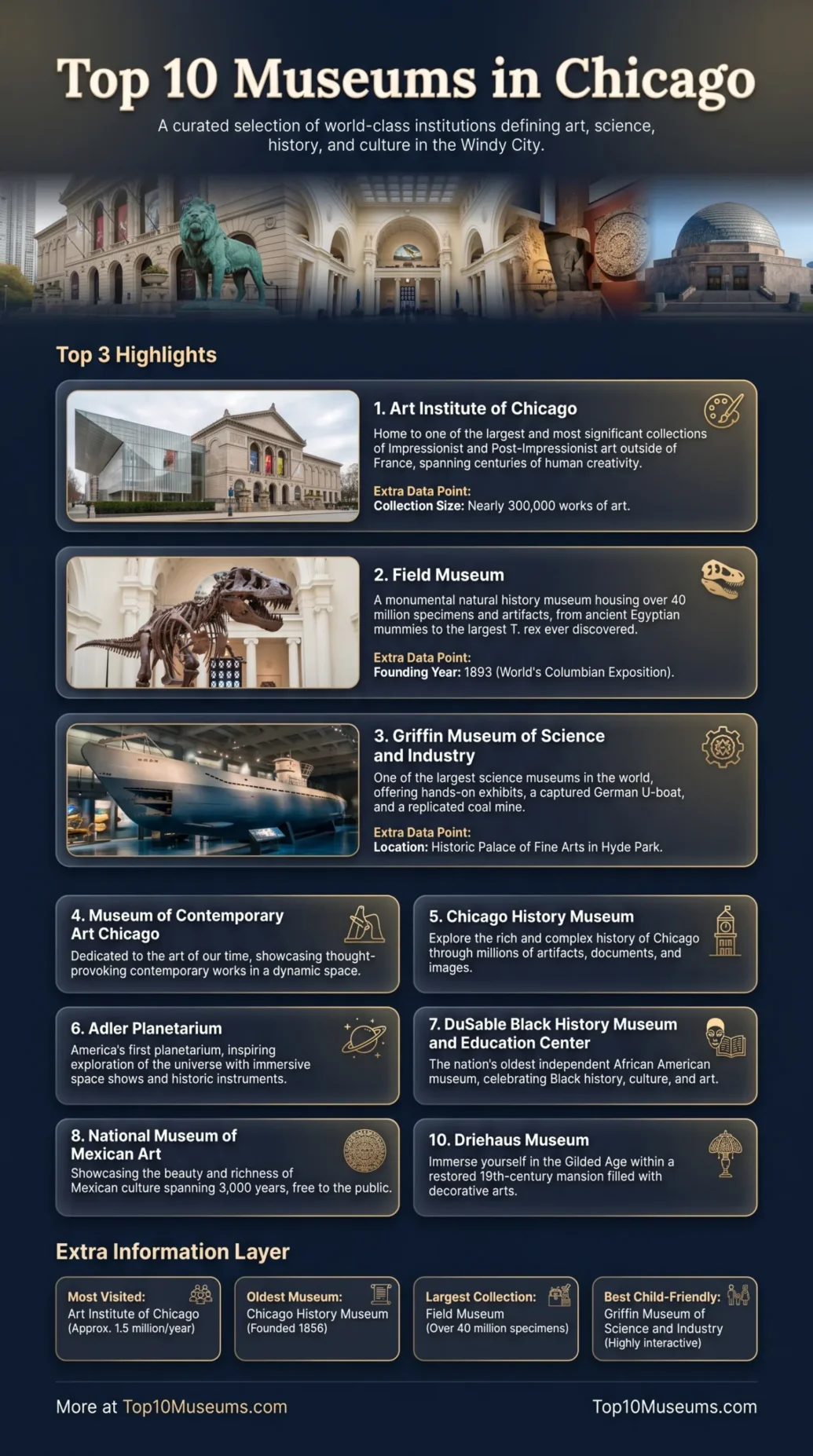
Chicago does museum-hopping exceptionally well. You can spend a morning with Impressionist painting, switch to dinosaur skeletons after lunch, and finish the day inside a Gilded Age mansion or under a planetarium dome. This list of the Top 10 Museums in Chicago leans toward places that give visitors something clear and memorable—major collections, a building you will actually remember later, or a point of view that feels distinctly Chicago.
| Rank | Name | Founded | Collection Type | Website |
|---|---|---|---|---|
| 1 | Art Institute of Chicago | 1879 | Encyclopedic art | Official Website |
| 2 | Field Museum | 1893 | Natural history | Official Website |
| 3 | Griffin Museum of Science and Industry | 1933 | Science and technology | Official Website |
| 4 | Museum of Contemporary Art Chicago | 1967 | Contemporary art | Official Website |
| 5 | Chicago History Museum | 1856 | City and U.S. history | Official Website |
| 6 | Adler Planetarium | 1930 | Astronomy and space science | Official Website |
| 7 | DuSable Black History Museum and Education Center | 1961 | Black history, culture, and art | Official Website |
| 8 | National Museum of Mexican Art | 1982 | Mexican and Mexican American art | Official Website |
| 9 | ISAC Museum | 1919 | Ancient West Asia and North Africa | Official Website |
| 10 | Driehaus Museum | 2008 | Gilded Age decorative arts | Official Website |
Why These Ten Work So Well for a Chicago Museum Trip
This lineup is built for real visitors, not just for name recognition. It mixes Chicago’s headline institutions with places that reveal the city’s neighborhoods, immigrant stories, scientific curiosity, and long habit of building big public culture. You get the obvious heavyweights, yes—but you also get museums that make a weekend here feel less generic and more local.
Another reason these ten hold up: they create strong pairs. Museum Campus works for a history-and-space day, Hyde Park works for a science-and-ancient-world day, and downtown lets you combine old masters, newer art, and mansion interiors without burning all your energy on transit. For families, first-time visitors, and travelers chasing a balanced museum list, this mix simply travels better than a one-note art-only shortlist.
1) Art Institute of Chicago
The Art Institute is the one museum in Chicago that almost every visitor should consider first. Founded in 1879 and home to nearly 300,000 works, it covers a huge range without feeling random, and the building itself still delivers that classic museum-day feeling the moment you reach the lion-guarded entrance. If your museum time in Chicago is limited, this is the safest place to bet several hours and still feel you used them well.
What makes it rise above the usual “must-see” label is how many different museum moods it handles at once. You can go straight for icons like A Sunday on La Grande Jatte, move into modern design, then slow down in smaller galleries that do not feel like a checklist stop at all. It rewards both fast visits and long ones, which is rare.
Best for: First-time Chicago visitors, Impressionist fans, architecture-and-design browsers, and travelers who want one museum with serious breadth.
Nearby alternative: American Writers Museum — an easy add-on from downtown, especially good if a giant art day feels too heavy and you want a smaller cultural stop within the Loop area.
2) Field Museum
The Field Museum is where Chicago goes big in the best possible way. The institution dates to 1893, and its collections reach far beyond the public galleries: the Collections Resource Center alone houses more than 11 million specimens and objects, plus nearly 200,000 frozen DNA and tissue samples. On the visitor side, it is still wonderfully legible—dinosaurs, ancient cultures, gemstones, animals, and enough scale to make the trip feel like an event.
Families usually come for SUE, but adults who like natural history, archaeology, or old-school civic grandeur will find plenty here too. The lakefront setting helps; stepping outside after a long gallery stretch gives the day a natural reset. It is one of the easiest Chicago museums to recommend across age groups.
Best for: Families with kids, dinosaur fans, natural-history lovers, school-age travelers, and anyone building a classic Museum Campus day.
Nearby alternative: Adler Planetarium — just along Museum Campus, it works especially well if you want to swap fossils and anthropology for skyline views, sky shows, and space history.
3) Griffin Museum of Science and Industry
This is the museum for travelers who like their museum day hands-on. Open since June 19, 1933, and housed in the last major building left from the 1893 Columbian Exposition, the Griffin Museum of Science and Industry remains one of the largest science centers in the Western Hemisphere. Even before you get to the exhibits, the building gives the visit some real weight.
Inside, the range is broad enough to keep mixed groups happy. The U-505 experience pulls in history fans, the science galleries work well for curious kids, and the old favorites—like the Coal Mine and Colleen Moore’s Fairy Castle—give the museum a slightly eccentric Chicago charm. It is especially good on a cold or rainy day, when a long indoor visit feels like the smart move.
Best for: STEM-curious kids, multigenerational groups, interactive-museum fans, and visitors who want a full half-day or longer in Hyde Park.
Nearby alternative: ISAC Museum — a short ride away in Hyde Park, it offers a quieter shift from buttons-and-machines energy to ancient sculpture, writing systems, and archaeology.
4) Museum of Contemporary Art Chicago
The MCA has been championing new art since 1967, and that long commitment matters. Contemporary art museums can sometimes feel cold or overly sealed off, but this one usually reads better than that for everyday visitors. The location near the Magnificent Mile also makes it easy to work into a downtown day without turning the whole afternoon into a transit project.
The draw here is not “masterpieces everyone already knows.” It is the chance to see what artists have been doing after World War II and into the present, often in exhibitions that feel more alive, more current, and occasionally more challenging than a standard permanent-collection stop. Dan Flavin had his first solo show here, which says a lot about the museum’s long appetite for new work. Come here when you want surprise, not comfort food.
Best for: Contemporary-art followers, repeat Chicago visitors, design-minded travelers, and anyone who prefers fresh exhibitions over familiar icons.
Nearby alternative: Driehaus Museum — about a short walk or quick cab ride away, it gives you the opposite mood: ornate interiors, decorative arts, and late-19th-century Chicago instead of newer work.
5) Chicago History Museum
For visitors who like to understand a city rather than merely pass through it, the Chicago History Museum earns its place very quickly. Established in 1856, it holds more than 23 million objects, images, and documents, and the scale shows in the way the museum handles big Chicago themes—fire, labor, neighborhoods, politics, architecture, transportation, and public memory. It feels grounded rather than flashy, which actually helps.
The collection has some unusually direct hooks, including the bed on which Abraham Lincoln died and George Washington’s compass, but the bigger payoff is how the museum helps the rest of Chicago make more sense. After a visit here, the city’s street plan, skyline, and neighborhood identities land differently. It is a smart early-trip stop, especially for history-minded travelers.
Best for: City-history fans, architecture lovers, first-time visitors who want context, and adults who enjoy museums built around stories rather than spectacle.
Nearby alternative: International Museum of Surgical Science — a short trip east, it is smaller, stranger, and ideal if you want a very specific museum stop after the broader sweep of Chicago history.
6) Adler Planetarium
The Adler works because it offers two kinds of payoff at once: museum content and one of the best skyline views in Chicago. It opened on May 12, 1930 as the first planetarium in the Western Hemisphere, and its collections still go far beyond sky-show entertainment. The Adler holds more than 2,800 three-dimensional artifacts, around 2,700 rare books, and more than 750 works on paper connected to astronomy and space science.
This is a very good stop for people who say they are “not really museum people” but still like wonder, scale, and a strong sense of place. Kids usually latch onto the interactive side, while adults tend to remember the historic instruments, the domes, and the lakefront setting. On a clear day, the exterior view is part of the ticket in spirit.
Best for: Space-loving kids, skyline chasers, Museum Campus planners, couples wanting a lighter museum stop, and travelers who prefer science with strong visuals.
Nearby alternative: Field Museum — a straightforward walk back across Museum Campus, perfect if you want to turn one focused science-and-space visit into a bigger all-day cultural run.
7) DuSable Black History Museum and Education Center
The DuSable is one of the most important cultural institutions in the city, and it adds real moral and historical depth to any Chicago museum list. Founded in 1961, it is the nation’s oldest independent Black history museum, and over the decades it has built a collection of more than 15,000 objects alongside major archival holdings. That alone makes it more than a side visit.
What stands out here is focus. Rather than trying to do everything, the museum stays centered on Black history, art, civic life, and cultural memory in a way that feels purposeful and human. The result is a visit that often lingers longer than bigger institutions do. Anyone shaping a fuller Chicago museum trip should make room for it.
Best for: Black history readers, culture-focused travelers, repeat visitors looking beyond the downtown circuit, and anyone who wants a museum stop with lasting emotional weight.
Nearby alternative: Smart Museum of Art — a useful Hyde Park follow-up if you want to move from history and memory into a university art museum with a calmer pace.
8) National Museum of Mexican Art
This is one of the sharpest museum picks in Chicago, full stop. The National Museum of Mexican Art holds more than 22,000 pieces, one of the country’s largest Mexican art collections, and it does that while staying free to visit every day. In practical trip terms, that is a remarkable combination. It also draws more than 150,000 visitors a year, including 52,000 K–12 students, which tells you plenty about its local reach.
Just as important, the museum does not feel like a token “good smaller option.” It feels fully formed. The Pilsen location matters because the museum and neighborhood reinforce each other—murals, food, street life, and the collection all speak to one another. If you want one museum on this list that feels especially tied to its neighborhood, this is it.
Best for: Free-museum hunters, neighborhood explorers, families, Mexican art and culture fans, and travelers who want a strong stop outside the standard downtown loop.
Nearby alternative: Jane Addams Hull-House Museum — an easy CTA-linked follow-up if you want another culturally rooted stop with social-history substance rather than a second giant museum.
9) ISAC Museum
The ISAC Museum is one of Chicago’s best quieter wins. The institute was founded in 1919, the museum opened to the public in 1931, and the collection now includes roughly 350,000 artifacts, with about 5,000 on display. That means the visit has genuine research depth behind it, not just a handful of crowd-pleasing objects.
What you get here is a focused look at ancient Egypt, Nubia, Persia, Mesopotamia, Anatolia, Syria, and the Levant, all in galleries that feel calm enough to actually look closely. The large-scale sculpture helps a lot; this is not a tiny case-and-label museum, even though it rewards patient visitors. For anyone who likes archaeology, writing systems, or the early history of cities, this is a standout.
Best for: Archaeology fans, university-area wanderers, travelers who like quieter galleries, and visitors who want ancient history without downtown crowds.
Nearby alternative: Smart Museum of Art — practically a Hyde Park companion stop, ideal if you want to pair ancient civilizations with a smaller art museum on the same campus side of town.
10) Driehaus Museum
The Driehaus Museum is the list’s most elegant change of pace. It opened to the public in 2008 and occupies the restored 1883 Nickerson Mansion, now joined by the landmarked 1926 Murphy building. That setting does a lot of the work before you even start thinking about the collection. If many big museums feel broad and public, this one feels interior, intimate, and beautifully staged.
The focus on late-19th- and early-20th-century art, design, and decorative objects makes it a smart pick for visitors who care about interiors, craft, ornament, Tiffany-era taste, and old Chicago wealth turned into public culture. It is not the city’s most famous museum, but it is one of the easiest to enjoy slowly. That slower rhythm is exactly why it belongs here.
Best for: Decorative-arts fans, architecture lovers, couples, repeat visitors, and travelers who prefer beautifully restored rooms to giant blockbuster galleries.
Nearby alternative: Museum of Contemporary Art Chicago — a natural contrast a short ride away, useful if you want to pair ornate historic rooms with a sharper dose of postwar and current art.
How to Tour These Museums
Best Classic Art Day
Start with the Art Institute of Chicago in the morning, when your eyes are still fresh and you can give the big galleries real attention. After lunch, head north to the Museum of Contemporary Art Chicago for a cleaner, newer visual rhythm. End with the Driehaus Museum if you still have energy; its mansion setting feels slower and more intimate, which is exactly what many people want by late afternoon.
Best Family Day
Do the Field Museum first, because younger visitors usually arrive ready for the biggest, loudest material. After a break, walk or hop over to the Adler Planetarium for domes, space, and the lakefront view. If the group still wants more, save the Griffin Museum of Science and Industry for a separate day rather than trying to force all three into one tired marathon.
Best Hyde Park Day
Build this one around the Griffin Museum of Science and Industry in the morning, since it easily absorbs several hours. Then move to the ISAC Museum for a quieter shift into archaeology and ancient sculpture. If you still want one more stop and your pace is holding up, the DuSable Black History Museum and Education Center adds historical and cultural depth without sending you all the way back downtown.
Best Two-Day Route
Day one: Art Institute, MCA, and Driehaus for a downtown-and-near-north art run with minimal zigzagging. Day two: Field Museum and Adler on Museum Campus, then choose either Griffin MSI, DuSable, or ISAC depending on whether you want science, Black history, or ancient cultures. Put National Museum of Mexican Art into a lunch-or-early-evening Pilsen outing if you want one museum day that also includes a neighborhood meal and street-level wandering.
[ayaz_safe_content id=”2729″ key=”p2729b1ngeq12yg”]
Who Will Love These Museums?
- Old-master and Impressionist fans: The Art Institute of Chicago is the obvious first call, and still the city’s most dependable all-around museum day.
- Families with school-age kids: Field Museum, Adler Planetarium, and Griffin MSI are the easiest trio for keeping attention high without forcing one narrow topic.
- Travelers who like free cultural stops: National Museum of Mexican Art is the strongest free museum pick here, and it does not feel like a compromise.
- People who want Chicago context: Chicago History Museum explains the city behind the skyline, the neighborhoods, and the civic myths.
- Contemporary-art followers: Museum of Contemporary Art Chicago works best for visitors who want newer voices, changing exhibitions, and less of the “greatest hits” atmosphere.
- Black history and culture readers: DuSable Black History Museum and Education Center belongs high on the list for anyone building a museum trip with real historical depth.
- Archaeology and ancient-world enthusiasts: ISAC Museum is the calm, deeply rewarding stop for visitors who would gladly trade crowds for Mesopotamian and Egyptian material.
- Decorative-arts and interior-design lovers: Driehaus Museum is the right pick when restored rooms, ornament, and late-19th-century style matter as much as objects in cases.
- Visitors staying in Hyde Park: Griffin MSI, DuSable, and ISAC make that part of the city unusually strong for a museum-focused day.
- Weekend travelers who want variety fast: Pair the Art Institute with either MCA or Field, then add one neighborhood museum—NMMA, DuSable, or ISAC—for a trip that feels less generic.