
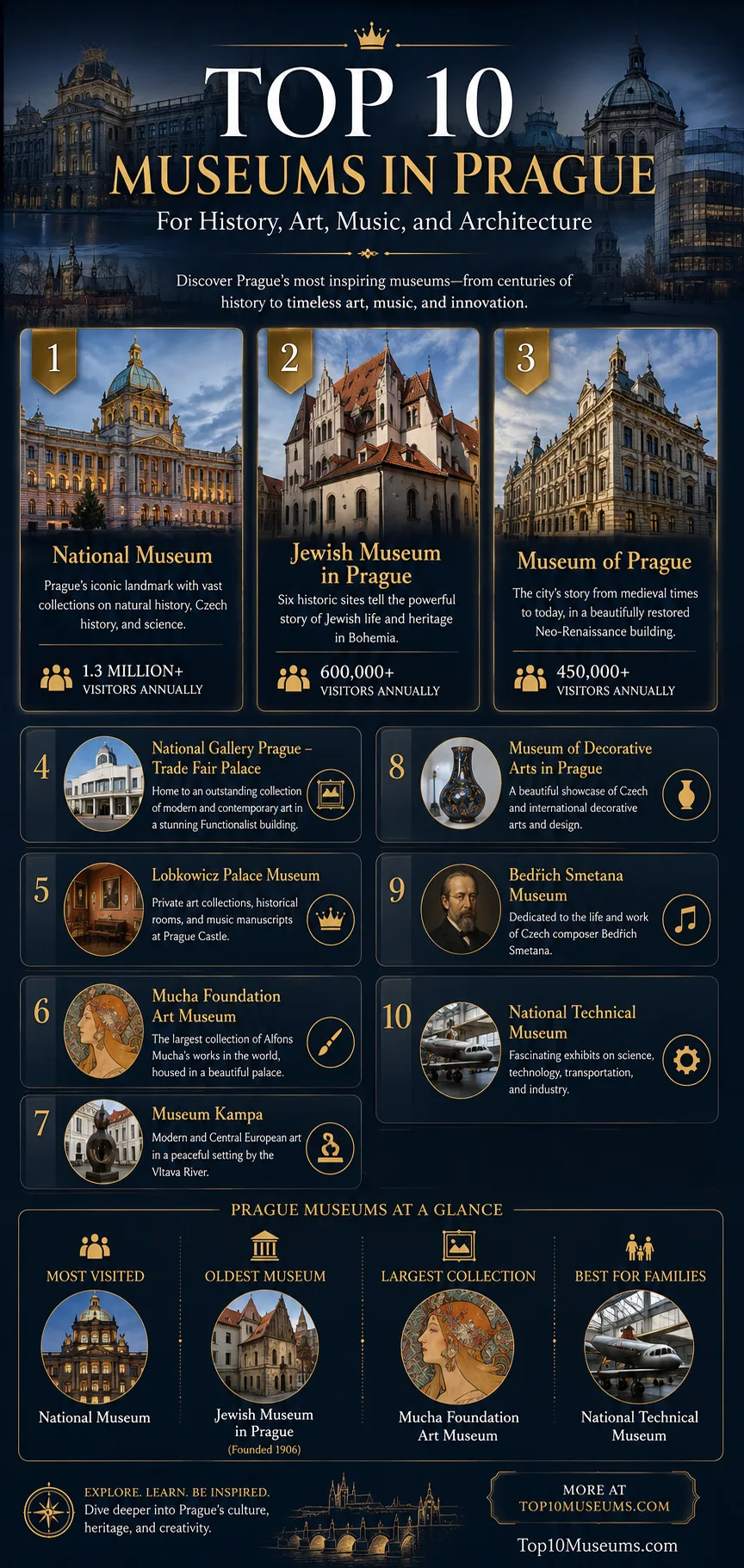
Prague’s museum landscape is shaped as much by its buildings as by the collections inside them. Czech history fills a domed Neo-Renaissance landmark, medieval panels hang in a Gothic convent, modern art occupies a vast Functionalist palace, and music manuscripts remain inside aristocratic rooms at Prague Castle. First-time visitors seeking the broadest introduction should begin with the National Museum, the Jewish Museum in Prague, and the recently renewed Museum of Prague. The other choices become stronger when the visit has a clear focus: painting, Art Nouveau, music, design, architecture, or technology.
[ayaz_safe_content id=”3143″ key=”p3143b142oouyrv”]
| Rank | Name | Founded | Collection Type | Website |
|---|---|---|---|---|
| 1 | National Museum | 1818 | Czech history and natural history | Official site |
| 2 | Jewish Museum in Prague | 1906 | Jewish history, religion, and memory | Official site |
| 3 | Museum of Prague | 1881 | Prague history and urban development | Official site |
| 4 | National Gallery Prague — Trade Fair Palace | 1796 | Modern and contemporary art | Official site |
| 5 | Lobkowicz Palace Museum | 2007 | Old Masters, music, and aristocratic collections | Official site |
| 6 | Mucha Foundation Art Museum | 2025 | Alphonse Mucha and Art Nouveau | Official site |
| 7 | Museum Kampa | 2003 | Czech and Central European modern art | Official site |
| 8 | Museum of Decorative Arts in Prague | 1885 | Design, glass, fashion, and applied arts | Official site |
| 9 | Bedřich Smetana Museum | 1926 | Classical music and composer archives | Official site |
| 10 | National Technical Museum | 1908 | Transport, engineering, and industrial history | Official site |
2026 museum update: The Czech Museum of Music is closed from June 29 through December 31, 2026 while work is carried out on the lantern above its dome. It is therefore not ranked among the ten currently available choices. The Bedřich Smetana Museum offers a composer-focused alternative, while the Lobkowicz Palace Museum combines music manuscripts, paintings, and live chamber concerts.
Prague’s Strongest Museums by Collection and Setting
A ranking cannot remove the basic differences between these institutions. The National Museum and National Technical Museum can each occupy much of a day. The Bedřich Smetana Museum is compact. The Jewish Museum is a route through several historic sites rather than a visit to one exhibition building. National Gallery Prague presents a different problem: its collections are divided among palaces, a medieval convent, and the Trade Fair Palace.
The order below weighs permanent collections, connection to Prague or Czech culture, architectural interest, visit quality, and usefulness for a first or second trip. Temporary exhibitions may add another reason to visit, but they do not determine the ranking.
1. National Museum
The National Museum stands at the upper end of Wenceslas Square, where its dome, long façade, and broad staircase give it the role of a civic monument before a ticket is even checked. The institution began in 1818, while the current Historical Building opened in 1891. Architect Josef Schulz designed the building in the Neo-Renaissance style, with a central Pantheon, painted ceilings, sculpture, stone columns, and a ceremonial staircase suited to the national ambitions of the period.
The museum’s scale allows Czech history and natural history to be viewed within one complex. The historical displays trace the Czech lands through political change, religion, dynasties, war, industry, and the formation of the modern state. Archaeological material and royal objects sit alongside sections dealing with the 19th and 20th centuries. A connecting corridor links the Historical Building with the former Federal Assembly building, creating a sharp architectural transition between ornate national symbolism and postwar modernism.
Natural history remains one of the main reasons families choose the museum. The Miracles of Evolution exhibition contains about 1,500 objects, including the institution’s fin whale skeleton. Mineral galleries and displays on animals, evolution, and prehistory widen the visit far beyond Czech political history. The museum can become tiring when treated as a room-by-room completion exercise. A better approach is to choose two main interests and allow time for the Pantheon and interior architecture between them.
The full complex suits a visit of at least two and a half hours. Three to four hours is more realistic when history and natural history are both priorities. Families planning to use the separate Children’s Museum should check timed-entry availability before arriving, especially on weekends and school holidays.
Best for: First-time visitors wanting Czech history, natural history, and monumental architecture in one place
Nearby alternative: Antonín Dvořák Museum — a smaller composer museum in a Baroque villa, around a fifteen-minute walk from the National Museum.
2. Jewish Museum in Prague
The Jewish Museum is spread across Josefov, the former Jewish Town. Its historic synagogues, cemetery, memorial spaces, and exhibitions form a walking route through the district rather than a conventional museum arranged around one central hall. The institution was founded in 1906 as sections of the old quarter were being demolished during urban renewal. Its early work preserved objects from synagogues that would otherwise have disappeared with the surrounding streets.
The current visitor route brings together sites with different purposes. The Maisel Synagogue introduces Jewish life in the Czech lands through historical objects and documents. The Spanish Synagogue, built in 1868, carries the story into the period of emancipation, cultural participation, and the 20th century. Its richly patterned interior can easily draw attention away from the exhibition, so time is needed for both the architecture and the historical material.
The Pinkas Synagogue works as a memorial rather than a normal gallery. The names of Jewish victims from Bohemia and Moravia cover its walls, while drawings made by children imprisoned in the Terezín ghetto restore individual experiences to a history often described through totals. The change in tone is immediate. Visitors should avoid treating this part of the route as a short passage between more photogenic interiors.
The Old Jewish Cemetery was used between 1439 and 1787 and contains more than 12,000 visible tombstones. Limited space and religious rules protecting existing graves led to burials being placed in layers. The crowded stones therefore record both belief and the physical limits imposed on the community. The Old-New Synagogue adds a different perspective because it remains an active place of worship as well as one of Europe’s oldest surviving synagogues.
Allow about two and a half to three hours for the main route. The sites are close together, but security procedures, narrow interiors, and the emotional weight of the Pinkas Synagogue affect the pace. The museum closes on Saturdays and Jewish holidays, which can determine the order of an entire Prague museum itinerary.
Best for: Visitors seeking Jewish history through preserved religious sites, objects, and memorial spaces
Nearby alternative: Convent of St Agnes of Bohemia — a National Gallery site where medieval art is displayed inside one of Prague’s oldest Gothic monastic complexes.
3. Museum of Prague
The Museum of Prague offers the clearest explanation of how the city itself changed. The institution was founded in 1881, and its main building at Florenc opened in 1900. After a five-year renewal, the building reopened to visitors on December 6, 2025 with new digital interpretation, restored interiors, and a redesigned presentation of its best-known object.
Antonín Langweil began constructing his paper model of Prague in 1826 and worked on it until 1837. The finished model covers about 20 square metres and records more than 2,000 buildings across the Old Town, Lesser Town, Prague Castle, and the former Jewish Town. Windows, doors, façades, courtyards, roofs, and even damaged surfaces were reproduced by hand.
The model matters because much of the city it records no longer exists. Hundreds of houses disappeared during redevelopment in the late 19th and early 20th centuries, especially in Josefov and adjoining parts of the Old Town. Comparing the model with present-day Prague reveals altered street widths, removed courtyards, vanished lanes, and the scale of neighbourhood clearance. It functions as architectural evidence rather than a decorative miniature.
The renewed presentation uses projections and immersive media to enlarge details that were once difficult to inspect through the display case. Other rooms introduce life in 19th-century Prague through archaeology, architecture, historical objects, and reconstructed stories. The technology works best when it returns attention to the original objects instead of becoming the main event.
The distinction between this museum and the National Museum is useful. The National Museum explains the Czech lands and their institutions. The Museum of Prague concentrates on the physical city: buildings, districts, residents, infrastructure, and the consequences of urban change. Around two hours is enough for a focused visit, though close study of the Langweil model can extend that time.
Best for: Urban-history readers, architecture travelers, and anyone trying to understand how Prague’s street pattern evolved
Nearby alternative: Museum of Communism — a private historical museum near Náměstí Republiky dealing with everyday life and state control in communist Czechoslovakia.
4. National Gallery Prague — Trade Fair Palace
National Gallery Prague does not have one central museum building. Its medieval, Old Master, modern, and contemporary collections occupy several sites, each with its own architectural character. The Trade Fair Palace is the strongest single choice for modern art and for visitors interested in 20th-century architecture.
The palace was built between 1925 and 1928 to designs by Josef Fuchs and Oldřich Tyl. Long horizontal windows, reinforced concrete, open galleries, and a vast central hall place the building among the defining works of Czech Functionalism. It originally served international trade fairs. After a major fire in 1974 and a long reconstruction, it reopened as a gallery site in 1995.
The permanent displays concentrate on modern Czech and European art, with changing sections extending into contemporary practice. Czech painting, sculpture, photography, and design gain more meaning here when seen against the political shifts of the 20th century. The building itself controls the pace. Galleries unfold around tall internal spaces, and moving between levels can take longer than the map suggests.
Visitors seeking another period should choose a different National Gallery building rather than expecting the Trade Fair Palace to cover the full collection. The Convent of St Agnes of Bohemia is the better choice for medieval art. Schwarzenberg Palace presents Old Masters in a Renaissance setting, while Sternberg Palace offers European painting in smaller palace rooms near Prague Castle.
A selective Trade Fair Palace visit takes about two hours. Art students, modernism specialists, and architecture-focused visitors can easily remain for half a day. Its scale also makes it a poor addition after another large museum unless both visits are deliberately narrowed.
Best for: Modern-art visitors who also want to experience Czech Functionalist architecture
Nearby alternative: Lapidarium of the National Museum — a seasonal museum at the Prague Exhibition Grounds containing original stone sculptures and architectural fragments.
5. Lobkowicz Palace Museum
Lobkowicz Palace is the only privately owned palace within the Prague Castle complex. Built in the 16th century and later altered in the Baroque period, it returned to the Lobkowicz family in 2002 after confiscation under both Nazi occupation and communist rule. The restored museum opened to the public in 2007.
The collection was assembled by one family across generations, so paintings, musical documents, arms, ceramics, furniture, and household objects remain connected by patronage and inheritance. Works associated with Pieter Bruegel the Elder, Canaletto, and Diego Velázquez share the galleries with decorative arts and objects related to the political history of Bohemia.
Music is one of the palace’s strongest subjects. Annotated scores, manuscripts, and early editions linked to Beethoven, Mozart, and other composers show how aristocratic support shaped European musical life. Beethoven’s relationship with the family gives the documents a context that a general display of composer memorabilia would lack.
The audio guide is unusually useful because members of the family and collection specialists explain how individual objects survived war, seizure, dispersal, and restitution. The personal narration suits a collection built around family history, though visitors interested mainly in painting can follow a shorter route through the principal galleries.
A normal museum visit takes about ninety minutes. Daily chamber concerts in the 17th-century concert hall create a natural extension for music-focused visitors, but the concert should be planned as a separate event rather than treated as background entertainment. Time must also be allowed for Prague Castle security and the walk through the complex.
Best for: Visitors interested in Old Masters, Beethoven manuscripts, aristocratic collecting, and palace interiors
Nearby alternative: Prague Castle Picture Gallery — a smaller collection of European painting within the castle complex, reached without leaving the main grounds.
6. Mucha Foundation Art Museum
The Mucha Foundation Art Museum opened in 2025 inside the restored Savarin Palace on Na Příkopě. It is the Prague museum endorsed by the Mucha Foundation and the artist’s family. This distinction matters because another venue using the Mucha name continues to operate at Kaunitz Palace. The museum ranked here is the Savarin Palace institution.
Alphonse Mucha is often reduced to ornamental posters of women surrounded by flowers, halos, and decorative lettering. Those works are central to his fame, especially the posters made for actor Sarah Bernhardt, but the museum places them beside paintings, pastels, drawings, book designs, photographs, sculpture, personal material, and studies connected with larger projects.
The exhibition examines the creation of the visual language known as “Le Style Mucha” as well as the artist’s ideas about Czech identity, Slavic history, education, and social harmony. The move between commercial Parisian work and later cultural projects prevents Art Nouveau from appearing as a purely decorative episode.
Visitors expecting to see the complete Slav Epic should adjust that expectation. The twenty monumental canvases are not installed here as a full cycle. The museum instead uses studies, documents, projections, and interpretive material to explain the work’s creation and themes. The selection at Savarin Palace is broad enough to show Mucha as an illustrator, painter, photographer, designer, and public thinker without pretending that every major work is present.
The palace interiors and contemporary exhibition design make this a manageable visit of about ninety minutes. It pairs well with another central museum, but dense display text may extend the visit for anyone studying illustration, graphic design, or the relationship between art and national identity.
Best for: Art Nouveau enthusiasts and visitors seeking a broader view of Alphonse Mucha than his poster designs
Nearby alternative: House of Photography — a Prague City Gallery venue near Revoluční Street with changing exhibitions devoted to Czech and international photography.
7. Museum Kampa
Museum Kampa occupies Sova’s Mills on the edge of Kampa Island, where a former industrial site has been adapted for modern art. Its riverside setting is visually memorable, but the main reason to visit is the Jan and Meda Mládek collection of Czech and Central European art.
František Kupka forms the centre of the permanent display. His work is arranged to show the gradual move away from figuration toward non-objective painting rather than presenting abstraction as a sudden invention. Studies and transitional works reveal how he tested line, rhythm, colour, movement, and the organisation of the painted surface. The permanent presentation includes more than seventy works, with paintings such as Amorpha — Warm Chromatic, The Cathedral, and The Form of Yellow among its reference points.
Otto Gutfreund’s sculpture adds a second account of Czech modernism. His Cubist forms translate fragmented planes into three dimensions, while later work shows another direction in his career. Jiří Kolář and artists working under state socialism or in exile extend the collection beyond the early avant-garde.
Meda Mládková’s collecting activity also carries political meaning. She and Jan Mládek supported artists whose work had limited visibility in communist Czechoslovakia, building parts of the collection while living abroad. The museum therefore records patterns of exile, censorship, private support, and cultural return alongside formal changes in art.
Allow ninety minutes to two hours for the permanent rooms and one temporary exhibition. The adapted mill contains level changes and irregular circulation, so it feels smaller and less predictable than the Trade Fair Palace. It works particularly well after a morning at Prague Castle because the art and building offer a clear change of scale.
Best for: Visitors interested in František Kupka, Czech abstraction, and Central European art under political pressure
Nearby alternative: Karel Zeman Museum — a compact film museum near Charles Bridge exploring practical effects, animation, and the sets of the Czech director.
8. Museum of Decorative Arts in Prague
The Museum of Decorative Arts asks visitors to study objects that are often separated from fine-art narratives: glass, furniture, clothing, ceramics, jewellery, metalwork, clocks, books, posters, toys, and household design. Founded in 1885, it occupies a purpose-built museum completed around the turn of the 20th century beside the Old Jewish Cemetery.
Josef Schulz, who also designed the National Museum, gave this building a Neo-Renaissance exterior with a Baroque-influenced entrance balcony. Reliefs on the façade depict crafts such as weaving, printing, glassmaking, metalwork, pottery, and bookbinding. The decoration introduces the museum’s central claim before entry: skilled production deserves the same attention as painting and sculpture.
The permanent exhibition, ART, LIFE. ART FOR LIFE, follows the relationship between material, technique, use, and social taste. Bohemian glass receives close attention, but it is not presented as a row of luxury souvenirs. Changes in cutting, colour, chemistry, production, and design show how craft and industry affected one another.
Furniture and interiors reveal class, domestic habits, and manufacturing methods. Fashion shows how the body was reshaped by different ideals. Posters, typography, photography, and book design connect visual culture with commerce and public communication. These sections make the museum especially useful for designers because they explain why an object looks the way it does and how it was meant to function.
Czech Cubism continues at the museum’s House at the Black Madonna branch rather than inside the main building. That separate display brings together Cubist furniture, ceramics, graphics, and interiors within Josef Gočár’s Cubist architecture. Visitors with a strong design focus should treat the two sites as a pair and reserve at least half a day.
Best for: Design students and visitors interested in Bohemian glass, fashion, furniture, typography, and Czech Cubism
Nearby alternative: House at the Black Madonna — the museum’s Old Town branch, where Czech Cubist design is displayed inside a Cubist landmark.
9. Bedřich Smetana Museum
The Bedřich Smetana Museum is small enough to fit into an Old Town walk, yet its subject connects music, Czech cultural identity, theatre, and the Vltava. The museum was established in 1926 and opened its permanent exhibition in the current building in 1936.
The Neo-Renaissance building was constructed in 1883–1884 as the Old Town waterworks. Antonín Wiehl designed it, while sgraffito decoration based on work by Josef Ženíšek and Mikoláš Aleš covers the exterior. Its position beside the river and Charles Bridge is especially apt for a museum devoted to the composer of Vltava, the second symphonic poem in the cycle Má vlast.
Manuscripts, letters, portraits, printed documents, personal possessions, and theatre material trace Smetana’s career. The display explains his involvement with Czech-language opera, the National Theatre, and works including The Bartered Bride, Libuše, and Má vlast. Documents connected with composition are more informative than the personal relics when the aim is to understand how individual works developed.
An interactive conductor’s podium allows visitors to select musical extracts using a special baton directed toward display stands. The device is simple, but it gives sound a structural role in an exhibition that would otherwise depend heavily on manuscripts and written explanation.
Most visits take forty-five to seventy-five minutes. The building is not wheelchair accessible, an important limitation for route planning. During the Czech Museum of Music’s 2026 closure, this is the most direct central choice for a museum devoted specifically to a Czech composer.
Best for: Classical-music visitors seeking a focused account of Smetana’s life, manuscripts, and major works
Nearby alternative: Charles Bridge Museum — a very close historical museum examining the medieval bridge, its construction, and the earlier Judith Bridge.
10. National Technical Museum
The National Technical Museum began in 1908 and has occupied its monumental Letná building since the 1940s. Its main transport hall creates the first impression: automobiles, motorcycles, bicycles, aircraft, locomotives, and suspended objects are arranged across several levels, turning the engineering displays into an architectural composition.
The Transportation exhibition follows changes in road, rail, air, water, and emergency vehicles. Czech manufacturers receive close attention, but the galleries also explain how new machines altered speed, production, travel, and urban life. Children often concentrate on the largest vehicles. Adults interested in design can compare body shapes, materials, mechanical layouts, and the way manufacturers presented technological progress.
The rest of the museum is broader than the transport hall suggests. Permanent exhibitions cover astronomy, time measurement, photography, printing, architecture, construction, mining, metallurgy, chemistry, household technology, television, and communication. A reconstructed ore and coal mine creates a different type of display, while the architecture galleries use plans, models, fragments, and engineering documents to connect design with construction methods.
In June 2026, the institution opened a new Postal Museum presentation at Vávra’s Mill in the Old Town. That separate site examines postal technology, telecommunications, stamps, the telegraph, telephone systems, and the shift from stagecoaches to airmail. It also restores access to Biedermeier rooms with wall paintings made by Josef Navrátil in 1847. It should be treated as an additional museum visit rather than another floor of the Letná building.
Two and a half hours is a practical minimum for the main museum. Families and transport specialists can remain considerably longer. Trying to combine every permanent exhibition in one visit leads to rapid fatigue, so it is better to choose the transport hall plus two or three supporting subjects.
Best for: Families, transport enthusiasts, engineering readers, and visitors who prefer large objects to painting galleries
Nearby alternative: National Agricultural Museum — a neighbouring institution covering farming, food production, forestry, fishing, and agricultural machinery.
Museum Routes That Avoid Repeated Cross-City Travel
Josefov and the Old Town: Memory, Design, and Music
Begin with the Jewish Museum in Prague because its route takes the most time and its Saturday and holiday closures affect planning. Allow the morning for the synagogues and Old Jewish Cemetery. The Museum of Decorative Arts is only a short walk away and works well as an afternoon visit because its focus shifts from religious and community history to objects, materials, and design.
The Bedřich Smetana Museum can be added near the end of the day when opening hours permit. Its compact exhibition and riverside location require less concentration than another large historical museum. Attempting to add the entire House at the Black Madonna Cubism display to the same schedule would make the route rushed; that branch is better reserved for a separate design-focused day.
Prague Castle and Kampa: Collections Formed Outside State Museums
Visit Lobkowicz Palace in the morning, allowing extra time for castle security and the uphill journey. The museum itself usually takes about ninety minutes. A concert extends the castle portion of the day and may leave too little time for a detailed second museum.
Museum Kampa is the natural later stop. The route descends through Malá Strana toward the river, and the contrast is clear: aristocratic collecting and Old Masters at the palace, followed by Kupka, Gutfreund, exile, and Czech modernism in a converted mill. Both are art museums, but they demand different kinds of attention.
Letná and Holešovice: Machines or Modern Art
The National Technical Museum and the Trade Fair Palace occupy the same northern part of central Prague, but both are large. A full day can include them only through selective routes. One practical plan is to spend the morning in the National Technical Museum’s transport hall, architecture section, and one specialist gallery, then move to the Trade Fair Palace for a chosen period or temporary exhibition.
Visitors who read every label, travel with children, or study modern art should place the museums on separate days. The National Agricultural Museum can replace the Trade Fair Palace for a shorter, family-oriented pairing because it stands beside the technical museum.
Two Different Accounts of Prague and the Czech Lands
The National Museum and Museum of Prague answer different historical questions. Start at the National Museum for the development of the Czech lands, natural history, national institutions, and political change. Move to Florenc later for the Langweil model and the physical transformation of Prague.
This pairing is realistic only when the National Museum visit is limited to selected galleries. A long natural-history visit followed by every historical room leaves too little energy for close study of the city model. Visitors with two days should divide the museums and use the second afternoon for the Mucha Foundation Art Museum or another compact central collection.
Museum Architecture Across Six Prague Styles
- Gothic monastic architecture: The Convent of St Agnes places medieval panels and sculpture in a setting created within the same religious culture. Stone passages, chapels, and changing ceiling heights affect how the works are read.
- Renaissance palace architecture: Schwarzenberg Palace uses a sgraffito-covered noble residence for Old Master displays. Its domestic scale differs sharply from the open floors of the Trade Fair Palace.
- Baroque palace interiors: Lobkowicz Palace and Savarin Palace preserve aristocratic settings, though the museums use them differently. Lobkowicz connects objects to family patronage, while Savarin contains a contemporary exhibition design devoted to one artist.
- Neo-Renaissance civic museums: The National Museum, Museum of Prague, Museum of Decorative Arts, and Bedřich Smetana Museum belong to a period when public institutions used historical styles to express education, cultural confidence, and civic identity.
- Functionalism: The Trade Fair Palace rejects applied ornament in favour of reinforced concrete, long windows, open circulation, and large internal volumes. The building remains part of the modern-art experience.
- Industrial conversion: Museum Kampa retains the identity of Sova’s Mills while adapting the site for galleries. Uneven circulation and surviving structural traces distinguish it from purpose-built exhibition halls.
Which Museums Deserve the Most Time?
Allow three hours or more: The National Museum, Jewish Museum in Prague, National Technical Museum, and Trade Fair Palace can each absorb half a day. Their size, multi-part routes, or dense permanent displays make rushed visits less rewarding.
Allow about two hours: Museum of Prague, Museum Kampa, and the Museum of Decorative Arts fit comfortably into a half-day pairing when only one temporary exhibition is added.
Allow about ninety minutes: Lobkowicz Palace Museum and the Mucha Foundation Art Museum are concentrated enough for a second museum on the same day. Concert attendance at Lobkowicz Palace changes that calculation.
Allow about one hour: The Bedřich Smetana Museum is the easiest main-list choice to place between Old Town activities. Its limited accessibility and Tuesday closure should still be checked before building a route around it.
Choosing by Subject Rather Than Rank
- Czech national history: Choose the National Museum for the broadest historical account.
- Prague’s changing streets and neighbourhoods: Choose the Museum of Prague and spend time with the Langweil model.
- Jewish history and religious heritage: Choose the Jewish Museum in Prague and reserve most of a morning.
- Medieval art: Visit the National Gallery’s Convent of St Agnes rather than the Trade Fair Palace.
- Modern Czech painting and sculpture: Pair the Trade Fair Palace with Museum Kampa.
- Art Nouveau: Choose the Mucha Foundation Art Museum at Savarin Palace.
- Classical music manuscripts: Choose Lobkowicz Palace for several composers or the Bedřich Smetana Museum for one composer.
- Glass, furniture, fashion, and graphic design: Choose the Museum of Decorative Arts and consider its House at the Black Madonna branch.
- Transport and engineering: Choose the National Technical Museum and limit the visit to a few main subjects.
- Museum buildings: The National Museum, Trade Fair Palace, Convent of St Agnes, and Lobkowicz Palace offer the strongest architectural contrasts.
Prague Museum Questions
Is National Gallery Prague one museum building?
No. Its collections are divided among several buildings. Trade Fair Palace is the main choice for modern and contemporary art, the Convent of St Agnes for medieval art, and the Schwarzenberg and Sternberg palaces for Old Masters.
Which museum gives the best introduction to Czech history?
The National Museum provides the broadest national account. The Museum of Prague is better when the main interest is the capital’s streets, architecture, neighbourhoods, and urban redevelopment.
Are the Jewish Museum sites inside one building?
No. The museum route crosses several historic synagogues and the Old Jewish Cemetery within Josefov. The sites are close together, but the full visit usually takes at least two and a half hours.
Which Mucha museum appears in this ranking?
The listed institution is the Mucha Foundation Art Museum at Savarin Palace, Na Příkopě 10. Prague also has an older venue using the Mucha name at Kaunitz Palace, so the address should be checked before departure.
Which Prague museum is best for classical music?
Lobkowicz Palace is the stronger choice for music patronage, Beethoven and Mozart manuscripts, palace rooms, and live chamber concerts. The Bedřich Smetana Museum offers a smaller exhibition devoted to one Czech composer and his works.
Is the Czech Museum of Music open in 2026?
It is closed from June 29 through December 31, 2026 because of work on the building’s dome lantern. The Bedřich Smetana Museum and Lobkowicz Palace Museum remain the main music-related alternatives in central Prague during that period.
Which museums work best for families?
The National Technical Museum is the easiest choice for children drawn to aircraft, trains, cars, machines, and large physical objects. The National Museum adds natural history and a separate Children’s Museum, though timed entry may be needed for the children’s area.
Can the National Technical Museum and Trade Fair Palace be visited on the same day?
Yes, but only through selective visits. Both museums are large. A practical plan limits the technical museum to the transport hall and two supporting sections, then reserves the afternoon for one period or exhibition at the Trade Fair Palace.