
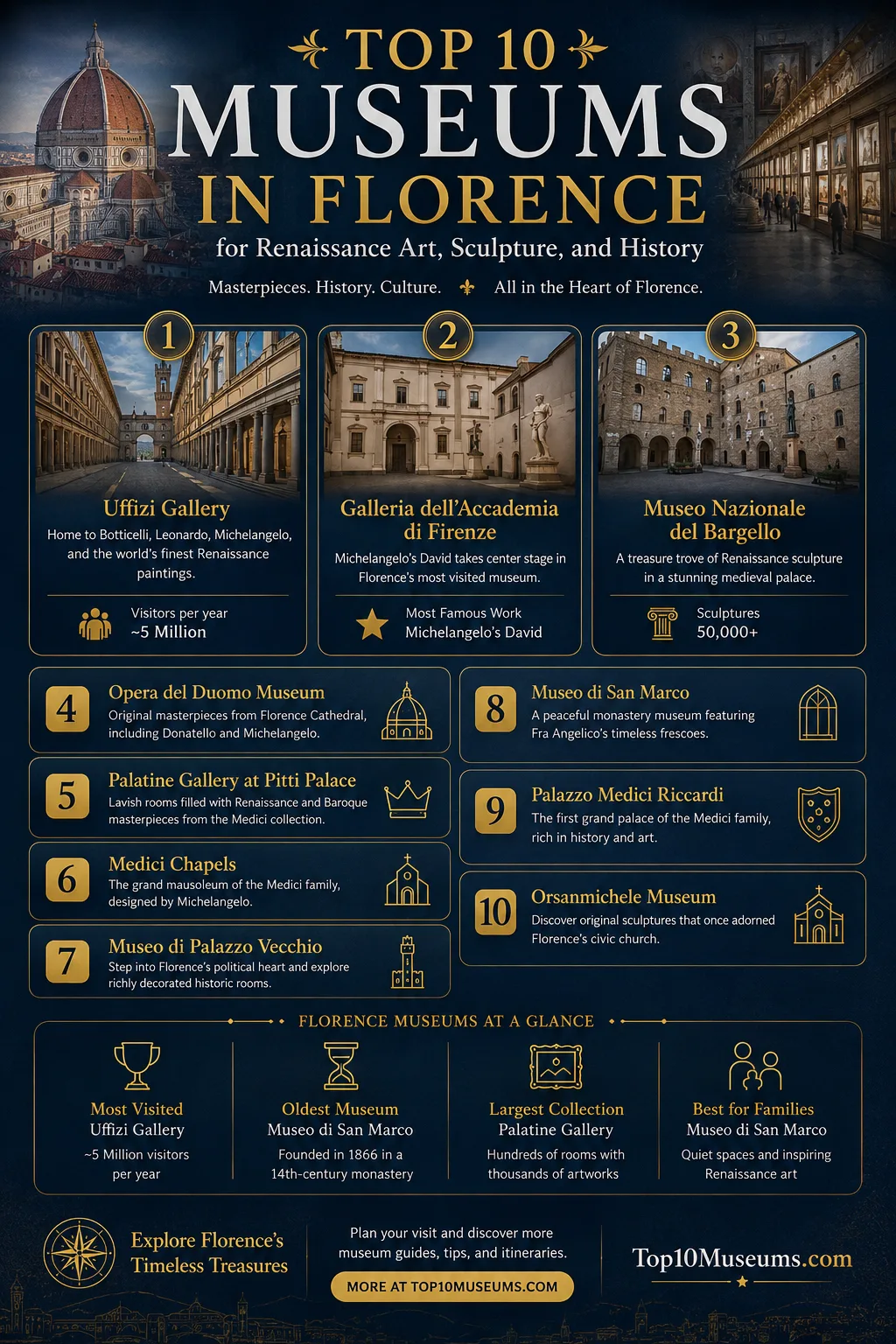
Florence places its Renaissance story across galleries, churches, palaces, former government rooms, and monastic cells. The Uffizi traces changes in painting, the Accademia concentrates attention on Michelangelo, the Bargello allows close comparison of sculptors, and the city’s palace museums explain who commissioned the art and why. Choosing among them is less about finding a single “best” collection than deciding which part of Florentine art and history deserves the most time.
[ayaz_safe_content id=”3145″ key=”p3145b1bplyrdkw”]
| Rank | Name | Founded | Collection Type | Website |
|---|---|---|---|---|
| 1 | Uffizi Gallery | 1769 | Renaissance painting and dynastic collections | Official site |
| 2 | Galleria dell’Accademia di Firenze | 1784 | Michelangelo sculpture and Florentine painting | Official site |
| 3 | Museo Nazionale del Bargello | 1865 | Italian Renaissance sculpture and decorative arts | Official site |
| 4 | Opera del Duomo Museum | 1891 | Cathedral sculpture, doors, and architectural history | Official site |
| 5 | Palatine Gallery at Pitti Palace | 1828 | Medici and grand-ducal picture collection | Official site |
| 6 | Medici Chapels | 1869 | Medici tombs and Michelangelo sculpture | Official site |
| 7 | Museo di Palazzo Vecchio | 1299 (palace begun) | Civic government, Medici rooms, and court decoration | Official site |
| 8 | Museo di San Marco | 1869 | Fra Angelico frescoes and Dominican history | Official site |
| 9 | Palazzo Medici Riccardi | 1444 (palace commissioned) | Medici residence, Renaissance architecture, and frescoes | Official site |
| 10 | Orsanmichele Museum | 1996 | Guild sculpture in its original architectural setting | Official site |
Why Florence’s Renaissance Cannot Be Seen in One Museum
The city’s collections divide naturally into four strands. Uffizi and San Marco show how Florentine painting moved from devotional images toward convincing space, individual expression, classical subjects, and larger human figures. Accademia, Bargello, Opera del Duomo, and Orsanmichele explain sculpture through marble, bronze, wood, competition panels, public niches, and unfinished surfaces.
Palazzo Vecchio, the Medici Chapels, and Palazzo Medici Riccardi supply the political setting. Their rooms, façades, tombs, and fresco cycles reveal how republican institutions, merchant guilds, and the Medici family used art to shape public identity. Pitti Palace adds the later court collection, where paintings remain surrounded by decorated ceilings, furniture, silk wall coverings, and ceremonial rooms.
A first visit usually starts with Uffizi and Accademia. A sculpture-led trip gains more from Bargello and Opera del Duomo. Visitors who already know the famous paintings often find San Marco, Orsanmichele, and Palazzo Medici Riccardi more focused because the works remain closely tied to the spaces and patrons for which they were made.
Ten Florence Museums That Explain the Renaissance from Different Angles
1. Uffizi Gallery
The Uffizi offers the clearest long view of Florentine painting. Rather than moving directly to Botticelli, begin with the earlier altarpieces. Gold backgrounds, flattened space, and fixed devotional poses gradually give way to weightier bodies, architectural depth, landscape, and recognizable emotion. That sequence makes later rooms easier to understand.
Botticelli’s Primavera and The Birth of Venus sit within a broader change in subject matter. Classical poetry, myth, courtly culture, and Medici patronage enter a collection previously dominated by Christian commissions. Leonardo’s Adoration of the Magi, Michelangelo’s Doni Tondo, and works by Raphael then show painters testing movement, anatomy, grouped figures, and monumental scale.
The gallery opened to the public as a museum in 1769, and its historic Lorraine Staircase returned to use in March 2026 after years of closure. The building is large enough to exhaust visitors who try to inspect every room. Two and a half to three hours works for a selective route; a slower chronological visit can take most of a morning or afternoon.
Best for: first-time visitors who want the strongest single survey of Florentine Renaissance painting
Nearby alternative: Museo Galileo — a few steps away, it replaces painting with instruments, experiments, and the scientific culture of Medici Florence.
2. Galleria dell’Accademia di Firenze
Michelangelo’s David controls the final approach through the Tribune, but the route toward it matters. The unfinished Prisoners expose drill marks, rough stone, emerging limbs, and changing decisions. They make the polished surfaces of David look less inevitable and turn the visit into a study of carving rather than a stop for one famous image.
David was carved between 1501 and 1504 and stands just over five metres high. The enlarged head and hands relate partly to its intended elevated position, while the concentrated gaze presents the figure before action rather than after victory. Seeing the sculpture from the side and rear clarifies the shifted weight, the supporting leg, and the controlled turn of the torso.
The museum also holds early Florentine paintings, musical instruments from Medici collections, and the nineteenth-century Gipsoteca with plaster models by Lorenzo Bartolini and other sculptors. These rooms are useful when crowds concentrate around David. Most visits need 75 to 120 minutes, though sculpture students can spend longer comparing finished marble, plaster, and incomplete stone.
Best for: visitors who want to study Michelangelo’s carving process as well as David
Nearby alternative: Museo dell’Opificio delle Pietre Dure — a short walk away, it explains how paintings, stone, and other materials are examined and conserved.
3. Museo Nazionale del Bargello
Bargello is the strongest place in Florence for comparing Renaissance sculptors across several generations. Donatello’s bronze David, Verrocchio’s bronze David, Michelangelo’s youthful Bacchus, Cellini’s bronzes, and Giambologna’s figures reveal how artists treated balance, surface, movement, youth, and classical models in sharply different ways.
The Brunelleschi and Ghiberti panels for the 1401 Baptistery door competition deserve unhurried comparison. Both show the Sacrifice of Isaac, yet they organize bodies, drapery, landscape, and emotional pressure differently. The panels provide a rare chance to inspect two solutions to the same commission beside one another rather than reconstructing the contest from reproductions.
The palace itself began as a civic and judicial building. Its stone courtyard, external stair, tower, and former halls give the collection a tougher setting than the ordered corridors of the Uffizi. Bargello opened as Italy’s first national museum in 1865. Allow about two hours, with more time for the Donatello, Michelangelo, and bronze rooms.
Four Florentine Davids, Four Ideas of Victory
| Artist | Material | What changes | Where to see it |
|---|---|---|---|
| Donatello, early David | Marble | A Gothic figure beginning to occupy space with greater independence | Bargello |
| Donatello, bronze David | Bronze | An intimate, ambiguous image of youthful victory | Bargello |
| Verrocchio, David | Bronze | A more alert figure with controlled confidence and crisp surface detail | Bargello |
| Michelangelo, David | Marble | A monumental defender shown before combat | Accademia |
Best for: sculpture-focused visitors who want direct comparisons among Donatello, Verrocchio, Michelangelo, Cellini, and Giambologna
Nearby alternative: Casa Buonarroti — roughly ten minutes east, it adds Michelangelo’s early reliefs Madonna of the Stairs and Battle of the Centaurs.
4. Opera del Duomo Museum
Many sculptures seen outside Florence Cathedral and the Baptistery are replicas placed there to protect the originals. Opera del Duomo Museum reunites those original works with models, reconstructions, and architectural displays that explain where they stood. This makes it the clearest museum for understanding the cathedral complex as a long sequence of commissions rather than a group of separate monuments.
Lorenzo Ghiberti’s original Gates of Paradise can be examined at close range without the distance and weather conditions of the Baptistery façade. Donatello’s wooden Penitent Magdalene rejects smooth ideal beauty in favour of age, deprivation, and an intense inward expression. Michelangelo’s unfinished Florentine Pietà, also known as the Bandini Pietà, belongs to his late career and carries visible evidence of alteration, damage, and abandonment.
A full-scale reconstruction of the cathedral’s lost medieval façade returns sculptures to their intended architectural levels. Nearby rooms then show Brunelleschi’s dome models, choir lofts by Donatello and Luca della Robbia, liturgical objects, and the building campaign that continued across centuries. The museum opened in 1891 and was radically redesigned in 2015. Plan for about two hours before adding a dome or bell-tower climb.
Best for: visitors interested in how sculpture, architecture, and cathedral commissions worked together
Nearby alternative: Museo della Misericordia di Firenze — directly on Piazza del Duomo, it presents the long history, artworks, and civic work of the Florentine confraternity.
5. Palatine Gallery at Pitti Palace
The Palatine Gallery does not arrange its paintings as a clean chronological lesson. Roughly five hundred works hang in former ceremonial rooms, surrounded by decorated ceilings, silk wall coverings, furniture, sculpture, and elaborate frames. The display follows the logic of a court collection, so visual density is part of the experience rather than a flaw to overcome.
Raphael is a central reason to visit. The Madonna del Granduca, Woman with a Veil, portraits, and larger devotional works show different stages of his Florentine and Roman development. Titian, Andrea del Sarto, Caravaggio, Rubens, and artists working for the Medici and later grand-ducal courts broaden the visit beyond Florentine fifteenth-century art.
The gallery opened to the public in 1828. It is best treated as a half-day palace visit rather than a smaller version of the Uffizi, especially when combined with the Royal Apartments or another Pitti collection. Restoration and room closures can alter the route. In 2026, the Room of the Iliad is temporarily closed from 30 June through 25 October, while other notices may affect individual rooms or works.
Planning note: Expect more walking and more visual competition than at Accademia or San Marco. Choose a few rooms or artists before arriving instead of trying to read every label.
Best for: visitors who want Renaissance and Baroque paintings inside a preserved court setting
Nearby alternative: Museum of Costume and Fashion — housed in the same palace, it shifts attention from painting to clothing, court dress, and Italian fashion history.
6. Medici Chapels
The Medici Chapels turn family memory into architecture. The visit begins below ground among tombs, continues through the vast Chapel of the Princes, and reaches Michelangelo’s New Sacristy. Each level uses different materials and scale, moving from burial records to dynastic display and then to a tightly controlled union of sculpture and architecture.
In the New Sacristy, Michelangelo designed the room and the tomb monuments together. The reclining figures known as Dawn, Dusk, Day, and Night do not operate as isolated statues. Their unstable poses, unfinished passages, and placement above the tombs connect time, bodily strain, death, and the continuation of the family name.
The Chapel of the Princes offers a different language: coloured stone, coats of arms, large ducal tombs, and a scale intended to outlast individual rulers. The complex became a state museum in 1869. A focused visit usually needs 60 to 90 minutes, but access controls and narrow passages can slow movement at busy times.
Best for: visitors studying Michelangelo’s tomb sculpture and the public image of the Medici dynasty
Nearby alternative: Museo de’ Medici — close to San Lorenzo, it uses portraits, objects, and family history to follow the dynasty beyond the chapel monuments.
7. Museo di Palazzo Vecchio
Palazzo Vecchio explains the political settings that produced many works now displayed elsewhere. Construction began in 1299 for Florence’s civic government. Later, Cosimo I de’ Medici transformed the building into a ducal residence, filling republican rooms with new decorative cycles that recast Florence’s history around Medici rule.
The Salone dei Cinquecento is the spatial centre of the visit. Its size reflects government assemblies, while Vasari’s later paintings and architectural changes belong to the ducal reworking of the hall. Smaller rooms dedicated to members of the Medici family connect myth, genealogy, military success, and territorial ambition through painted ceilings and wall decoration.
Francesco I’s Studiolo is a compact contrast to the great hall. Cabinets and paintings once organized rare materials, natural specimens, crafted objects, and images according to courtly ideas about nature and art. Access to some routes, including the tower, battlements, archaeological area, or hidden passages, can depend on separate tickets, weather, scheduled visits, or capacity. The main museum route usually takes 90 minutes to two hours.
Best for: visitors who want to connect Renaissance art with republican government and Medici court politics
Nearby alternative: Museo Horne — east of Piazza della Signoria, this quieter house museum presents Renaissance paintings, sculpture, furniture, and domestic objects.
8. Museo di San Marco
San Marco preserves Fra Angelico’s frescoes inside the Dominican convent for which they were painted. The setting changes how the work is read. A fresco in a narrow cell, made for prayer and contemplation, asks for a slower response than a large altarpiece hung among hundreds of paintings in a gallery.
The Annunciation appears at the top of the staircase, where architecture, natural light, painted columns, and the visitor’s approach work together. The dormitory contains frescoes across forty-four cells. Their repeated scenes of Christ, the Crucifixion, and Dominican devotion vary in composition and narrative detail without losing the restraint suited to monastic life.
Ground-floor rooms add Fra Angelico’s panel paintings, a large Crucifixion in the Chapter House, Michelozzo’s library, refectory frescoes, and rooms connected with Girolamo Savonarola. The convent was declared a national monument and partly converted into a museum in 1869. San Marco is manageable in 90 minutes, yet it rewards a quieter two-hour visit more than a rushed circuit.
Best for: visitors who want Fra Angelico’s frescoes in their original monastic setting
Nearby alternative: Museo degli Innocenti — a short walk across Piazza Santissima Annunziata, it combines Brunelleschi’s architecture with the history and art of a children’s institution.
9. Palazzo Medici Riccardi
Commissioned by Cosimo de’ Medici in 1444, the palace shows how a powerful banking family balanced wealth with a controlled public façade. Michelozzo’s rusticated stonework becomes lighter on the upper levels, while the courtyard introduces classical columns, round arches, sculpture, and carefully ordered proportions.
The Magi Chapel is the main artistic focus. Benozzo Gozzoli’s procession places richly dressed riders, animals, distant landscapes, sacred history, and portraits from the Medici circle inside a small private chapel. The room helps explain how religious imagery could also record alliances, status, family presence, and diplomatic spectacle.
The palace later passed to the Riccardi family, whose additions include the Baroque Gallery with a ceiling by Luca Giordano and collections of ancient marble. The museum is smaller than Uffizi or Pitti, but timed access and limited capacity in the Magi Chapel can shape the visit. Allow 60 to 90 minutes and do not expect every part of the working palace to be open to museum visitors.
Best for: visitors interested in Medici patronage, Renaissance palace design, and the Magi Chapel frescoes
Nearby alternative: Museo Novecento — about ten minutes toward Santa Maria Novella, it provides a clear change of period through Italian twentieth- and twenty-first-century art.
10. Orsanmichele Museum
Orsanmichele began as a grain-market building before becoming a church closely tied to Florence’s guilds. The guilds commissioned statues of their patron saints for exterior niches, turning the building into a public display of professional identity, religious duty, expense, and artistic competition.
The exterior now carries replicas, while the original sculptures are protected upstairs. Donatello, Ghiberti, Nanni di Banco, Verrocchio, Giambologna, and others can therefore be compared in relation to the niches and streets for which their works were designed. Bronze and marble respond differently to light, depth, drapery, and the need to be read from below.
The sculpture museum first opened to the public in 1996 and later underwent further restoration and reorganization. The upper floor also gives broad views across the historic centre, but the building’s vertical circulation and controlled opening pattern make current planning important. The collection itself is focused enough for about an hour, longer when the church and exterior niches are studied first.
Best for: visitors examining how guild patronage placed Renaissance sculpture into public streets
Nearby alternative: Museo di Palazzo Davanzati — several minutes west, it shifts from public guild identity to the rooms, furnishings, wall decoration, and routines of a wealthy Florentine household.
Florence Museum Routes That Avoid Repeating the Same Story
One Day for Painting and Michelangelo
Book the Accademia for the first morning slot and give the museum about 90 minutes. Walk south through the historic centre, leaving time for a break before a timed Uffizi entry in the early afternoon. Uffizi needs at least two and a half hours. Adding Pitti Palace on the same day usually turns three demanding collections into a rushed sequence.
One Day for Renaissance Sculpture
Begin at Opera del Duomo Museum, where the cathedral’s original sculptures and doors establish the religious and architectural setting. Continue to Orsanmichele to see how guild commissions occupied public niches. Finish at Bargello, about a five-minute walk away, with Donatello, Verrocchio, Michelangelo, Cellini, and Giambologna. The route works because each museum answers a different question: church building, street patronage, and sculptural comparison.
One Day for Medici Florence
Start with Palazzo Medici Riccardi and its Magi Chapel, then walk to the Medici Chapels at San Lorenzo. After lunch, continue to Palazzo Vecchio for the shift from family residence and burial monument to civic government and ducal rule. This route is compact, but three interiors are enough. Pitti Palace belongs on a second day because it represents a later, larger court and requires more walking.
Two Days for the Broadest Renaissance Sequence
Use the first day for Accademia in the morning and Uffizi after a substantial break. On the second day, choose Opera del Duomo Museum and Bargello for sculpture, then add either San Marco for frescoes or Palazzo Vecchio for political history. This produces a clearer sequence than visiting four major collections in one day, and it leaves space to look rather than simply pass through rooms.
Which Florence Museums Need Advance Planning?
- Uffizi Gallery: advance timed tickets are the safest choice during busy months. The Vasari Corridor requires a separate timed reservation and is entered from inside the Uffizi. Standard daytime scheduling places Uffizi admission two hours before the corridor slot.
- Galleria dell’Accademia: the concentration of visitors around David makes advance booking useful even though the overall museum is smaller than Uffizi.
- Palazzo Medici Riccardi: the Magi Chapel is a small room, so capacity and time controls can matter more than the size of the wider palace suggests.
- Palazzo Vecchio: the main museum and special areas do not always share the same access conditions. Tower, battlement, archaeological, or hidden-route visits may require separate booking or operate only at set times.
- Opera del Duomo Museum: the museum belongs to a larger cathedral-complex ticket system. Dome climbs require a reserved slot, while the museum itself should be planned around the validity and conditions of the selected pass.
- Orsanmichele: opening patterns and access routes can be more limited than at the major daily museums, so checking the official schedule shortly before visiting prevents a wasted walk.
Current Florence Museum Notes for 2026
The Uffizi’s historic Lorraine Staircase reopened in March 2026, restoring the monumental entrance associated with the museum’s public opening in 1769. The Vasari Corridor is again accessible only through controlled, timed visits. From 3 July to 20 November 2026, Friday evening corridor sessions run in addition to the standard daytime schedule, subject to mandatory reservation and available places.
At Pitti Palace, restoration and room maintenance can alter the Palatine Gallery route. The Room of the Iliad is scheduled to remain closed from 30 June through 25 October 2026. Individual works and rooms elsewhere in the palace may also be temporarily unavailable, so the current notice page matters more here than a fixed room-by-room itinerary.
The Bargello group currently includes Bargello, the Medici Chapels, Orsanmichele, Palazzo Davanzati, and Casa Martelli under one administration. Casa Martelli is closed for renovation from 10 March through 31 December 2026, which is why it is not used as a practical nearby substitute in the main list. Opening days and hours across the group can differ even when the museums are close together.
Choosing Three Museums by Interest
| Primary interest | Best three-museum combination | Reason for the pairing |
|---|---|---|
| First visit to Florence | Uffizi, Accademia, Opera del Duomo Museum | Painting, Michelangelo, and the cathedral’s original sculpture without repeating the same collection type |
| Renaissance sculpture | Bargello, Accademia, Orsanmichele | Studio process, public guild commissions, and close comparison of bronze and marble |
| Medici family and government | Palazzo Medici Riccardi, Medici Chapels, Palazzo Vecchio | Residence, burial, family image, and the conversion of civic rooms into a ducal palace |
| Painting beyond the most famous works | Uffizi, San Marco, Palatine Gallery | Chronological gallery display, frescoes in place, and a dense court collection |
| Michelangelo | Accademia, Medici Chapels, Bargello | David and the Prisoners, tomb sculpture, early works, and unfinished surfaces |
| Smaller, more focused visits | San Marco, Palazzo Medici Riccardi, Orsanmichele | Clear themes, strong architectural context, and less collection fatigue than the largest galleries |