
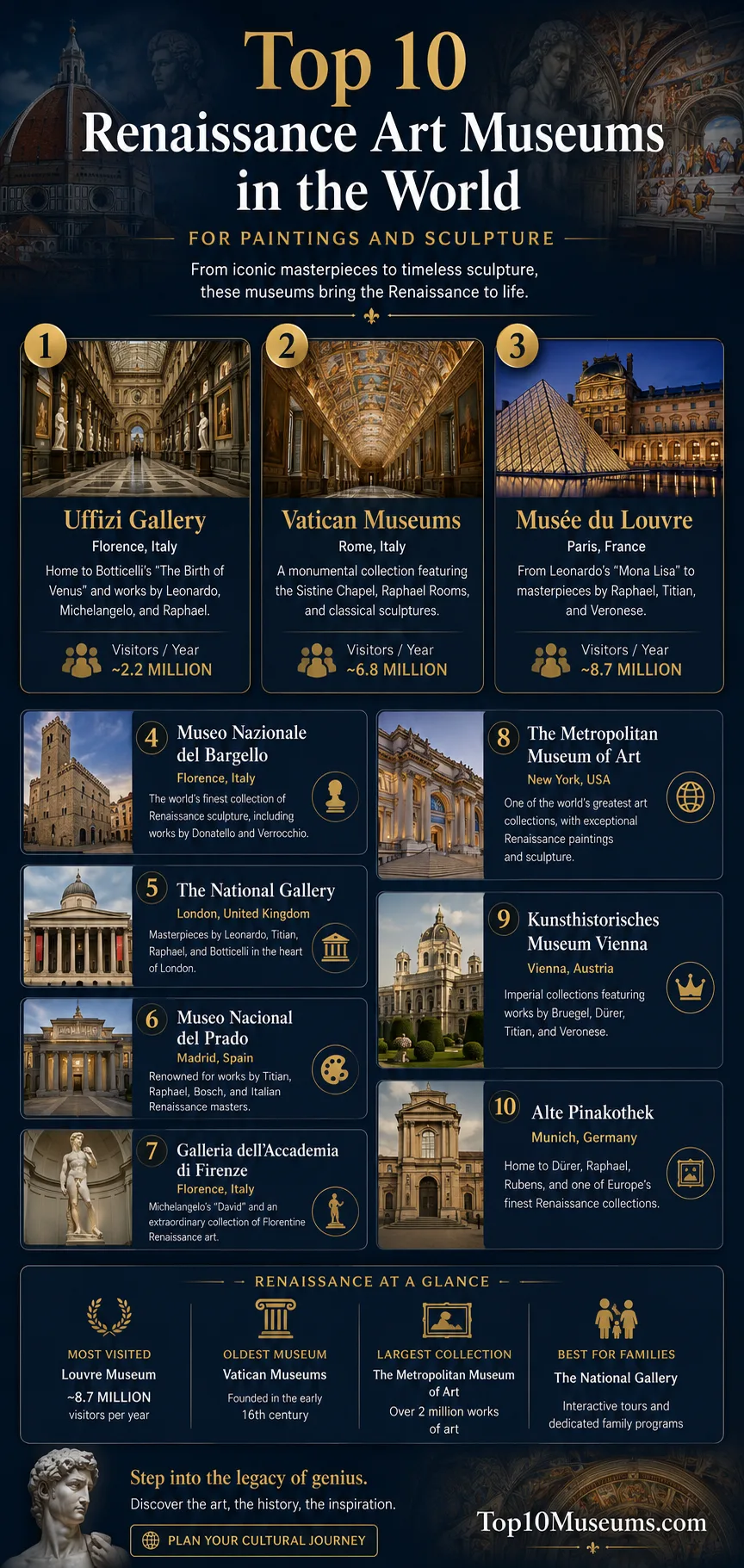
The closest visual sequence runs from early experiments in perspective to Botticelli, Leonardo and Michelangelo. The Vatican presents fresco as an architectural and political language; Madrid and Vienna reveal how royal collecting shaped the survival of Titian, Raphael and Dürer; and specialist sculpture museums make bronze and marble as central as painting. These ten museums are ranked by the strength of their permanent Renaissance holdings, the concentration of major works, the value of seeing related artists together and the clarity of the visit for someone choosing between painting, fresco and sculpture.
[ayaz_safe_content id=”3153″ key=”p3153b1lufhvtpy”]
| Rank | Name | Founded | Collection Type | Website |
|---|---|---|---|---|
| 1 | Uffizi Gallery | 1769 as a public museum | Florentine and Italian Renaissance painting | Official Site |
| 2 | Vatican Museums | 1506 collection nucleus | Fresco, papal rooms and Italian painting | Official Site |
| 3 | Musée du Louvre | 1793 | Italian painting and Renaissance sculpture | Official Site |
| 4 | Museo Nazionale del Bargello | 1865 | Italian Renaissance sculpture and decorative arts | Official Site |
| 5 | The National Gallery | 1824 | Italian and Northern Renaissance painting | Official Site |
| 6 | Museo Nacional del Prado | 1819 | Italian, Spanish and Northern court painting | Official Site |
| 7 | Galleria dell’Accademia di Firenze | 1784 | Michelangelo sculpture and early Italian painting | Official Site |
| 8 | The Metropolitan Museum of Art | 1870 | Painting, sculpture and Renaissance decorative arts | Official Site |
| 9 | Kunsthistorisches Museum Vienna | 1891 | Habsburg painting and Kunstkammer objects | Official Site |
| 10 | Alte Pinakothek | 1836 | Italian, German and Early Netherlandish painting | Official Site |
What Separates These Renaissance Collections
The ranking gives most weight to permanent collections rather than temporary exhibitions. A museum rises when it lets a visitor compare several stages, materials or regional schools without relying on one celebrity work. The Uffizi leads because the passage from early Florentine painting to Botticelli, Leonardo, Raphael and Michelangelo can be followed inside one gallery. The Bargello earns a high place for a different reason: Donatello, Verrocchio and Michelangelo turn the development of Renaissance sculpture into a visible sequence.
The term “Renaissance” is used here in a broad but controlled sense. Italian painting and sculpture remain central, while German, Early Netherlandish and Habsburg collections are included when they show how portraiture, oil technique, court patronage and religious imagery developed north of the Alps. Museums dominated by later Baroque art appear only when their Renaissance holdings can sustain a focused visit of their own.
Ten Museums That Show Different Renaissances
1. Uffizi Gallery, Florence
The Uffizi offers the clearest museum-based timeline of Florentine Renaissance painting. Its early rooms establish the changes that made later masterpieces possible: Giotto’s weighty figures, Filippo Lippi’s intimate faces, Piero della Francesca’s measured space and the sharply profiled portraits of the Duke and Duchess of Urbino. Botticelli’s Primavera and The Birth of Venus then show mythology, courtly learning and flowing line on a scale that cannot be understood through reproductions alone.
Leonardo’s Annunciation and unfinished Adoration of the Magi reward close viewing for different reasons. One uses landscape, atmosphere and botanical observation to extend the painted space; the other exposes layers of thought before a composition was resolved. Raphael’s Madonna of the Goldfinch brings a calmer geometry, while Michelangelo’s Doni Tondo makes painted bodies feel carved and compressed within the circular frame. Titian and other Venetian painters broaden the visit beyond Florence by shifting attention toward colour, surface and light.
The permanent Botticelli rooms reopened in a newly designed form on 16 June 2026. The display gives the largest works more breathing room and restores a stronger relationship between paintings, detached fresco and architectural scale. A focused Renaissance visit normally needs about three hours. Early entry is preferable because the Botticelli and Leonardo rooms attract the densest crowds, while the less famous transition rooms are where the development of the period becomes easiest to read.
Best for: visitors seeking the strongest continuous survey of Florentine Renaissance painting
Nearby alternative: Palazzo Vecchio — a short walk across Piazza della Signoria, with Medici apartments and civic rooms that place Florentine art inside the political setting that commissioned it.
2. Vatican Museums, Vatican City
The Vatican Museums show Renaissance painting operating across walls, ceilings, doorways and ceremonial rooms. In the Sistine Chapel, the side-wall cycle by Perugino, Botticelli, Ghirlandaio, Cosimo Rosselli and their workshops predates Michelangelo’s ceiling. Looking at those walls first changes the reading of the room: Michelangelo entered an existing visual programme and transformed its scale, bodily language and sense of movement rather than decorating an empty chapel.
The Raphael Rooms form a second centre of gravity. The School of Athens works through architecture, grouped figures and controlled perspective, while the surrounding frescoes connect philosophy, theology, poetry and law to the papal apartment. Raphael and his workshop painted the four rooms between 1508 and 1524, so the sequence also reveals how a major commission continued beyond a single artist’s hand.
The Pinacoteca is easy to underuse because many visitors treat the Sistine Chapel as the finish line. Its chronological display contains about 460 paintings, including Raphael’s Transfiguration, Leonardo’s unfinished Saint Jerome and works by Perugino and Titian. It supplies the framed-panel and altarpiece side of a visit otherwise dominated by fresco. Four hours is a realistic minimum for a Renaissance-led route, and a longer visit is sensible when the Pinacoteca is included. The circulation is extensive and often one-directional, so the order of priorities should be decided before entering.
Best for: fresco, High Renaissance composition and art made for papal architecture
Nearby alternative: Museo Nazionale di Castel Sant’Angelo — across the river approach from the Vatican, it adds papal apartments, military architecture and a more compact museum visit.
3. Musée du Louvre, Paris
The Louvre’s Italian Renaissance strength extends far beyond Mona Lisa. Leonardo’s The Virgin and Child with Saint Anne is the better work for studying how glances, gestures and a pyramidal group direct the eye. Saint John the Baptist reduces the setting and relies on a turning body, an emerging smile and soft transitions between light and shadow. Seen together, the paintings reveal Leonardo’s repeated interest in figures that seem to form inside atmosphere rather than against a hard outline.
The long Italian painting galleries add Raphael, Titian and other regional schools, but the Louvre’s advantage over a painting-only collection lies downstairs. Michelangelo’s Dying Slave and Rebellious Slave turn bodily tension into two opposed movements: one collapses inward while the other twists against restraint. Changes in polish, tool marks and unfinished areas are easier to compare in marble than in photographs. Gallery rotations and renovation closures can affect the sculpture route, so the official open-room schedule deserves checking on the day of the visit.
A Renaissance-only plan should allow at least four hours and resist the urge to cross the entire museum. Begin with Leonardo and the Grande Galerie, continue through selected Italian rooms, then move to Renaissance sculpture. For visits from 1 July through 31 August 2026, the museum requires a timed reservation. The rule is especially relevant to travellers who previously relied on arriving early without a booking.
Best for: combining Leonardo’s mature paintings with Michelangelo’s monumental marble figures
Nearby alternative: Musée de l’Orangerie — at the western end of the Tuileries Garden, it provides a smaller painting visit when another large palace museum would be excessive.
4. Museo Nazionale del Bargello, Florence
The Bargello is the most concentrated museum for Italian Renaissance sculpture. Its Donatello Hall places the artist’s marble David, bronze David, Saint George, Marzocco and other works within sight of Verrocchio’s younger, clothed David. This makes the room less a parade of isolated masterpieces than a study of changing ideas about civic virtue, youthful bodies, victory and the revival of freestanding sculpture.
Donatello’s bronze David appears after the battle, with Goliath already defeated beneath his feet. Its small scale, relaxed pose, hat and exposed body create an uneasy mixture of vulnerability and authority. Verrocchio’s version is more alert and socially legible: clothed, upright and self-aware. The comparison becomes richer when followed by Michelangelo’s Bacchus, where balance looks unstable and the classical body appears affected by wine rather than ideal calm.
The museum occupies Florence’s oldest public palace, a thirteenth-century building later used as a prison. Its stone courtyard and upper loggia give sculpture changing distances and viewpoints. The renewed Donatello Hall reopened in April 2025 with nine works by the artist, restoring the core of the collection after reorganisation. Allow about two hours; the scale is manageable, but bronzes, medals, glazed terracotta and Michelangelo’s works reward slower looking.
Best for: Donatello, Verrocchio and the development of freestanding Renaissance sculpture
Nearby alternative: Orsanmichele Museum — only a few streets away, it preserves the original setting and museum display of sculptures commissioned by Florence’s guilds.
5. The National Gallery, London
The National Gallery makes it possible to compare Leonardo, Michelangelo and Raphael without the scale or route complexity of the Louvre or Vatican Museums. Leonardo’s The Virgin of the Rocks uses shadow, geological forms and tightly linked gestures to create an enclosed, uncertain space. Michelangelo’s unfinished The Entombment and The Manchester Madonna show a harder, more sculptural treatment of the body. Raphael’s Ansidei Madonna and Madonna of the Pinks replace that tension with measured balance and lucid relationships.
Botticelli’s Venus and Mars and Titian’s Bacchus and Ariadne widen the subject matter from altarpiece and devotion to mythology, desire and poetic narrative. The Northern collections add Dürer and Holbein, allowing close comparison between Italian concern with ideal proportion and Northern attention to fabric, facial detail, objects and social identity.
The Sainsbury Wing reopened in May 2025 after renovation, with the earlier paintings placed in a clearer chronological sequence. That change matters for this topic because the route into the collection now gives medieval and Renaissance painting a more legible beginning. The permanent collection remains free. Two to three hours is enough for a focused Renaissance visit, while a broader Old Masters route can easily fill half a day.
Best for: comparing Leonardo, Michelangelo, Raphael and Northern portraiture in a compact route
Nearby alternative: National Portrait Gallery — directly beside the National Gallery, it extends the study of identity and public image through British portraiture.
6. Museo Nacional del Prado, Madrid
The Prado’s Renaissance collection reflects the choices of Spanish monarchs rather than an attempt to represent every school evenly. Titian is central because his relationship with Charles V and Philip II joined Venetian painting to Habsburg rule. Charles V at Mühlberg turns equestrian portraiture into an image of controlled authority. The mythological paintings made for Philip II, including Danaë and Venus and Adonis, use colour, flesh and atmosphere differently from the firmer outlines associated with Florentine painting.
Raphael’s works introduce another courtly language based on compositional calm and idealised figures. Fra Angelico’s Annunciation provides an earlier point of comparison, while Mantegna shows how archaeology, perspective and hard-edged form could shape Renaissance narrative. Dürer’s paired Adam and Eve and Bosch’s The Garden of Earthly Delights prevent the visit from becoming an Italian-only story; each demonstrates a Northern approach to the body, landscape and symbolic detail.
The Prado opened in 1819, and its holdings retain the character of a royal collection: deep in certain artists, less even in others. A three-hour visit can concentrate on Titian, Raphael, Fra Angelico, Mantegna, Dürer and Bosch without attempting the entire building. The rooms around the central spine can become tiring when visited in numerical order, so an artist-led route is more useful than trying to cover every gallery.
Best for: Titian, Habsburg patronage and the meeting of Italian and Northern court painting
Nearby alternative: Museo Nacional Thyssen-Bornemisza — a short walk along the Paseo del Prado, with Early Netherlandish and Italian paintings that fill gaps in the royal collection.
7. Galleria dell’Accademia di Firenze
Michelangelo’s David dominates the Accademia, yet the museum becomes more useful when the sculpture is viewed with the unfinished Prisoners and Saint Matthew. Carved between 1501 and 1504 and standing 517 centimetres high, David represents the hero before the battle. The enlarged hand, tightened neck and concentrated gaze carry the narrative; Goliath is absent because the work centres on decision rather than aftermath.
The corridor leading toward David changes the reading of the finished statue. In the Prisoners, bodies appear caught within roughly worked stone, with polished limbs beside surfaces still marked by chisels. These works were left incomplete, but they expose how Michelangelo searched for pose, weight and release within the block. Saint Matthew provides another stage in that process. The nearby Palestrina Pietà should be approached with care because its attribution to Michelangelo remains debated.
The early painting galleries add gold-ground altarpieces and Florentine devotional panels, supplying a useful contrast to the fame of the sculpture hall. The museum was founded in 1784 as part of the reorganisation of Florence’s art academy. A visit can be completed in about ninety minutes, though two hours allows time for the paintings and the musical-instrument collection. Timed booking is sensible because the route around David concentrates visitors in a small part of the building.
Best for: Michelangelo’s finished and unfinished marble sculpture in direct sequence
Nearby alternative: Museo di San Marco — a short walk away, with Fra Angelico frescoes and cells that preserve painting within a Dominican convent setting.
8. The Metropolitan Museum of Art, New York
The Met is strongest when Renaissance art is treated as a material culture rather than a row of paintings. Its European Paintings department holds more than 2,500 works across many periods, while the Robert Lehman Collection adds 2,600 objects ranging through painting, drawing, manuscript illumination, sculpture, glass, textiles, maiolica, enamels and frames. That range makes it possible to move between public altarpieces, private portraits and domestic objects made for handling or display.
Fra Filippo Lippi’s double portrait of a woman and a man at a casement is especially useful for studying marriage, costume and the controlled presentation of status. Bronzino’s Portrait of a Young Man turns clothing, hand position and an unreadable expression into a polished social image. Sienese painting in the Lehman galleries offers a different line of development from Florence, while small bronzes and painted ceramics show how Renaissance forms entered studies, dining rooms and private collections.
The main challenge is distance inside the building. Renaissance works are divided among European Paintings, the Lehman Wing and sculpture or decorative-arts galleries, so a planned route is far better than browsing floor by floor. Allow half a day for painting plus objects. Visitors with children or limited stamina may get more from a two-hour selection built around portraiture, maiolica and small sculpture than from attempting every related gallery.
Best for: seeing Renaissance painting beside bronzes, ceramics, manuscripts and domestic objects
Nearby alternative: Neue Galerie New York — several blocks north on Fifth Avenue, it offers a much smaller museum built around German and Austrian art of a later period.
9. Kunsthistorisches Museum Vienna
The Kunsthistorisches Museum presents the Renaissance through Habsburg collecting. Raphael’s Madonna in the Meadow shows the triangular figure grouping and calm landscape associated with his Florentine years. Titian’s portraits and religious paintings reveal why Venetian colour appealed to an international court: fabric, flesh and status emerge through layered paint rather than strict contour alone. Works by Dürer place Northern self-fashioning and close surface description within the same imperial setting.
The Picture Gallery is only one part of the visit. The Kunstkammer brings together bronzes, carved vessels, clocks, precious materials and courtly objects whose craftsmanship once stood beside painting in elite collections. Moving between these departments helps correct the modern habit of separating “fine art” from the objects that furnished princely rooms and communicated learning, wealth or technical skill.
The museum opened to the public in 1891 after the imperial collections were brought into a purpose-built Ringstrasse building. Its monumental stair, domed hall and richly decorated galleries shape the pace of the visit, so two and a half to three hours is a practical minimum for Picture Gallery and selected Kunstkammer rooms. Bruegel’s large group of paintings is later than many Italian works on this list, but it gives the museum an exceptional bridge from Renaissance observation toward early modern genre and landscape.
Best for: Habsburg portraiture, Venetian painting and court objects seen in one building
Nearby alternative: Albertina — within walking distance near the Hofburg, with Old Master drawings that reveal the preparatory line behind finished paintings and prints.
10. Alte Pinakothek, Munich
The Alte Pinakothek places Italian, German and Early Netherlandish painting in direct conversation. Leonardo’s Madonna of the Carnation belongs to his early career and already shows his interest in delicate expressions, complex drapery and close observation. Raphael’s Canigiani Holy Family arranges several figures into a stable pyramidal group without making the relationships feel static.
Dürer’s Self-Portrait with Fur-Trimmed Robe, dated 1500, confronts the viewer through frontal pose, controlled symmetry and carefully rendered hair and fur. Its visual authority differs sharply from the social conventions of many court portraits. Rogier van der Weyden’s St Columba Altarpiece supplies an earlier Northern model of detailed surfaces and emotional narrative, while Albrecht Altdorfer’s The Battle of Alexander at Issus expands landscape and military action into a vast, compressed scene.
The purpose-built gallery opened in 1836 and still encourages comparison through long sightlines and schools arranged across adjoining rooms. Two to three hours is sufficient for a Renaissance-led visit. The museum is a particularly efficient choice when a traveller wants both Italian masters and German painting without moving between institutions, and its evening openings on selected weekdays can ease daytime scheduling.
Best for: Leonardo and Raphael beside Dürer, Altdorfer and Early Netherlandish altarpieces
Nearby alternative: Museum Brandhorst — beside the Pinakothek complex, it offers a compact modern-art contrast without another cross-city journey.
Three Davids, Three Florentine Ideas of Victory
Florence provides the rare chance to compare three major versions of the same biblical hero within a walkable part of the city. Donatello and Verrocchio show David after the victory, while Michelangelo removes Goliath and shifts attention to the moment before action. Material, clothing, scale and timing produce three different civic images rather than three variations on one pose.
| Work | Museum | Material | Narrative Moment | What to Notice |
|---|---|---|---|---|
| Donatello’s David | Museo Nazionale del Bargello | Bronze | After the battle | Relaxed stance, hat, exposed body and Goliath beneath the feet |
| Verrocchio’s David | Museo Nazionale del Bargello | Bronze | After the battle | Clothing, alert expression and youthful civic confidence |
| Michelangelo’s David | Galleria dell’Accademia | Marble | Before the battle | Scale, enlarged hand, tightened neck and concentrated gaze |
How the Same Period Changes Between Galleries
Florentine Disegno: Line, Structure and the Body
At the Uffizi, Bargello and Accademia, look for the planning beneath the finished work. Florentine disegno joins drawing, design and intellectual conception. Michelangelo’s painted figures often behave like sculpture, while Donatello and Verrocchio use silhouette and weight to make a body readable from several angles. The unfinished surfaces at the Accademia expose this search more directly than a polished final work.
Venetian Colorito: Light Built Through Paint
Titian is best compared across the Prado, Kunsthistorisches Museum, National Gallery and Uffizi. Rather than following only outlines, watch how flesh, silk, armour and sky emerge from layered colour. The surface may look loose at close range and coherent from several steps back. That changing distance is part of the viewing method, especially in large mythological or state portraits.
Northern Renaissance Surfaces and Social Identity
Dürer, Holbein, Rogier van der Weyden and related painters use hair, fur, jewellery, glass, inscriptions and domestic objects to build meaning. These details are not decorative leftovers. They can establish profession, marriage, devotion, rank or moral character. The National Gallery, Prado, Kunsthistorisches Museum and Alte Pinakothek allow this Northern attention to surfaces to be compared with Italian ideal bodies and architectural space.
Fresco as a Designed Environment
The Vatican requires a different habit of looking because the paintings cannot be separated from their rooms. Perspective lines respond to doors and walls; figures guide movement through ceremonial space; subject cycles communicate institutional authority. The Sistine Chapel and Raphael Rooms should therefore be read from several positions before individual faces or episodes are examined.
Turn the Global Ranking into Practical Museum Days
Florence: Divide Painting and Sculpture Across Two Days
Use the first morning for the Uffizi and allow at least three hours. After a break, the Bargello can fill the later part of the day without repeating the same material or visitor rhythm. On a second morning, reserve the Accademia and continue to Museo di San Marco. This order keeps the Uffizi’s large painting sequence separate from Michelangelo’s concentrated sculpture display and avoids attempting three reservation-heavy museums in one day.
Vatican City: Give the Fresco Route Its Own Half Day
The Vatican Museums should not be paired with another major art museum. A morning booking leaves enough time for the Pinacoteca, Raphael Rooms and Sistine Chapel without treating the final rooms as a race. Castel Sant’Angelo can follow only when energy remains; it works better as a change of scale and subject than as another dense painting collection.
Paris and London: One Major Collection, Then a Smaller Neighbour
In Paris, build the day around a targeted Louvre route and keep the Musée de l’Orangerie optional. In London, the National Gallery and National Portrait Gallery can be combined more easily because they share Trafalgar Square and neither requires a long transfer. Three hours in the National Gallery followed by lunch and a shorter portrait visit is more realistic than adding another large London institution.
Madrid: Use the Paseo del Arte Without Overloading the Day
Start at the Prado with a preselected group of Renaissance rooms. The nearby Thyssen-Bornemisza works best as a shorter second visit focused on Early Netherlandish and Italian painting. Trying to add the Reina Sofía on the same day turns three major collections into a transport-and-corridor exercise, even though the museums sit within the same district.
New York, Vienna and Munich: Plan Around Building Scale
The Met needs half a day because its Renaissance works cross several departments. In Vienna, combine the Kunsthistorisches Museum Picture Gallery with only selected Kunstkammer rooms, then leave the Albertina for another session unless drawings are the main interest. The Alte Pinakothek is more compact; it can fit into a half day and still leave time for a nearby museum in Munich’s Kunstareal.
Match the Museum to the Time Available
- About 90 minutes: Galleria dell’Accademia for Michelangelo, or the Bargello for a tightly edited sculpture route.
- Two to three hours: The National Gallery, Kunsthistorisches Museum Picture Gallery or Alte Pinakothek.
- Three to four hours: Uffizi Gallery or Museo del Prado with a defined Renaissance route.
- Half a day or longer: Vatican Museums, Musée du Louvre or The Metropolitan Museum of Art.
- Best manageable option for families: Bargello for varied objects and an open courtyard, or the Accademia when Michelangelo is the clear priority.
- Best choice for specialist comparison: Uffizi for Florentine painting, Bargello for sculpture, Prado for Titian and Habsburg collecting, and Alte Pinakothek for Italian–German contrast.