
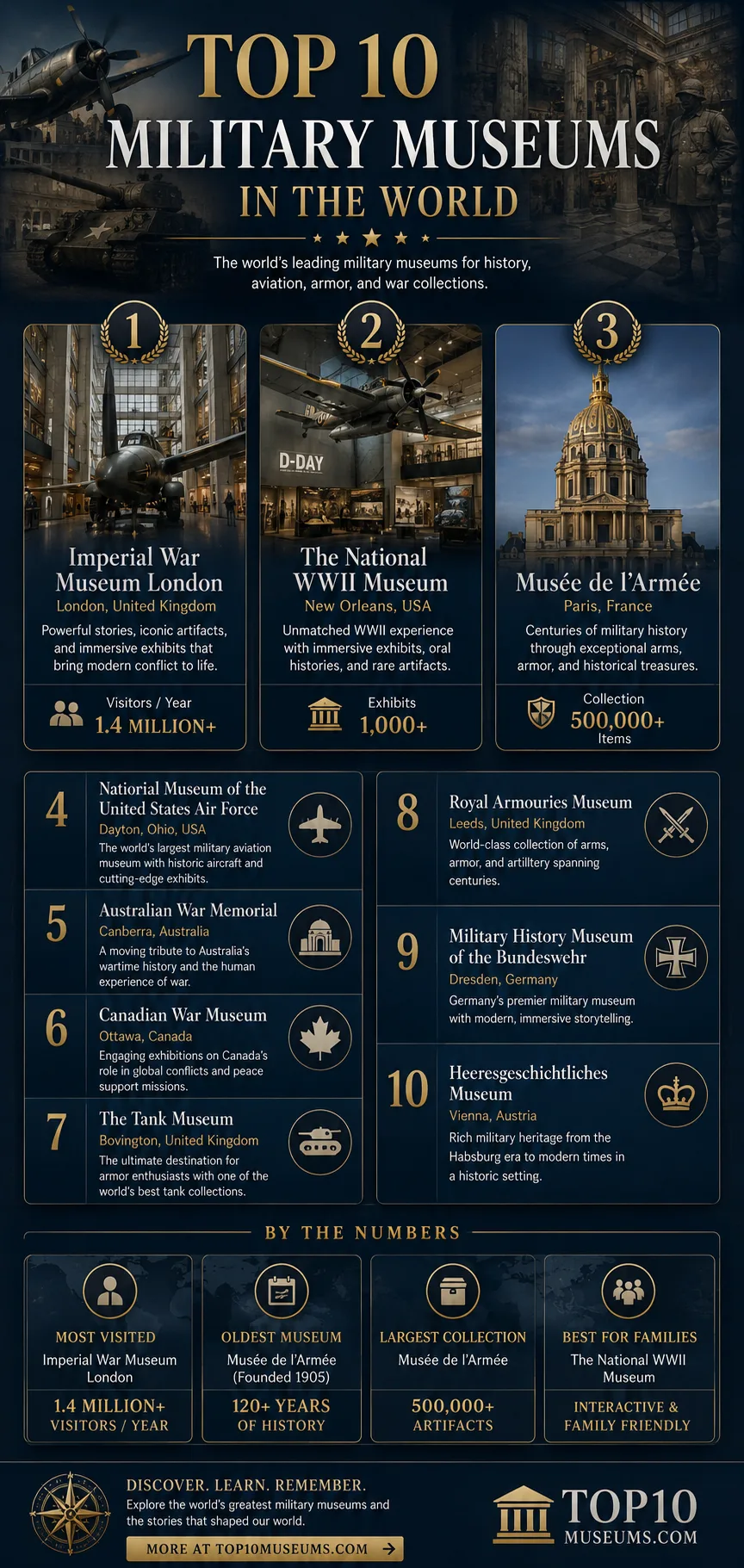
The Top 10 Military Museums in the World are not just rooms full of uniforms, tanks, medals, and aircraft. The best ones help visitors understand people under pressure: soldiers, civilians, engineers, nurses, families, prisoners, pilots, commanders, and children caught in events larger than themselves. This list favors museums with serious collections, strong interpretation, visitor-friendly layouts, and enough range to reward both first-time travelers and lifelong military history readers.
[ayaz_safe_content id=”2785″ key=”p2785b1i9jqydwj”]
| Rank | Name | Founded | Collection Type | Website |
|---|---|---|---|---|
| 1 | Imperial War Museum London | 1917; opened in 1920 | Modern conflict, war art, archives, aircraft, vehicles, personal stories | Official website |
| 2 | The National WWII Museum | 2000 | World War II artifacts, oral histories, home-front exhibits, aircraft, campaigns | Official website |
| 3 | Musée de l’Armée | 1905 | Arms, armor, artillery, uniforms, Napoleon’s tomb, military art | Official website |
| 4 | National Museum of the United States Air Force | 1923 | Military aviation, missiles, presidential aircraft, Cold War, air power | Official website |
| 5 | Australian War Memorial | 1941 | Military history, remembrance, archives, aircraft, naval objects, art | Official website |
| 6 | Canadian War Museum | 1880; current building opened in 2005 | Canadian military history, vehicles, uniforms, war art, archives | Official website |
| 7 | The Tank Museum | 1923 | Armored vehicles, tank design, crews, battlefield technology | Official website |
| 8 | Royal Armouries Museum | 1996 in Leeds | Arms, armor, artillery, firearms, tournament culture, edged weapons | Official website |
| 9 | Military History Museum of the Bundeswehr | 2011 reopening in its current form | War and society, military technology, uniforms, art, 700 years of conflict history | Official website |
| 10 | Heeresgeschichtliches Museum | 1856 | Austrian military history, Sarajevo 1914, uniforms, weapons, naval history, artillery | Official website |
Why These Ten Military Museums Stand Out
These museums were chosen because they do more than display rare military objects. They explain how weapons were used, how civilians were affected, how technology changed, and why remembrance still needs careful language. Some are ideal for families; others are better for adults who want several focused hours with documents, maps, memorial rooms, and large machines.
The ranking also balances different kinds of military museums. A tank specialist may place Bovington first, while an aviation reader may choose Dayton, and an art-history traveler may prefer Paris or Leeds. The list keeps that variety on purpose: war museums, aviation museums, armor museums, arms-and-armor collections, and national memorial museums all answer different visitor needs.
1. Imperial War Museum London — London, United Kingdom
Best for: First-time military history visitors, modern conflict readers, families with older children, war art fans, and travelers who want a serious free museum in central London.
Imperial War Museum London began with the First World War and now covers conflict from 1914 onward, including Britain, the Commonwealth, and global civilian experience. Its collection reaches into the millions across objects, photographs, film, sound, art, documents, and printed material, so the museum feels less like a trophy room and more like a layered record of modern war and memory.
The strongest galleries are the ones that connect objects to people: letters, uniforms, evacuation stories, Holocaust testimony, press photography, and aircraft suspended in the atrium. The museum’s free admission makes it unusually accessible for London, although special exhibitions may carry a ticket price in USD-equivalent local pricing depending on exchange rates and the exhibition.
Nearby alternative: Churchill War Rooms — a strong add-on for visitors who want a wartime command-center setting within a short Tube or taxi ride from IWM London.
2. The National WWII Museum — New Orleans, United States
Best for: World War II beginners, oral-history listeners, U.S. history travelers, veterans’ families, teachers, and visitors who want a full-day museum experience.
The National WWII Museum opened in 2000 as the National D-Day Museum and later became America’s official World War II museum. Its collections include more than 250,000 artifacts and over 9,000 personal accounts, which is why the visitor experience often feels story-led rather than object-led.
The campus covers multiple pavilions in downtown New Orleans, with exhibits on D-Day, the Pacific, the home front, wartime industry, liberation, and the human cost of the war. It is one of the most time-consuming museums on this list; a rushed two-hour stop will work, but a half day or full day gives the museum enough breathing room.
Nearby alternative: Ogden Museum of Southern Art — a nearby culture stop that gives visitors a softer second museum after the emotional weight of World War II galleries.
3. Musée de l’Armée — Paris, France
Best for: Napoleon readers, armor lovers, European history travelers, art-and-arms visitors, and anyone who wants a grand Paris museum with military depth.
Musée de l’Armée was created in 1905 and holds nearly 500,000 works and objects, ranging from armor and artillery to uniforms, emblems, paintings, prints, photographs, manuscripts, and private archives. It sits inside Les Invalides, so the visit combines military collections with one of the most recognizable historic settings in Paris.
The museum is especially strong for early arms and armor, French military history, the two World Wars, and Napoleon’s tomb beneath the Dôme des Invalides. It is not a small stop: official material describes around 15,000 square meters of museum space, and many visitors underestimate how much walking the complex requires.
Nearby alternative: Musée de l’Ordre de la Libération — a close alternative inside the Invalides area for visitors who want more on Free France, resistance, and liberation history.
4. National Museum of the United States Air Force — Dayton, United States
Best for: Aviation fans, STEM-curious teens, families, aircraft photographers, Cold War readers, and travelers who want a free museum with huge indoor galleries.
National Museum of the United States Air Force dates back to 1923 and is widely known as the world’s largest military aviation museum. The museum displays more than 350 aerospace vehicles and missiles across about 19 to 20 indoor acres, with free admission and free parking.
The scale is the draw. Visitors can move from early flight and World War II aircraft to Cold War bombers, missiles, presidential aircraft, and space-related exhibits. The presidential aircraft collection is a favorite because it turns political history into a physical walk-through, while the missile and bomber galleries give older visitors a clear sense of Cold War technology.
Nearby alternative: National Aviation Hall of Fame — an easy companion stop on the same aviation campus for visitors who want more pilot, inventor, and aerospace biography.
5. Australian War Memorial — Canberra, Australia
Best for: Remembrance-focused travelers, Australian history readers, families with school-age children, archive-minded visitors, and people who prefer museums with a solemn tone.
Australian War Memorial opened in 1941, but its national collection grew from wartime collecting work that began in 1917. The Memorial combines museum galleries, archive material, commemorative spaces, and the Roll of Honour, so the visit is both a history lesson and a memorial experience.
The collection includes aircraft, vehicles, art, photographs, diaries, uniforms, medals, and battlefield relics connected to Australian service. Its emotional center is not a single famous object but the careful blend of names, stories, and material evidence, especially for visitors tracing family service or studying Australia’s role in global conflicts.
Nearby alternative: Museum of Australian Democracy — a useful add-on near Parliament House for visitors who want to connect military history with civic history in Canberra.
6. Canadian War Museum — Ottawa, Canada
Best for: Canada-focused travelers, families, war art fans, remembrance visitors, and readers who want national military history told through people as well as objects.
Canadian War Museum traces its origins to an 1880 militia-artifact collection and opened its current LeBreton Flats building in 2005. Its national collection contains about 500,000 military-related items, including uniforms, medals, archival documents, photographs, vehicles, works of art, and around 860 linear meters of archival material.
The permanent galleries are built around the Canadian military experience, from early conflicts to contemporary service, with a strong emphasis on the human side of war. The museum also benefits from its location: it sits near the Ottawa River, close enough to combine with other national museums without turning the day into a transport puzzle.
Nearby alternative: Canadian Museum of History — a short cross-river trip for visitors who want a wider national story after the military galleries.
7. The Tank Museum — Bovington, United Kingdom
Best for: Tank enthusiasts, engineering-minded kids, model builders, military vehicle photographers, and visitors who want armor history without a generic museum layout.
The Tank Museum was founded in 1923 as a teaching resource for the Tank Corps and now houses around 300 armored vehicles. Its galleries cover tank development from the First World War onward, including famous vehicles such as Little Willie, Tiger I, Panther, Chieftain, M4 Sherman, Renault FT, Centurion, and T-72.
This is the most specialist museum on the list, and that is its advantage. The displays explain how crews worked inside vehicles, how design changed under battlefield pressure, and why mobility, armor, firepower, maintenance, and visibility were constant trade-offs. Families also get a practical benefit: large machines keep younger visitors engaged even when the history gets technical.
Nearby alternative: Dorset Museum & Art Gallery — a good Dorchester option for visitors who want local archaeology, literature, and natural history after a tank-heavy day.
8. Royal Armouries Museum — Leeds, United Kingdom
Best for: Arms-and-armor lovers, medieval history readers, families, design students, martial culture fans, and visitors who want free entry in northern England.
Royal Armouries Museum opened in Leeds in 1996 and houses the bulk of the United Kingdom’s national collection of arms and armor. The wider Royal Armouries collection includes the national arms-and-armor collection, national artillery collection, and national firearms collection, making it one of the world’s strongest museums for weapons as craft, technology, and ceremony.
The Leeds galleries cover armor, swords, firearms, hunting weapons, tournament culture, Asian arms, and artillery. It works well for families because many objects have immediate visual appeal, but the museum also rewards slower visitors who want to compare blade forms, armor construction, gun mechanisms, and the social rituals around combat.
Nearby alternative: Leeds City Museum — an easy city-center choice for visitors who want a broader local museum after the arms-and-armor collection.
9. Military History Museum of the Bundeswehr — Dresden, Germany
Best for: Adult history readers, architecture fans, modern Europe travelers, ethics-focused visitors, and people who want military history without simple hero storytelling.
Military History Museum of the Bundeswehr reopened in Dresden in 2011 after a major redesign by Daniel Libeskind. Its collection contains more than 1.6 million objects, while the permanent exhibition presents about 10,000 exhibits across hundreds of years of war, military culture, violence, and society.
This museum is less about “look at the weapon” and more about “what does organized violence do to people?” The architecture reinforces that idea: the modern wedge cuts into the older arsenal building, turning the museum itself into a visual argument. Visitors who expect only tanks and uniforms may be surprised, but those who like moral context will find it one of Europe’s most thoughtful military museums.
Nearby alternative: Dresden Transport Museum — a practical city-center follow-up for visitors who want technology, vehicles, and engineering history in a lighter setting.
10. Heeresgeschichtliches Museum — Vienna, Austria
Best for: Habsburg history readers, First World War visitors, architecture fans, artillery enthusiasts, and travelers who want a classic European military museum.
Heeresgeschichtliches Museum in Vienna is one of Europe’s older military museums, with roots in the mid-19th century Arsenal complex. Its collections include more than 1.5 million objects across uniforms, equipment, insignia, weapons, technology, art, sculpture, audiovisual material, and documentary collections.
The museum is especially known for its First World War material and the Sarajevo 1914 section connected to the assassination of Archduke Franz Ferdinand. It also offers artillery halls, armored vehicles, Austrian naval history, and imperial-era rooms, so it suits visitors who want Central European military history in a more traditional museum setting.
Nearby alternative: Belvedere 21 — a nearby modern art stop that gives visitors a change of tone after the Arsenal’s military galleries.
How to Tour These Military Museums
Best London and Southern England Route
Start with Imperial War Museum London in the morning, when the Holocaust and modern conflict galleries are easier to absorb. On a separate day, travel to The Tank Museum in Bovington rather than trying to pair it with central London. If Leeds is also on the trip, give Royal Armouries its own half day because the train travel and gallery time deserve a calmer schedule.
Best World War II and Aviation Route in the United States
For a U.S. trip, treat The National WWII Museum and the National Museum of the United States Air Force as separate anchor stops, not quick side visits. New Orleans needs at least half a day for the WWII campus, while Dayton can easily fill a full day for aircraft fans. Families should put the aviation museum first if kids respond better to large machines than dense text panels.
Best Paris and Central Europe Route
Begin with Musée de l’Armée in Paris, then use Vienna and Dresden as deeper European military-history stops on a longer rail trip. Vienna works well for visitors who like imperial history and First World War material, while Dresden is better for those who want a more reflective museum about war, society, and memory. Do not rush Dresden late in the day; it asks for concentration.
Best Family-Friendly Plan
For families, the easiest wins are National Museum of the United States Air Force, The Tank Museum, and Royal Armouries Museum. Large aircraft, armored vehicles, armor displays, and live or interactive programming are easier for children to understand visually. Save heavier memorial museums, such as the Australian War Memorial or Canadian War Museum, for children old enough to process loss, remembrance, and civilian impact.
Best Two-Day Military Museum Style
On day one, choose a broad museum such as Imperial War Museum London, Canadian War Museum, or Australian War Memorial. On day two, choose a specialist museum such as Dayton, Bovington, Leeds, or Dresden. This pairing works because one day explains the human story, while the other focuses on technology, design, weapons, or interpretation style.
Who Will Love These Museums?
- Modern conflict readers: Imperial War Museum London is the strongest first stop for 20th- and 21st-century war history.
- World War II-focused travelers: The National WWII Museum offers the most detailed single-site WWII visit on this list.
- Napoleon and armor visitors: Musée de l’Armée combines French military history, arms, armor, artillery, and Napoleon’s tomb.
- Aviation fans and STEM-curious teens: National Museum of the United States Air Force is the best match for aircraft, missiles, and air-power technology.
- Remembrance-minded travelers: Australian War Memorial and Canadian War Museum are best for visitors who want military history tied to national memory.
- Tank and vehicle enthusiasts: The Tank Museum is the clearest choice for armored warfare, crew stories, and vehicle design.
- Arms-and-armor lovers: Royal Armouries Museum is ideal for swords, firearms, armor, artillery, and martial display culture.
- Ethics-focused adult visitors: Military History Museum of the Bundeswehr is best for people who want war explained through society, violence, memory, and responsibility.
- Central Europe history readers: Heeresgeschichtliches Museum works well for Habsburg, Sarajevo 1914, First World War, artillery, and Austrian military history.
- Families planning mixed museum days: Dayton, Bovington, Leeds, Ottawa, and London offer the easiest balance of visual exhibits, pacing, and practical visitor flow.