
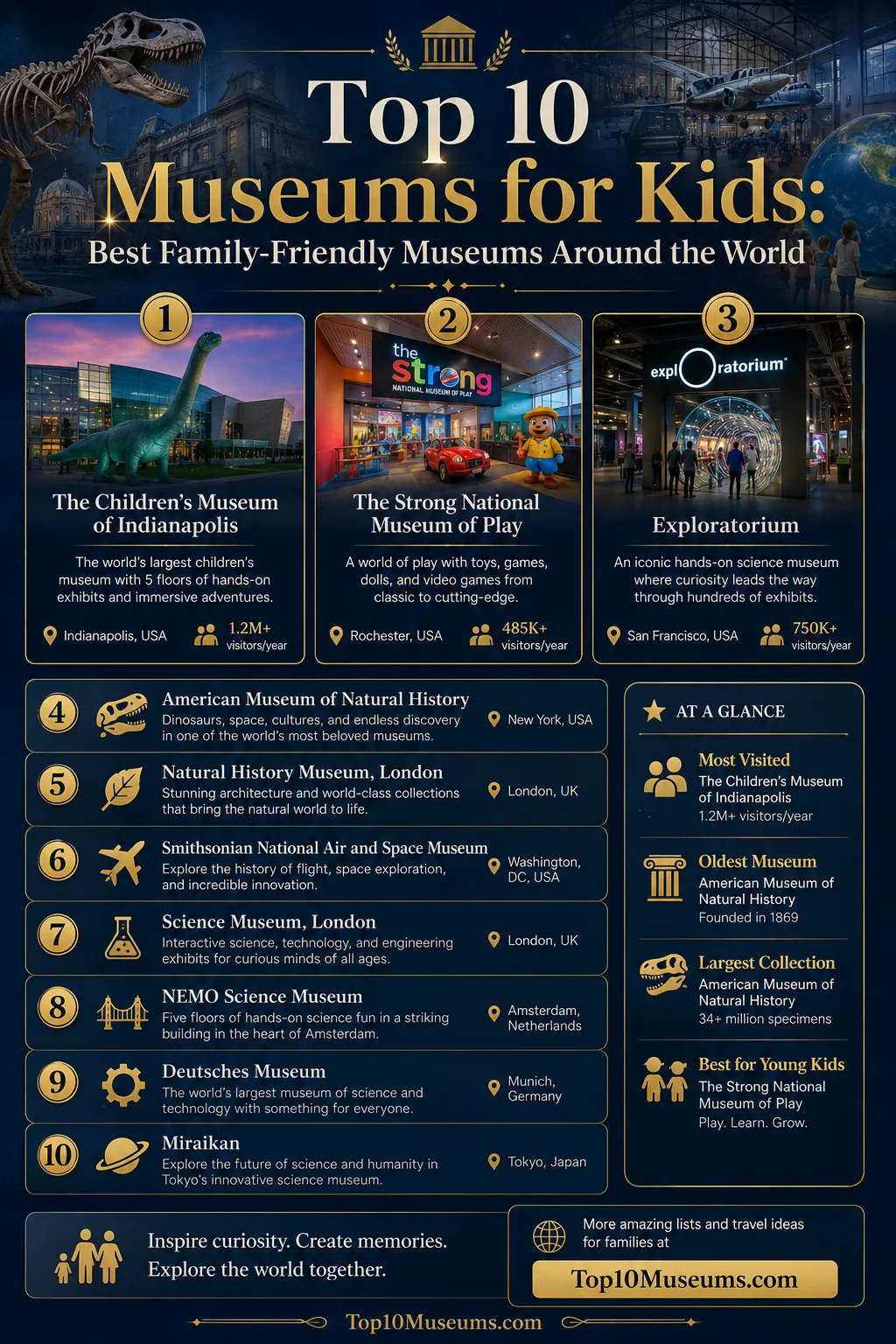
Some museums ask children to look quietly. The best ones let them ask, touch, test, climb, compare, build, and wonder. This list of the top 10 museums for kids focuses on places where families can spend real time: hands-on science floors, dinosaur halls, toy collections, aircraft galleries, planet displays, sensory spaces, and exhibits that work for short attention spans as well as curious older children.
The ranking favors museums with clear family appeal, strong collections, practical layouts, and enough variety to keep different ages engaged. A toddler, a 9-year-old dinosaur fan, and a teen who loves robotics may not want the same day out — so these picks cover play, science, nature, technology, space, engineering, and discovery without turning the visit into homework.
[ayaz_safe_content id=”2789″ key=”p2789b1z8ub9hbl”]
| Rank | Name | Founded | Collection Type | Website |
|---|---|---|---|---|
| 1 | The Children’s Museum of Indianapolis | 1925 | Children’s museum, natural history, science, culture, play | Official website |
| 2 | The Strong National Museum of Play | 1968 | Play history, toys, games, dolls, video games | Official website |
| 3 | Exploratorium | 1969 | Interactive science, art, human perception | Official website |
| 4 | American Museum of Natural History | 1869 | Natural history, dinosaurs, Earth science, space, cultures | Official website |
| 5 | Natural History Museum, London | 1881 | Natural history, specimens, dinosaurs, Earth and life science | Official website |
| 6 | Smithsonian National Air and Space Museum | 1976 | Aviation, spaceflight, aircraft, rockets, archives | Official website |
| 7 | Science Museum, London | 1909 | Science, technology, medicine, engineering, interactive galleries | Official website |
| 8 | NEMO Science Museum | 1923 | Hands-on science, technology, experiments, rooftop learning | Official website |
| 9 | Deutsches Museum | 1903 | Science and technology, engineering, transport, Kids’ Kingdom | Official website |
| 10 | Miraikan | 2001 | Emerging science, robotics, Earth data, life science, future tech | Official website |
Why These Ten Museums Made the List
For families, a great museum is not only about the size of the collection. It needs clear movement, patient pacing, hands-on moments, and memorable objects. A child may remember a giant bubble, a T. rex skeleton, a moon rock, a marble run, a hall of aircraft, or a game they played with a parent — that memory often matters more than seeing every gallery.
These ten museums were chosen because each one gives children a different kind of entry point. Some are built around active play; others use real specimens, aircraft, machines, experiments, or digital displays. Together, they cover toddlers, school-age children, STEM-curious teens, dinosaur fans, space lovers, young artists, and families who need a museum day that feels doable rather than tiring.
The 10 Best Museums for Kids
1. The Children’s Museum of Indianapolis
Best for: Families with young kids, dinosaur fans, first-time museum visitors, and children who learn best through touch, movement, and themed play.
The Children’s Museum of Indianapolis is one of the easiest museums to recommend for families because it was built around children from the start. Its collection includes more than 130,000 items, ranging from dinosaur material and cultural objects to toys, artwork, and movie props. That variety matters: one child can chase fossils while another leans toward sports, space, history, or imaginative play.
The museum works especially well for mixed-age groups. Younger children get room to move, while older kids still have enough real collection material to feel they are not in a soft-play center wearing a museum badge. Parents should plan for a long visit, because this is not a “walk through in one hour” stop; it rewards a half-day or full-day family schedule.
Nearby alternative: Newfields — a good family-friendly art and garden stop north of downtown Indianapolis, useful when children need outdoor space after a busy indoor museum day.
2. The Strong National Museum of Play
Best for: Toy lovers, video game fans, preschoolers, board-game families, and kids who prefer play-based learning over quiet galleries.
The Strong National Museum of Play in Rochester is built around a simple idea: play is worth preserving. The museum’s collection, library, and archives include more than half a million play-related items, covering toys, dolls, board games, video games, electronic games, trade catalogs, books, and other material tied to how people play.
This is a rare museum where adults often become as animated as children. A parent may stop for the National Toy Hall of Fame, while a child heads toward interactive exhibits, game history, or pretend-play spaces. The best part is the mix: it feels active and nostalgic at the same time, which makes it one of the strongest choices for multigenerational family visits.
Nearby alternative: Rochester Museum & Science Center — a practical second stop for families who want more science exhibits without leaving the Rochester area.
3. Exploratorium
Best for: Curious tweens, science-loving families, hands-on learners, visual thinkers, and kids who ask “what happens if I try this?” all day.
San Francisco’s Exploratorium is a museum of science, art, and human perception, and that combination makes it feel different from a standard science center. Founded in 1969, it now offers hundreds of interactive exhibits; museum materials describe over 650 hands-on exhibits across indoor and outdoor spaces at Pier 15.
Children can experiment with light, sound, motion, biology, electricity, and perception without needing a long lecture first. The museum’s strength is that it lets visitors test ideas with their own bodies: spin, listen, watch, pull, compare, notice. For families with older children, the Exploratorium is especially good because it respects their intelligence while still feeling playful and loose.
Nearby alternative: California Academy of Sciences — a strong nature-and-science choice in Golden Gate Park, best paired with the Exploratorium on a separate San Francisco day.
4. American Museum of Natural History
Best for: Dinosaur fans, space-curious kids, school-age children, families visiting New York, and children who like big, dramatic museum halls.
The American Museum of Natural History has the kind of scale children remember. Founded in 1869, the museum holds more than 34 million specimens and artifacts, covering fossils, animals, minerals, meteorites, human cultures, biodiversity, and space science. For many kids, the dinosaur halls alone are enough reason to go.
The museum works best when families choose a few zones rather than trying to cover everything. A strong visit might combine dinosaurs, ocean life, meteorites, and the space center, then stop before museum fatigue takes over. Its Central Park West location also helps: families can pair the visit with a low-pressure park break instead of pushing children through gallery after gallery.
Nearby alternative: Children’s Museum of Manhattan — a smaller Upper West Side option for younger children when a huge natural history museum feels too much for the day.
5. Natural History Museum, London
Best for: Dinosaur lovers, animal-obsessed children, free-museum families, first-time London visitors, and kids who like fossils, rocks, and big skeletons.
London’s Natural History Museum opened in 1881 and cares for more than 80 million objects spanning billions of years. For children, the appeal is immediate: dinosaurs, fossils, minerals, mammals, marine life, Earth science, and a building that feels like part of the adventure before the galleries even begin.
This museum is especially useful for families because general admission is free, though ticketing and busy days still need planning. The best visit is selective: start with dinosaurs or the most wanted galleries, take a snack break, then choose one more zone. A child who loves animals, bones, volcanoes, or deep time can easily spend hours here without needing every room.
Nearby alternative: Victoria and Albert Museum — a close South Kensington option with family trails, design objects, and calmer galleries when children need a change of pace.
6. Smithsonian National Air and Space Museum
Best for: Space fans, aircraft lovers, future engineers, history-minded kids, and families who want a strong free museum in Washington, DC.
The Smithsonian National Air and Space Museum opened its National Mall building in 1976 and holds more than 70,000 aviation and space objects, plus huge archives of photographs, documents, films, and videos. For children, the subject is easy to grasp: people tried to fly, then crossed oceans, then reached space.
The museum is strongest for kids who love machines with stories behind them. Aircraft, rockets, spacecraft, suits, engines, and flight records give families plenty to talk about without forcing every child to read long labels. Because it sits on the National Mall, it also fits well into a Washington, DC family itinerary with short walks between museums.
Nearby alternative: Smithsonian National Museum of Natural History — a nearby free museum on the National Mall, ideal for families who want dinosaurs, gems, animals, and Earth science after space exhibits.
7. Science Museum, London
Best for: STEM-curious children, families with kids aged 7–14, free-gallery visitors, young inventors, and children who like experiments more than display cases.
The Science Museum in London officially became the Science Museum in 1909, with roots in earlier South Kensington collections. The wider Science Museum Group cares for millions of items, while the London museum gives families a strong mix of engines, medicine, flight, communications, mathematics, energy, space, and hands-on galleries.
For children, the standout is Wonderlab, an interactive gallery aimed mainly at curious minds aged 7–14, with more than 50 exhibits across seven zones. Families with younger children can also look for play-based spaces such as The Garden. This is one of London’s best museums for turning a child’s “why?” into a real experiment.
Nearby alternative: Natural History Museum — the closest big family museum, just across Exhibition Road for dinosaurs, specimens, minerals, and Earth science.
8. NEMO Science Museum
Best for: Hands-on science lovers, Amsterdam family trips, children who like experiments, and kids who enjoy learning through sound, light, bubbles, motion, and technology.
NEMO Science Museum traces its history to 1923, when the Labour Museum was founded. Today, its green Renzo Piano-designed building above Amsterdam’s Oosterdok is one of the easiest science museums for families to spot — and inside, the museum is arranged around floors of active discovery.
NEMO’s exhibitions cover everyday physics, technology, the human body, space, matter, and experiments children can actually try. Its floors include areas such as Fenomena, Technium, Elementa, Humania, and the rooftop square. A detail kids often remember: the Elementa exhibition includes a 4.6-billion-year-old meteorite weighing 47 kilos, which turns “space” into something very real.
Nearby alternative: National Maritime Museum — a good Amsterdam family option within a short ride or longer walk, especially for children interested in ships, maps, and sea travel.
9. Deutsches Museum
Best for: Young engineers, children aged 3–8 in the Kids’ Kingdom, older STEM fans, model railway lovers, and families who want a full science-and-technology day in Munich.
Founded in 1903, the Deutsches Museum in Munich is one of Europe’s great science and technology museums. Its collections include more than 125,000 objects, with thousands of exhibits shown across the Museum Island and branch museums. Children can move from aircraft and robotics to optics, energy, music, transport, chemistry, and model railway displays.
For younger children, the museum’s Kids’ Kingdom is the main reason it belongs on this list. The area is designed for ages 3–8 and has around 1,195 square metres of exhibition space, with a water play area, giant guitar, marble run, tactile models, media stations, and hands-on demonstrations. It is a strong choice when families need real science with room to play.
Nearby alternative: Deutsches Museum Verkehrszentrum — a transport-focused branch in Munich, useful for children who want more trains, cars, bicycles, and mobility history.
10. Miraikan
Best for: Tech-minded kids, robotics fans, Tokyo family trips, older children, teens, and families interested in Earth data, future science, and research made visible.
Miraikan, the National Museum of Emerging Science and Innovation in Tokyo, opened in July 2001. It is not a classic “old objects in cases” museum; it is built around current science, technology, communication, and questions about the future. That makes it especially good for children who prefer robots, screens, data, space, biology, and interactive explanation.
The museum is known for helping visitors connect big ideas to daily life. Families may encounter displays about Earth systems, life science, robotics, information networks, and new technologies. It works best for older children and teens who want to talk, test, and compare ideas, though patient younger children can still enjoy the visual and interactive parts.
Nearby alternative: Tokyo Water Science Museum — a nearby Odaiba-area choice for younger children who enjoy interactive displays about water, daily life, and city systems.
How to Tour These Museums
Best U.S. Family Museum Route
For a U.S.-focused family trip, start with Washington, DC for the National Air and Space Museum, then go north to New York for the American Museum of Natural History. Add Rochester for The Strong if play history and video games are a priority, then finish with Indianapolis if the trip can handle one more stop. This route works best as a multi-city vacation, not a rushed weekend.
Best London Family Science Day
In London, the Natural History Museum and Science Museum sit close enough to pair, but families should avoid doing both at full speed. Start with one must-see area at the Natural History Museum — usually dinosaurs or minerals — then take a real break before moving to the Science Museum. If Wonderlab is the goal, book around that and treat it as the main afternoon activity.
Best Europe Science Route
For families traveling through Europe, a relaxed route could connect London, Amsterdam, and Munich. Use London for natural history and classic science, Amsterdam for NEMO’s playful experiments, and Munich for Deutsches Museum’s engineering depth. This works best over a week or more, with non-museum days between major stops so children do not burn out.
Best Tech-and-Future Route
For older children and teens, build the plan around Exploratorium, Science Museum London, NEMO, Deutsches Museum, and Miraikan. The theme becomes experimentation, invention, engineering, and future science. Keep mornings for the biggest museum of the day, then leave afternoons open for food, parks, or a lighter local stop.
Best One-City Choice for a First Museum Trip
For a first serious museum day with children, choose a museum that matches how they already play. Pick The Children’s Museum of Indianapolis for broad child-centered variety, The Strong for play and games, the Exploratorium for hands-on science, or the Natural History Museum in London for dinosaurs and specimens. A good first trip should end with children wanting another museum, not begging to leave the building.
Who Will Love These Museums?
- Dinosaur-focused kids: American Museum of Natural History and Natural History Museum, London, both give fossil lovers the big skeleton experience they usually hope for.
- Hands-on experimenters: Exploratorium, NEMO Science Museum, and Science Museum London work well for children who want to test, push, listen, build, and compare.
- Young children and preschool families: The Children’s Museum of Indianapolis, The Strong, and Deutsches Museum’s Kids’ Kingdom offer more movement and play than most traditional museums.
- Space and aircraft fans: Smithsonian National Air and Space Museum is the clearest pick, with aircraft, spacecraft, archives, and real flight history in one place.
- Video game and toy lovers: The Strong is the strongest match, especially for children and adults who connect learning with toys, board games, arcade culture, and electronic games.
- STEM-curious teens: Miraikan, Deutsches Museum, Exploratorium, and Science Museum London give older kids enough science depth without losing the family-day feel.
- Families watching the budget: London’s major national museums and Smithsonian museums can be especially useful because general admission is free, though special exhibitions or ticketed galleries may cost extra.
- Parents planning around fatigue: Choose one big museum per day, set one or two “must-see” galleries, and leave before everyone is tired. That simple rule often saves the whole trip.