
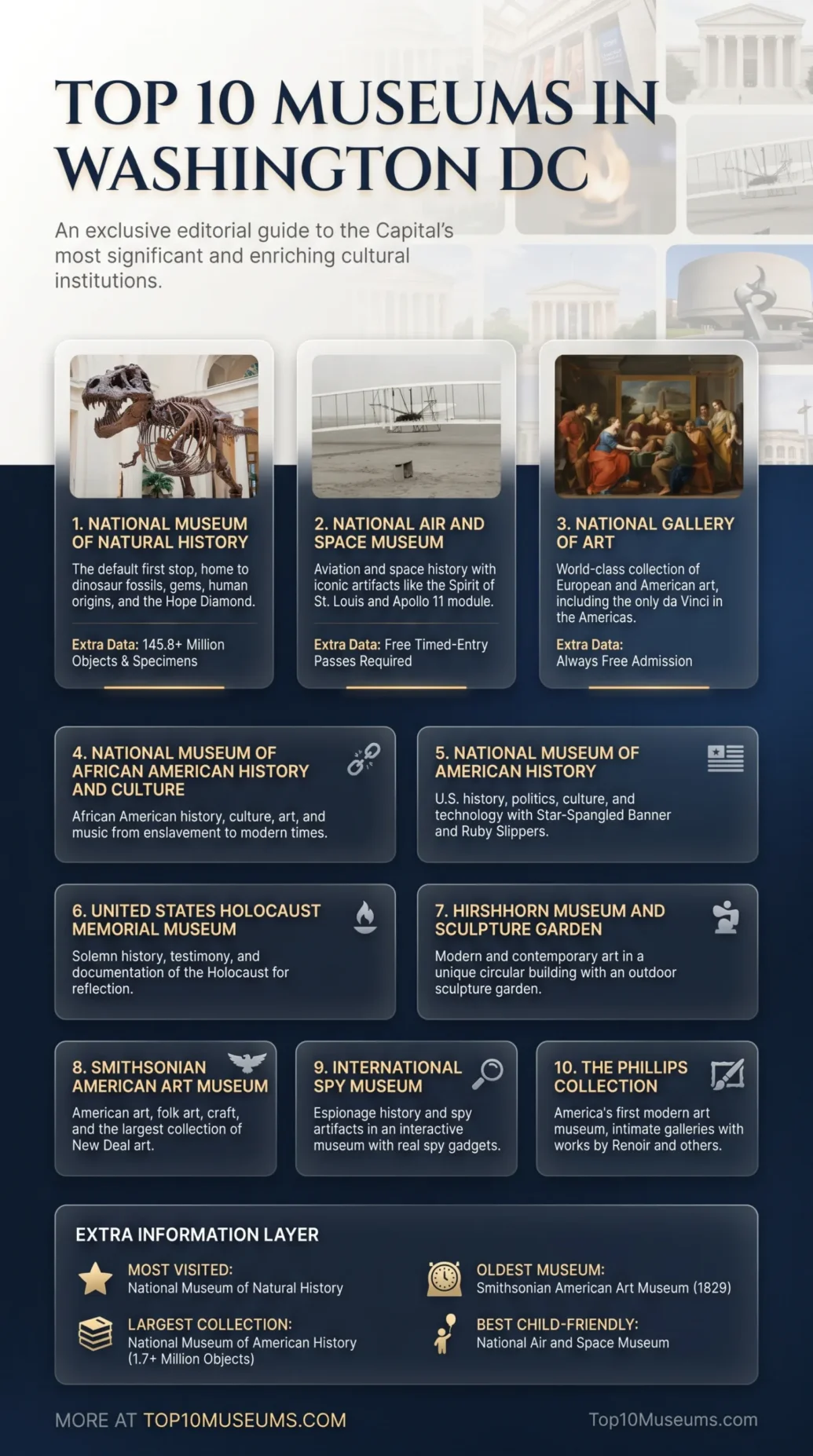
Washington DC is one of the rare cities where a museum-heavy trip can feel generous rather than punishing: many of the best stops are free, several sit within easy walking distance, and the range runs from dinosaur halls to modern painting to espionage gear. This list of the top 10 museums in Washington DC leans on collection strength, visit quality, and real trip logic—because a famous museum is only worth the slot if it still feels good once you are inside.
| Rank | Name | Founded | Collection Type | Website |
|---|---|---|---|---|
| 1 | National Museum of Natural History | 1910 | Natural history, fossils, gems, human origins | Official site |
| 2 | National Air and Space Museum | 1946 | Aviation and space history | Official site |
| 3 | National Gallery of Art | 1937 | European and American art, sculpture, modern art | Official site |
| 4 | National Museum of African American History and Culture | 2003 | African American history, culture, art, music | Official site |
| 5 | National Museum of American History | 1964 | United States history, politics, culture, technology | Official site |
| 6 | United States Holocaust Memorial Museum | 1993 | Holocaust history, testimony, documentation | Official site |
| 7 | Hirshhorn Museum and Sculpture Garden | 1966 | Modern and contemporary art | Official site |
| 8 | Smithsonian American Art Museum | 1829 | American art, folk art, craft, New Deal art | Official site |
| 9 | International Spy Museum | 2002 | Espionage history and spy artifacts | Official site |
| 10 | The Phillips Collection | 1921 | Modern art and intimate collection galleries | Official site |
Why These 10 Museums Made the Cut
These ten were chosen for a mix of collection depth and actual visit quality. Some are easy first-timer picks because the holdings are huge, the admission is free, or the building sits right where most travelers already are. Others earned their place because they give Washington DC something a little sharper—public access to top-tier art, emotionally serious history, or a museum day that works for kids without feeling watered down.
I also kept route logic in mind. A museum can be excellent and still be a poor fit for a short trip; these ten group well by neighborhood, pair well by theme, and cover art, science, social history, and kid-friendly stops without filling the list with museums that feel too similar once you start moving through the city.
1. National Museum of Natural History
The National Museum of Natural History is the default first stop for a reason. The museum cares for more than 145.8 million objects and specimens, and that scale shows up fast: dinosaur fossils, deep-ocean life, human origins, insects, meteorites, and the Hope Diamond all sit under one roof. For a first visit to Washington DC, this is the museum that gives the broadest return for the time you spend.
It is also one of the easiest wins on the Mall. Admission is free, no tickets are required, and the building is so large that it works best as a half-day stop rather than a rushed box-check. Families usually do better by choosing two or three halls on purpose instead of trying to “finish” the museum in one go.
Best for: first-time visitors, families with kids, science-curious travelers, and anyone who wants one museum that covers a lot of ground.
Nearby alternative: National Museum of American History — an easy walk west along Constitution if you want to switch from fossils and gems to objects like the Star-Spangled Banner and Dorothy’s Ruby Slippers.
2. National Air and Space Museum
The National Air and Space Museum is still one of DC’s surest crowd-pleasers. Its collection holds more than 70,000 air and space objects, with headline pieces that many visitors already know before they step inside: the 1903 Wright Flyer, the Spirit of St. Louis, and the Apollo 11 Command Module Columbia. Even people who are lukewarm on “museum trips” usually lock in here within minutes.
This one works especially well for families, teens, and travelers who like museums with a clear through-line. The mood is lighter than in many history museums, but the objects still have real weight. Admission is free, though the DC building currently uses free timed-entry passes, so it is smart to book this early in your day instead of hoping for a casual walk-up.
Best for: families, aviation fans, STEM-minded teens, and travelers who want a high-energy museum without a heavy reading load.
Nearby alternative: Hirshhorn Museum and Sculpture Garden — just up the Mall if your group wants a total mood change from aircraft and spacecraft to bold contemporary art.
3. National Gallery of Art
If art is the center of your trip, the National Gallery of Art belongs near the top. The collection includes more than 160,000 works, and the museum holds the only painting by Leonardo da Vinci in the Americas: Ginevra de’ Benci. That alone would make it worth a stop, but the real appeal is the range—Raphael, Vermeer, Rembrandt, Degas, Calder, Rothko, and much more without an admission fee.
The Gallery is one of the easiest places in DC to pace yourself well. You can spend an hour and still see something memorable, or you can stay most of the day and split your time between the West Building, East Building, and Sculpture Garden. Admission is always free, which makes it an unusually generous art museum for repeat visits.
Best for: old-master lovers, casual art fans, date-day museumgoers, and travelers who want a top art museum without paying museum-level prices.
Nearby alternative: Smithsonian American Art Museum — a good follow-up if you want to shift from European painting to American art in a downtown setting that feels less formal.
4. National Museum of African American History and Culture
This is one of the strongest museums in the city, full stop. The National Museum of African American History and Culture has collected more than 45,000 artifacts, and the building turns that material into a visit that moves from enslavement and freedom struggles to music, sport, style, foodways, and visual culture. It is not a quick browse museum; it asks for time, attention, and a little emotional room.
That slower pace is exactly why it lands so high on this list. The museum feels carefully built rather than overstuffed, and the experience stays with you. Admission is free, but free timed-entry passes are required, so this is another museum that should be booked early—especially on weekends or holidays.
Best for: history-minded travelers, thoughtful repeat visitors, adults and older teens, and anyone who wants a museum with moral force as well as memorable objects.
Nearby alternative: National Museum of American History — a short walk away if you want to keep the history focus but move into politics, culture, technology, and iconic national objects.
5. National Museum of American History
The National Museum of American History is the most “this is DC” museum on the list. It holds more than 1.7 million objects and 22,000 linear feet of archival material, yet it still manages to feel legible because the anchors are so recognizable: the Star-Spangled Banner, the Greensboro lunch counter, presidential material, and Dorothy’s Ruby Slippers. It covers politics, culture, technology, labor, entertainment, and everyday life without pretending American history is neat.
For mixed-age groups, this museum is a very smart middle-ground choice. Adults get plenty to read into, while younger visitors still have iconic objects to latch onto right away. Admission is free and no tickets are required, which makes it one of the easiest same-day additions to a Mall itinerary.
Best for: first-time DC visitors, multigenerational groups, U.S. history fans, and travelers who want famous objects rather than a niche subject.
Nearby alternative: National Museum of Natural History — a simple swap if your group wants fewer text-heavy galleries and more instant visual payoff.
6. United States Holocaust Memorial Museum
This is not a casual stop, and it should not be treated like one. The museum holds millions of documents, artifacts, photos, films, books, and testimonies, and since its 1993 dedication it has welcomed around 50 million visitors. The permanent exhibition remains one of the most affecting museum experiences in Washington—slow, serious, and meant for reflection rather than speed.
Entry to the museum is free, but timed tickets are required only for the Permanent Exhibition. For families, the better first entry point is often Remember the Children: Daniel’s Story, which is recommended for ages 8 and up and gives younger visitors a gentler way into the history. Go when you have the emotional energy for it, not because there is an empty slot in the day.
Best for: adults, older teens, teachers, reflective travelers, and visitors who want one of the city’s most serious museum experiences.
Nearby alternative: International Spy Museum — close enough for a same-area pairing if you want another history-focused museum nearby, though in a more interactive and less emotionally heavy format.
7. Hirshhorn Museum and Sculpture Garden
The Hirshhorn is the sharpest contemporary-art stop on the Mall. Its holdings come from a base of more than 12,000 works, and the museum has long punched above its weight with ambitious installations, outdoor sculpture, and high-recognition names. It is the kind of place where one room can be meditative and the next can feel loud, strange, or funny—and that swing is part of the appeal.
Visitors who find some art museums too hushed usually do better here. The circular building encourages a looser, more curious rhythm, and the sculpture garden gives you a built-in reset between galleries. Admission is free, passes are not required, and it works especially well as an afternoon museum when you want something visually fresh without committing to a full-day art marathon.
Best for: contemporary art fans, architecture watchers, teens who like bold visuals, and travelers who want an art museum with some edge.
Nearby alternative: National Air and Space Museum — only a short walk away if your group wants to split between modern art and a museum with more hands-on family pull.
8. Smithsonian American Art Museum
The Smithsonian American Art Museum gives you a broad view of American art without the stiffness some national museums carry. Its roots go back to 1829, and it is home to one of the largest and most inclusive collections of American art in the country. One standout strength is especially worth noting: the museum holds the largest collection of New Deal art and murals in the United States.
This is a very good choice for travelers who want art with a strong sense of place. The downtown location is practical, the Kogod Courtyard is one of DC’s nicest indoor reset spots, and the museum is easy to pair with dinner in Penn Quarter afterward. Admission is free, no tickets are required, and the museum’s mood is more relaxed than many visitors expect.
Best for: American art fans, downtown visitors, repeat DC travelers, and anyone who wants a calmer art stop away from the Mall crowds.
Nearby alternative: National Portrait Gallery — in the same building complex, and a very easy add-on if you want faces, biography, and political culture alongside American art.
9. International Spy Museum
The International Spy Museum is one of the few paid museums here that really earns its ticket. It holds the largest collection of international espionage artifacts on public display, and the object list is a strong hook even before the interactive elements kick in: George Washington’s spy letter, a lipstick pistol, a shoe with a heel transmitter, and the Aston Martin DB5 tied to Bond history all land well with visitors who want stories they can retell later.
This museum is especially good when your group wants energy, motion, and a more playful tone. It is not free—timed tickets are paid, and the museum says buying ahead can save up to 30% depending on the day—but it can be a smart splurge for families with older kids, teens, and adults who do not want another long sequence of glass cases and wall labels.
Best for: teens, families with older kids, Cold War and spy-story fans, and travelers who want an interactive museum that still has real artifacts behind the fun.
Nearby alternative: United States Holocaust Memorial Museum — close by if you want a more solemn historical counterpart after the high-interaction spy format.
10. The Phillips Collection
The Phillips Collection gives this list something the big national museums do not: intimacy. Founded in 1921 and holding nearly 6,000 works, it is America’s first museum of modern art, and it still feels personal in the best way. Renoir’s Luncheon of the Boating Party is the museum’s calling card, and the collection also includes four panels from Jacob Lawrence’s Migration Series, which gives the visit more weight than a “pretty rooms and famous paintings” stop might suggest.
This is the museum for people who would rather look hard at a smaller number of works than race through a national institution. It is one of the few paid entries on the list: adults pay $20, seniors $15, students and educators $10, and visitors 18 and under enter free. There is also a nice budget move built in—Third Thursdays bring free admission from 5–8 p.m.
Best for: modern art lovers, couples, slower museumgoers, and travelers who prefer character and atmosphere over sheer scale.
Nearby alternative: Renwick Gallery — a good follow-up if you want another art stop near central DC with a craft-heavy focus and free entry.
How to Tour These Museums
Best Classic Mall Day
Start with the National Museum of Natural History right at opening, when the biggest halls still feel manageable. Move to the National Museum of American History after lunch so the visit shifts from natural science to iconic national objects without a long walk. End at the National Gallery of Art if you still have energy; art tends to play better late in the day than another giant museum full of crowds and school groups.
Best Family Day
Book the National Air and Space Museum first, since timed-entry museums are easiest in the morning and kids usually hit that one with full energy. After a break, go to the National Museum of Natural History and pick a few sure-fire halls instead of roaming everything. If the group still wants one more stop—and you are okay paying for it—the International Spy Museum is the best late-day add-on for older kids and teens.
Best Art Day
Do the National Gallery of Art in the morning, when you can give the West Building and one slice of the East Building real attention. Take the Metro or a short ride north later for The Phillips Collection, where the smaller rooms feel especially good after a national-scale museum. If you want a third stop, slot in the Hirshhorn between them for a stronger contemporary-art note.
Best Two-Day Route
On day one, cluster the Mall museums: Air and Space, Hirshhorn, and either NMAAHC or American History, depending on whether your group wants more contemporary visual culture or more national history. On day two, split north and downtown: Natural History in the morning, then SAAM, then The Phillips Collection if you want a more intimate art finish. Keep the Holocaust Memorial Museum on its own or pair it with only one lighter museum; it is not the sort of visit most people want to cram into a packed checklist day.
[ayaz_safe_content id=”2725″ key=”p2725b1czqahetz”]
Who Will Love These Museums?
- Old-master lovers — National Gallery of Art and The Phillips Collection are the best fits for visitors who want to linger with painting rather than race through a giant checklist.
- Families with curious kids — National Museum of Natural History and National Air and Space Museum are the easiest all-ages wins, with the Spy Museum as a paid bonus for older children.
- Travelers who want mostly free museums — eight of the ten picks here offer free general admission, which makes DC unusually good for long museum weekends.
- People who care about national history — National Museum of American History, NMAAHC, and the Holocaust Memorial Museum carry the most weight if the trip is built around public memory and civic history.
- Contemporary art fans — Hirshhorn is the most direct hit, while SAAM adds a strong American angle and The Phillips gives you a more intimate modern-art setting.
- Adults traveling without kids — The Phillips Collection, Hirshhorn, and the Holocaust Memorial Museum usually reward a slower pace and quieter looking.
- Teens who get bored by traditional museums — Air and Space, Spy Museum, and Hirshhorn tend to hold attention better because the objects are immediate, dramatic, or visually bold.
- First-time Washington DC visitors — Natural History, American History, National Gallery, and Air and Space form the safest core four if you only have one short trip to work with.