
[ayaz_safe_content id=”2723″ key=”p2723b11vg7gu2c”]
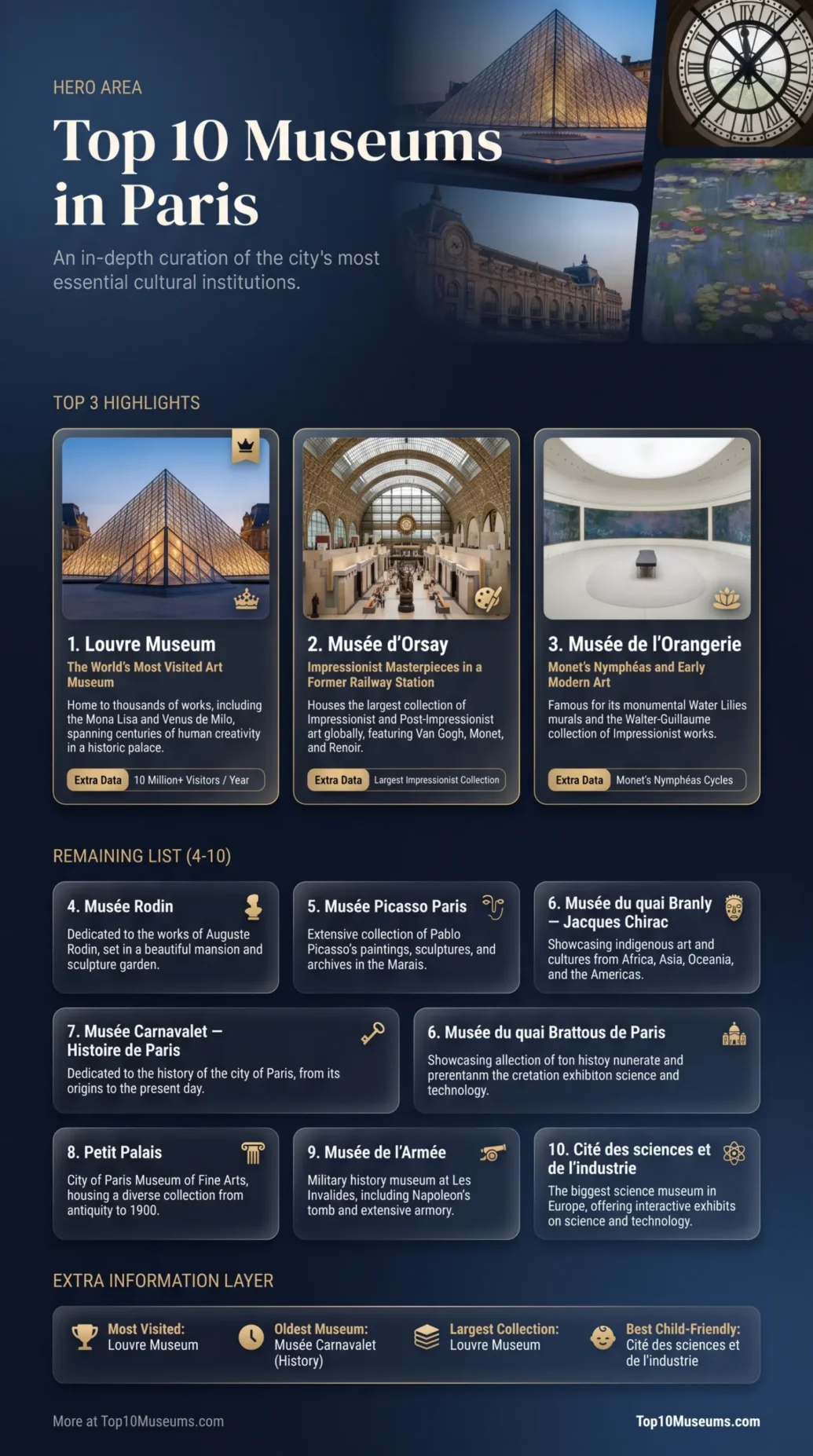
Paris can spoil museum-goers a little. One hour you are standing under the Louvre’s glass pyramid with half the planet, the next you are alone with Monet’s water gardens or an old Paris shop sign in the Marais. This list of the top 10 museums in Paris is built for real trips: places with staying power, collections that truly deliver, and enough range to suit art lovers, families, history fans, and first-time visitors without wasting a precious morning.
| Rank | Name | Founded | Collection Type | Website |
|---|---|---|---|---|
| 1 | Louvre Museum | 1793 | Art, antiquities, decorative arts | Official site |
| 2 | Musée d’Orsay | 1986 | Impressionist and 19th-century art | Official site |
| 3 | Musée de l’Orangerie | 1927 | Impressionist and early modern art | Official site |
| 4 | Musée Rodin | 1919 | Sculpture and artist museum | Official site |
| 5 | Musée Picasso Paris | 1985 | Modern art and archives | Official site |
| 6 | Musée du quai Branly – Jacques Chirac | 2006 | Arts of Africa, Asia, Oceania, and the Americas | Official site |
| 7 | Musée Carnavalet – Histoire de Paris | 1880 | Paris history and decorative arts | Official site |
| 8 | Petit Palais | 1902 | Fine arts and decorative arts | Official site |
| 9 | Musée de l’Armée | 1905 | Military history, arms, and national history | Official site |
| 10 | Cité des sciences et de l’industrie | 1986 | Science, industry, and hands-on learning | Official site |
Why These Ten Museums Earned Their Place
This ranking weighs collection strength, the quality of the visit once you are actually inside, and whether a museum adds a different side of Paris. That is why giant names like the Louvre sit beside free favorites such as Petit Palais and Carnavalet, and why Cité des sciences makes the cut for families and curious teens. A museum can be famous and still not be the best use of a half day; this list leans toward places that feel worth the queue, the metro ride, or the detour.
1. Louvre Museum
Opened in 1793, the Louvre is still the heavyweight: around 35,000 works are on display across a palace with more than 400 rooms, while the wider database covers more than 500,000 objects. The headline pieces are obvious—Mona Lisa, Venus de Milo, Winged Victory of Samothrace—but the real payoff comes when you stop chasing icons and pick one lane, whether Egyptian antiquities, Near Eastern art, or French decorative arts.
For a first visit, go in with a plan rather than a heroic all-day fantasy. Families often do better with the Egyptian galleries or the medieval Louvre remains under the palace; art-first visitors can make a clean Denon-to-Sully route and leave Richelieu for another trip. It is enormous, and your feet will know it, so treat the Louvre like two or three museums living under one roof.
Best for: first-time Paris visitors, old-master lovers, ancient-world fans, and travelers planning one big flagship museum day
Nearby alternative: Musée des Arts Décoratifs — right on the same Rue de Rivoli stretch, so it is an easy add-on if you want design, interiors, and fashion after the palace-scale marathon.
2. Musée d’Orsay
Musée d’Orsay opened in 1986 inside the former Gare d’Orsay and focuses on the years 1848 to 1914; it is also known for holding the world’s largest collection of Impressionist and Post-Impressionist paintings. This is where Manet’s Olympia, Renoir’s Bal du moulin de la Galette, Degas dancers, Cézanne, Gauguin, and several essential Van Goghs live in one building that is far easier to read than the Louvre.
The sweet spot here is the mix: paintings, sculpture, decorative arts, photography, and a station interior that still feels theatrical without trying too hard. Go early for the upper-floor masterpieces, then drift back through the sculpture nave and clock-face viewpoints. For many visitors, this is the museum that feels most like “Paris art” in one stop.
Best for: Impressionist loyalists, first-time art visitors, photography fans, and travelers who want one museum that covers a whole era well
Nearby alternative: Musée de l’Orangerie — an easy continuation through the Tuileries if you want Monet in a quieter, shorter visit after Orsay’s larger sweep.
3. Musée de l’Orangerie
Musée de l’Orangerie earns its place because it does one thing beautifully. Claude Monet’s eight Water Lilies panels wrap two oval rooms built for slow looking, and the Walter-Guillaume collection adds 148 works by Cézanne, Renoir, Matisse, Picasso, Modigliani, and others. It is compact, central, and unusually kind to travelers who only have ninety minutes to spare.
This is the museum for visitors who prefer depth over volume. Instead of racing from room to room, you can settle into Monet’s late style, then move into the smaller galleries and notice how the collection bridges Impressionism into early modern art. It feels calm by Paris standards, which is half the charm.
Best for: Monet lovers, short-stay travelers, quiet-gallery seekers, and visitors who want a smaller museum with a very high hit rate
Nearby alternative: Musée d’Orsay — cross the river on foot when you want the wider 19th-century picture after Monet’s immersive rooms.
4. Musée Rodin
First opened in 1919, the Musée Rodin feels personal in a way giant museums rarely do. The Hôtel Biron displays nearly 300 works from Rodin’s collection, while the garden stages sculptures like The Thinker, The Burghers of Calais, and The Gates of Hell in open air rather than a crowded corridor. That indoor-outdoor rhythm makes the visit refreshingly light.
Rodin is also one of Paris’s best museum settings, full stop. You move from salon-like rooms into lawns and gravel paths, then back again, which breaks up visual fatigue and lets sculpture breathe. For travelers who usually fear “another art museum,” this is often the place that changes their mind.
Best for: sculpture fans, garden walkers, couples after a slower museum, and visitors who want a strong collection without a mega-museum pace
Nearby alternative: Musée de l’Armée — a short walk toward Invalides if you want to swap sculpture for armor, Napoleon, and a more narrative history stop.
5. Musée Picasso Paris
Musée Picasso Paris is not just a greatest-hits room of blue-period paintings. The museum holds about 5,000 works and several tens of thousands of archival items, including 297 paintings, 368 sculptures and 3D works, and a huge archive that shows how Picasso kept reworking ideas across decades. Set inside the Hôtel Salé, it gives you Picasso the painter, sculptor, printmaker, ceramic artist, and collector all at once.
That range matters. Instead of leaving with one tidy label for Picasso, you see the restless jump between styles, materials, and moods. The museum rewards repeat visitors, but even a first pass is packed with reveals—especially in the sculpture rooms and the parts that show how his studio thinking never really sat still.
Best for: Picasso devotees, modern-art readers, repeat Paris visitors, and travelers who enjoy seeing process as much as finished masterpieces
Nearby alternative: Musée Carnavalet — only a short Marais walk away if you want to trade one artist’s universe for the broader story of Paris.
6. Musée du quai Branly – Jacques Chirac
Opened in 2006, the Musée du quai Branly – Jacques Chirac brings together art and material culture from Africa, Asia, Oceania, and the Americas on a scale few Paris museums can match. Its holdings include more than 370,000 objects, 700,000 iconographical pieces, and a permanent route with about 3,500 works on view. The Jean Nouvel building keeps the mood dim, hushed, and a little cinematic.
This is not a check-the-box stop; it asks for slow attention. Masks, textiles, carved figures, musical instruments, and ceremonial objects carry very different visual languages, so the visit stays fresh from room to room. It is one of Paris’s best choices when you want your museum day to widen the frame beyond Europe.
Best for: travelers after a global lens, design-minded visitors, anthropology-curious readers, and anyone ready for a museum with a different visual rhythm
Nearby alternative: Musée d’Art Moderne de Paris — a quick riverside hop if you want to move from global collections into 20th-century painting and sculpture.
7. Musée Carnavalet – Histoire de Paris
Musée Carnavalet is the museum people skip until they realize they want the city itself to make more sense. Open since 1880, it is the oldest City of Paris museum and now holds over 618,000 items from prehistory to the present. The route moves through revolution, literature, interiors, shop signs, portraits, and everyday objects, so Paris stops being postcard-pretty and starts feeling lived-in.
It is also a smart budget pick because the permanent collections are free. The reward is context: after Carnavalet, the Marais, Haussmann boulevards, and revolutionary sites all read differently. The Declaration of the Rights of Man and of the Citizen, period rooms, and old street signs give the visit both civic weight and a slightly quirky texture.
Best for: city-history lovers, budget travelers, literary-minded visitors, and anyone who wants Paris explained rather than simply admired
Nearby alternative: Musée Picasso Paris — in the same neighborhood, with an easy walking connection and a completely different lens on culture in Paris.
8. Petit Palais
Petit Palais is the museum seasoned Paris visitors keep recommending for good reason. Built for the 1900 Universal Exhibition and turned into a museum in 1902, it pairs a free permanent collection with around 43,000 works linked to its holdings. The building itself—vaulted entrance, painted ceilings, curved courtyard, and garden café—earns part of the visit before you even look at a single canvas.
Inside, the collection moves from antiquity to the early 20th century, with strong French painting, sculpture, decorative arts, and a few lovely surprises by artists such as Courbet, Monet, and Rembrandt. This is the rare Paris museum that feels generous rather than demanding; you can drop in for an hour and still leave satisfied.
Best for: free-museum planners, architecture lovers, repeat visitors, and travelers who enjoy elegant collections without heavy crowd pressure
Nearby alternative: Palais Galliera — almost next door, so it is a simple same-area detour if fashion history sounds better than another painting room.
9. Musée de l’Armée
Founded in 1905 inside Les Invalides, the Musée de l’Armée holds some 500,000 pieces spanning the Bronze Age to the 21st century and draws over 1.2 million visitors a year. Armor, uniforms, artillery, paintings, personal objects, and the Dôme with Napoleon I’s tomb make it far more varied than the name might suggest. History buffs love it, but so do plenty of visitors who simply want scale, drama, and a clearer sense of France’s state story.
This museum works especially well for travelers who want something less gallery-like and more narrative. The medieval armor rooms are excellent with older kids, and the route through modern conflict gives the visit real structure instead of a blur of cases. Give it time; it is much larger than first impressions suggest.
Best for: military-history fans, Napoleon followers, older kids, and visitors who want a museum day with a stronger story line
Nearby alternative: Musée Rodin — close enough for a same-area pairing if you want to split the day between national history and sculpture.
10. Cité des sciences et de l’industrie
Created in 1986, the Cité des sciences et de l’industrie is Paris’s big science stop and still one of the city’s easiest wins for families. The site mixes permanent exhibitions, temporary shows, the planetarium, and child-focused spaces such as Cité des enfants 5-10; across the broader Cité des enfants concept, more than 15 million young visitors have already passed through these learning spaces. It sits farther out in La Villette, but the extra metro ride often pays off when classic-art fatigue kicks in.
This is where a Paris museum list gets more useful and less predictable. Teens who glaze over at oil paintings often wake up here, and younger kids get room to test, build, press, listen, and move. Not every museum day needs gilded frames—sometimes a planetarium, hands-on displays, and a change of pace save the trip.
Best for: families with school-age children, STEM-curious teens, rainy-day planners, and travelers who want one museum day that feels active rather than hushed
Nearby alternative: Musée de la Musique — another easy La Villette stop with instruments, sound, and a second family-friendly option nearby.
How to Tour These Museums
Best Classic Art Day
Start with Musée de l’Orangerie when the Tuileries are still quiet, then move to Musée d’Orsay before lunch for the main 19th-century run. After a break, finish at Musée Rodin, where the garden gives your eyes and legs a breather. It is a smart sequence because the museums are close, the art periods speak to one another, and the day gets physically easier rather than harder.
Best Marais Day
Pair Musée Carnavalet and Musée Picasso Paris on the same day. Do Carnavalet first so the city’s history sits in your head while you walk the Marais, then head to Picasso after lunch when you are ready for a more focused artist museum. This plan works well for visitors who like good museums but do not want the mega-scale exhaustion of the Louvre.
Best Monument-and-History Day
Begin at Musée de l’Armée in the morning, when you have the energy for the larger historical route and the Dôme. Then move to Musée Rodin or Musée du quai Branly depending on your mood: Rodin if you want air, sculpture, and a lighter finish; quai Branly if you want a darker, slower, more contemplative afternoon. This part of Paris is easy to move through without zigzagging across the city.
Best Family Day
Give Cité des sciences et de l’industrie the morning and do not rush it. Have lunch in La Villette, then decide whether the family still has fuel left for a second stop; if yes, keep it simple and choose Musée de l’Armée for armor and Napoleon or save the rest of the day for the park. Families usually enjoy Paris more when one museum is the anchor and the rest of the day has room to breathe.
Best Two-Day Route
Day one: Louvre Museum, then a lighter second stop at Musée de l’Orangerie or Petit Palais. Day two: Musée d’Orsay in the morning, followed by Musée Rodin or Musée Carnavalet depending on whether you want sculpture and gardens or city history and neighborhood wandering. Keep quai Branly and Cité des sciences as separate half days if they are high priorities; both deserve more than a rushed add-on slot.
Who Will Love These Museums?
• Old-master hunters — Louvre Museum first, with Petit Palais as a quieter extra.
• Impressionist loyalists — Musée d’Orsay and Musée de l’Orangerie are the natural pair.
• Sculpture fans and garden walkers — Musée Rodin is the clear favorite.
• Picasso obsessives and modern-art readers — Musée Picasso Paris gives the broadest single-artist view on this list.
• Travelers who want Paris itself explained — Musée Carnavalet does that better than almost anywhere else.
• Visitors after a wider global lens — Musée du quai Branly – Jacques Chirac brings in entirely different visual traditions.
• Napoleon, armor, and military-history followers — Musée de l’Armée is the obvious choice.
• Families with school-age kids — Cité des sciences et de l’industrie is the most reliable win, with Musée de l’Armée as a strong second pick.
• Free-museum planners — Petit Palais and Musée Carnavalet stretch the budget without feeling like “backup” options.
• First-time visitors building one short Paris list — Louvre Museum, Musée d’Orsay, and Musée de l’Orangerie cover the classic core very well.