
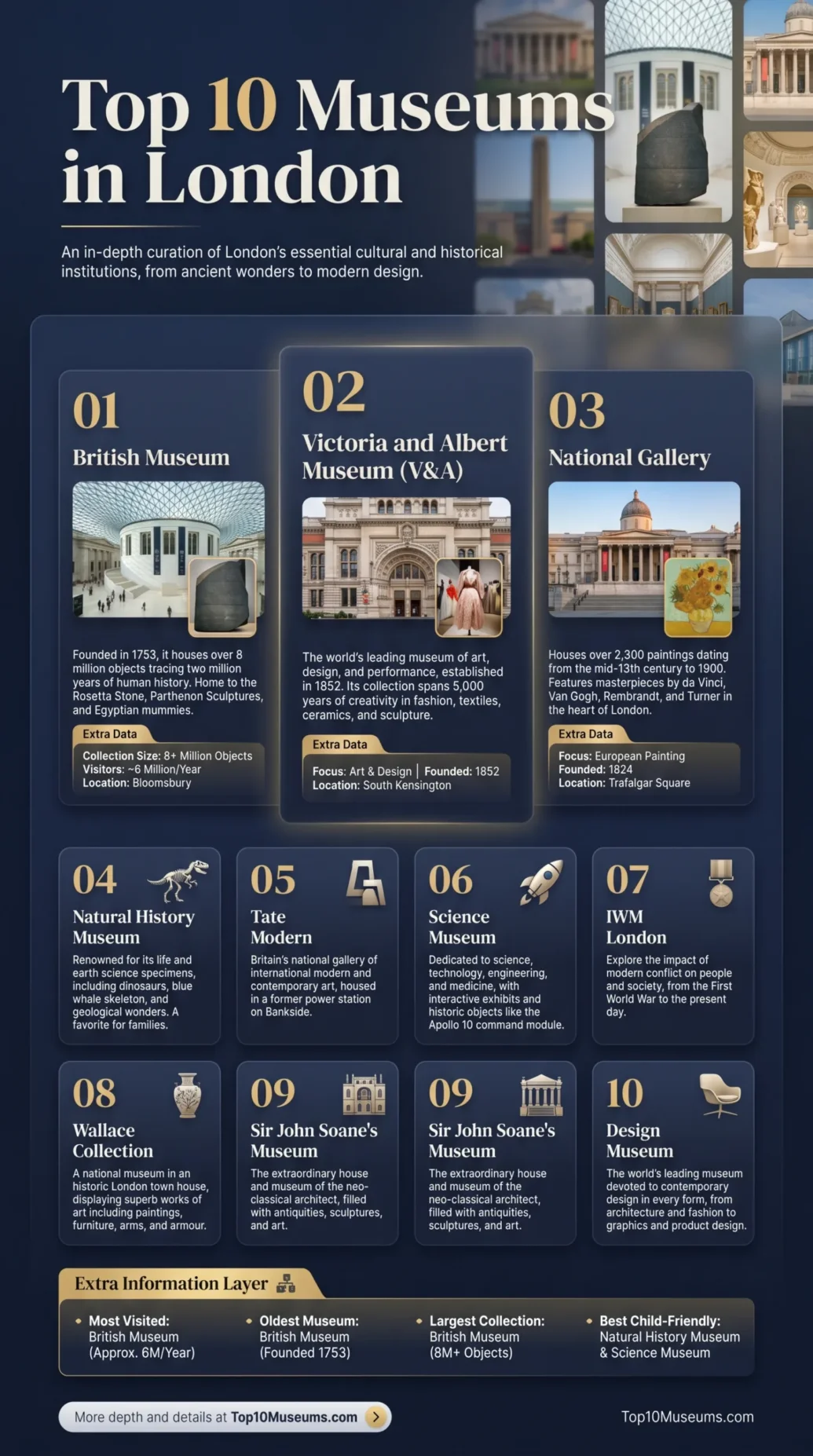
London rewards museum people in a very particular way: you can spend a morning with a 2,000-year-old object, a late lunch under a Victorian dome, and an afternoon staring at a Rothko or a blue whale skeleton without feeling as if the city has changed character on you. For anyone searching for the Top 10 Museums in London, the real trick is not finding famous names; it is working out which museums suit your time, your energy, and the kind of day you actually want to have.
This list favors museums with serious permanent collections, clear visitor payoff, and a place in an actual London itinerary. Some are grand first-timer stops, some are quieter house museums, and several are especially good for children because general admission is USD 0. Together, they give you a strong cross-section of art, design, science, natural history, and lived history without padding the list with “worth a look if you happen to pass by” filler.
| Rank | Name | Founded | Collection Type | Website |
|---|---|---|---|---|
| 1 | British Museum | 1753 | World history, archaeology, antiquities | Official Site |
| 2 | Victoria and Albert Museum | 1852 | Art, design, fashion, decorative arts | Official Site |
| 3 | National Gallery | 1824 | European painting | Official Site |
| 4 | Natural History Museum | 1881 | Natural history, earth science, zoology | Official Site |
| 5 | Tate Modern | 2000 | Modern and contemporary art | Official Site |
| 6 | Science Museum | 1909 | Science, technology, medicine, engineering | Official Site |
| 7 | IWM London | 1920 | War history, personal testimony, military collections | Official Site |
| 8 | Wallace Collection | 1900 | Fine art, arms and armour, decorative arts | Official Site |
| 9 | Sir John Soane’s Museum | 1833 | House museum, architecture, antiquities, drawings | Official Site |
| 10 | Design Museum | 1989 | Contemporary design, product design, fashion, architecture | Official Site |
Why These Ten Work for Art Lovers, Science Fans, and Free Museum Days
London has dozens of museums, but not all of them carry the same weight for a short stay. These ten were chosen because they offer lasting collections, not just temporary buzz, and because they cover different travel moods: blockbuster classics, child-friendly science stops, quieter connoisseur spaces, and places where the building itself is half the reason to go. A list like this should help with decision-making, not create more of it.
Another reason this line-up works: it is surprisingly practical. Several of the best museums cluster in Bloomsbury, South Kensington, and central Westminster, so you can pair them without zigzagging across the city all day. And because many main collections are free at USD 0, it becomes much easier to build a London museum plan around interest rather than ticket anxiety.
The 10 Museums That Earn a Place on a London Trip
1. British Museum — the broadest single-stop history museum in the city
Best for: First-time London visitors, history lovers, archaeology fans, and travelers who want a huge “one museum covers many civilizations” day.
Founded in 1753, the British Museum remains the easiest answer for anyone who wants a museum that feels big in every sense. Its holdings have grown to about eight million objects, which means you can move from Assyrian reliefs to the Parthenon sculptures, then into Egyptian rooms without ever feeling the collection narrows too early. If you only have time for one major history museum in London, this is usually the safest pick.
It is also a museum with genuinely famous must-sees, and that matters more than some writers admit. The Rosetta Stone is still the object many people make a beeline for, and it earns that attention; it is not just a famous slab, it changed how hieroglyphs were read. General admission is USD 0, which is excellent, but the trade-off is crowd density—go early, choose two or three target areas, and resist trying to “finish” the place in one pass.
Nearby alternative: Petrie Museum of Egyptian and Sudanese Archaeology — a much smaller stop with a tight Egypt-focused collection, roughly a 10-minute walk north via Gower Street if you want a quieter add-on after the main event.
2. Victoria and Albert Museum — London’s smartest all-round design and decorative arts museum
Best for: Design-minded travelers, fashion fans, decorative-arts lovers, and anyone who likes museums that reward wandering as much as checklist viewing.
The V&A, founded in 1852, covers over 5,000 years of human creativity and gives London one of its best museums for repeat visits. The collection database alone lets you search more than 1.25 million objects, which hints at the scale without forcing the galleries to feel chaotic. You can come here for sculpture, furniture, jewelry, metalwork, photography, theatre design, or ceramics and still leave feeling as if you only skimmed the surface.
What makes the V&A especially good is that it works for both focused and unfocused visitors. The fashion holdings stretch across five centuries, the cast courts still have real wow factor, and the building gives you enough visual payoff between galleries that the day never turns flat. Main entry is USD 0, so it is an easy museum to keep flexible: stay 90 minutes for highlights or lose half a day here without regret.
Nearby alternative: Leighton House — a more intimate art-and-interiors museum with standout Victorian atmosphere, about 15 minutes west by bus or around 20 minutes on foot from South Kensington.
3. National Gallery — the best old-master stop for a first or second London visit
Best for: Old-master lovers, couples on a short city break, first-timers staying near the West End, and anyone who wants a high-hit-rate art museum.
The National Gallery began in 1824 with a purchase of 38 paintings; today, the collection has grown to more than 2,400 works. That size is large enough to feel important and small enough to remain workable in a half-day, which is exactly why the museum suits London so well. You can trace European painting from the 13th century to 1900 without the fatigue that sometimes arrives in bigger institutions.
There is almost no dead zone here. Van Gogh’s Sunflowers, Jan van Eyck’s The Arnolfini Portrait, Holbein’s The Ambassadors, Turner, Monet, Titian, Velázquez—room after room gives you paintings people actually came to London hoping to see. General admission is USD 0, and the Trafalgar Square location means it is one of the easiest museum visits to slot into a day of walking, theatre, or dinner plans.
Nearby alternative: National Portrait Gallery — a natural companion if you want British history through faces and biography, just a short walk around the corner at St Martin’s Place.
4. Natural History Museum — the strongest family museum day in London
Best for: Families with children, dinosaur fans, school-age explorers, and adults who still enjoy a museum with scale, bones, and a bit of spectacle.
The Natural History Museum opened in 1881 and cares for around 80 million specimens across life and earth sciences. That number sounds abstract until you remember what it translates into on a visit: fossils, mammals, minerals, insects, meteorites, dinosaur skeletons, and research collections that make the museum feel like more than a public display case. It is one of London’s best examples of a museum that can be genuinely educational and still feel fun.
The building helps, too. Hintze Hall, with the suspended blue whale, sets the tone before you have even chosen a direction, and children tend to understand the museum instantly—big objects, clear themes, room to react. General admission is USD 0, though timed entry can make busy periods smoother. Go early if dinosaurs are the mission; those galleries pull the heaviest foot traffic for good reason.
Nearby alternative: Science Museum — a perfect same-area swap if your group would rather press buttons, watch demonstrations, and move from fossils to engineering in about five minutes on foot.
5. Tate Modern — the London pick for modern art, big rooms, and a less formal pace
Best for: Modern and contemporary art fans, repeat London visitors, architecture watchers, and travelers who like museums with room to breathe.
Tate Modern opened to the public in May 2000, and it still feels like one of the city’s sharpest museum transformations: a former power station turned into a home for modern and contemporary art. Across Tate, the collection includes over 70,000 artworks, and Tate Modern gives a strong share of that energy a properly large stage. Even before you get to the rooms, the building tells you this will not be a hushed, tightly framed picture gallery kind of day.
The Turbine Hall alone is 155 metres long, and that sense of scale matters because contemporary art can fall flat in cramped spaces. Here it usually does not. You come for Rothko, Picasso, Bourgeois, Kusama, or installation-heavy displays, but you stay because the museum lets ideas stretch out. Entry to the main collection is USD 0, making this one of London’s best-value museum visits for anyone who wants art that feels unmistakably 20th- and 21st-century.
Nearby alternative: The Old Operating Theatre Museum — a smaller, stranger stop near London Bridge with surgical history and attic-like atmosphere, about a 15- to 20-minute walk east if you want something off-rhythm after contemporary art.
6. Science Museum — the best London museum for STEM-curious kids and hands-on energy
Best for: STEM-curious teens, families with school-age kids, aviation and space fans, and adults who prefer inventions to oil paintings.
The Science Museum officially took on its present name in 1909, though its roots go back further through South Kensington’s museum culture. Today its digital access points include more than 500,000 objects and archives, and that breadth comes through in the galleries: medicine, transport, computing, flight, energy, communications, and iconic industrial objects all sit within a visit that feels busy in a good way. This is one of the easiest museums in London to enjoy without specialist knowledge.
It is also one of the easiest places to keep a family moving. The museum’s permanent galleries are USD 0, while optional experiences such as Wonderlab or IMAX screenings can add paid extras if you want them. That split works well: you can have a free core visit, then decide on one add-on rather than committing your whole day and budget from the start. For mixed-age groups, that flexibility is gold.
Nearby alternative: Natural History Museum — the obvious next-door swap if your group wants dinosaurs, minerals, and natural science rather than engineering, reached in just a few minutes along Exhibition Road.
7. IWM London — the most affecting history museum on this list
Best for: 20th-century history readers, military history followers, older teens, and visitors who value personal testimony as much as large objects.
IWM London opened its first permanent exhibition in 1920, and that long institutional memory shows. This is not simply a room full of tanks and uniforms, though it certainly has major physical objects; it is a museum built around the way conflict changes individual lives. The collections include roughly 11 million photographs, alongside documents, art, film, and oral histories, which gives the museum more emotional range than many travelers expect before walking in.
It is also one of the few museums in London where pacing really matters. Some galleries are heavy, and that is part of the point, so give yourself breaks and do not stack this with too many other intense history stops in one day. General admission is USD 0, which makes it an accessible visit, but the better reason to come is that the museum treats war as a human condition, not just a display of equipment.
Nearby alternative: Florence Nightingale Museum — a smaller museum with medical-history focus near Westminster Bridge, a practical next stop if you want to pivot from conflict history to nursing and reform.
8. Wallace Collection — the best quieter art museum in central London
Best for: Visitors who love old painting without giant crowds, French decorative-arts fans, and anyone who wants a house-museum mood without sacrificing quality.
Opened to the public in 1900, the Wallace Collection feels very different from the larger national museums, and that difference is its strength. At Hertford House you get paintings, sculpture, furniture, porcelain, and arms and armour in rooms that still feel tied to private collecting rather than institutional sorting. The result is more intimate, more atmospheric, and often more memorable for travelers who are tired of very large galleries by day three or four in London.
There are real headline works here, not just “nice rooms.” Fragonard’s The Swing alone earns the detour, and the museum also holds strong works by Titian, Velázquez, Rubens, and Van Dyck, plus one of Britain’s best arms-and-armour displays. Entry to the permanent collection is USD 0, and the Marylebone location makes it a smart pick for a slower morning before lunch, shopping, or a walk through the West End.
Nearby alternative: The Cartoon Museum — a lighter museum stop with British comics, graphic satire, and illustration, around 20 minutes away on foot toward Fitzrovia if you want something playful after rococo and armour.
9. Sir John Soane’s Museum — the best small museum in London for atmosphere and surprise
Best for: Architecture students, lovers of unusual interiors, curious repeat visitors, and people who prefer strange, unforgettable spaces over polished grandeur.
Sir John Soane set up the legal protection for his museum in 1833, and the place still carries the feeling of a personal vision frozen in time. The collection includes paintings, antiquities, sculpture, furniture, and over 30,000 architectural drawings, all arranged inside one of London’s most distinctive interiors. This is not a museum you “cover” room by room; it is one you absorb, doubling back when a mirror, hidden panel, or unexpected shaft of light suddenly changes what you think you are looking at.
The famous object here is the alabaster sarcophagus of Seti I, but the greater pleasure is the house itself—the Picture Room panels, the compressed scale, the sense that every corner was designed to trigger curiosity. Entry is USD 0, though capacity is limited and queues can form because the museum is genuinely small. That smallness is not a flaw; it is why the visit stays with people.
Nearby alternative: Charles Dickens Museum — another characterful house museum, this one focused on literary London, reachable in roughly 15 minutes by foot or a short bus ride east.
10. Design Museum — the best stop for contemporary objects, ideas, and modern visual culture
Best for: Design students, product and branding geeks, fashion-and-architecture followers, and travelers who want a museum that feels current rather than ceremonial.
Founded in 1989, the Design Museum brings a more modern tone to a London museum day. Its collection holds about 5,000 objects dating from 1859 to 2025, which means the conversation ranges from furniture and transport to graphics, digital culture, fashion, and the everyday products people actually live with. It is less about reverence and more about noticing how design decisions shape routine life.
The free permanent display, Designer Maker User, is a good entry point because it keeps the museum legible even for visitors who do not work in design. You can move from iconic chairs and consumer products to questions about materials, manufacturing, and use without needing specialist vocabulary. Permanent-collection access is USD 0; major temporary exhibitions are usually ticketed separately, so it works well as either a short focused stop or a longer design-led afternoon.
Nearby alternative: Museum of Brands — a handy follow-up for packaging, advertising, and consumer culture, reached by a short bus ride or a longer walk northwest toward Notting Hill.
How to Tour These Museums
Best Classic Art Day
Start with the National Gallery when the doors open and use the morning for your must-see paintings before Trafalgar Square gets busier. Move next to the Wallace Collection for a calmer second act and lunch in Marylebone. If you still have energy, finish with the British Museum and focus on just two zones rather than trying to chase every civilization before closing. This route works because it begins with high-attention looking, then shifts into rooms where the pace softens.
Best Family Day
Do Natural History Museum first, especially if dinosaurs are non-negotiable, because children usually arrive with the most patience they are going to have all day. After a break, walk straight to the Science Museum and let the hands-on, machine-heavy galleries carry the afternoon. If the group still has fuel left, step into the V&A courtyard or one or two lighter galleries rather than attempting a full third museum. South Kensington is ideal for this because the travel time between stops is almost nothing.
Best Two-Day Route
Day 1: British Museum, Sir John Soane’s Museum, and the National Gallery. That gives you archaeology, an unusual house museum, and European painting in one central sweep with sensible transfer times. Day 2: Choose South Kensington in the morning with the V&A plus either the Natural History Museum or the Science Museum, then cross the river later for Tate Modern if you want a different visual language to end the trip. Keep IWM London and the Design Museum as swaps if your interests lean more toward modern history or contemporary design than old painting.
Best Low-Stress Half-Day Pairings
V&A + Natural History Museum works when your group has mixed interests and you want maximum choice with minimum transport. National Gallery + National Portrait Gallery is the easiest art-and-history pairing in the West End. Wallace Collection + Sir John Soane’s Museum suits travelers who prefer smaller rooms, stronger atmosphere, and fewer gigantic queues. When London weather turns grey—and, well, sometimes it does—these pairings save a day.
[ayaz_safe_content id=”2721″ key=”p2721b1ut6y2qzd”]
Who Will Love These Museums?
• First-time London visitors: Start with the British Museum and the National Gallery, because they deliver the fastest sense of historical and artistic range.
• Old-master lovers: Put the National Gallery first, then add the Wallace Collection for French 18th-century rooms and a much quieter pace.
• Design and fashion fans: The V&A and the Design Museum are the essential pair, with the V&A leaning historical and the Design Museum leaning current.
• Families with young children: Natural History Museum and Science Museum are the easiest winners because they mix scale, movement, and subjects kids recognize immediately.
• STEM-curious teens: Science Museum first, then Natural History Museum if space, fossils, or geology are more likely to hold attention than pure engineering.
• Modern art followers: Tate Modern is the clearest choice, especially for visitors who prefer big installations, postwar art, and less formal gallery energy.
• Architecture students and museum regulars: Sir John Soane’s Museum is the one people tend to remember longest because the house itself behaves like an exhibit.
• Travelers who want emotionally weighty history: IWM London is the right pick when personal testimony, memory, and modern conflict matter more than “famous objects.”
• Visitors who dislike huge crowds: Wallace Collection and Sir John Soane’s Museum offer stronger atmosphere and shorter, more focused visits than the mega-museums.
• Budget-conscious museum hoppers: This whole list is unusually friendly because most main collections are USD 0, letting you build a rich London museum trip without paying premium admission at every stop.