
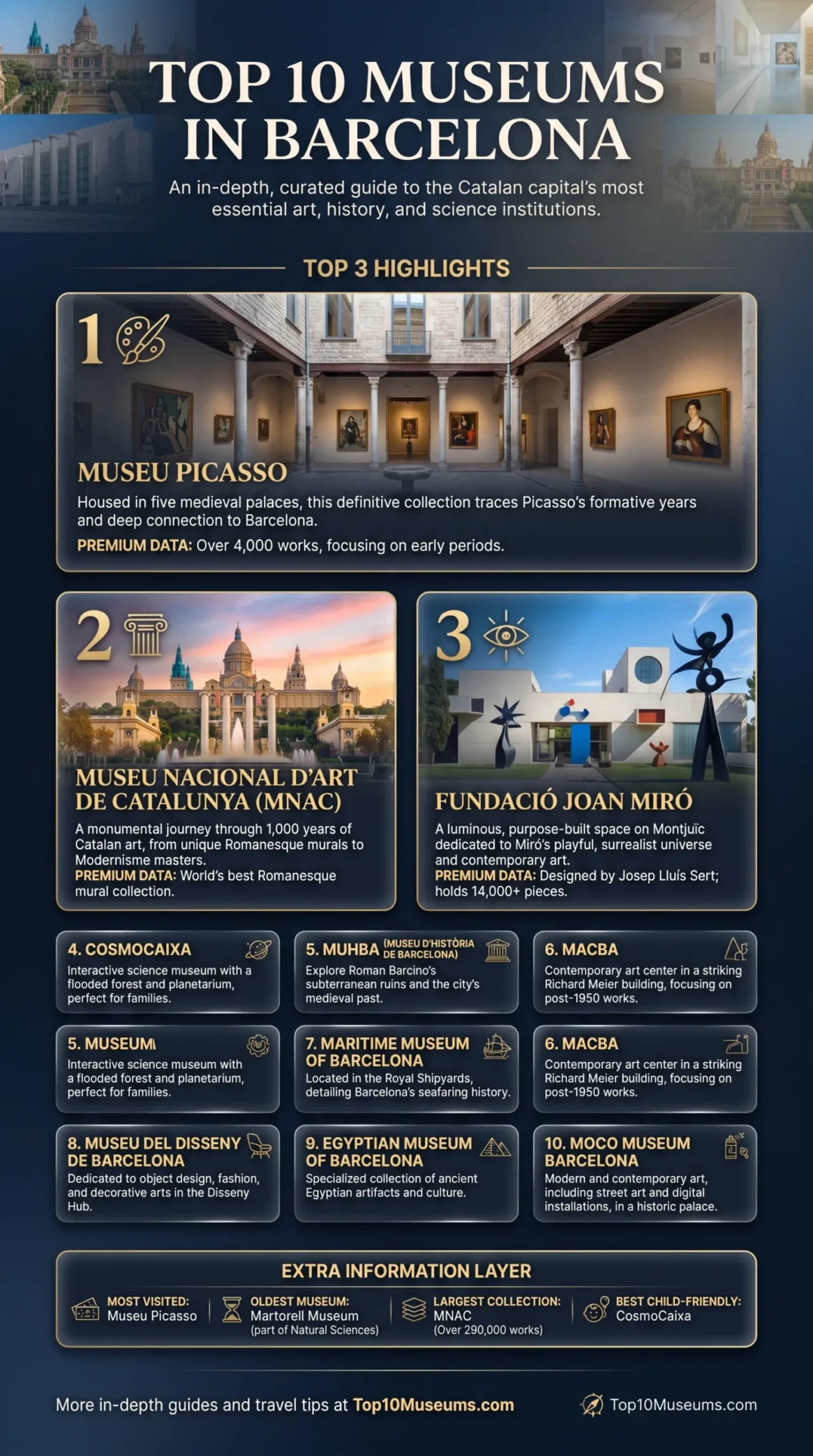
Barcelona does museums in a very Barcelona way: a little grand, a little surprising, and often far more varied than first-time visitors expect. For anyone searching for the top 10 museums in Barcelona, the smart move is not to chase only the biggest names. The better plan is balance—one or two major art stops, one city-history anchor, one science museum that keeps kids awake, and a couple of smaller places that add texture. That mix makes the city feel clearer, more human, and much easier to enjoy.
| Rank | Name | Founded | Collection Type | Website |
|---|---|---|---|---|
| 1 | Museu Picasso | 1963 | Picasso’s formative-period art | Official site |
| 2 | Museu Nacional d’Art de Catalunya (MNAC) | 1934 | Catalan art, Romanesque to early 20th century | Official site |
| 3 | Fundació Joan Miró | 1975 | Miró collection and modern art | Official site |
| 4 | CosmoCaixa | 1981 | Science, nature and space | Official site |
| 5 | Museu d’Història de Barcelona (MUHBA) | 1943 | City history and archaeology | Official site |
| 6 | MACBA | 1995 | Contemporary art since the late 20th century | Official site |
| 7 | Maritime Museum of Barcelona | 1936 | Ships, navigation and maritime heritage | Official site |
| 8 | Museu del Disseny de Barcelona | 2014 | Design, fashion, decorative arts and objects | Official site |
| 9 | Egyptian Museum of Barcelona | 1994 | Pharaonic archaeology and Egyptology | Official site |
| 10 | Moco Museum Barcelona | 2021 | Modern, street, digital and immersive art | Official site |
Why These Ten Work Better Than a Plain Fame List
Many roundups stack famous names, then leave you to guess which museum actually suits your day. This selection does the harder job. It mixes headline institutions with places that show different sides of Barcelona—Roman ruins below the Gothic Quarter, a science stop that still feels fun after lunch, and design and maritime collections that help the city make more sense. That matters on the ground, because museum-going in Barcelona is not only about masterpieces; it is also about neighborhood logic, energy level, and whether you are traveling with kids, art lovers, or people who want one strong stop rather than four half-hearted ones.
1. Museu Picasso
Best for: Picasso fans, first-time visitors, art-history travelers, couples staying in the Gothic Quarter or El Born
Museu Picasso is still the cleanest first pick for most visitors because it shows how Picasso became Picasso, not just how famous he later was. The museum opened in 1963 and today spreads across five medieval palaces on Carrer Montcada, which already gives the visit a lovely old-city mood. Its collection holds around 5,000 pieces, with special strength in the artist’s early years, and the permanent display runs through 22 rooms. Works such as Science and Charity and The First Communion make the point fast: this was not a rough sketchbook stop in a young artist’s life, but a place where technique, ambition, and identity started to lock together.
What many shorter articles miss is the museum’s practical edge. It sits in El Born, so it is easy to pair with a walk, lunch, or a second cultural stop without wasting half your day in transit. If you only want one museum in the old city, this is usually the one that gives the strongest return.
Nearby alternative: Moco Museum Barcelona — right along Carrer de Montcada, only a minute or two away on foot, and a good swap if your group prefers Banksy, Basquiat and digital installations over early modern painting.
2. Museu Nacional d’Art de Catalunya (MNAC)
Best for: classic-art lovers, architecture fans, photographers, travelers who want one long museum session
If Museu Picasso is the sharpest biography-led museum in the city, MNAC is the broad, cathedral-like answer. Housed inside the Palau Nacional on Montjuïc, it opened in 1934 and now manages some 290,000 works. The sweep is huge—roughly 1,000 years of Catalan art—but the real magnet is the Romanesque collection. MNAC describes its mural paintings and panel paintings as the biggest and oldest in Europe, and that part alone can justify the trip. Add Gothic altarpieces, Modernisme, and names such as Ramon Casas and Gaudí, and the museum starts to feel like several serious museums folded into one.
This is also one of the few places where the building and the views are part of the pleasure. Go when you have the attention span for it; rushing MNAC is a bit like sprinting through a cathedral and calling it done. Give it time, and Barcelona’s visual history starts to line up in a way that helps the whole city click.
Nearby alternative: Fundació Joan Miró — another Montjuïc heavyweight, reachable by a short bus ride or a manageable uphill move if you want to shift from medieval and Modernisme rooms to a lighter modern-art atmosphere.
3. Fundació Joan Miró
Best for: Miró admirers, modern-art beginners, families with school-age kids, visitors who like airy museum spaces
Fundació Joan Miró often wins people over even when Miró was not the original reason for the trip. Part of that is the building: Josep Lluís Sert’s 1975 design gives the museum a calm, bright rhythm that suits the art beautifully. Part of it is scale. The collection includes more than 14,000 works, among them 217 paintings, 178 sculptures, 9 textiles, 4 ceramics and roughly 8,000 drawings. That means you are not getting a token overview; you are getting a museum that can actually trace the artist’s thinking over time.
It is also one of the friendlier top-tier art museums for mixed groups. Miró’s forms, symbols and colors can land well with children and with adults who do not want wall text to feel like homework. If MNAC feels grand and weighty, Miró feels open, curious, and easier to breathe inside.
Nearby alternative: Museu Nacional d’Art de Catalunya — close by on Montjuïc, and a sensible backup if you want a more historical, collection-heavy visit after deciding that a single-artist museum is not enough for the day.
4. CosmoCaixa
Best for: families with kids, STEM-curious teens, rainy-day planners, travelers who want a break from art museums
CosmoCaixa earns its place because Barcelona museum fatigue is real, and this is the place that resets the mood. The institution dates to 1981, and the museum has become one of the city’s biggest cultural draws; in 2024 it welcomed more than 1.18 million visitors. That popularity makes sense once you are inside. The planetarium adds a proper dome-projection experience, and the museum’s programming ranges across astronomy, earth science, biology and hands-on learning. It is the easiest museum on this list to recommend to both adults and children at the same time.
It also works well for travelers who have already done Sagrada Família, a couple of art stops, and need something less formal. CosmoCaixa is not a filler museum. It is a full-scale destination that changes the tempo of a Barcelona trip and gives families a stop that does not rely on “please behave” energy for two straight hours.
Nearby alternative: Monestir de Pedralbes — about 10 to 15 minutes away by taxi from upper Barcelona, and a much quieter option if your group wants cloisters, medieval atmosphere and fewer hands-on crowds.
5. Museu d’Història de Barcelona (MUHBA)
Best for: history lovers, archaeology fans, repeat visitors, travelers staying around the Gothic Quarter
MUHBA is where Barcelona stops being just pretty streets and starts showing its bones. The museum was inaugurated in 1943, and its Plaça del Rei headquarters is the part most visitors should prioritize first. Below ground, the visit lets you move through parts of ancient Barcino, including Roman streets, early Christian remains, and even a 2nd-century laundry. That detail alone tells you the place is not about generic city-history panels; it is about entering the actual material life of the old city. That underground route is the hook, and it is a good one.
This museum is especially useful for first-time visitors who plan to spend hours around the cathedral, Plaça Sant Jaume and the Gothic lanes. Once you have seen MUHBA, the quarter above it feels less like a postcard and more like a place with layers, conflicts, trade, religion and daily work behind the stone façades.
Nearby alternative: Museu Frederic Marès — a short walk behind the Cathedral, and a charming follow-up if you want sculpture, collecting culture and one of the old city’s most idiosyncratic museum interiors.
6. MACBA
Best for: contemporary-art followers, architecture enthusiasts, younger travelers, anyone curious about post-1960 art
MACBA is the sharp contrast piece in a Barcelona museum itinerary. Officially opened on 28 November 1995, it brought the city a public contemporary-art museum of real scale, and the collection now holds more than 6,000 works. The focus is mostly on art from the second half of the 20th century to the present, which makes this the best stop for visitors who want installation, video, conceptual work, sound pieces and art that asks harder questions. The white Richard Meier building matters too: it offers 14,300 square metres of floor space and gives the museum a crisp, open feel even before you reach the galleries.
Not everyone will love every room here—and that is part of the point. MACBA tends to reward visitors who like seeing where art went after painting stopped behaving politely. It is a strong pick when your group wants something more current than Miró or Picasso, and it sits in a part of the city that is easy to pair with coffee, bookstores and people-watching.
Nearby alternative: Can Framis Museum — about 20 minutes away by metro toward Poblenou, and a good move if you want contemporary art with a more painterly, quieter Catalan focus.
7. Maritime Museum of Barcelona
Best for: ship lovers, families, medieval-architecture fans, travelers walking between the old city and the waterfront
The Maritime Museum of Barcelona gets bonus points before you even enter the collection because it lives inside the Reials Drassanes, the royal shipyards whose roots go back to the 13th century. As a museum, it was created in 1936, and it covers navigation, shipbuilding and Mediterranean maritime culture in a setting that feels properly grounded in the subject. Its collections stretch from objects and documents to vessels and models, while the museum library alone gives access to more than 28,000 volumes, around 150 publications and 250 ship blueprints. That is not window dressing; it shows the institution has real depth behind the displays.
This is one of the city’s better mixed-age museums. Adults get history and architecture; kids tend to lock onto ships, models and the scale of the old arsenals. It is also well placed for a low-stress day, because you can combine it with the Columbus area, the port and a long seaside walk without forcing the schedule.
Nearby alternative: History Museum of Catalonia — an easy walk along Port Vell, and a smart backup if you want the day to lean more toward Catalan social history than ships and navigation.
8. Museu del Disseny de Barcelona
Best for: design fans, fashion students, shoppers with taste, travelers who enjoy everyday objects as much as paintings
This museum is often skipped by first-time visitors, which is a pity because it adds a whole different reading of Barcelona. The current home in Disseny Hub opened in 2014, and the museum holds more than 70,000 objects drawn from decorative arts, ceramics, textiles, fashion, graphic arts and product design. Instead of asking you to admire only “high art,” it shows how cities express themselves through chairs, posters, garments, glass, tools and public taste. There is also a documentation centre with over 9,000 documents, including around 1,600 published before 1950, which tells you the research side is serious too.
If your travel brain switches on around storefronts, interiors, typography, fashion and household objects, this museum can be more revealing than another canonical painting stop. It also suits visitors who want a museum that feels rooted in lived urban culture rather than only in masterpieces on walls.
Nearby alternative: Museu de la Música — practically next door in the same broader Glòries area, and an easy add-on if you want instrument history after design, textiles and decorative arts.
9. Egyptian Museum of Barcelona
Best for: Egyptology fans, curious kids, travelers wanting a compact specialist museum, people staying in Eixample
The Egyptian Museum of Barcelona is one of the city’s most focused museum visits, and that focus is exactly why it belongs here. Open since 1994, it is presented by the museum itself as the only museum in Spain devoted to Egyptian themes. The permanent display is built around the Jordi Clos collection and fills more than 2,000 square metres. Official museum material also notes more than 1,300 original pieces distributed across its three floors, which is enough for the visit to feel real rather than decorative. Royal imagery, mummies, hieroglyphic writing, everyday objects and funerary culture are all handled in a compact urban setting.
This is a strong choice when you want something more specialized than the big-city headline museums but still easy to fit into a normal day. It works especially well in Eixample, where many visitors are already walking between Passeig de Gràcia, Gaudí houses and lunch spots. Small does not mean minor here; it means focused and easy to absorb.
Nearby alternative: Fundació Antoni Tàpies — a short walk away toward Passeig de Gràcia, and a neat switch if your group would rather move from pharaonic objects to bold 20th-century Catalan art.
10. Moco Museum Barcelona
Best for: younger travelers, street-art fans, digital-art followers, groups split between “museum people” and “not really”
Moco is the newest museum on this list, opening in Barcelona in 2021, and it plays a different game from the older institutions. Set in the 16th-century Palau Cervelló in El Born, it brings together more than 100 works of modern, contemporary, digital and immersive art. Banksy, Warhol, Basquiat and Haring are part of the draw, and the museum leans into a faster, more image-friendly rhythm than the city’s classical collections. For some travelers, that makes it lighter. For others, it makes it more approachable—which is not the same thing as shallow.
Moco works best when you know what it is and what it is not. It is not your all-day art-history anchor; MNAC and Picasso do that better. It is, however, one of the easier museum wins for mixed groups, especially if some people in the party want street art, digital installations and a shorter visit that still feels current.
Nearby alternative: Museu Picasso — literally next door in the same Montcada corridor, and the ideal pivot if you want to trade immersive contemporary rooms for a much deeper look at one artist’s early development.
How to Tour These Museums
Best Classic Art Day
Start with MNAC in the morning, when you have the focus for Romanesque rooms, Gothic painting and the Palau Nacional itself. After lunch, move to Fundació Joan Miró so the mood shifts from dense historical material to lighter, more open modern art. End with a relaxed viewpoint pause on Montjuïc rather than squeezing in a third full museum. This is the best one-day route for art-first travelers who do not want to zigzag across the city.
Best Family Day
Give CosmoCaixa the morning, because hands-on science and the planetarium land better before everyone gets tired. After lunch, head down toward the waterfront and do the Maritime Museum if your group still has energy for ships, huge medieval spaces and a shorter cultural second act. This pairing keeps transit reasonable while avoiding the common mistake of forcing children through two dense painting museums on the same day.
Best Gothic Quarter and El Born Day
Begin at MUHBA around Plaça del Rei so the Roman and medieval layers of the old city are fresh in your mind while you walk outside afterward. Then move to Museu Picasso for the main art stop, and use Moco as the optional late-afternoon add-on if your group still wants one more museum without a long journey. This is the smartest route for visitors staying in the old center who want a day built mostly on foot.
Best Two-Day Route
On day one, do MNAC and Fundació Joan Miró together on Montjuïc, then leave the evening for the Plaça d’Espanya side of town. On day two, group MUHBA, Museu Picasso and Moco in the old city, because they sit naturally with lunch and wandering. Slot MACBA into day two only if contemporary art matters a lot to you; otherwise, save it for another trip and keep the day calmer.
[ayaz_safe_content id=”2739″ key=”p2739b1alpzyhfh”]
Who Will Love These Museums?
- Picasso early-period followers — Museu Picasso is the best place in the city to see how the artist’s language formed through roughly 5,000 works.
- Romanesque and Gothic art lovers — MNAC is the right stop if medieval painting, altarpieces and Catalan visual history are your thing.
- Travelers who like modern art without too much friction — Fundació Joan Miró is easier for many first-time modern-art visitors than a harder-edged contemporary museum.
- Families with young kids and STEM-curious teens — CosmoCaixa is the clearest kid-friendly winner on this list.
- People who want Barcelona’s past under their feet — MUHBA gives you Roman streets and archaeological remains, not just labels on walls.
- Contemporary-art regulars — MACBA is the one for post-1960 art, installations, sound, video and changing critical conversations.
- Ship, port and exploration fans — the Maritime Museum is a strong fit for visitors who want something more tactile than painting rooms.
- Design students, fashion people and object nerds — Museu del Disseny turns everyday form, style and materials into the main event.
- Egyptology fans who want a focused visit — the Egyptian Museum is compact, specialized and easy to fit into an Eixample day.
- Younger travelers and mixed groups — Moco works well when some people want a museum and others want something faster, more current and more digital.