
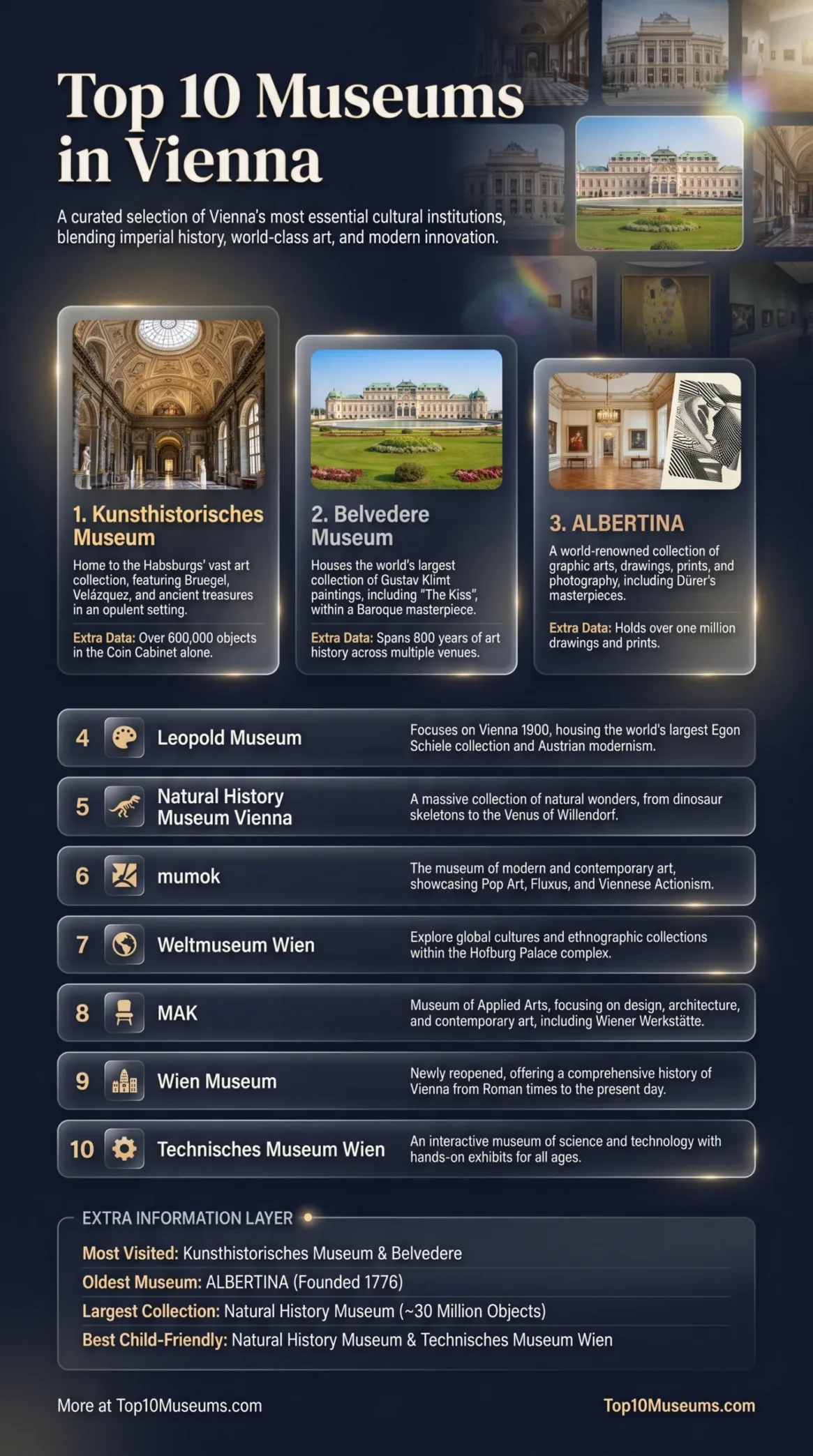
Vienna does not make museum picking easy. One hour can mean Klimt and Schiele; the next can mean meteorites, royal collections, or a steam engine big enough to stop a child mid-sentence. For travelers trying to narrow it down, this list of the top 10 museums in Vienna focuses on places that feel worth the time on a first visit, but still hold up for repeat museum people who like to linger.
| Rank | Name | Founded | Collection Type | Website |
|---|---|---|---|---|
| 1 | Kunsthistorisches Museum | 1891 | Old Masters, antiquities, decorative arts | Official website |
| 2 | Belvedere Museum | 1903 | Austrian art, Klimt, modern art | Official website |
| 3 | ALBERTINA | 1776 | Drawings, prints, modern masters, photography | Official website |
| 4 | Leopold Museum | 2001 | Vienna 1900, Schiele, Austrian modernism | Official website |
| 5 | Natural History Museum Vienna | 1876 | Natural history, prehistory, science | Official website |
| 6 | mumok | 1962 | Modern and contemporary art | Official website |
| 7 | Weltmuseum Wien | 1928 | Global cultures, ethnographic collections | Official website |
| 8 | MAK | 1863 | Applied arts, design, architecture | Official website |
| 9 | Wien Museum | 1887 | Vienna history, art, archaeology | Official website |
| 10 | Technisches Museum Wien | 1909 | Science, technology, transport, hands-on exhibits | Official website |
Why These Ten Stand Out in Vienna
These museums were chosen because they give a visitor a clean, usable cross-section of Vienna rather than ten versions of the same day. There is old-master muscle, yes, but also city history, science, design, and family-friendly stops that break up the rhythm. Just as important, the list works on the ground: several picks cluster neatly around the Ring, MuseumsQuartier, Heldenplatz, and Karlsplatz, so the city never turns into a series of long detours.
Kunsthistorisches Museum
If Vienna has one all-round art heavyweight, this is it. The museum stretches across five millennia, and even a single department can feel huge on its own: the Coin Cabinet alone holds about 600,000 objects. Come for Bruegel, Velázquez, Caravaggio, the Egyptian and Near Eastern rooms, and the grand staircase that feels half museum, half imperial stage set. For a first-time visitor, it is the easiest place to get old masters, antiquity, and decorative arts under one roof without zigzagging across the city.
Best for: Old-master lovers, first-time Vienna visitors, travelers who want one flagship museum with a lot of range
Nearby alternative: Imperial Treasury Vienna — a smart add-on in the Hofburg area if crowns, regalia, and Habsburg objects sound more tempting after a painting-heavy visit.
Belvedere Museum
Belvedere wins people over twice: first with the Baroque setting, then with the art. Across its venues, it covers about 800 years of art history and houses the world’s largest collection of Gustav Klimt paintings, including The Kiss. That alone would be enough for many visitors, but the bigger pleasure is how the museum lets Viennese modernism sit beside older Austrian painting in a place that still feels wonderfully ceremonial. It is one of the few museums where the walk between galleries and gardens is part of the experience, not a break from it.
Best for: Klimt fans, romantic city-break travelers, visitors who want palace architecture and art in the same stop
Nearby alternative: Belvedere 21 — a handy follow-up for contemporary art, just a short walk beyond the main Belvedere grounds.
ALBERTINA
ALBERTINA is the sharpest pick in central Vienna for anyone who likes works on paper but does not want a dry, specialist visit. Its collection includes over one million drawings and prints, and the Dürer holdings alone include nearly 140 drawings. The palace rooms bring a bit of polish, but the real appeal is range: drawing, printmaking, photography, modern painting, architecture, and usually a strong temporary show without the day feeling overloaded. If museum energy dips fast, this is one of the easiest art stops to enjoy in under two hours.
Best for: Drawing and print lovers, central-stay visitors, travelers who want a polished museum close to the Opera
Nearby alternative: House of Music — an easy walk from Albertinaplatz if you want something lighter and more interactive near the State Opera area.
Leopold Museum
For Vienna 1900, few places feel more focused. The Leopold Museum holds the largest Schiele collection in the world, including 44 paintings and more than 200 works on paper, so the museum has a clear voice from the moment you walk in. Klimt, Kokoschka, furniture, decorative arts, and posters widen the story, which keeps the visit from becoming a one-artist shrine. It is also one of the most comfortable museums for people who like clean labels, natural pacing, and a layout that does not fight back.
Best for: Schiele devotees, Vienna 1900 fans, art travelers who prefer a focused museum over a huge all-day palace visit
Nearby alternative: Kunsthalle Wien — also in MuseumsQuartier, and a good switch if you want a more current, exhibition-led mood after early modern Austrian art.
Natural History Museum Vienna
This is the museum that often makes children speed up instead of slow down. The Natural History Museum keeps about 30 million objects, and even one section can land hard: the bird galleries alone display more than 2,500 species. Add the Venus of Willendorf, giant skeletons, meteorites, minerals, and dense taxidermy halls, and the visit feels generous without being chaotic. Adults who think they are “just here for the kids” tend to get pulled in anyway, especially once the building starts showing off.
Best for: Families with school-age kids, science-curious teens, travelers who want a grand museum that feels lively rather than hushed
Nearby alternative: Kunsthistorisches Museum — directly across Maria-Theresien-Platz, making it very easy to shift from fossils and meteorites to old masters in one outing.
mumok
mumok is where you go when Vienna’s gilded ceilings start to feel like too much of one note. Its collection comprises around 12,500 artworks or work groups by about 1,600 artists, with strong holdings in Pop Art, Fluxus, Viennese Actionism, Concept Art, and later 20th-century work. The dark basalt exterior splits opinion, but inside the museum reads clearly and fast, which is a gift after a long run of palace galleries. It is a very good “reset museum” for travelers who want sharp modern lines and fewer chandeliers.
Best for: Contemporary art fans, repeat Vienna visitors, travelers who want postwar art after the city’s historic heavyweights
Nearby alternative: Leopold Museum — right in the same MuseumsQuartier complex if you want to pair modern and contemporary work with Vienna 1900 in a single afternoon.
Weltmuseum Wien
If you want Vienna to feel less self-contained, head here. Weltmuseum Wien houses around 200,000 objects, and its museum identity took public shape in 1928 as the Museum of Ethnology, even though parts of the collection go back much earlier. The famous feather headdress draws attention, but the deeper reward is how the galleries open up collecting, trade, empire, belief, travel, and daily life without rushing the story. This is one of Vienna’s best slow museums: read a little more than usual and it pays you back.
Best for: Global-history readers, curious museumgoers who like context, visitors who want a Hofburg stop beyond royal silver and portraits
Nearby alternative: Imperial Treasury Vienna — in the same Hofburg orbit, and a very easy second stop if you want to pivot from global collections to dynastic objects.
MAK
MAK is where Vienna’s design intelligence really shows. Founded in 1863, the museum preserves about 900,000 objects and printed works, moving from furniture and Wiener Werkstätte design to glass, posters, textiles, architecture, and contemporary interventions. That breadth sounds academic on paper, but in person the museum feels practical and stylish rather than stiff. Visitors who think design museums are only about chairs often leave realizing that daily life, taste, and city identity are the real subject here.
Best for: Design lovers, architecture fans, travelers who want something different from painting-led museum days
Nearby alternative: Kunst Haus Wien — worth the short ride east if you want Hundertwasser architecture and a less formal design-and-art mood.
Wien Museum
After reopening in late 2023, the Wien Museum became the cleanest single stop for visitors who want the city itself to make sense. Its holdings exceed one million objects, including around 130,000 paintings and graphic works, which lets the museum move from Roman Vienna to Red Vienna, fashion, protest, architecture, and everyday urban life without feeling patched together. It is especially useful near the start of a trip, when street names, districts, and local references are still just noise. A good city museum does not just inform; it tunes your eye for everything else outside.
Best for: First-time city-break visitors, history-minded walkers, travelers who want Vienna’s backstory before diving deeper into art
Nearby alternative: Otto Wagner Pavilion Karlsplatz — a neat short detour nearby if you want a smaller stop tied to Vienna’s transport and design history.
Technisches Museum Wien
This is the easiest sell for families and curious adults who like to press buttons, watch machines move, and ask how things work. The museum offers about 22,000 square meters of exhibition space, draws roughly 500,000 visitors per year, and holds hundreds of thousands of objects and archives—yet only about 5% can be shown at once. Energy, transport, musical instruments, media, and hands-on areas keep the rhythm lighter than a painting-heavy museum run. On a long Vienna trip, it is the place that often resets everyone’s mood.
Best for: Families with kids, engineering-minded visitors, travelers who want an interactive museum day away from the center’s palace circuit
Nearby alternative: Imperial Carriage Museum — a good follow-up toward Schönbrunn if transport history sounds fun but you want a more royal angle next.
How to Tour These Museums
Best Classic Art Day
Start at Belvedere in the morning, when the palace rooms feel calmer and the gardens still have breathing room. Move to ALBERTINA after lunch for drawings, modern painting, and a shorter, easier city-center museum session. Finish at the Kunsthistorisches Museum in late afternoon, when you are ready for a slower old-master visit and can happily stay until museum fatigue catches up. This order works because it moves from open palace space to tighter galleries, not the other way around.
Best Family Day
Begin at the Natural History Museum Vienna, which is usually the safest bet for early energy. Have lunch near MuseumsQuartier or on the Ring, then head west to the Technisches Museum Wien for hands-on exhibits and bigger machines in the afternoon. If everyone still has some fuel left, keep Schönbrunn or the carriage museum area in reserve rather than squeezing in a third major stop. Families generally do better with two strong museums than three rushed ones.
Best Two-Day Route
On day one, group the center: Kunsthistorisches Museum, Natural History Museum Vienna, Weltmuseum Wien, and ALBERTINA all sit within a very workable central arc if you choose two or three rather than all four. On day two, build around MuseumsQuartier with Leopold and mumok, then finish with MAK, Wien Museum, or Belvedere depending on whether you want design, city history, or Klimt. Keep the Technisches Museum for the west side of town, preferably on a different day unless you are already planning Hietzing or Schönbrunn.
[ayaz_safe_content id=”2741″ key=”p2741b1b3fymm2n”]
Who Will Love These Museums?
• Old-master lovers — Kunsthistorisches Museum is the first stop, especially for Bruegel, Velázquez, Caravaggio, and imperial-scale display rooms.
• Klimt pilgrims — Belvedere is the obvious pick because The Kiss and the museum’s Klimt holdings carry the day almost on their own.
• Print, drawing, and photography fans — ALBERTINA works beautifully for visitors who want paper-based art without giving up modern names.
• Vienna 1900 devotees — Leopold Museum is the one for Schiele, early modern Austrian art, and a tighter curatorial focus.
• Families with school-age kids — Natural History Museum Vienna and Technisches Museum Wien usually land best because they mix scale, movement, and easy visual rewards.
• Postwar and contemporary art followers — mumok is the strongest choice for visitors who want Vienna beyond palace-era painting.
• Global-history readers — Weltmuseum Wien suits visitors who like context, object stories, and museum visits that reward careful reading.
• Design and architecture people — MAK is hard to beat for Wiener Werkstätte, interiors, objects, and the look of daily life in Vienna.
• Travelers who want the city explained — Wien Museum is the most useful stop for urban history, neighborhood context, and how Vienna became Vienna.