
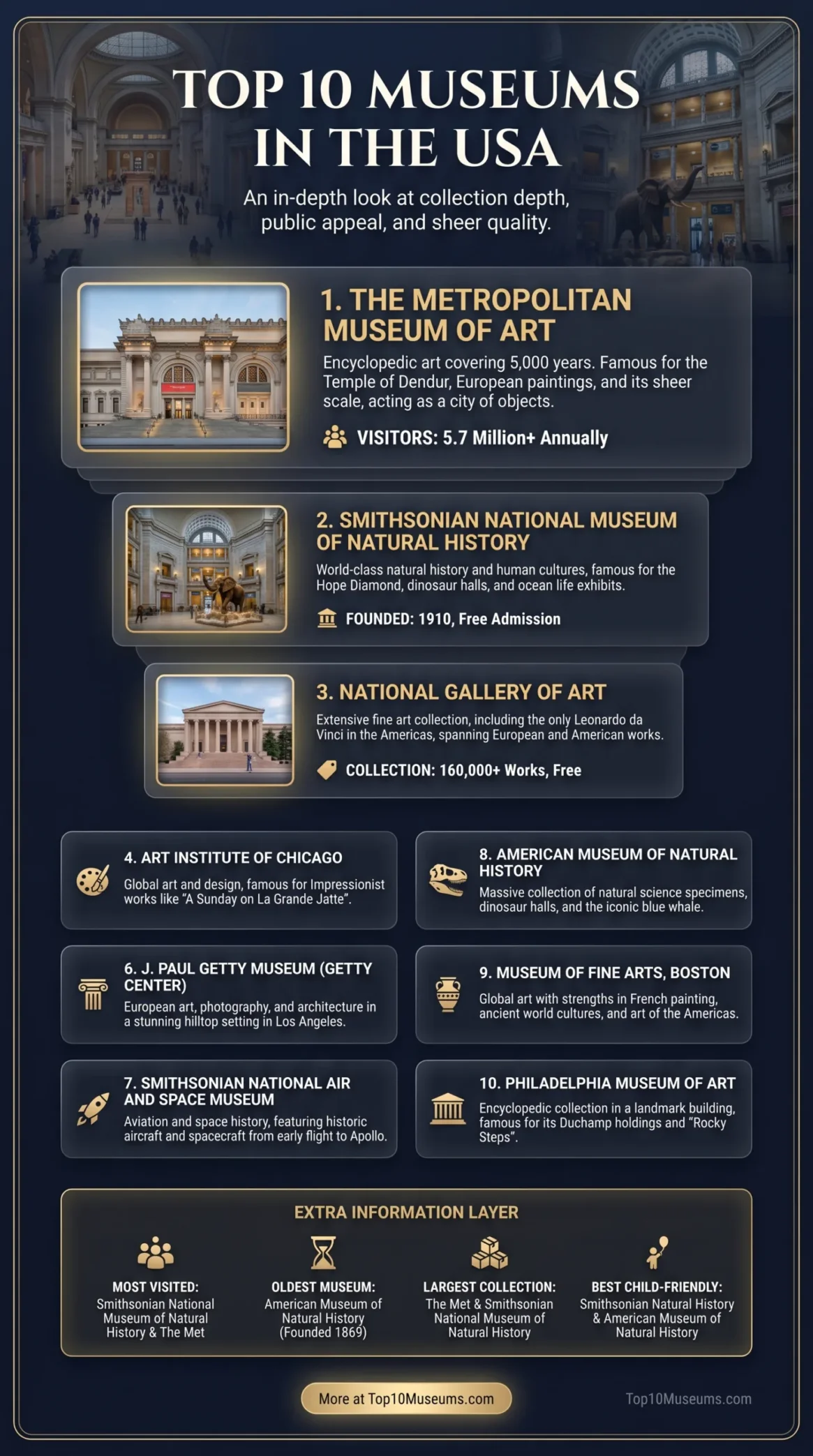
The top 10 museums in the USA cover a lot of ground—old-master painting, fossils, aircraft, design, Egyptian temples, and kid-friendly halls that can keep a family busy for hours. This list leans on collection depth, public appeal, travel value, and sheer museum quality, so it works for first-time visitors, weekend planners, and travelers who want one standout stop in each city rather than a long maybe-list.
| Rank | Name | Founded | Collection Type | Website |
|---|---|---|---|---|
| 1 | The Metropolitan Museum of Art | 1870 | Encyclopedic art | Official website ↗ |
| 2 | Smithsonian National Museum of Natural History | 1910 | Natural history | Official website ↗ |
| 3 | National Gallery of Art | 1941 | Fine art | Official website ↗ |
| 4 | Art Institute of Chicago | 1879 | Global art and design | Official website ↗ |
| 5 | Museum of Modern Art (MoMA) | 1929 | Modern and contemporary art | Official website ↗ |
| 6 | J. Paul Getty Museum (Getty Center) | 1954 | European art and photography | Official website ↗ |
| 7 | Smithsonian National Air and Space Museum | 1976 | Aviation and space history | Official website ↗ |
| 8 | American Museum of Natural History | 1869 | Natural science and human cultures | Official website ↗ |
| 9 | Museum of Fine Arts, Boston | 1870 | Global art | Official website ↗ |
| 10 | Philadelphia Museum of Art | 1876 | Encyclopedic art | Official website ↗ |
Why These 10 Museums Earned Their Place
Not every famous museum makes a top-10 list feel balanced. These picks do. Together they cover art, science, family appeal, free national museums, and once-in-a-trip landmarks, and each one has either a collection large enough to shape a full day or a signature experience that travelers remember for years. A few are pure art pilgrimages; others are better for kids, first-timers, or anyone who wants a big return on a limited schedule.
1. The Metropolitan Museum of Art, New York City
Best for: first-time visitors to New York, old-master lovers, Egyptian art fans, travelers who want one museum that can fill half a day or more
If one museum in the country feels like a city of objects, it is The Met. Founded in 1870, it now cares for more than 1.5 million objects across over 5,000 years, which means one visit can jump from Greek sculpture to Japanese screens to arms and armor without ever feeling thin. The Temple of Dendur gives the museum one of the most memorable indoor spaces in the United States, and recent attendance above 5.7 million shows that this is still the place many travelers build their New York museum day around. It is large—very large—so it rewards a route more than a casual wander.
Nearby alternative: Solomon R. Guggenheim Museum — a short walk north on Fifth Avenue, with a very different mood and a building that is almost as famous as the art inside.
2. Smithsonian National Museum of Natural History, Washington, DC
Best for: families with young kids, dinosaur fans, visitors who want a free museum, travelers mixing science and sightseeing on the National Mall
This is one of the easiest top-tier museum recommendations in America because it is both world-class and free. The museum, established in 1910, stewards more than 148 million objects and specimens, and Smithsonian materials note that it draws more than six million visitors a year. Even better for travelers, the experience is broad without feeling stuffy: dinosaurs, gems, ocean life, human origins, and culture galleries all sit in one building right on the Mall. For families or first-time DC visitors, that mix is hard to top.
Nearby alternative: National Museum of the American Indian — an easy walk across the Mall if the natural history crowds feel heavy and you want a more focused cultural stop.
3. National Gallery of Art, Washington, DC
Best for: classic art lovers, budget-conscious travelers, travelers who want a free museum with major European names, couples planning a quieter DC museum stop
The National Gallery of Art feels generous in the best sense: admission is always free, yet the collection runs to more than 160,000 works and includes the only Leonardo da Vinci painting in the Americas. The original building opened in 1941, and the museum now welcomes nearly four million visitors a year, which says plenty about its reach. This is the place for travelers who want Rembrandt, Vermeer, Monet, Rothko, sculpture, and a proper art-museum pace without ticket stress. On a busy DC itinerary, it is also a welcome reset—cool, calm, and easy to pair with another Mall stop.
Nearby alternative: Hirshhorn Museum and Sculpture Garden — a short walk east for travelers who want to pivot from older European art to 20th-century and contemporary work.
4. Art Institute of Chicago, Chicago
Best for: art-first city breaks, Impressionism fans, travelers who like iconic paintings, visitors who want a major museum in a walkable downtown area
The Art Institute of Chicago gets the balance right between fame and substance. Founded in 1879, it has grown to nearly 300,000 works of art, spanning about 5,000 years, yet it still feels very human in the way many people visit it: to see A Sunday on La Grande Jatte, American painting, Japanese screens, or modern design up close. The downtown location helps, too—you can step out and still be in the middle of a real city day rather than stranded on a museum campus. For travelers who want one major art museum outside New York or Washington, this is often the smartest pick.
Nearby alternative: Field Museum — a quick cab, bus, or rideshare south to Museum Campus if you want to trade painting galleries for fossils, anthropology, and big natural history halls.
5. Museum of Modern Art (MoMA), New York City
Best for: modern art fans, design lovers, shorter museum visits in Midtown, travelers who want famous 20th-century works without committing to an all-day museum
MoMA is the sharpest modern-art stop in the country for visitors who want the canon in one building. Established in 1929, it now holds almost 200,000 works and welcomed nearly 2.8 million visitors in fiscal year 2025, which tells you it still sits high on every serious New York art itinerary. The Starry Night brings in plenty of first-timers, but the real strength is the range: painting, design, photography, film, architecture, and media art all speak to one another. It is busy, yes, though the museum’s compact vertical layout makes it far easier to manage than bigger encyclopedic museums.
Nearby alternative: The Frick Collection — a short uptown ride or longer walk if you want to swap modernism for a more intimate old-master setting.
6. J. Paul Getty Museum (Getty Center), Los Angeles
Best for: Los Angeles first-timers, travelers who want art plus architecture, photography fans, visitors who enjoy a scenic museum setting
The Getty Center earns its place because the visit is not just about the galleries; it is also about the hilltop setting, the architecture, and the feel of arrival. The J. Paul Getty Museum opened to the public in 1954 and today the Getty Museum Collection includes metadata for more than 250,000 objects. Inside, European painting, decorative arts, sculpture, manuscripts, and photography give the museum real weight, while Van Gogh’s Irises remains one of the best-known crowd magnets in Los Angeles. This is a museum for people who want culture with a bit of California air around it—not a rushed in-and-out stop.
Nearby alternative: Getty Villa — about a 20 to 30 minute drive west, with Greek and Roman art in a coastal setting that feels almost like a separate trip.
7. Smithsonian National Air and Space Museum, Washington, DC
Best for: STEM-curious teens, aviation buffs, families, travelers who want a free museum with big visual payoffs
Some museums win on atmosphere; this one wins the moment you look up. The museum in Washington opened in 1976, and the Smithsonian’s collection includes over 60,000 artifacts plus a huge body of archival material. Historic aircraft and spacecraft give it instant appeal, but the deeper draw is how clearly the museum turns national and global history into something visible: you can move from early flight to Apollo-era material in one afternoon. For kids, teens, or adults who do not usually call themselves museum people, this is often the surprise favorite.
Nearby alternative: National Museum of the American Indian — an easy walk east along Independence Avenue if your group wants a quieter second stop after the big crowds here.
8. American Museum of Natural History, New York City
Best for: families with school-age kids, dinosaur lovers, repeat New York visitors, travelers who prefer science museums to art museums
The American Museum of Natural History is one of those places that still feels fun before you even choose a gallery. Founded in 1869, it holds more than 30 million specimens and objects, and it packs that scale into displays people actually remember: the 94-foot blue whale, the dinosaur halls, and the 122-foot Titanosaur that famously pushes beyond the gallery space. It is one of the easiest museums in the country to recommend to a mixed-age group because the visual payoff starts right away. If the usual New York art circuit feels a bit samey, this stop adds science, spectacle, and real variety.
Nearby alternative: New-York Historical — just a short walk south if you want to move from natural science to the story of New York and the wider nation.
9. Museum of Fine Arts, Boston
Best for: travelers who want a big art museum without New York-scale crowds, Monet fans, Boston weekend visitors, mixed-interest art groups
The Museum of Fine Arts, Boston, belongs on this list because it offers serious depth without asking visitors to wrestle with the pace of Manhattan. Founded in 1870, it houses nearly 500,000 works of art and welcomed 966,525 visitors in fiscal year 2024. The museum is especially strong in French painting, ancient art, and art of the Americas, and its Monet holdings stand out—MFA materials point to 35 paintings by Claude Monet, one of the largest such groups outside France. For many travelers, it is the sweet spot: large enough to feel major, calm enough to enjoy.
Nearby alternative: Isabella Stewart Gardner Museum — a very short walk away, ideal if you want a more intimate setting with a strong sense of personality and place.
10. Philadelphia Museum of Art, Philadelphia
Best for: weekend city-break travelers, modern art fans, visitors who want a major museum in a manageable format, people pairing art with a walkable cultural district
The Philadelphia Museum of Art rounds out the list because it brings together a strong permanent collection, a memorable setting, and a visit that feels approachable rather than overwhelming. The museum traces its roots to the Centennial era and today cares for more than 240,000 objects, while its Marcel Duchamp holdings remain one of the clearest reasons art lovers make the trip. That means a visit can move from medieval rooms to Asian art to modern experiments without losing its shape. Add the Benjamin Franklin Parkway setting and the museum’s own landmark steps, and you get a stop that is both serious and very easy to fold into a city weekend.
Nearby alternative: Barnes Foundation — a brief walk east along the Parkway if you want another art-heavy stop with a very different display philosophy.
How to Tour These Museums
Best New York Art Day
Do The Met in the morning, when energy is high and your feet are still on your side. Keep the visit focused—Egypt, European painting, or Asian art—then move to MoMA after lunch for a tighter, more modern counterpoint. Save the American Museum of Natural History for a separate day unless the group is unusually fast; trying to do all three in one stretch usually turns into gallery blur.
Best Washington, DC Free Museum Day
Start at the National Museum of Natural History when kids and casual visitors are freshest, then cross to the National Gallery of Art for a calmer midday shift. Put Air and Space in the afternoon if the group wants something visually big to finish on. All three are free, which makes DC the easiest city on this list for travelers who want a full museum day without ticket math.
Best Family Science Day
For a family-led trip, split the science museums by city rather than forcing comparison. In New York, build the day around the American Museum of Natural History and leave room for breaks around the Upper West Side. In Washington, pair Natural History with Air and Space only if the children still have energy after lunch; both are excellent, but both can be tiring if rushed.
Best Two-Day Route for Art Lovers
Day one in New York works best with The Met and MoMA, in that order. Day two in Washington, DC should be the National Gallery of Art, with either the Smithsonian Natural History Museum or Air and Space added depending on whether the group leans toward science or classical art. That two-city pairing gives travelers the broadest museum hit rate in a short East Coast trip.
Best Relaxed Single-Museum City Picks
If the goal is one museum per city and no rushing, pick the Getty Center in Los Angeles, the Art Institute in Chicago, the MFA in Boston, and the Philadelphia Museum of Art in Philadelphia. Each one can anchor a half day without requiring military-level planning. That matters more than people admit—good museum travel is often about pacing, not just rankings.
[ayaz_safe_content id=”2743″ key=”p2743b1cwxbwvee”]
Who Will Love These Museums?
- Old-master lovers: The Metropolitan Museum of Art and the National Gallery of Art are the best pair for visitors who want European painting, sculpture, and long-view art history.
- STEM-curious teens: The Smithsonian National Air and Space Museum gives them rockets, aircraft, and clear visual storytelling without feeling classroom-heavy.
- Families with young kids: Smithsonian National Museum of Natural History and the American Museum of Natural History both offer fast visual wins—dinosaurs, whales, gems, and giant halls.
- Modern art fans: MoMA is the cleanest choice for 20th-century and contemporary art, while the Philadelphia Museum of Art adds Duchamp and broader context.
- Travelers on a tighter budget: Washington, DC is the jackpot—Natural History, the National Gallery of Art, and Air and Space can fill a full trip day without admission costs.
- Visitors who want one museum and done: The Met, the Art Institute of Chicago, and the MFA Boston all work well as anchor museums for a city weekend.
- Architecture-and-view seekers: The Getty Center is as much about the setting and campus experience as it is about the collection.
- Repeat New York visitors: American Museum of Natural History is a smart switch when the usual Manhattan art circuit starts to feel overfamiliar.
- Monet and Impressionism fans: MFA Boston and the Art Institute of Chicago both reward visitors who care about 19th-century painting.
- Travelers who like manageable museum days: The Philadelphia Museum of Art offers major works and a clear layout without the scale shock that can come with the very biggest museums.