
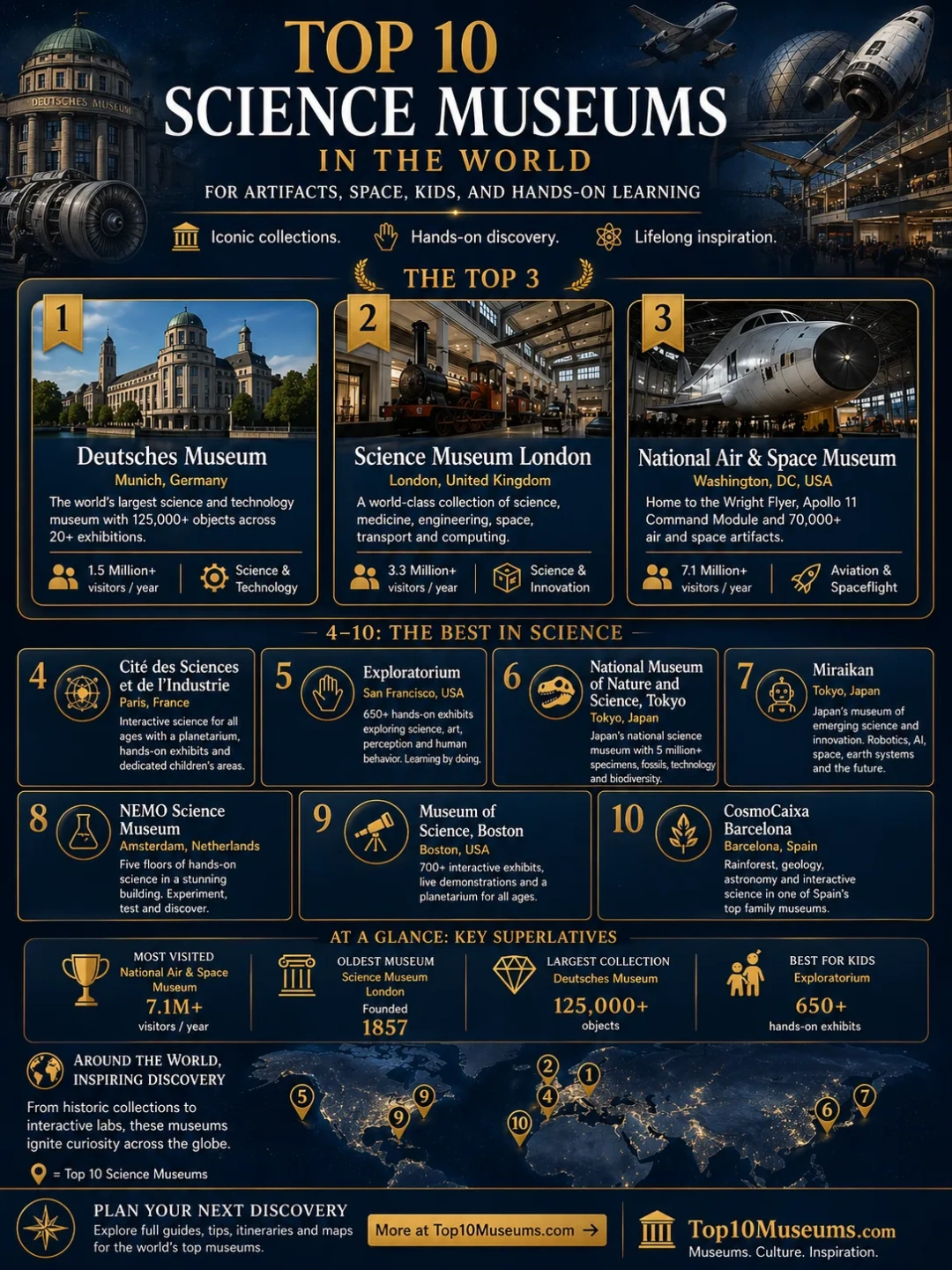
Science museums are not all built for the same kind of visitor. Some are artifact-heavy institutions where original aircraft, engines, medical tools, fossils, and space capsules do most of the talking. Others are hands-on laboratories where children, teens, and adults test ideas by touching, building, listening, lifting, coding, or watching a live experiment unfold in front of them. This list of the Top 10 Science Museums in the World favors museums that combine strong collections, public learning, memorable buildings, and a reason to stay longer than planned.
| Rank | Name | Founded | Collection Type | Website |
|---|---|---|---|---|
| 1 | Deutsches Museum | 1903 | Science, engineering, technology, aviation, energy, robotics | Official website |
| 2 | Science Museum London | 1857 | Science, medicine, engineering, space, transport, computing | Official website |
| 3 | National Air and Space Museum | 1946 | Aviation, spaceflight, aircraft, spacecraft, astronomy | Official website |
| 4 | Cité des Sciences et de l’Industrie | 1986 | Interactive science, industry, planetarium, children’s science | Official website |
| 5 | Exploratorium | 1969 | Hands-on science, art, perception, physics, human behavior | Official website |
| 6 | National Museum of Nature and Science, Tokyo | 1877 | Natural history, science history, fossils, technology, biodiversity | Official website |
| 7 | Miraikan | 2001 | Emerging science, robotics, earth systems, space, future technology | Official website |
| 8 | NEMO Science Museum | 1923 | Hands-on science, technology, chemistry, energy, design | Official website |
| 9 | Museum of Science, Boston | 1830 | Interactive science, engineering, planetarium, live demonstrations | Official website |
| 10 | CosmoCaixa Barcelona | 1981; reopened as CosmoCaixa in 2004 | Interactive science, geology, rainforest, astronomy, family learning | Official website |
Why These Ten Science Museums Stand Out
The ranking gives weight to original objects, not just display size. A museum with a real command module, a historic engine, a major fossil collection, or a working demonstration earns a stronger place than a venue built mainly around screens. That is why older institutions such as Deutsches Museum and the Science Museum London sit beside newer public science centers such as Miraikan and NEMO.
Family value also matters. A strong science museum should work for a ten-year-old, a tired parent, a STEM-curious teenager, and an adult who quietly wants to spend 20 minutes staring at a machine, specimen, or space artifact. The best places here offer clear routes, tactile exhibits, visual drama, and enough depth to reward a second visit.
Geography is part of the choice too. This is not a list of one country’s biggest science museums; it moves across Europe, North America, and East Asia, where many of the world’s best-known public science collections are concentrated. The result is a practical list for travelers who want museums that are worth shaping a day around.
Best Science Museums in the World
1. Deutsches Museum — Munich, Germany
Best for: engineering fans, aviation lovers, robotics-curious teens, families who want a full-day science museum.
The Deutsches Museum is one of the strongest science and technology museums anywhere because it treats machines, instruments, and experiments as cultural objects, not just tools. Its collection includes more than 125,000 objects, with around 20 permanent exhibitions on the main Museum Island site, covering topics such as astronautics, optics, chemistry, robotics, health, aviation, and energy. For visitors who like to understand how things work — engines, bridges, aircraft, musical instruments, power systems — this museum feels wonderfully hands-on without losing its scholarly weight.
The building itself can absorb most of a day. The aviation and astronautics areas are especially useful for first-time visitors because they combine large-scale objects with clear storytelling. Families should not rush the Kids’ Kingdom, while adults with limited time should choose two or three zones rather than trying to cover every floor. Plan for fatigue: this is a museum where “just one more gallery” can easily become another hour.
Nearby alternative: BMW Museum — a strong engineering and design alternative northwest of the city center, especially easy to pair with Munich’s U-Bahn network.
2. Science Museum London — London, United Kingdom
Best for: first-time London visitors, medical history readers, space fans, families looking for a free museum day.
The Science Museum London has the kind of range that makes it useful for almost every visitor: space, medicine, energy, computing, engineering, mathematics, transport, and industrial history all sit under one roof in South Kensington. The Science Museum Group’s online collection gives access to more than 500,000 objects and archives, and the London museum is famous for artifacts such as the Apollo 10 command module, early engines, medical objects, and machines that shaped public life. It is also one of the most practical museums on this list because general admission is free, though some exhibitions may require paid tickets.
The museum works best when visited with a theme. Families often head toward interactive galleries and space displays, while adults can build a slower route around medicine, information technology, and industrial design. Its South Kensington location is a gift: three major museums sit within a short walk, so it can fit into a broader museum day without awkward travel. Do not overpack the day if children are with you; this museum is denser than it looks from the entrance.
Nearby alternative: Natural History Museum — a short walk away on Exhibition Road, ideal for fossils, minerals, dinosaurs, and life science collections.
3. National Air and Space Museum — Washington, DC, United States
Best for: aviation fans, space-history readers, families with older kids, travelers who want a free Smithsonian museum.
The Smithsonian’s National Air and Space Museum has a collection that is hard to match for aviation and spaceflight history. The museum’s holdings include more than 70,000 air and space objects, with icons such as the 1903 Wright Flyer and the Apollo 11 Command Module Columbia connected to the national collection. Its central Washington, DC location also makes it one of the easiest major science museums in the world to fit into a city itinerary.
The museum is especially good for visitors who want original objects rather than only digital displays. Aircraft, spacecraft, flight suits, engines, and mission hardware give the galleries a strong sense of scale — the sort of thing photos never quite capture. Because the museum has gone through major renovation phases, visitors should check gallery availability before setting expectations. Timed-entry planning matters, especially during school breaks and summer travel weeks.
Nearby alternative: National Museum of Natural History — a short National Mall walk away, with minerals, fossils, ocean life, and family-friendly science galleries.
4. Cité des Sciences et de l’Industrie — Paris, France
Best for: families in Paris, interactive learners, planetarium visitors, children who need movement and play.
Cité des Sciences et de l’Industrie, opened in 1986 in Parc de la Villette, is one of Europe’s major public science venues and one of the best options in Paris for families who want science without a formal classroom mood. The museum includes permanent exhibitions, temporary shows, a planetarium, and dedicated children’s areas, with the address at 30 avenue Corentin Cariou in the 19th arrondissement. It is a useful counterpoint to the art-heavy museum circuit in central Paris.
The strongest reason to visit is its age range. Younger children can focus on tactile play and basic experimentation, while teens and adults can spend time with space, industry, sound, light, mathematics, and environmental topics. The site is large, so a visit works best when treated as a half-day rather than a quick stop between landmarks. Paris can be tiring on foot, and this museum gives families a more open, practical, rain-proof block of time.
Nearby alternative: Musée des Arts et Métiers — a Métro ride away, excellent for inventions, scientific instruments, clocks, machines, and early technology.
5. Exploratorium — San Francisco, United States
Best for: hands-on learners, curious adults, teens, families who prefer experiments over display cases.
The Exploratorium is different from the artifact-led museums on this list because its real strength is active discovery. Founded in 1969 by physicist Frank Oppenheimer, it now occupies Pier 15 on San Francisco’s waterfront and features more than 650 hands-on exhibits, many made in its own exhibit-development shop. The museum’s focus on science, art, and human perception makes it especially good for visitors who learn by doing rather than reading long labels.
Expect light, sound, motion, biology, cognition, behavior, and Bay Area environmental exhibits to blend together in a way that feels playful but never shallow. Adults often enjoy it as much as children because many exhibits reveal how easily the brain, eye, and body can be tricked. Leave room for wandering: the best moments here often come from an exhibit you did not plan to see.
Nearby alternative: California Academy of Sciences — across town in Golden Gate Park, strong for natural history, aquarium exhibits, rainforest displays, and a planetarium.
6. National Museum of Nature and Science, Tokyo — Tokyo, Japan
Best for: natural history fans, fossil lovers, Japan-focused travelers, families already visiting Ueno Park.
The National Museum of Nature and Science in Tokyo, often called Kahaku, is one of Japan’s most important science institutions. Founded in 1877, it is the country’s only national museum devoted broadly to the history of nature, science, and technology, with research collections reported at more than 5 million materials. Its Ueno Park location makes it easy to pair with several major cultural sites, but the museum itself deserves dedicated time.
The museum is especially strong for visitors who want both natural history and science history. Fossils, biodiversity, Japanese species, earth science, astronomy, and technological artifacts sit across the Japan Gallery and Global Gallery. Outside, the life-size blue whale model is one of the museum’s most recognizable sights, while inside the displays reward patient visitors who enjoy specimens and classification. For families, it is one of Tokyo’s safest museum choices because the subject range is broad enough to hold different attention spans.
Nearby alternative: Tokyo National Museum — a short walk within Ueno Park, best for travelers who want to pair science with Japanese art, archaeology, and cultural history.
7. Miraikan — Tokyo, Japan
Best for: robotics fans, future-tech readers, teens, travelers interested in AI, space, climate, and society.
Miraikan, the National Museum of Emerging Science and Innovation, opened in July 2001 in Tokyo’s Odaiba area. It is not a traditional museum built around old machines; it is a future-facing science center that looks at robotics, earth systems, space, life science, data, and the social questions that come with new technology. Permanent exhibition areas include themes such as “Create Your Future” and “Explore the Frontiers,” giving the museum a clear identity for visitors who want science tied to daily life and tomorrow’s choices.
This is a strong pick for older children and teens because the displays invite discussion rather than passive viewing. Robots, environmental systems, space science, and human-centered technology are presented in a way that connects science with ethics, work, health, and the planet. Miraikan pairs well with Odaiba because the district itself feels like a lesson in urban planning, transit, and engineering.
Nearby alternative: Museum of Maritime Science — an Odaiba-area alternative for visitors interested in ships, ports, and marine technology.
8. NEMO Science Museum — Amsterdam, Netherlands
Best for: families with school-age kids, design-minded travelers, first-time Amsterdam visitors, hands-on science fans.
NEMO Science Museum is the largest science center in the Netherlands and one of Amsterdam’s most recognizable museum buildings. The institution traces its origins to 1923, while the current copper-green building by Renzo Piano opened in 1997 above the Oosterdok. Inside, visitors find five floors of hands-on science, with exhibitions built around technology, chemistry, energy, the human body, and everyday questions.
NEMO is particularly good for families because the museum makes basic science feel physical: visitors push, pull, test, mix, build, and compare. The rooftop also adds an unusual bonus, with public views over Amsterdam and outdoor installations tied to nature and energy. Adults without children should not dismiss it; the design, demonstrations, and city views make it more than a kids-only stop.
Nearby alternative: The National Maritime Museum — an easy walk from NEMO, ideal for navigation, shipbuilding, maps, and Dutch maritime technology.
9. Museum of Science, Boston — Boston, United States
Best for: families, school groups, live-demonstration fans, visitors who want planetarium and engineering exhibits together.
The Museum of Science in Boston began in 1830 as the Boston Society of Natural History and later grew into one of the United States’ best-known public science museums. Its current Science Park location opened in 1951, and the museum is known for more than 700 interactive exhibits, live presentations, a planetarium, engineering displays, biology topics, and changing exhibitions. It is built for repeat local visits as much as for tourists.
The museum’s strength is variety without feeling too formal. A family can move from electricity and engineering to dinosaurs, live animals, the human body, and space-themed programming in one visit. The Charles River setting between Boston and Cambridge also makes it easy to connect with nearby university areas. For first-timers, choosing one show or planetarium program in advance helps shape the day.
Nearby alternative: MIT Museum — a short trip into Cambridge, especially good for invention, robotics, photography, holography, and university-linked science culture.
10. CosmoCaixa Barcelona — Barcelona, Spain
Best for: families, geology fans, rainforest lovers, Barcelona visitors who want science beyond the historic center.
CosmoCaixa Barcelona began as the Science Museum of Barcelona in 1981 and reopened under its current name in 2004 after major redevelopment. It is one of Spain’s strongest interactive science museums, with permanent spaces devoted to nature, matter, geology, astronomy, experimentation, and family learning. One of its most memorable features is the Flooded Forest, a recreation of more than 1,000 square meters of Amazon rainforest environment.
The museum works especially well for travelers who want a slower, cooler, more family-friendly block away from the busiest parts of Barcelona. The Planetarium and geology areas add structure, while the rainforest section gives younger visitors an immediate visual anchor. It is not in the Gothic Quarter or Eixample museum cluster, so plan transport rather than treating it as a casual walk-by stop.
Nearby alternative: Museu de Ciències Naturals de Barcelona — a cross-city option for natural history collections, biodiversity, and family-friendly science displays.
How to Tour These Museums
Best Europe Science Museum Route
For a Europe-focused trip, start with Science Museum London, then move to Amsterdam for NEMO, Paris for Cité des Sciences, Munich for Deutsches Museum, and Barcelona for CosmoCaixa. This is not a single-city route; it works best as a rail-and-flight museum itinerary over 8 to 14 days. Put Deutsches Museum after a lighter city day because it is the most demanding full-day stop. CosmoCaixa is a good final museum because it is interactive, calmer, and easier for tired travelers than another dense artifact collection.
Best Tokyo Science Day
In Tokyo, treat the National Museum of Nature and Science and Miraikan as two different moods, not substitutes for each other. Start in Ueno Park with Kahaku in the morning, when energy is higher for fossils, specimens, and science history. Save Miraikan for another day in Odaiba, ideally in the afternoon, when future-tech displays and waterfront walking feel easier. Trying both on the same day is possible, but not pleasant unless you move quickly and skip several sections.
Best United States Science Museum Pairing
For a US science-museum trip, the easiest pair is Washington, DC and Boston: the National Air and Space Museum gives you aviation and space icons, while the Museum of Science, Boston gives you live demonstrations and family-friendly interactivity. Add the Exploratorium only if the trip also includes the West Coast, because San Francisco changes the travel scale. In Washington, keep the Air and Space Museum to one strong half-day and leave room for the National Mall. In Boston, plan around a show, planetarium slot, or live demonstration so the visit has a clear rhythm.
Best Family-Friendly Strategy
Families should choose one dense museum per day, not two. NEMO, Exploratorium, Museum of Science Boston, CosmoCaixa, and Cité des Sciences are the easiest picks for children because the visit is physical and varied. Deutsches Museum and the Science Museum London are excellent for families too, but they require more adult guidance to avoid museum fatigue. Build in food breaks, a nearby park or waterfront walk, and one “everyone chooses a gallery” moment to keep the day from feeling like school.
[ayaz_safe_content id=”2771″ key=”p2771b15tspj3l5″]
Who Will Love These Museums?
- Engineering obsessives: Deutsches Museum, NEMO, and the Museum of Science Boston offer machines, experiments, and applied science in clear public settings.
- Space and aviation fans: National Air and Space Museum, Science Museum London, Deutsches Museum, and Miraikan all give strong reasons to plan around flight, spacecraft, and astronomy.
- Families with young kids: Cité des Sciences et de l’Industrie, NEMO, Exploratorium, CosmoCaixa, and Museum of Science Boston are the easiest picks for movement, touch, and short attention spans.
- Natural history readers: National Museum of Nature and Science, Tokyo and CosmoCaixa Barcelona are especially useful for fossils, biodiversity, earth science, and living environments.
- Teens who say museums are boring: Exploratorium, Miraikan, and NEMO are the strongest bets because they connect science with perception, robotics, future technology, and everyday choices.
- Free-museum planners: Science Museum London and the Smithsonian National Air and Space Museum are especially attractive because general admission is free, though reservations or paid special exhibitions may still apply.
- Architecture-minded travelers: NEMO’s Renzo Piano building, CosmoCaixa’s dramatic interior route, and Cité des Sciences in Parc de la Villette all add strong building design to the science visit.