
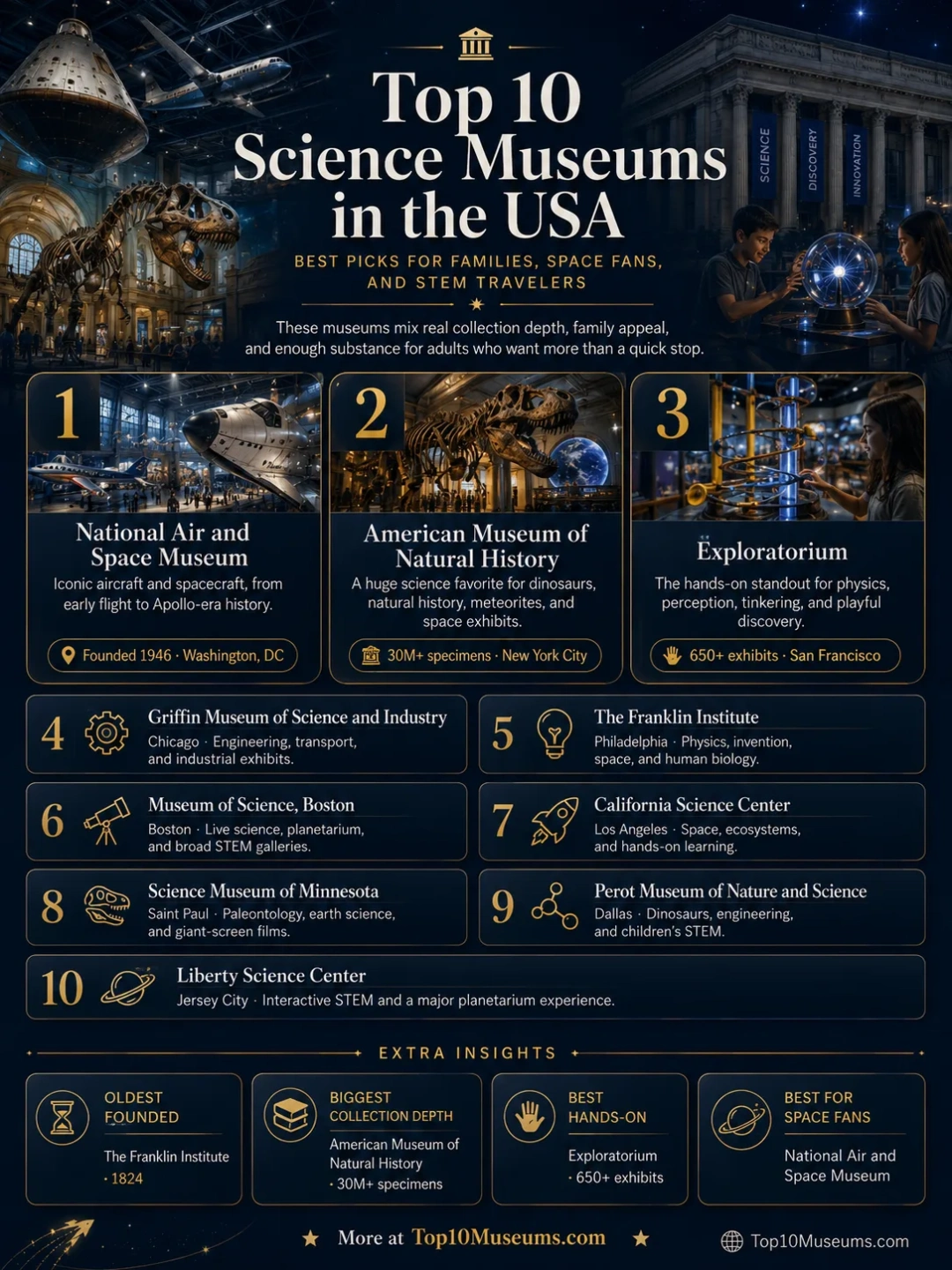
The top 10 science museums in the USA are not all the same kind of place. Some are built around spacecraft and aviation history, some focus on dinosaurs and natural science, and others are best for hands-on experiments where kids can pull, spin, test, build, and ask “wait, why did that happen?” This list keeps the focus on museums that are useful for real trip planning: strong collections, visitor-friendly exhibits, family appeal, and enough depth for adults who do not want a thin, one-hour stop.
| Rank | Name | Founded | Collection Type | Website |
|---|---|---|---|---|
| 1 | National Air and Space Museum | 1946 | Aviation, spaceflight, planetary science | Official website |
| 2 | American Museum of Natural History | 1869 | Natural history, anthropology, earth and space science | Official website |
| 3 | Exploratorium | 1969 | Hands-on science, art, perception, physics | Official website |
| 4 | Griffin Museum of Science and Industry | 1933 | Engineering, industry, transport, technology | Official website |
| 5 | The Franklin Institute | 1824 | Physics, invention, space, human biology | Official website |
| 6 | Museum of Science, Boston | 1830 | STEM exhibits, live science, planetarium, technology | Official website |
| 7 | California Science Center | 1951 | Space, life science, ecosystems, hands-on galleries | Official website |
| 8 | Science Museum of Minnesota | 1907 | Paleontology, human body, earth science, giant screen films | Official website |
| 9 | Perot Museum of Nature and Science | 1936 roots / 2012 campus | Nature, engineering, dinosaurs, children’s STEM | Official website |
| 10 | Liberty Science Center | 1993 | Interactive STEM, planetarium, live animals, engineering | Official website |
Why These Ten Science Museums Made the List
This selection favors museums with real collection weight, not only fun displays. That is why a space museum with historic aircraft, a natural history museum with tens of millions of specimens, and hands-on science centers all appear together. A good science museum should work for a curious adult, a school-age child, and a first-time visitor who has only one open afternoon.
Geography also matters. The list covers the East Coast, Midwest, Texas, and California, so it is not just a New York-and-Washington roundup. It also gives weight to museums that can anchor a full day: planetariums, IMAX or giant-screen theaters, live demonstrations, dinosaur halls, engineering galleries, space artifacts, and exhibits that reward slow looking.
1. National Air and Space Museum — Washington, DC
The National Air and Space Museum is the best first pick for visitors who want science tied to real machines that changed history. Established in 1946 as the National Air Museum, it is closely linked with the Smithsonian’s aviation and spaceflight collections, and its best-known objects include icons such as the Wright Flyer, Spirit of St. Louis, and Apollo 11 Command Module Columbia. It is especially strong for travelers who prefer artifacts over screens: you are not only reading about flight; you are standing near the hardware that made flight and space exploration feel possible.
Best for: Spaceflight fans, aviation history readers, STEM-focused teens, and families who want a museum with famous aircraft and spacecraft.
Nearby alternative: National Museum of Natural History — a National Mall option for visitors who want fossils, gems, ocean science, and natural history within the same general museum district.
2. American Museum of Natural History — New York City
The American Museum of Natural History is a science museum for people who like their science big: dinosaurs, meteorites, ocean life, human cultures, and space all sit under one roof. Founded in 1869, the museum’s scientific collections include more than 30 million specimens and objects, which gives its halls a depth that many smaller museums cannot match. The dinosaur galleries are the headline for many families, but the Rose Center for Earth and Space and Hayden Planetarium make it just as useful for astronomy-minded visitors.
Best for: Dinosaur fans, natural history lovers, planetarium visitors, and families who want one museum that can fill most of a day.
Nearby alternative: Intrepid Museum — a good choice for aviation, naval engineering, and space shuttle displays, reachable by a crosstown ride from the Upper West Side.
3. Exploratorium — San Francisco
The Exploratorium is less about “look, but do not touch” and more about testing ideas with your hands. Opened in 1969, it now features more than 650 hands-on exhibits, many built in its own exhibit development shop. The mix of physics, perception, biology, sound, light, tinkering, and art makes it one of the best science museums in the country for visitors who learn by trying things rather than reading long labels.
Best for: Hands-on learners, curious adults, teens who like experiments, and families who want science to feel playful rather than lecture-like.
Nearby alternative: California Academy of Sciences — a strong Golden Gate Park option for visitors who want an aquarium, planetarium, rainforest dome, and natural history exhibits in one stop.
4. Griffin Museum of Science and Industry — Chicago
Chicago’s Griffin Museum of Science and Industry is a top choice for anyone drawn to engineering, machines, transport, and industrial design. Founded in 1933, it is housed in the historic Palace of Fine Arts from the 1893 World’s Columbian Exposition, so the building itself already has a story. The museum’s classic experiences include the Coal Mine and the U-505 Submarine, a World War II German U-boat that has been part of the museum experience since 1954.
Best for: Engineering fans, train and submarine enthusiasts, older kids, and visitors who like large-scale exhibits with real machines.
Nearby alternative: Adler Planetarium — a lakefront science stop for astronomy and space exhibits, best paired by car, rideshare, or a longer public-transit route from Hyde Park.
5. The Franklin Institute — Philadelphia
The Franklin Institute is one of the oldest science institutions in the United States, founded in 1824 to promote science and the mechanic arts. Its style is very Philadelphia: historic, educational, and still fun for school trips. The famous Giant Heart, built in 1953, remains a visitor favorite, while exhibits on space, electricity, physics, sports science, and engineering help the museum work for both young kids and adults who want more than a photo stop.
Best for: Families, school-age children, invention fans, human biology learners, and travelers who want a classic American science museum.
Nearby alternative: Academy of Natural Sciences of Drexel University — an easy walk for visitors who want dinosaurs, dioramas, and natural history after a Franklin Institute visit.
6. Museum of Science, Boston — Boston
The Museum of Science, Boston has roots in the Boston Society of Natural History, founded in 1830, but today it feels like a broad STEM center with live presentations, technology exhibits, animals, and space programming. Its best-known experiences include the Theater of Electricity, the Charles Hayden Planetarium, and the Mugar Omni Theater. With hundreds of interactive exhibits, it is one of the most practical science museums for families visiting Boston with mixed ages.
Best for: Families with kids, planetarium fans, visitors who like live science shows, and STEM travelers who want a flexible half-day or full-day stop.
Nearby alternative: MIT Museum — a smart Cambridge add-on for robotics, design, holography, and invention-focused exhibits, reachable by a short rideshare or public-transit trip.
7. California Science Center — Los Angeles
The California Science Center is a strong Los Angeles choice because it blends space, life science, ecosystems, and hands-on learning in Exposition Park. The institution traces its science-museum identity to 1951, when the California Museum of Science and Industry name was adopted, and it became the California Science Center in 1998. Space Shuttle Endeavour, an orbiter that completed 25 missions, is the headline space artifact, though visitors should check current viewing status before planning a trip around Endeavour alone.
Best for: Space shuttle fans, Los Angeles families, budget-aware travelers, and visitors who want science galleries close to other Exposition Park museums.
Nearby alternative: Natural History Museum of Los Angeles County — a next-door option for dinosaurs, gems, mammals, and Southern California natural history.
8. Science Museum of Minnesota — Saint Paul
The Science Museum of Minnesota is a strong pick for visitors who want paleontology, human biology, earth science, and giant-screen films without the scale of a coastal mega-city museum. Founded in 1907 as the St. Paul Institute of Science and Letters, it became known as the Science Museum of Minnesota in 1970. Its history includes a complete Triceratops skeleton in 1959 and a museum-made touring exhibit program that has reached millions of visitors through traveling exhibitions.
Best for: Dinosaur fans, Midwest road-trippers, human body learners, giant-screen film fans, and families visiting the Twin Cities.
Nearby alternative: Bell Museum — a University of Minnesota option for natural history, wildlife dioramas, and planetarium programming, best reached by car or transit from downtown Saint Paul.
9. Perot Museum of Nature and Science — Dallas
The Perot Museum of Nature and Science gives Dallas a polished, family-friendly science anchor with nature, engineering, dinosaurs, space, gems, and children’s exhibits. The institution’s roots date to 1936, while the current Victory Park campus opened in 2012. Its building has 11 permanent exhibit halls, so it works well for visitors who want a structured museum day without jumping between multiple locations.
Best for: Dallas families, dinosaur fans, children’s STEM learners, architecture watchers, and visitors who like modern exhibit design.
Nearby alternative: Frontiers of Flight Museum — a strong aviation-focused add-on near Dallas Love Field for visitors who want aircraft, space items, and Texas flight history.
10. Liberty Science Center — Jersey City
Liberty Science Center is a very practical science stop for visitors staying in New York City or northern New Jersey. Opened in 1993, it mixes interactive STEM exhibits, live animals, engineering displays, and astronomy programming in Liberty State Park. Its Jennifer Chalsty Planetarium is billed as the biggest planetarium in the Western Hemisphere, making the museum especially useful for families who want a science day with a strong sky-and-space angle.
Best for: Planetarium fans, New Jersey families, younger kids, hands-on STEM learners, and New York travelers willing to cross the Hudson.
Nearby alternative: Intrepid Museum — a Manhattan option for aircraft, naval engineering, and space shuttle history, reachable with a PATH-and-subway route or rideshare.
How to Tour These Museums
Best East Coast Science Route
Start in Boston with the Museum of Science, then move to New York City for the American Museum of Natural History and Liberty Science Center. Continue to Philadelphia for The Franklin Institute, then finish in Washington, DC at the National Air and Space Museum. This route works best over four or five days, because each city has enough museums and transit time to make rushing feel wasteful.
Best Family-First Science Trip
For families with younger kids, choose one city cluster instead of trying to cover the whole list. Boston, New York/Jersey City, Philadelphia, and Washington, DC give the easiest museum-to-museum rhythm by train. Keep mornings for big museums, then leave afternoons for parks, food, and lighter stops so the trip does not turn into a museum marathon.
Best California Science Pair
The Exploratorium and California Science Center are both in California, but they are not a same-day pair. Treat them as separate city days: San Francisco for hands-on science and perception, Los Angeles for space, ecosystems, and Exposition Park. This is best for travelers already planning a wider California trip, not for a short weekend.
Best Midwest Add-On
Chicago’s Griffin Museum of Science and Industry can easily anchor a full day, especially if you add extra time for the Coal Mine or U-505 experiences. The Science Museum of Minnesota works better as a Twin Cities day rather than a quick side stop from Chicago. Pair them only if you are already doing a Midwest road trip or multi-city flight plan.
Best One-City Science Day
If the goal is one strong science day, choose the museum that best fits the traveler. Pick National Air and Space Museum for spaceflight, American Museum of Natural History for dinosaurs and natural science, Exploratorium for hands-on discovery, or Griffin MSI for engineering and industrial exhibits. For younger kids, Liberty Science Center, Perot Museum, and the Museum of Science, Boston are often easier to pace.
[ayaz_safe_content id=”2773″ key=”p2773b1fh8visv9″]
Who Will Love These Museums?
• Spaceflight fans: National Air and Space Museum and California Science Center are the strongest picks for aircraft, spacecraft, and mission history.
• Dinosaur and fossil lovers: American Museum of Natural History, Science Museum of Minnesota, and Perot Museum of Nature and Science offer the best fit for natural history and paleontology-focused visits.
• Hands-on learners: Exploratorium, Liberty Science Center, Museum of Science, Boston, and Perot Museum are especially good for visitors who want to touch, test, and experiment.
• Engineering and machine fans: Griffin Museum of Science and Industry and The Franklin Institute are strong choices for industry, invention, electricity, transport, and practical science.
• Families with mixed ages: Museum of Science, Boston, Liberty Science Center, California Science Center, and the Science Museum of Minnesota are easy to pace when one child wants dinosaurs and another wants buttons, screens, or live shows.
• Planetarium visitors: Liberty Science Center, American Museum of Natural History, Museum of Science, Boston, and Science Museum of Minnesota are the best places on this list for sky shows and space-related theater experiences.