
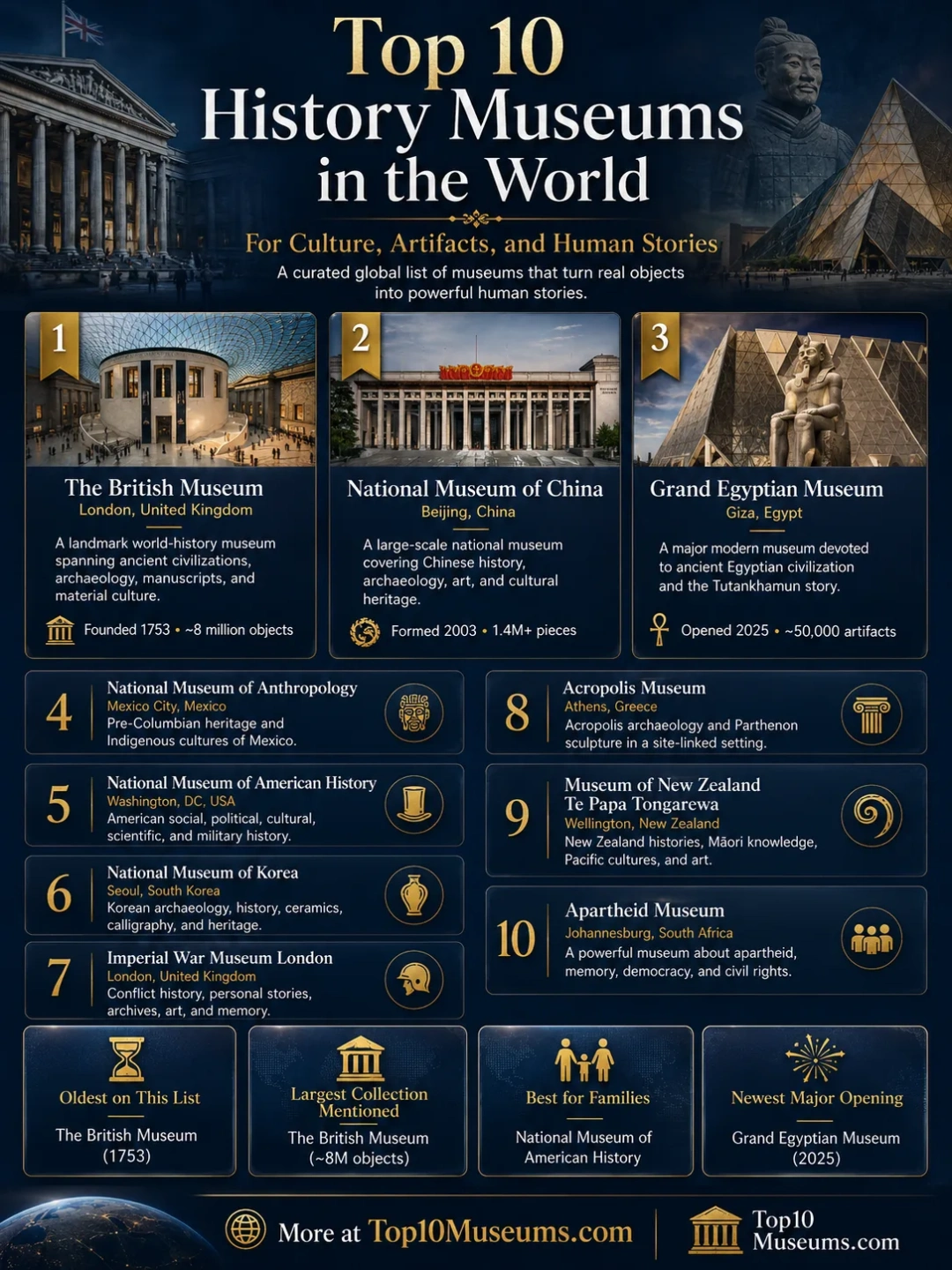
The top 10 history museums in the world are not just places with old objects behind glass. They help visitors understand how people lived, ruled, migrated, built cities, made art, fought wars, remembered trauma, and passed culture forward. This list favors museums with strong collections, clear storytelling, major public value, and enough depth to reward both first-time visitors and serious history lovers.
[ayaz_safe_content id=”2775″ key=”p2775b1rajnmxom”]
| Rank | Name | Founded | Collection Type | Website |
|---|---|---|---|---|
| 1 | The British Museum | 1753 | World history, archaeology, ancient cultures, manuscripts, coins, and material culture | Official website |
| 2 | National Museum of China | 2003 | Chinese history, archaeology, art, cultural relics, and national heritage | Official website |
| 3 | Grand Egyptian Museum | 2025 | Ancient Egyptian archaeology, royal objects, monumental sculpture, and Tutankhamun treasures | Official website |
| 4 | National Museum of Anthropology | 1964 | Archaeology, anthropology, Indigenous cultures of Mexico, and pre-Columbian heritage | Official website |
| 5 | National Museum of American History | 1964 | American social, political, cultural, scientific, and military history | Official website |
| 6 | National Museum of Korea | 1945 | Korean archaeology, history, calligraphy, sculpture, ceramics, and cultural heritage | Official website |
| 7 | Imperial War Museum London | 1917 | Twentieth- and twenty-first-century conflict history, archives, oral histories, art, and objects | Official website |
| 8 | Acropolis Museum | 2009 | Archaeology of the Athenian Acropolis, Parthenon sculptures, and ancient urban remains | Official website |
| 9 | Museum of New Zealand Te Papa Tongarewa | 1998 | New Zealand histories, Māori knowledge, Pacific cultures, natural history, and art | Official website |
| 10 | Apartheid Museum | 2001 | South African history, apartheid-era storytelling, democracy, memory, and civil rights | Official website |
Why These Ten History Museums Stand Out
This list gives priority to museums where visitors can follow large human stories through real objects, not just wall text. A strong history museum should make time feel close: a carved stone, a handwritten letter, a royal object, a ship model, a protest poster, or a child’s toy can explain more than a long lecture.
The selection also avoids making the list too narrow. There are ancient civilizations, national stories, social history, conflict memory, archaeology, Indigenous culture, and museum experiences that work for families, students, first-time travelers, and people who like to move slowly through a gallery.
Top 10 History Museums in the World
1. The British Museum — London, United Kingdom
Best for: global history lovers, ancient civilization fans, archaeology beginners, and visitors who want one museum that covers many cultures.
The British Museum is one of the most useful starting points for world history because its collection reaches across ancient Egypt, Greece, Rome, Mesopotamia, Asia, Africa, Europe, and the Americas. Founded in 1753 and opened to the public in 1759, the museum is often linked with the idea of a public national museum, and its collection is commonly described at around 8 million objects.
Visitors usually come for headline objects such as the Rosetta Stone, the Parthenon sculptures, Egyptian mummies, Assyrian reliefs, and the Sutton Hoo treasures. The museum is also free to enter for the permanent collection, which makes it a strong choice for travelers who want serious history without a high entry cost.
The main challenge is size. A first visit works best when you choose two or three areas, such as Egypt, Greece and Rome, and Britain and Europe, instead of trying to see every room. Families can do well here too, but it helps to plan short gallery stops and a break in the Great Court.
Nearby alternative: Sir John Soane’s Museum — a smaller London house museum with classical fragments, architectural models, and a short walk from Holborn.
2. National Museum of China — Beijing, China
Best for: visitors interested in Chinese civilization, dynastic history, archaeology, ceramics, bronzes, and large national museums.
The National Museum of China sits on the eastern side of Tiananmen Square and presents Chinese history on a large scale. The current institution was formed in 2003 through the merger of earlier museums, and its collection includes more than 1.4 million pieces and sets, from ancient cultural heritage to modern historical material.
This museum is best for visitors who want a clear line through China’s long material culture: ritual bronzes, jade, ceramics, calligraphy, sculpture, and objects connected to major periods of Chinese history. The building itself is large, so a focused visit is more pleasant than trying to finish every gallery in one pass.
Because of its location, it pairs naturally with Tiananmen Square and the Forbidden City area, but that also means security checks and timed planning can matter. For families, the best approach is to choose a single theme — bronzes, ceramics, or ancient China — and keep the visit manageable.
Nearby alternative: The Palace Museum — the Forbidden City is nearby and gives visitors a palace-based view of imperial history and court life.
3. Grand Egyptian Museum — Giza, Egypt
Best for: ancient Egypt fans, families with older kids, archaeology travelers, pyramid-area visitors, and anyone focused on Tutankhamun.
The Grand Egyptian Museum is one of the newest major history museums on this list, with its full public opening in 2025 near the Giza pyramids. It is built around ancient Egyptian civilization, with collections spanning from prehistoric Egypt through the Greek and Roman periods.
Its biggest draw is the chance to see the Tutankhamun story in a fuller setting than older displays allowed. Public reporting around the opening noted space for roughly 50,000 artifacts, including the complete Tutankhamun tomb collection shown together for the first time.
The museum also works well because of its location. Visitors can connect the galleries with the pyramids, making the day feel less like a standard museum stop and more like a full ancient Egypt route. For children, the scale, royal objects, and monumental sculpture can be memorable, though the visit is still best paced with breaks.
Nearby alternative: Egyptian Museum in Cairo — the older Tahrir Square museum remains a classic stop for Egyptian antiquities and is better for visitors staying in central Cairo.
4. National Museum of Anthropology — Mexico City, Mexico
Best for: archaeology fans, Mexico City first-timers, Indigenous culture learners, design lovers, and families with curious older children.
The National Museum of Anthropology in Mexico City is one of the strongest archaeology and culture museums in the Americas. Opened in 1964, it is known for its pre-Columbian collections, especially the Mexica, Maya, Olmec, Teotihuacan, Oaxaca, and Gulf Coast galleries.
Many visitors come for the Stone of the Sun, often called the Aztec Calendar Stone, but the museum is much more than a single famous object. Its galleries help explain how diverse societies lived, governed, traded, built cities, and developed religious and artistic traditions across what is now Mexico.
The museum sits in Chapultepec Park, which makes it easier to combine with a relaxed walk or another museum nearby. The courtyard and umbrella fountain give the building a strong visual identity, and the large galleries reward slow viewing — especially if you focus on three or four rooms instead of all of them.
Nearby alternative: Chapultepec Castle National History Museum — a short park-based trip away, with Mexico’s national history presented inside a former imperial residence.
5. National Museum of American History — Washington, DC, United States
Best for: families, school-age kids, American history visitors, pop culture fans, invention lovers, and National Mall museum-hoppers.
The Smithsonian’s National Museum of American History opened in 1964 and focuses on the social, political, cultural, scientific, and military history of the United States. Its collection includes more than 1.8 million objects and large archival holdings.
The Star-Spangled Banner is the best-known object, but the museum also covers transportation, food history, business, entertainment, technology, presidents, first ladies, and everyday American life. That mix makes it one of the most family-friendly history museums on this list.
Because it is part of the Smithsonian system, admission to the permanent museum is free. It also sits on the National Mall, so visitors can combine it with the National Museum of Natural History, the National Gallery of Art, or monuments nearby — just avoid trying to pack too many stops into one afternoon.
Nearby alternative: National Museum of African American History and Culture — another Smithsonian museum nearby, with a powerful focus on Black history and American life.
6. National Museum of Korea — Seoul, South Korea
Best for: Korean history learners, ceramic art fans, archaeology visitors, Seoul first-timers, and travelers who like calm museum layouts.
The National Museum of Korea was established in 1945 and is the flagship museum for Korean history, archaeology, and art. Its collection is commonly described at more than 310,000 pieces, with thousands displayed across permanent galleries.
The museum is especially strong for visitors who want a long view of Korean culture, from prehistoric tools and Three Kingdoms material to Buddhist sculpture, celadon ceramics, calligraphy, painting, and Asian art connections. The building’s broad halls and open spaces make it easier to visit without feeling crowded.
For a first visit, the Prehistory and Ancient History Gallery, Medieval and Early Modern History Gallery, and sculpture or ceramics sections are the best anchors. Families can also use the outdoor grounds and nearby Yongsan setting to keep the day from becoming too gallery-heavy.
Nearby alternative: War Memorial of Korea — a nearby museum for visitors who want military history, national memory, and large outdoor displays.
7. Imperial War Museum London — London, United Kingdom
Best for: modern history readers, military history learners, archive-minded visitors, older teens, and travelers interested in memory and conflict.
Imperial War Museum London began in 1917 and focuses on conflict from the First World War to the present. Its collection includes objects, documents, photographs, film, sound, art, and personal stories, which makes it more than a display of uniforms and vehicles.
The museum is strongest when it connects big events to individual experience. Visitors can see aircraft and military equipment, but also letters, posters, oral histories, and artworks that show how conflict affected civilians and service members. This gives the museum a human-history angle, not only a military one.
Some galleries can be emotionally heavy, so this museum is usually better for older children, teens, and adults than for very young visitors. Admission to the main London museum is free, which helps if you want to keep the visit shorter and focus on selected galleries.
Nearby alternative: Churchill War Rooms — a central London underground site that works well for visitors who want a tighter Second World War-focused experience.
8. Acropolis Museum — Athens, Greece
Best for: ancient Greece fans, architecture lovers, archaeology students, Parthenon visitors, and travelers who like site-specific museums.
The Acropolis Museum opened to the public in 2009 and focuses on objects from one archaeological site: the Athenian Acropolis. More than 4,250 objects are exhibited, with galleries arranged to connect the museum experience to the sacred rock above it.
The Parthenon Gallery is the main reason many people visit. Its layout helps visitors understand the sculptural program of the Parthenon, while the glass views toward the Acropolis keep the ancient site physically close. The museum also includes an archaeological excavation beneath the building.
This is one of the best museums in the world for linking place, objects, and architecture. It is also easier to handle than many giant museums: a focused visit can feel satisfying in a few hours, especially if paired with the Acropolis itself early in the day.
Nearby alternative: National Archaeological Museum — a short taxi or metro ride away, with a broader view of ancient Greek archaeology beyond the Acropolis.
9. Museum of New Zealand Te Papa Tongarewa — Wellington, New Zealand
Best for: families, New Zealand travelers, Māori culture learners, Pacific history visitors, and people who enjoy interactive exhibits.
Te Papa opened in 1998 and serves as New Zealand’s national museum. Its collections include more than 2 million objects across New Zealand histories, Māori knowledge, Pacific cultures, natural history, and art.
The museum is known for mixing history with hands-on interpretation, which makes it one of the most accessible museums on this list for families. Visitors can learn about Māori taonga, migration, geology, wildlife, art, and national identity without the visit feeling too formal.
Te Papa is also useful because it does not treat history as separate from land, language, and living culture. For first-time visitors to New Zealand, it is a strong place to build context before traveling around the country.
Nearby alternative: Wellington Museum — a waterfront museum nearby with local maritime history, city stories, and a smaller scale.
10. Apartheid Museum — Johannesburg, South Africa
Best for: modern history readers, South Africa visitors, older teens, social history learners, and travelers interested in civil rights.
The Apartheid Museum opened in 2001 and focuses on the rise and fall of apartheid in twentieth-century South Africa. It is smaller than many museums on this list, but its subject matter and visitor route make it one of the world’s most memorable social history museums.
The museum uses photographs, film, documents, personal accounts, installations, and spatial design to help visitors understand a system of racial segregation and the long struggle toward democracy. It is not a light visit, but it is clear, serious, and deeply tied to Johannesburg’s wider history.
This museum is best for adults and older teens rather than young children. Plan enough time to move slowly, because the visit is more meaningful when you do not rush through the material.
Nearby alternative: Constitution Hill Human Rights Precinct — another Johannesburg site that connects prison history, democracy, law, and human rights.
How to Tour These Museums
Best Classic World History Route
Start with The British Museum in London, then build outward to the Acropolis Museum in Athens and the Grand Egyptian Museum in Giza. This route gives travelers a strong ancient-world sequence: Mediterranean history, Greek civic culture, and Egyptian archaeology. It works best as a multi-country trip, not a rushed one-weekend plan.
Best Family-Friendly Museum Route
For families, the easiest choices are the National Museum of American History, Te Papa, the National Museum of Korea, and the British Museum. These museums offer free or accessible permanent collections, large public spaces, and subjects that can be broken into short stops. Keep each visit to two or three main galleries if children are young.
Best Archaeology and Ancient Civilizations Route
Choose the Grand Egyptian Museum, National Museum of Anthropology, Acropolis Museum, National Museum of China, and National Museum of Korea. This route is ideal for visitors who love objects pulled from deep time: stone tools, tomb goods, temple sculpture, ritual bronzes, ceramics, and city remains. It is best planned as separate trips by region.
Best Modern History and Memory Route
Pair Imperial War Museum London with the Apartheid Museum, then add the National Museum of American History for a wider view of political and social change. These museums are strongest for visitors who want history told through personal stories, documents, media, and public memory. They are better for older teens and adults because some topics are emotionally demanding.
Who Will Love These Museums?
- Ancient civilization fans: The Grand Egyptian Museum, Acropolis Museum, British Museum, and National Museum of Anthropology offer some of the strongest archaeology-focused visits.
- Families with school-age kids: The National Museum of American History, Te Papa, National Museum of Korea, and British Museum are easier to break into shorter gallery stops.
- STEM-curious teens: The National Museum of American History is useful for invention, technology, transport, and science-linked American stories.
- Art-and-history crossover visitors: The British Museum, National Museum of Korea, Acropolis Museum, and National Museum of China connect objects, design, craft, and historical context.
- Modern history readers: Imperial War Museum London and the Apartheid Museum are better for visitors who want twentieth-century history, public memory, and personal testimony.
- Travelers planning city museum days: London, Washington, Athens, Mexico City, Seoul, and Wellington all make it possible to pair one major history museum with another nearby cultural stop.
- Budget-conscious visitors: The British Museum, National Museum of American History, Imperial War Museum London, and Te Papa are especially appealing where free permanent admission or free local access applies.