
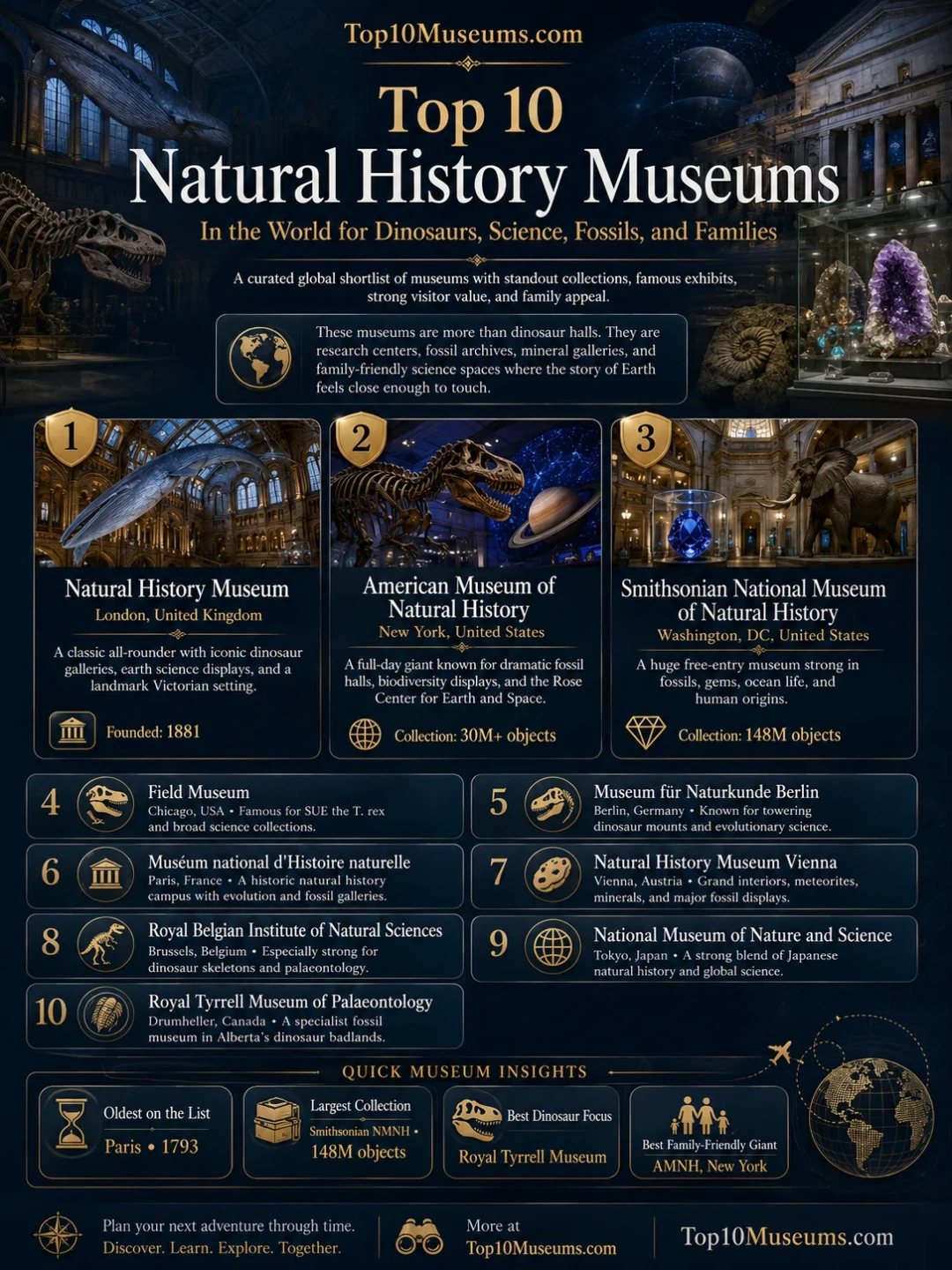
The top 10 natural history museums in the world are not just places to see dinosaur skeletons. They are research centers, family-friendly science spaces, fossil archives, mineral galleries, and quiet places where the story of Earth feels close enough to touch. This list focuses on museums with major collections, strong visitor value, and memorable exhibits rather than simple fame.
World Map of These Natural History Museums
| Rank | Name | Founded | Collection Type | Website |
|---|---|---|---|---|
| 1 | Natural History Museum, London | 1881 | Life sciences, earth sciences, fossils, minerals, zoology | Official website |
| 2 | American Museum of Natural History | 1869 | Natural history, dinosaurs, space science, anthropology, biodiversity | Official website |
| 3 | Smithsonian National Museum of Natural History | 1910 | Natural history, geology, gems, zoology, fossils, ocean science | Official website |
| 4 | Field Museum | 1893 | Fossils, anthropology, botany, zoology, geology, conservation science | Official website |
| 5 | Museum für Naturkunde Berlin | 1810 | Palaeontology, zoology, mineralogy, meteorites, biodiversity research | Official website |
| 6 | Muséum national d’Histoire naturelle, Paris | 1793 | Naturalist collections, botany, geology, palaeontology, evolution | Official website |
| 7 | Natural History Museum Vienna | 1889 | Minerals, meteorites, fossils, anthropology, zoology | Official website |
| 8 | Royal Belgian Institute of Natural Sciences | 1846 | Dinosaurs, geology, palaeontology, biodiversity, anthropology | Official website |
| 9 | National Museum of Nature and Science, Tokyo | 1877 | Japanese nature, global science, fossils, species, science history | Official website |
| 10 | Royal Tyrrell Museum of Palaeontology | 1985 | Dinosaurs, fossils, palaeontology research, badlands geology | Official website |
Why These Ten Natural History Museums Earn Their Place
This list gives weight to collection size, research role, public galleries, family appeal, and famous specimens. A museum with millions of objects behind the scenes matters, but so does the way a first-time visitor can actually understand those objects in a few hours.
The selection also balances classic natural history giants with specialist fossil museums. That is why a huge national museum in Washington, DC can sit beside a palaeontology-focused museum in Alberta: both help visitors understand Earth, life, extinction, adaptation, and deep time in a clear way.
The Top 10 Natural History Museums in the World
1. Natural History Museum, London
Best for: First-time London visitors, dinosaur fans, families, architecture lovers, and anyone who wants a classic natural history museum experience.
The Natural History Museum in London is one of the clearest choices for the top spot. It holds more than 80 million objects, covering botany, entomology, mineralogy, palaeontology, and zoology. For visitors, the appeal starts before the first gallery: the Waterhouse building itself feels like a cathedral for science, with carved animals, warm stone, and a central hall that stops people in their tracks.
The museum first opened its doors in 1881, and its star displays include dinosaurs, meteorites, minerals, and the famous blue whale skeleton in Hintze Hall. Families usually head straight for the dinosaur galleries, while adults who enjoy geology can spend a long time with gems, volcanoes, earthquakes, and Earth science displays. It is also one of the easiest museums on this list to combine with other major London museums because South Kensington has several large institutions within walking distance.
Nearby alternative: Science Museum — a strong choice for space, engineering, medicine, and hands-on science, located just a short walk from the Natural History Museum in South Kensington.
2. American Museum of Natural History, New York
Best for: Dinosaur lovers, families with kids, space fans, New York first-timers, and visitors who want a full-day museum.
The American Museum of Natural History has been part of New York’s museum life since 1869. Its collections contain more than 30 million specimens and objects, and the public galleries cover dinosaurs, mammals, ocean life, human cultures, meteorites, minerals, and the universe. It is the kind of museum where a visitor can plan two hours and then suddenly realize half the day has gone.
For many people, the fossil halls are the main reason to go. The museum is known for dramatic dinosaur mounts, including giant sauropods and classic fossil displays that make deep time easy to picture. The Rose Center for Earth and Space adds another layer, especially for teens and adults who want astronomy with their natural history.
Nearby alternative: New-York Historical Society — a useful add-on for visitors who want city history after AMNH, located a short walk south along Central Park West.
3. Smithsonian National Museum of Natural History, Washington, DC
Best for: Budget-conscious travelers, families, geology fans, gem lovers, school groups, and visitors planning a National Mall museum day.
The Smithsonian National Museum of Natural History opened in 1910 and houses about 148 million objects, making it one of the largest natural history collections on Earth. Its location on the National Mall also makes it unusually easy to visit, especially because admission is free for regular entry.
The museum is especially strong for geology, gems, fossils, mammals, ocean life, insects, and human origins. The Hope Diamond, a 45.52-carat blue diamond, is one of its best-known objects, while the fossil hall gives visitors a strong route through life, climate, extinction, and environmental change. It is a smart pick for families because the galleries are broad, the building is central, and nearby museums give plenty of backup plans.
Nearby alternative: National Air and Space Museum — a strong science-focused follow-up, located along the National Mall within an easy walk from the natural history museum.
4. Field Museum, Chicago
Best for: T. rex fans, families, anthropology readers, Chicago visitors, and anyone planning a Museum Campus day.
The Field Museum grew from the collections of the 1893 World’s Columbian Exposition and opened to the public in 1894. Today, it holds nearly 40 million artifacts and specimens, with galleries covering fossils, ancient cultures, plants, animals, gems, meteorites, and conservation science.
The star is SUE the T. rex, one of the most famous Tyrannosaurus rex specimens ever discovered. SUE is more than 40 feet long and about 90 percent complete by bone count, which makes the fossil more than a photo stop; it is a research object with real scientific weight. The museum also works well for families because Shedd Aquarium and Adler Planetarium are nearby on Chicago’s Museum Campus.
Nearby alternative: Shedd Aquarium — a natural follow-up for animal lovers, located on the same Museum Campus within a short walk from the Field Museum.
5. Museum für Naturkunde Berlin
Best for: Dinosaur fans, fossil readers, Berlin museum visitors, science-minded teens, and travelers who like compact but rich galleries.
Museum für Naturkunde Berlin traces its roots to 1810 and is one of Europe’s great natural history institutions. Its collections include millions of zoological, palaeontological, and mineralogical objects, and the museum is especially known for fossils, biodiversity research, meteorites, and evolutionary science.
The main draw for many visitors is the mounted Giraffatitan brancai, a towering dinosaur skeleton from the Tendaguru fossil beds. The museum is also home to a famous Archaeopteryx specimen, which makes it a strong stop for anyone interested in the link between dinosaurs and birds. It is not as physically huge as some museums on this list, but it rewards close looking.
Nearby alternative: Futurium — a good add-on for visitors who want modern science, technology, and society exhibits, located within a short transit or taxi ride from the museum.
6. Muséum national d’Histoire naturelle, Paris
Best for: Evolution readers, Paris repeat visitors, families, botany fans, and travelers who prefer museum campuses over single-building stops.
The Muséum national d’Histoire naturelle in Paris was created in 1793, with roots tied to the Jardin des Plantes. Its collections include around 68 million specimens, spread across natural history fields such as botany, palaeontology, geology, zoology, anthropology, and comparative anatomy.
For visitors, the Paris museum works best as a campus experience. The Grande Galerie de l’Évolution gives a dramatic introduction to biodiversity, while the fossil and comparative anatomy galleries add a more old-school naturalist feel. This is a strong museum for people who like to move between galleries, gardens, and specimen halls instead of staying inside one building all day.
Nearby alternative: Galerie de Paléontologie et d’Anatomie Comparée — a specimen-heavy alternative on the Jardin des Plantes campus, ideal if fossils and skeletons are your main interest.
7. Natural History Museum Vienna
Best for: Mineral collectors, architecture fans, history-minded travelers, families, and visitors who want science in a grand museum setting.
The Natural History Museum Vienna opened in 1889 and keeps about 30 million objects. It is one of the most beautiful natural history museums in Europe, with grand staircases, painted ceilings, mineral halls, meteorites, fossils, animal displays, and anthropology galleries under one roof.
One of its most famous objects is the Venus of Willendorf, a small prehistoric figure often dated to around 29,500 years ago. The museum is also known for its meteorite collection and elegant mineral rooms. Visitors who enjoy both science and old museum architecture will probably find Vienna more rewarding than they expect.
Nearby alternative: Kunsthistorisches Museum Wien — a major art and history museum directly across Maria-Theresien-Platz, useful for pairing natural history with painting, sculpture, and imperial collections.
8. Royal Belgian Institute of Natural Sciences, Brussels
Best for: Dinosaur fans, school-age kids, fossil lovers, Brussels visitors, and travelers who want a strong museum without an all-day commitment.
The Royal Belgian Institute of Natural Sciences was founded in 1846 and its collections are estimated at about 38 million specimens. It is one of Europe’s most important natural history collections, especially for palaeontology, biodiversity, geology, and anthropology.
The museum’s best-known draw is the group of Bernissart Iguanodons. About thirty relatively complete iguanodon skeletons were discovered in a Belgian coal mine in the late 19th century, around 322 meters underground. For families, that gallery alone can make the visit worth it, and the museum’s Brussels location makes it easier to add to a short city trip.
Nearby alternative: House of European History — a useful cultural add-on in the European Quarter, located close enough to combine with the natural sciences museum on the same day.
9. National Museum of Nature and Science, Tokyo
Best for: Tokyo first-timers, families, Japan-focused travelers, science history readers, and visitors planning a Ueno Park museum day.
The National Museum of Nature and Science in Tokyo treats 1877 as its official establishment year, making it one of Japan’s oldest science museums. It sits in Ueno Park and covers natural history, Japanese biodiversity, fossils, technology, astronomy, and the development of science.
The museum is especially useful for travelers who want to understand Japan’s natural environment, not just global dinosaurs and fossils. The Japan Gallery and Global Gallery give the visit a clear split: one side looks closely at Japan, while the other places Earth, life, and science in a wider setting. The life-size blue whale model outside is also an easy meeting point and a favorite photo stop.
Nearby alternative: Tokyo National Museum — a strong cultural pairing in Ueno Park, best for visitors who want Japanese art, archaeology, and history after a science-focused stop.
10. Royal Tyrrell Museum of Palaeontology, Drumheller
Best for: Dinosaur lovers, fossil-focused travelers, families with school-age kids, road-trippers, and anyone visiting Alberta’s badlands.
The Royal Tyrrell Museum of Palaeontology opened in 1985 in Drumheller, Alberta, one of Canada’s most famous fossil regions. Its research collection contains more than 160,000 fossil specimens, including over 350 holotypes, and only a small share is on display at any one time.
This is the most specialist museum on the list, but that is exactly why it belongs here. The galleries focus heavily on dinosaurs, fossil preparation, ancient environments, and the geology of Alberta’s badlands. Unlike big-city museums, the setting adds to the visit: the landscape outside helps explain why so many fossil discoveries came from this region.
Nearby alternative: Atlas Coal Mine National Historic Site — a good regional history add-on, located about 25 minutes by car from the Royal Tyrrell Museum.
How to Tour These Museums
Best Two-Week World Route
Start with London, then continue by rail or short flight to Brussels and Paris. From there, move east to Vienna and Berlin, which keeps the European section fairly logical. After Europe, fly to New York, continue to Washington, DC, then Chicago, and finish the North American section with Calgary and Drumheller. Tokyo works best as a separate Asia stop unless you are already building a round-the-world itinerary.
Best Europe-Only Natural History Route
For a Europe-focused trip, use this order: London → Brussels → Paris → Vienna → Berlin. London, Brussels, and Paris are the easiest to connect by train, while Vienna and Berlin usually need a longer rail ride or a short flight. This route gives you five very different museum styles: Victorian London, dinosaur-heavy Brussels, garden-campus Paris, palace-like Vienna, and research-led Berlin.
Best North America Dinosaur and Science Route
For North America, begin in New York, take the train or a short flight to Washington, DC, then continue to Chicago. Save Drumheller for a separate Alberta road trip, because the Royal Tyrrell Museum works best when paired with the badlands landscape. This route is strong for families because AMNH, Smithsonian NMNH, and the Field Museum all offer large, kid-friendly fossil and science galleries.
Best Family-Friendly Museum Days
For children, the easiest full-day picks are AMNH in New York, the Smithsonian in Washington, DC, and the Field Museum in Chicago. Each has famous objects, clear visitor routes, and nearby alternatives if attention spans drop. London and Brussels are also excellent family choices, especially for dinosaur fans, but both can get crowded during school breaks.
Who Will Love These Museums?
• Dinosaur lovers: Field Museum, Museum für Naturkunde Berlin, Royal Belgian Institute of Natural Sciences, and Royal Tyrrell Museum of Palaeontology.
• Families with young kids: Natural History Museum London, American Museum of Natural History, Smithsonian NMNH, and Field Museum.
• Free museum planners: Smithsonian National Museum of Natural History is the easiest pick because regular admission is free.
• Fossil-focused travelers: Royal Tyrrell Museum, Field Museum, Museum für Naturkunde Berlin, and the Paris palaeontology galleries.
• Gem, mineral, and meteorite fans: Smithsonian NMNH, Natural History Museum Vienna, and Natural History Museum London.
• Architecture lovers: Natural History Museum London and Natural History Museum Vienna offer the strongest mix of science and historic interiors.
• Tokyo and Japan-focused visitors: National Museum of Nature and Science is the best fit because it explains Japan’s natural history alongside global science.
• Short city-break travelers: Brussels, Vienna, Berlin, and London are the easiest to fit into a compact museum-heavy itinerary.