
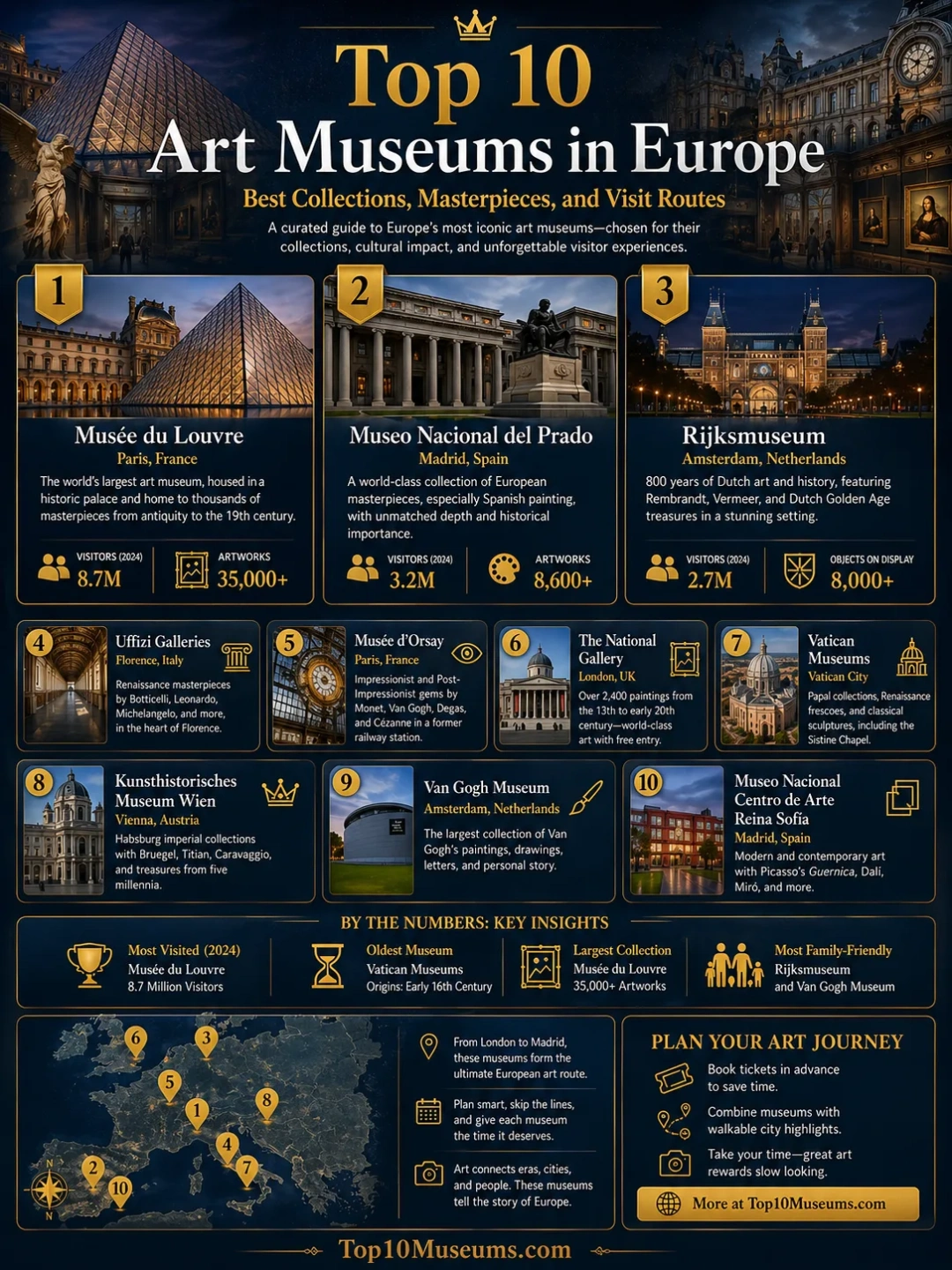
Europe rewards slow looking. A single morning can mean Rembrandt in Amsterdam, Botticelli in Florence, Goya in Madrid, or a quiet turn through Van Gogh’s letters and brushwork. This ranking of the Top 10 Art Museums in Europe focuses on museums with deep collections, famous works, strong visitor value, and enough cultural weight to justify planning a trip around them.
| Rank | Name | Founded | Collection Type | Website |
|---|---|---|---|---|
| 1 | Musée du Louvre | 1793 | European painting, sculpture, antiquities, decorative arts | Official website |
| 2 | Museo Nacional del Prado | 1819 | Spanish, Flemish, Italian, and European old-master painting | Official website |
| 3 | Rijksmuseum | 1800 | Dutch art, Golden Age painting, decorative arts, history | Official website |
| 4 | Uffizi Galleries | 1765 | Italian Renaissance painting and sculpture | Official website |
| 5 | Musée d’Orsay | 1986 | Impressionism, Post-Impressionism, sculpture, photography | Official website |
| 6 | The National Gallery | 1824 | Western European painting from the 13th to early 20th century | Official website |
| 7 | Vatican Museums | 1506 | Papal collections, Renaissance frescoes, classical sculpture | Official website |
| 8 | Kunsthistorisches Museum Wien | 1891 | Habsburg imperial collections, old masters, antiquities | Official website |
| 9 | Van Gogh Museum | 1973 | Vincent van Gogh paintings, drawings, letters, related artists | Official website |
| 10 | Museo Nacional Centro de Arte Reina Sofía | 1992 | Modern and contemporary Spanish art, Picasso, Dalí, Miró | Official website |
Why These Ten Art Museums Stand Above the Rest
These museums were chosen for collection depth, cultural reach, visitor experience, and the number of works that still reward repeat visits. A museum with one famous painting is not enough here; each pick has rooms, routes, and curatorial strength that make it useful for first-time visitors and serious art travelers alike.
The list also balances old masters, Renaissance art, Impressionism, modern art, free museums, and kid-friendly routes. Europe has many excellent art museums outside this ten, but these are the places most likely to shape a full itinerary rather than serve as a small side stop.
Best Art Museums in Europe
1. Musée du Louvre, Paris
The Louvre is still the natural starting point for European art museums because it combines scale, fame, and range in a way few institutions can match. The museum displays around 35,000 artworks across more than 400 rooms, and the 2024 visitor figure reached about 8.7 million, which explains why timing matters as much as taste here.
Most first-time visitors go straight for Leonardo da Vinci’s Mona Lisa, the Winged Victory of Samothrace, and the Venus de Milo, but the better Louvre visit usually includes a quieter wing too. The Richelieu rooms, French decorative arts, and Islamic art galleries give the museum more texture than a simple greatest-hits walk.
Best for: First-time Europe travelers, old-master lovers, palace-museum fans, and visitors who want one museum that can fill an entire day.
Nearby alternative: Musée de l’Orangerie — a focused choice for Monet’s Water Lilies, reached by walking through the Tuileries from the Louvre.
2. Museo Nacional del Prado, Madrid
The Prado is the museum to choose when painting, not architecture or spectacle, is the main reason for visiting. It opened to the public in 1819, and its first catalogue listed 311 paintings, while the royal collection behind it already held more than 1,500 pictures.
Its strength is the concentration of masters: Velázquez, Goya, El Greco, Bosch, Titian, Rubens, and many more appear with unusual depth. The museum’s Flemish holdings alone include nearly 1,000 paintings, and Bosch’s The Garden of Earthly Delights remains one of Europe’s most closely studied museum works.
Best for: Spanish painting fans, old-master travelers, Velázquez and Goya readers, and visitors who prefer focused galleries over giant museum complexes.
Nearby alternative: Thyssen-Bornemisza Museum — a short walk along Paseo del Prado, useful for filling the historical gaps between the Prado and Reina Sofía.
3. Rijksmuseum, Amsterdam
The Rijksmuseum tells the story of 800 years of Dutch art and history through about 8,000 objects on display. Its roots go back to the National Art Gallery, which first opened in 1800 at Huis ten Bosch in The Hague before the collection moved to Amsterdam.
Rembrandt’s The Night Watch is the anchor, but the museum is not only a Rembrandt stop. Vermeer, Frans Hals, ship models, Delftware, Asian art, and domestic objects make the visit feel connected to trade, city life, and everyday Dutch culture — not just framed paintings on white walls.
Best for: Dutch Golden Age fans, Amsterdam first-timers, families with older kids, and travelers who want art mixed with national history.
Nearby alternative: Stedelijk Museum — right on Museumplein, best for modern art, design, and a sharper contrast after the Rijksmuseum’s old-master rooms.
4. Uffizi Galleries, Florence
The Uffizi is one of Europe’s great Renaissance museums because Florence itself gives the collection context. The building was constructed between 1560 and 1580 for the Medici administration, and the galleries later became a public museum tied closely to the city’s artistic identity.
The museum is famous for Botticelli’s Birth of Venus, painted around 1485, but its power is the sequence: Giotto, Masaccio, Piero della Francesca, Leonardo, Michelangelo, Raphael, Titian, and Caravaggio. Few museums show the shift from medieval gold-ground painting to human-centered Renaissance art as clearly as the Uffizi.
Best for: Renaissance lovers, Botticelli fans, Florence first-time visitors, and travelers who want art tied closely to one city’s history.
Nearby alternative: Bargello Museum — a short walk away, excellent for sculpture by Donatello, Michelangelo, and other Florentine masters.
5. Musée d’Orsay, Paris
Musée d’Orsay is the best Paris choice when the Louvre feels too large or when Impressionism and Post-Impressionism are the priority. The museum opened in 1986 inside the former Gare d’Orsay railway station, and its collection focuses mainly on the period from 1848 to 1914.
Its rooms include Monet, Manet, Degas, Renoir, Cézanne, Gauguin, and Van Gogh, plus sculpture, furniture, photography, and decorative arts. At opening, the museum assembled about 1,200 sculptures, which still helps the central nave feel more varied than a painting-only gallery.
Best for: Impressionist art fans, Paris visitors with limited time, architecture lovers, and families who want a more manageable museum than the Louvre.
Nearby alternative: Musée Rodin — a pleasant Left Bank add-on, especially if sculpture and garden time sound better than another long gallery walk.
6. The National Gallery, London
The National Gallery is one of Europe’s strongest free art museums, sitting directly on Trafalgar Square with a collection of more than 2,400 paintings. Founded in 1824, it covers Western European painting from the mid-13th century to around 1900.
Its advantage is clarity. Van Eyck’s Arnolfini Portrait, Velázquez’s Rokeby Venus, Turner’s Fighting Temeraire, and Van Gogh’s Sunflowers can be seen without building an entire day around the museum. For London visitors, that makes it unusually easy to pair with theatre, Westminster, or a walk along the Thames.
Best for: Free museum seekers, London weekend visitors, Western painting students, and travelers who want a high-quality visit in two to three hours.
Nearby alternative: National Portrait Gallery — just behind the National Gallery, useful for British history, writers, monarchs, scientists, and cultural figures.
7. Vatican Museums, Vatican City
The Vatican Museums are not a calm little art stop; they are a long, crowded, visually dense route through papal collecting. The museum complex traces its origins to the early 16th century, and its collections conserve art gathered by popes across centuries, including classical sculpture, tapestries, maps, frescoes, and Renaissance painting.
The Sistine Chapel is the reason many visitors come, especially Michelangelo’s ceiling frescoes painted between 1508 and 1512. But the Raphael Rooms, Gallery of Maps, Pio-Clementine Museum, and Pinacoteca make the visit broader than a single chapel at the end of the route.
Best for: Sistine Chapel visitors, Renaissance fresco fans, religious art travelers, and people who can handle a busy timed-entry museum route.
Nearby alternative: Castel Sant’Angelo — a riverside walk from the Vatican area, good for history, city views, and a shorter museum visit after the Vatican route.
8. Kunsthistorisches Museum Wien, Vienna
The Kunsthistorisches Museum is the grand Habsburg answer to Europe’s old-master museums. Opened in 1891 on Vienna’s Ringstrasse, it holds objects from roughly five millennia, from Egyptian antiquities to late-18th-century European art.
The picture gallery is the main reason to come: Pieter Bruegel the Elder, Velázquez, Titian, Raphael, Caravaggio, Rubens, and Arcimboldo all appear in rooms that still feel imperial. Bruegel’s Tower of Babel and Hunters in the Snow give the museum a Northern Renaissance pull that many first-time Vienna visitors underestimate.
Best for: Bruegel admirers, Baroque painting fans, Vienna culture travelers, and visitors who want a grand museum without Louvre-level crowds.
Nearby alternative: Leopold Museum — a short walk into MuseumsQuartier, best for Egon Schiele, Gustav Klimt, and Austrian modernism.
9. Van Gogh Museum, Amsterdam
The Van Gogh Museum works because it narrows the lens. Instead of trying to cover all of European art, it follows one artist through paintings, drawings, letters, and influences, with more than 200 paintings and almost 500 drawings by Vincent van Gogh.
The main building opened in 1973, and the collection still feels personal because Van Gogh’s family history sits behind it. Works such as Sunflowers, The Potato Eaters, and late landscapes are easier to understand when seen beside his drawings and letters rather than as isolated poster images.
Best for: Van Gogh fans, first-time Amsterdam visitors, teens who connect with biography, and travelers who prefer one clear museum story.
Nearby alternative: Moco Museum — close to Museumplein, useful for visitors who want contemporary, street-art, and pop-culture contrast after Van Gogh.
10. Museo Nacional Centro de Arte Reina Sofía, Madrid
Reina Sofía is Madrid’s essential modern art museum and the natural counterweight to the Prado. Its collection includes about 25,000 pieces from the final decades of the 19th century to the present, with a strong focus on Spanish and international modern art.
Picasso’s Guernica is the museum’s anchor; the painting entered the Reina Sofía collection in 1992 after earlier display in Spain at the Casón del Buen Retiro. Dalí, Miró, Juan Gris, Ángeles Santos, and many other artists help the museum explain how Spanish modernism moved through war, exile, experimentation, and public memory.
Best for: Modern art travelers, Picasso and Dalí readers, Madrid museum-route planners, and visitors who want a stronger 20th-century collection after the Prado.
Nearby alternative: CaixaForum Madrid — a short walk away, useful for temporary exhibitions, design shows, and a lighter stop near Paseo del Prado.
How to Tour These Museums
Best Paris Art Day
Start with the Louvre early and keep the visit focused: Denon wing highlights first, then one quieter section before lunch. Move to Musée d’Orsay in the afternoon for Impressionism and the railway-station interior. This is a full day, so do not add another major museum unless the evening plan is very light.
Best Madrid Painting Day
Visit the Prado in the morning, when old-master galleries are easier to absorb. Take a real break before entering Reina Sofía, because Guernica and the surrounding 20th-century rooms need a different mental pace. This route works well because both museums sit in Madrid’s museum corridor and can be connected without wasting travel time.
Best Amsterdam Museumplein Day
Book the Rijksmuseum for the morning and give it the strongest part of the day. After lunch on or near Museumplein, move to the Van Gogh Museum with a timed ticket. The order matters: broad Dutch history first, one-artist emotional focus second.
Best Italy Art Pairing
Do the Uffizi as a Florence morning visit, then leave the afternoon for the historic center rather than another giant museum. Save the Vatican Museums for a separate Rome day with the earliest timed entry you can manage. Trying to combine them in one day is not practical; the cities deserve separate pacing.
Best Multi-City Europe Route
A strong art-focused itinerary can run London → Paris → Amsterdam → Vienna → Florence/Rome → Madrid. Use trains for London, Paris, and Amsterdam, then consider flights for Vienna, Italy, and Spain depending on your trip length. For most travelers, seven to ten days is the minimum if these museums are the main purpose of the trip.
[ayaz_safe_content id=”2767″ key=”p2767b1up3siry8″]
Who Will Love These Museums?
- First-time Europe travelers: Musée du Louvre gives the widest single-museum introduction to European art, sculpture, and palace history.
- Old-master lovers: Museo Nacional del Prado and The National Gallery are best for painting-focused visits without needing a full archaeology or decorative arts route.
- Dutch Golden Age fans: Rijksmuseum offers Rembrandt, Vermeer, Hals, Delftware, and Dutch history in one strong Amsterdam stop.
- Renaissance-focused travelers: Uffizi Galleries and Vatican Museums make the clearest pairing for Botticelli, Raphael, Michelangelo, and early Italian painting.
- Impressionism readers: Musée d’Orsay is the most satisfying choice for Monet, Manet, Degas, Renoir, Cézanne, Gauguin, and Van Gogh in a Paris setting.
- Vienna culture travelers: Kunsthistorisches Museum Wien suits visitors who want Bruegel, Habsburg collecting, grand interiors, and a quieter old-master experience.
- Single-artist visitors: Van Gogh Museum is ideal for people who want biography, letters, and visual development rather than a huge mixed collection.
- Modern art travelers: Museo Reina Sofía is the strongest pick here for Picasso’s Guernica, Dalí, Miró, and 20th-century Spanish art.
- Families with older kids: Rijksmuseum, Musée d’Orsay, Van Gogh Museum, and The National Gallery are usually easier to shape into shorter, clearer visits.
- Free museum seekers: The National Gallery is the easiest high-level choice because the main collection is free to enter.