
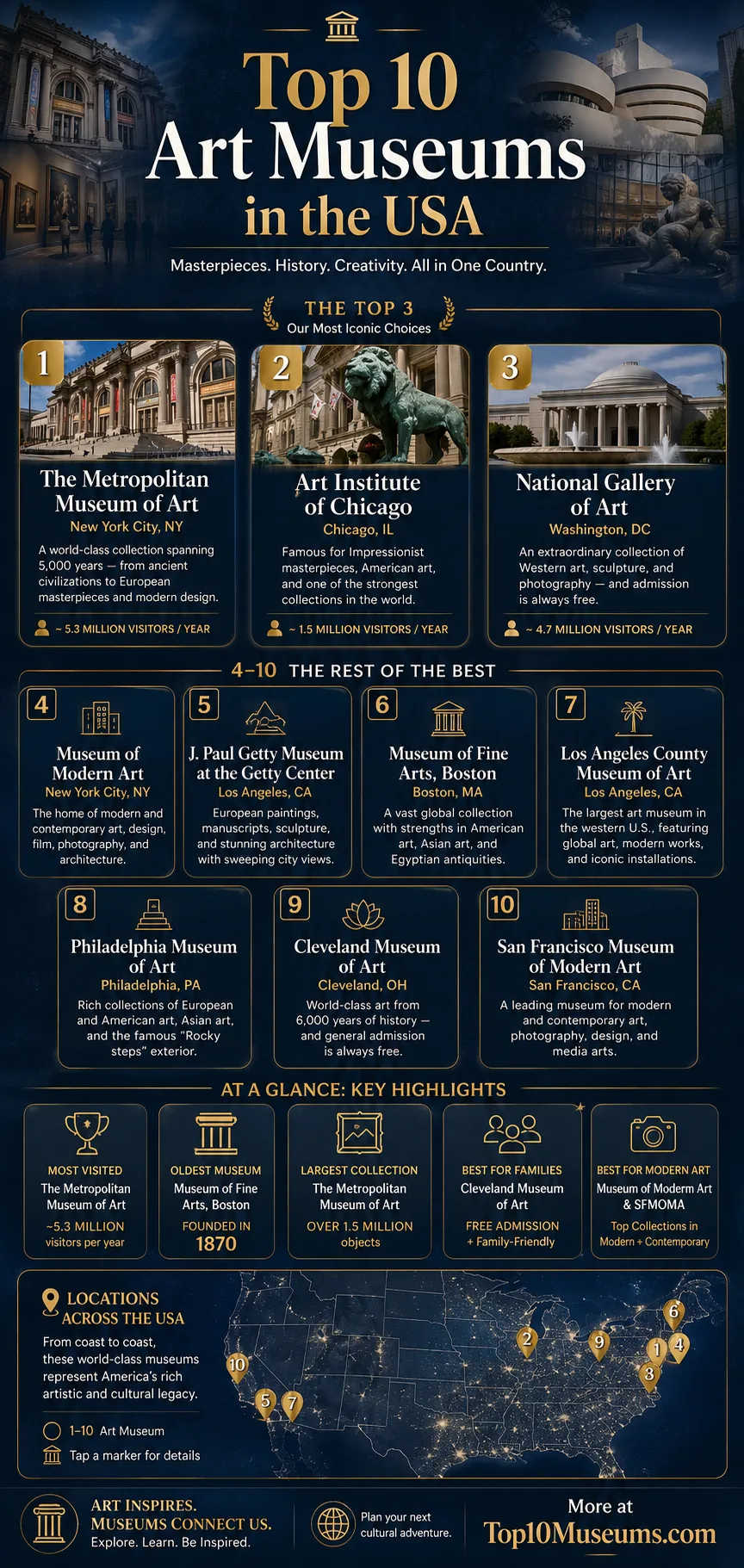
America’s best art museums are not all trying to do the same job. Some feel like full-day cultural campuses; others are sharper, faster, and built around modern art, photography, design, or a single city’s creative identity. This list of the Top 10 Art Museums in the USA keeps the focus on museums that reward a first visit, hold strong permanent collections, and give travelers enough depth without turning the day into homework.
| Rank | Name | Founded | Collection Type | Website |
|---|---|---|---|---|
| 1 | The Metropolitan Museum of Art | 1870 | Global art, 5,000 years of history, paintings, sculpture, arms, costumes, decorative arts | Official website |
| 2 | Art Institute of Chicago | 1879 | European painting, Impressionism, American art, Asian art, design, photography | Official website |
| 3 | National Gallery of Art | 1937 | Western art, old masters, sculpture, prints, photography, modern art | Official website |
| 4 | Museum of Modern Art | 1929 | Modern and contemporary art, design, film, photography, media, architecture | Official website |
| 5 | J. Paul Getty Museum at the Getty Center | 1954 | European paintings, manuscripts, decorative arts, sculpture, photography | Official website |
| 6 | Museum of Fine Arts, Boston | 1870 | Global art, American painting, Asian art, Egyptian art, textiles, photography | Official website |
| 7 | Los Angeles County Museum of Art | 1961 | Global art, modern art, Latin American art, Asian art, photography, design | Official website |
| 8 | Philadelphia Museum of Art | 1876 | European and American art, Asian art, arms and armor, decorative arts, prints | Official website |
| 9 | Cleveland Museum of Art | 1913 | Global art, Asian art, European painting, antiquities, textiles, decorative arts | Official website |
| 10 | San Francisco Museum of Modern Art | 1935 | Modern and contemporary art, photography, architecture, design, media arts | Official website |
Why These Ten Belong on the Shortlist
The ranking favors museums with major permanent collections, strong visitor flow, clear identity, and enough range to satisfy both casual travelers and art-focused visitors. A museum with one famous painting is not enough here; each choice needs rooms that can hold attention for two hours or more without relying only on temporary shows.
The list also balances geography. New York, Chicago, Washington, Boston, Los Angeles, Philadelphia, Cleveland, and San Francisco all represent different museum cultures, from free public collections to modern-art landmarks and large encyclopedic institutions. For families, the best picks are not only the biggest ones, but the museums with clear galleries, memorable objects, and breaks nearby.
Top 10 Art Museums in the USA
1. The Metropolitan Museum of Art — New York City
Best for: first-time New York visitors, old-master lovers, fashion-history readers, families who want one museum that can fill a full day
The Met is the museum many visitors picture first when they think of American art museums, and for good reason: its collection contains more than 1.5 million objects across roughly 5,000 years of art. You can move from Egyptian sculpture to European painting, from Japanese screens to musical instruments, and from armor galleries to the Costume Institute without leaving the same Fifth Avenue building. For a first visit, the Egyptian wing, European paintings, Greek and Roman galleries, and the American Wing give the cleanest route through the museum’s range.
What makes The Met work for travelers is its scale with structure. The galleries are huge, but many sections have clear anchor points: the Temple of Dendur, the Arms and Armor court, Vermeer paintings, and the period rooms in the American Wing. Families should not try to “finish” the museum; two or three zones are enough, especially with Central Park right outside for a reset.
Nearby alternative: Solomon R. Guggenheim Museum — a strong choice for modern art and architecture, located farther north on Fifth Avenue along Museum Mile.
2. Art Institute of Chicago — Chicago
Best for: Impressionist fans, American painting lovers, design-minded travelers, visitors staying near Millennium Park
The Art Institute of Chicago is one of the strongest all-around art museums in the country, with a permanent collection of nearly 300,000 works. It is especially rewarding for visitors who want paintings they already know by image: Georges Seurat’s A Sunday on La Grande Jatte, Grant Wood’s American Gothic, Edward Hopper’s Nighthawks, and works by Monet, Renoir, Cassatt, and Picasso. The museum’s location beside Millennium Park also makes it unusually easy to pair with a city walk.
The museum is not only about famous canvases. Its Asian art, arms and armor, photography, and design holdings make it a better second-visit museum than many travelers expect. If time is tight, start with the Impressionist and Post-Impressionist rooms, then move to American art and the Modern Wing; that route gives a strong sense of why the museum is often treated as Chicago’s cultural centerpiece.
Nearby alternative: Museum of Contemporary Art Chicago — a good follow-up for newer work, reachable by a short ride north from the Loop.
3. National Gallery of Art — Washington, DC
Best for: budget travelers, old-master fans, families visiting the National Mall, visitors who prefer free admission
The National Gallery of Art is one of the best free art experiences in the United States. Its collection includes nearly 160,000 works, with a Western art focus that stretches from medieval panels to modern painting, sculpture, prints, and photography. The museum was dedicated in 1941, and its West Building still feels like a formal national collection, while the East Building brings in modern and contemporary work in a sharper architectural setting.
For first-time visitors, the National Gallery is easy to fold into a Washington day because it sits directly on the National Mall. The West Building is the best place for Raphael, Leonardo, Rembrandt, Vermeer, and American painting; the East Building is better for Calder, Rothko, and postwar art. The free admission also makes it ideal for families who want to stop for 60–90 minutes rather than commit to a full museum day.
Nearby alternative: Hirshhorn Museum and Sculpture Garden — a compact modern and contemporary art option a short walk away on the National Mall.
4. Museum of Modern Art — New York City
Best for: modern-art beginners, design fans, architecture students, travelers who want famous 20th-century works in one visit
MoMA is the most direct answer for visitors asking where to see modern art in the United States. Its collection contains almost 200,000 works, with painting, sculpture, film, media, design, photography, architecture, and performance all treated as part of the same modern story. The museum’s best-known works include Van Gogh’s The Starry Night, Picasso’s Les Demoiselles d’Avignon, and Salvador Dalí’s The Persistence of Memory.
MoMA is easier to tour than The Met because the subject is narrower, but the rooms can still feel dense. A practical route starts with the fifth-floor collection galleries, then works downward through postwar art, design, photography, and newer installations. Visitors who usually feel lost in older art museums often do better here because the museum explains how painting, design, film, and everyday objects changed together in the 20th century.
Nearby alternative: The Morgan Library & Museum — a refined Midtown option for drawings, manuscripts, rare books, and historic interiors.
5. J. Paul Getty Museum at the Getty Center — Los Angeles
Best for: European art lovers, photography fans, architecture travelers, visitors who want art plus city views
The Getty Center is not only a museum visit; it is a full Los Angeles hilltop experience. The J. Paul Getty Museum opened to the public in 1954, while the Getty Center campus opened in 1997 on a 110-acre site in the Santa Monica Mountains. Its museum collections focus on European paintings, drawings, sculpture, decorative arts, manuscripts, and photography, with works by Van Gogh, Rembrandt, Monet, and many other major artists.
The Getty is especially good for visitors who want a slower museum day. Richard Meier’s architecture, Robert Irwin’s Central Garden, and the terraces are part of the visit, not just background scenery. Because general admission is free but parking is paid, the museum works best when treated as a half-day stop rather than a quick detour; the art, gardens, and skyline views all need time.
Nearby alternative: Hammer Museum — a strong Westside choice for modern, contemporary, and works-on-paper exhibitions, located in nearby Westwood.
6. Museum of Fine Arts, Boston — Boston
Best for: global art fans, Boston first-timers, families with older kids, visitors pairing art with Fenway or Back Bay
The Museum of Fine Arts, Boston is one of the oldest major art museums in the country, founded in 1870 and opened to the public in 1876. Its collection includes nearly 500,000 works, which gives it one of the broadest museum ranges in the United States. The MFA is strong in American art, Asian art, Egyptian material, European painting, prints, photography, textiles, and musical instruments.
What sets the MFA apart is the mix of depth and calm pacing. It has enough famous works to satisfy a first-time visitor, but it is often less frantic than New York’s biggest museums. A good route begins with Art of the Americas, then moves into European painting and Asian art; families can keep the visit manageable by choosing two large wings instead of trying to cross every floor.
Nearby alternative: Isabella Stewart Gardner Museum — a memorable palace-style collection within walking distance, best paired with the MFA on a slower Boston art day.
7. Los Angeles County Museum of Art — Los Angeles
Best for: Los Angeles visitors, global art explorers, modern-art fans, travelers interested in art across cultures
LACMA is the largest art museum in the western United States, with a collection of about 155,000 objects spanning roughly 6,000 years of artistic production. It became a separate art-focused institution in 1961 and opened its Wilshire Boulevard campus in 1965. For many visitors, the most photographed work is Chris Burden’s Urban Light, the outdoor installation of restored street lamps at the museum’s Wilshire entrance.
The museum’s strength is its Los Angeles lens: Latin American art, Asian art, modern and contemporary work, photography, design, and global objects are presented with less dependence on old European timelines than many older museums. Because the campus has gone through major building changes, visitors should check the day’s open galleries before planning a long visit. Even so, LACMA remains one of the best choices for seeing art across cultures in Southern California.
Nearby alternative: Craft Contemporary — a smaller Museum Row stop across Wilshire Boulevard, useful for visitors who want a focused design and craft visit nearby.
8. Philadelphia Museum of Art — Philadelphia
Best for: American art fans, architecture lovers, families, travelers doing a Northeast museum route
The Philadelphia Museum of Art began from the city’s 1876 Centennial Exhibition and now holds more than 240,000 objects. The collection covers European and American painting, Asian art, decorative arts, arms and armor, costumes, prints, drawings, photographs, and period rooms. Many casual visitors know the building from the “Rocky steps,” but the museum itself is far more than a photo stop.
The museum is especially good for visitors who like rooms that feel built around atmosphere: the Japanese teahouse, the Indian temple hall, European period rooms, and the arms and armor galleries give the visit a strong sense of place. The Benjamin Franklin Parkway setting also makes it easy to connect with other cultural stops. For families, the museum works best when paired with a walk outside afterward; the building is large, and gallery fatigue arrives faster than people expect.
Nearby alternative: Rodin Museum — a compact sculpture museum down the Benjamin Franklin Parkway, easy to combine with a shorter Philadelphia Museum of Art visit.
9. Cleveland Museum of Art — Cleveland
Best for: free-museum seekers, Asian art fans, families, Midwest travelers who want high quality without big-city crowds
The Cleveland Museum of Art is one of the most visitor-friendly major art museums in the country because general admission is free. Incorporated in 1913 and opened in 1916, the museum now holds more than 63,000 artworks spanning about 6,000 years. Its Asian art, medieval works, armor, European painting, textiles, and decorative arts are especially strong for a city that many first-time travelers underrate.
The museum’s layout also helps. The central atrium gives visitors a natural pause point, and the galleries feel less overwhelming than larger coastal museums. It is a smart choice for families and travelers who want high-quality art without a rushed ticketed schedule; you can spend 90 minutes or four hours and still feel the visit was worthwhile.
Nearby alternative: Museum of Contemporary Art Cleveland — a nearby University Circle option for visitors who want newer work after the older global collection.
10. San Francisco Museum of Modern Art — San Francisco
Best for: modern-art fans, photography lovers, design-minded visitors, travelers staying near Union Square or SoMa
SFMOMA opened in 1935 and was the first museum on the West Coast devoted to modern and contemporary art. Its collection includes more than 33,000 works across painting, sculpture, photography, architecture, design, and media arts. The museum is especially strong for visitors interested in postwar art, West Coast modernism, and the relationship between visual culture and technology.
The building’s expanded footprint makes SFMOMA feel more spacious than many urban modern-art museums. Visitors can see works by artists such as Frida Kahlo, Andy Warhol, Jackson Pollock, Mark Rothko, and Diane Arbus, while also spending time with design and photography galleries that are often easier for teens to connect with than older painting collections. It is a good museum for a two-hour modern-art visit rather than a full-day marathon.
Nearby alternative: Yerba Buena Center for the Arts — a nearby contemporary arts stop across the SoMa cultural district, useful if you want a more experimental second visit.
How to Tour These Museums
Best Northeast Art Route
Start in Boston with the Museum of Fine Arts, then move south to New York for The Met and MoMA. Continue to Philadelphia for the Philadelphia Museum of Art, then finish in Washington, DC at the National Gallery of Art. This route works well over five to seven days, with one major museum per day and travel time kept realistic.
Best New York Two-Museum Day
Do The Met in the morning, when energy is highest and the galleries are easier to manage. Take a long break for lunch or Central Park, then visit MoMA later in the day for a more focused modern-art session. This is a heavy art day, so choose two or three target sections at each museum instead of trying to see every room.
Best Midwest Pairing
Pair the Art Institute of Chicago with the Cleveland Museum of Art if you are building a Midwest culture trip. Chicago gives you famous paintings and a dense city-center museum day; Cleveland gives you a calmer, free-admission collection with strong Asian and European holdings. The two work better as a two-city weekend or long weekend than as a rushed single trip.
Best California Art Arc
In Los Angeles, split the Getty Center and LACMA across two separate days because both need time and sit in different parts of the city. Then fly or drive north to San Francisco for SFMOMA, which is easier to fit into a shorter downtown day. This route is best for visitors who want modern art, photography, architecture, and city views more than old-master depth.
Best Full Ten-Museum Plan
For all ten, use a regional sequence: Boston, New York, Philadelphia, Washington, Chicago, Cleveland, Los Angeles, then San Francisco. That order reduces backtracking and keeps the heaviest museums early, before travel fatigue builds. Plan at least 12 to 16 days if the goal is to enjoy the museums rather than simply check them off.
Who Will Love These Museums?
- Old-master lovers: The Met, National Gallery of Art, MFA Boston, and the Getty Center offer the strongest routes through European painting and sculpture.
- Modern-art beginners: MoMA and SFMOMA are the easiest places to understand modern art through painting, design, photography, film, and media.
- Families with young kids: The National Gallery of Art, Cleveland Museum of Art, and Getty Center work well because admission is free and visits can be kept short.
- Impressionist fans: The Art Institute of Chicago, MFA Boston, and Philadelphia Museum of Art give visitors plenty of Monet, Degas, Renoir, Cassatt, and related galleries.
- Architecture travelers: The Getty Center, SFMOMA, National Gallery East Building, and Philadelphia Museum of Art all make the building part of the experience.
- Photography and design fans: MoMA, SFMOMA, the Getty Center, and LACMA are the strongest choices for visitors who want art beyond painting.
- Budget-conscious travelers: The National Gallery of Art and Cleveland Museum of Art are the best picks because general admission is free.
- Cross-country museum planners: The Northeast route from Boston to Washington, DC gives the densest cluster, while California adds the Getty, LACMA, and SFMOMA for a modern West Coast finish.