
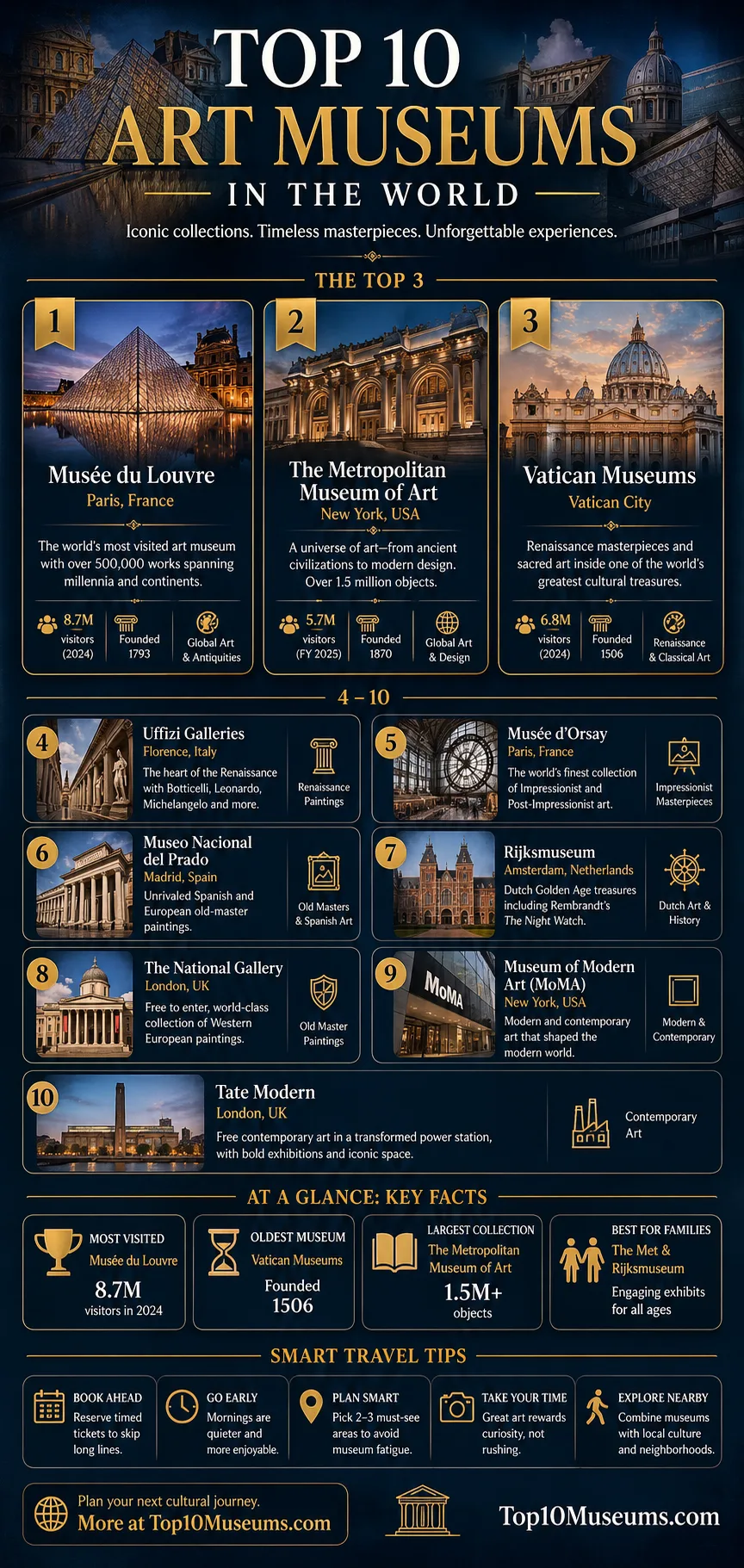
The Top 10 Art Museums in the World can be argued over for hours, but the strongest choices have one thing in common: they reward a real visit with masterpieces, range, public access, and a clear sense of place. Some are giant palace museums where one wing can take half a day; others are sharper, more focused homes for Impressionism, Dutch painting, modern art, or European old masters. This list is built for travelers who want the museum visit to feel worth the time — not just famous on paper.
[ayaz_safe_content id=”2759″ key=”p2759b1f5ec7ezu”]
| Rank | Name | Founded | Collection Type | Website |
|---|---|---|---|---|
| 1 | Musée du Louvre | 1793 | Global art, antiquities, sculpture, decorative arts | Official website |
| 2 | The Metropolitan Museum of Art | 1870 | Global art, design, arms, costume, antiquities | Official website |
| 3 | Vatican Museums | 1506 | Papal collections, Renaissance art, classical sculpture | Official website |
| 4 | Uffizi Galleries | 1769 | Italian Renaissance painting and sculpture | Official website |
| 5 | Musée d’Orsay | 1986 | Impressionist, Post-Impressionist, 1848–1914 art | Official website |
| 6 | Museo Nacional del Prado | 1819 | Spanish and European old-master painting | Official website |
| 7 | Rijksmuseum | 1798 | Dutch art, design, history, Golden Age painting | Official website |
| 8 | The National Gallery | 1824 | Western European paintings | Official website |
| 9 | Museum of Modern Art (MoMA) | 1929 | Modern and contemporary art, design, film, photography | Official website |
| 10 | Tate Modern | 2000 | International modern and contemporary art | Official website |
Why These Ten Art Museums Made the Cut
Visitor numbers matter, but they are not the only measure here. A museum can be crowded and still thin; another can be quieter and offer a better hour with art. These ten were chosen because they combine famous works, curatorial depth, visitor value, and a location that helps the collection make sense.
The list also balances old masters, Renaissance art, Impressionism, Dutch painting, modern art, free museums, and kid-friendly galleries. That balance matters for real travelers. A first trip to Paris asks for the Louvre and Orsay; a London weekend can pair the National Gallery with Tate Modern; a New York art trip feels incomplete without both the Met and MoMA.
Top 10 Art Museums in the World
1. Musée du Louvre, Paris — the museum other art museums are measured against
Best for: first-time Paris visitors, Renaissance fans, sculpture lovers, and travelers who want one museum with global range.
The Louvre is huge in a way that can feel unreal once you are inside: its online collections database includes more than 500,000 works, while the museum displays tens of thousands across former palace wings. In 2024, it welcomed 8.7 million visitors, which explains both the fame and the pressure. The Mona Lisa draws the densest crowd, but the better Louvre visit also makes time for the Winged Victory of Samothrace, Venus de Milo, the Apollo Gallery, and the quieter Near Eastern and Islamic art sections.
Do not treat the Louvre as a museum to “finish.” Choose three priorities, book a timed entry, and accept that part of the pleasure is leaving something unseen. For art-first travelers, the Denon Wing gives the most direct route to Italian painting and the big-name works; for families, sculpture halls and Egyptian antiquities often hold attention better than packed painting rooms.
Nearby alternative: Musée de l’Orangerie — a calmer follow-up for Monet’s Water Lilies, reached by walking through the Tuileries Garden.
2. The Metropolitan Museum of Art, New York — a full art civilization under one roof
Best for: global art learners, families, design lovers, and visitors who want variety without leaving one building.
The Met’s strength is range. Its collection includes more than 1.5 million objects across 5,000 years, and its 2025 fiscal-year attendance passed 5.7 million visitors. That scale means the museum can move from an Egyptian temple to European paintings, armor, musical instruments, Islamic art, American rooms, fashion, and photography without feeling like separate museums stitched together.
For a first visit, build the day around The Temple of Dendur, European paintings, the American Wing, and one smaller department that matches your taste. The Met is especially good for families because children can connect with objects before they connect with art labels: swords, rooms, statues, instruments, and giant architectural fragments make the visit physical, not just visual.
Nearby alternative: Solomon R. Guggenheim Museum — a short walk north on Fifth Avenue, useful if you want modern art and architecture after the Met.
3. Vatican Museums, Vatican City — Renaissance art at full ceremonial scale
Best for: Michelangelo admirers, Raphael fans, Rome first-timers, and visitors interested in art tied to ceremony and power.
The Vatican Museums began with Pope Julius II’s collecting in the early 1500s and now hold around 70,000 works, with about 20,000 on display. The 2024 visitor figure was about 6.8 million, and the one-way flow toward the Sistine Chapel makes that popularity easy to feel. Still, the rewards are unusually high: the Raphael Rooms, Gallery of Maps, classical sculpture courts, Pinacoteca, and Michelangelo’s Sistine Chapel ceiling form one of Europe’s densest art routes.
The best approach is to slow down before the final rooms. Many visitors race toward the Sistine Chapel and miss the Raphael Rooms, where The School of Athens sits inside a larger cycle of philosophy, theology, poetry, and law. For families, the Gallery of Maps is often the easiest middle section: long, colorful, and visually clear even without heavy art background.
Nearby alternative: Galleria Borghese — not next door, but a strong Rome art pairing by taxi or public transport if you want Bernini, Caravaggio, and a timed-entry visit.
4. Uffizi Galleries, Florence — the Renaissance in its home city
Best for: Renaissance travelers, Botticelli fans, Florence first-timers, and visitors who prefer paintings with a strong city story.
The Uffizi occupies a Vasari-designed building constructed between 1560 and 1580, and it became one of Europe’s earliest public art museums. Its famous pull comes from Botticelli’s The Birth of Venus and Primavera, but the visit is broader than two rooms: Giotto, Cimabue, Leonardo, Michelangelo, Raphael, Titian, Caravaggio, and the Medici collecting story all shape the route.
This is the museum where Florence makes the most sense as an art capital. The corridors look over the Arno, the Vasari Corridor links the Uffizi side of the river to the Pitti Palace route, and the city outside feels connected to the art inside. For a smooth visit, book early, start with the top floor, and give Botticelli attention before the rooms fill up.
Nearby alternative: Palazzo Pitti — cross the Ponte Vecchio for a larger palace setting and a natural second stop after the Uffizi.
5. Musée d’Orsay, Paris — Impressionism inside a former railway station
Best for: Impressionist fans, Paris couples, photography lovers, and visitors who want a museum that feels manageable in half a day.
Musée d’Orsay opened in 1986 inside the former Gare d’Orsay, a railway station built for the 1900 Universal Exposition. Its collection focuses on art from 1848 to 1914, and the museum received about 3.75 million visitors in 2024. The main draw is the richest Impressionist and Post-Impressionist collection in the world, with Monet, Manet, Degas, Renoir, Cézanne, Gauguin, Van Gogh, and many more.
Orsay is easier to handle than the Louvre, but it still deserves planning. The clock views are famous, yet the stronger visit is upstairs with Impressionist and Post-Impressionist paintings, then down through sculpture, decorative arts, and photography. It is also one of the better art museums for travelers who get tired quickly: the building has a clear central nave, and the collection has a tighter date range.
Nearby alternative: Musée Rodin — a short walk away, with sculpture gardens that work well after Orsay’s indoor galleries.
6. Museo Nacional del Prado, Madrid — Spain’s old-master heavyweight
Best for: Spanish painting fans, Velázquez and Goya readers, old-master travelers, and visitors who like focused painting museums.
The Prado opened in 1819 and grew from royal collecting into one of the world’s great painting museums. Its holdings include thousands of paintings, drawings, prints, sculptures, and documents, with Velázquez, Goya, Bosch, El Greco, Rubens, Titian, and Fra Angelico among the names that define the visit. In 2025, the museum passed 3.5 million visitors, a record that also pushed Madrid to think harder about crowd flow.
The Prado is not about variety in the Met sense; it is about depth in European painting. Las Meninas, The Garden of Earthly Delights, The Third of May 1808, and Goya’s Black Paintings can carry a whole morning. For a better visit, avoid trying to see every room: choose Spanish painting, Flemish works, and one personal detour.
Nearby alternative: Museo Nacional Thyssen-Bornemisza — a short walk along Paseo del Prado, useful for filling art-history gaps between the Prado and modern collections.
7. Rijksmuseum, Amsterdam — Dutch art with The Night Watch at the center
Best for: Dutch Golden Age fans, design-minded travelers, families, and visitors who want art plus national history.
The Rijksmuseum was founded in 1798, moved to Amsterdam in the 19th century, and now presents 800 years of Dutch art and history. Around 8,000 objects are on display from a much larger collection, with Rembrandt, Vermeer, Frans Hals, Jan Steen, Delftware, ship models, furniture, and Asian art all part of the experience. Its 2023 attendance reached about 2.7 million visitors.
The Gallery of Honour is the emotional center, leading toward Rembrandt’s The Night Watch. Yet the museum works best when you also give time to smaller objects, because Dutch art is often about surfaces, trade, homes, maps, and daily life. Families usually do well here because the museum tells stories through objects, not just wall text.
Nearby alternative: Van Gogh Museum — almost next door on Museumplein, making it the easiest art pairing in Amsterdam.
8. The National Gallery, London — free old-master painting in the middle of the city
Best for: free museum travelers, European painting fans, London weekend visitors, and people who prefer focused collections.
The National Gallery was founded in 1824 with 38 paintings and now holds more than 2,300 works spanning the major traditions of Western European painting. Its main collection is free to enter, which changes the rhythm of a visit: you can spend 45 minutes with Van Eyck, Turner, Velázquez, and Van Gogh, then return another day without guilt.
This is not the largest museum on the list, and that is part of its appeal. The collection is dense, readable, and placed in a city square that most London visitors already pass through. Works such as The Arnolfini Portrait, The Fighting Temeraire, The Rokeby Venus, and Sunflowers make it one of the best museums for learning painting history without losing a whole day.
Nearby alternative: National Portrait Gallery — directly behind Trafalgar Square, ideal if you want faces, biography, and British cultural history after the National Gallery.
9. Museum of Modern Art (MoMA), New York — modern art’s sharpest New York address
Best for: modern art fans, design students, photography lovers, and visitors who want a shorter New York museum than the Met.
MoMA was founded in 1929 and now holds almost 200,000 works of modern and contemporary art, with more than 100,000 available online. Its 2024–25 year brought nearly 2.8 million gallery visitors and more than 30 exhibitions. The museum’s best-known works include Van Gogh’s The Starry Night, Picasso’s Les Demoiselles d’Avignon, Monet’s Water Lilies, Warhol, Matisse, Pollock, and major design objects.
MoMA is best treated as a sequence of turning points rather than a long art timeline. Painting, design, film, photography, architecture, and media all appear in the same conversation. For visitors who find older art museums heavy, MoMA often feels more immediate — shorter labels, sharper rooms, and faster visual shifts.
Nearby alternative: The Morgan Library & Museum — a 15-to-20-minute walk southeast, with manuscripts, drawings, rare books, and intimate historic rooms.
10. Tate Modern, London — free contemporary art in a power station
Best for: contemporary art visitors, younger travelers, families who need open space, and London walkers crossing the Thames.
Tate Modern opened in 2000 inside the former Bankside Power Station and has become one of London’s easiest major art stops. Tate’s wider collection includes more than 70,000 artworks, and Tate Modern recorded about 4.6 million visitors in 2024. Entry to the main collection is free, while special exhibitions usually require paid tickets.
The building matters almost as much as the collection. The Turbine Hall gives contemporary art room to be large, strange, political, playful, or difficult, while the collection galleries move through international modernism, abstraction, photography, installation, and new media. For families, the open spaces and riverside location make Tate Modern less tiring than many older museums.
Nearby alternative: Tate Britain — a direct river bus or Tube ride away, with British art from 1500 onward and a calmer pace than Bankside.
How to Tour These Museums
Best Classic Art Day: Paris
Start with the Louvre in the morning, before the biggest midday crowd gathers around the Mona Lisa and Denon Wing. Keep the visit tight: Italian painting, sculpture, and one department you personally care about. After lunch, cross the Seine for Musée d’Orsay, where the clearer layout and 1848–1914 focus feel easier after the Louvre’s scale.
Best Free Art Day: London
Begin at the National Gallery while Trafalgar Square is still settling into the day, then walk or ride toward the river for Tate Modern in the afternoon. This route works well because the National Gallery gives you old-master painting, while Tate Modern resets the eye with modern and contemporary art. It is also one of the best budget routes on this list, since both main collections are free.
Best Old-Master Route: Madrid, Florence, Amsterdam
Do not force the Prado, Uffizi, and Rijksmuseum into long same-day museum marathons while traveling between cities. Give each one a morning slot on a separate day, then use the afternoon for walking neighborhoods nearby. This keeps energy high for the works that need attention: Las Meninas in Madrid, Botticelli in Florence, and The Night Watch in Amsterdam.
Best Rome Strategy: Vatican First, Then a Smaller Museum
The Vatican Museums are best handled early or with a carefully chosen late slot, because the route toward the Sistine Chapel can become slow. After that, avoid another giant museum. A timed visit to Galleria Borghese on the same day can work for art-focused travelers, but most people will enjoy it more the next morning.
Best New York Pairing: Met and MoMA Over Two Days
The Met and MoMA can technically fit into one long New York day, but that is rarely the best choice. Put the Met on the first morning, when you have energy for size and variety, then save MoMA for a separate half-day. This order moves naturally from global art history to modern art without turning either museum into a checklist.
Who Will Love These Museums?
- Old-master lovers: Prado, National Gallery, Louvre, and Uffizi give the strongest mix of European painting before 1900.
- Renaissance-first travelers: Uffizi and Vatican Museums are the clearest choices, with the Louvre close behind for Italian painting and sculpture.
- Impressionist fans: Musée d’Orsay is the main stop, while the Louvre and National Gallery add useful before-and-after context.
- Modern art readers: MoMA and Tate Modern are the best pair, especially for visitors interested in design, film, abstraction, photography, and installation.
- Families with curious kids: The Met, Rijksmuseum, Tate Modern, and Louvre work well because they offer objects, space, scale, and visual variety.
- Free museum travelers: The National Gallery and Tate Modern are the easiest wins, especially for a London weekend with limited budget.
- First-time Europe visitors: Louvre, Orsay, Uffizi, Vatican Museums, Prado, Rijksmuseum, National Gallery, and Tate Modern can anchor a serious art trip across the continent.
- Short-attention-span visitors: MoMA, Orsay, National Gallery, and Tate Modern are easier to shape into focused two-hour visits than the Louvre or Met.