
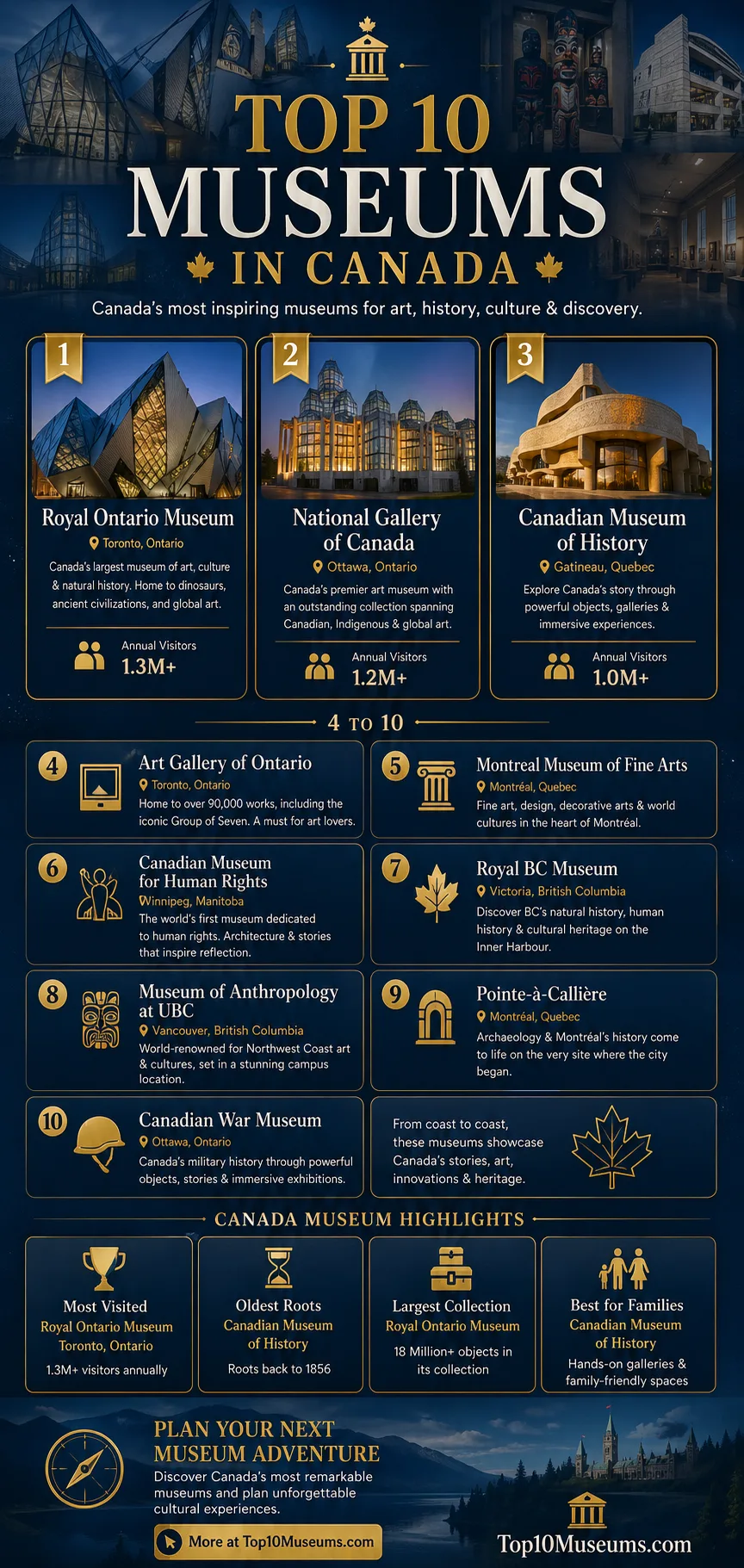
Canada’s museum map is not a single-city checklist. It stretches from Toronto’s big art-and-nature institutions to Ottawa-Gatineau’s national museums, Montréal’s archaeology and fine art stops, Winnipeg’s human-rights landmark, and the West Coast’s Indigenous and provincial-history collections. The best approach is to choose by interest first — art, science, history, architecture, or family learning — then group nearby museums into realistic days.
Top 10 Museums in Canada
| Rank | Name | Founded | Collection Type | Website |
|---|---|---|---|---|
| 1 | Royal Ontario Museum | 1914 | Art, culture, and natural history | Official website |
| 2 | National Gallery of Canada | 1880 | Canadian, Indigenous, European, Asian, contemporary art | Official website |
| 3 | Canadian Museum of History | 1856 roots | Canadian history, cultural objects, archival material | Official website |
| 4 | Art Gallery of Ontario | 1900 | Canadian, Indigenous, European, modern, and contemporary art | Official website |
| 5 | Montreal Museum of Fine Arts | 1860 | Fine art, design, decorative arts, world cultures | Official website |
| 6 | Canadian Museum for Human Rights | 2014 | Human rights, architecture, multimedia exhibitions | Official website |
| 7 | Royal BC Museum | 1886 | British Columbia natural history, human history, archives | Official website |
| 8 | Museum of Anthropology at UBC | 1947 | World arts and cultures, Northwest Coast collections | Official website |
| 9 | Pointe-à-Callière | 1992 | Archaeology and Montréal history | Official website |
| 10 | Canadian War Museum | 1880 roots | Canadian military history, war art, vehicles, archives | Official website |
Why These Ten Stand Out
These museums were chosen because they give visitors more than one strong reason to go: large collections, national relevance, strong architecture, clear visitor appeal, and city-trip usefulness. A museum that is famous but hard to fit into a real travel day ranks lower than one that combines a first-rate collection with a practical location.
The list also avoids making Canada feel like only Toronto, Ottawa, or Montréal. Those cities do dominate the national museum landscape, but Winnipeg, Victoria, and Vancouver bring different strengths — especially in architecture, human-rights storytelling, Northwest Coast art, and provincial history.
The 10 Best Museums in Canada
1. Royal Ontario Museum — Toronto
The Royal Ontario Museum is Canada’s biggest all-purpose museum, and that matters for first-time visitors who want one stop with dinosaurs, minerals, ancient cultures, textiles, design, and global art. ROM opened in 1914 and holds about 18 million artworks, cultural objects, and natural-history specimens, spread across dozens of gallery spaces. It works well for families because the natural-history galleries keep younger visitors engaged, while adults can move from Chinese temple art to fashion, biodiversity, or archaeology without leaving the building.
Plan at least 2.5 to 4 hours here. The Michael Lee-Chin Crystal exterior makes it easy to spot on Bloor Street, but the best visit is not just a photo stop; ROM rewards slow wandering, especially if you mix a high-energy dinosaur section with quieter galleries upstairs.
Best for: Families with kids, natural-history fans, first-time Toronto visitors, and travelers who want one museum with art, culture, and science in the same building.
Nearby alternative: Bata Shoe Museum — a compact, unusual museum a short walk from ROM, best if you want fashion, design, and social history without another huge museum day.
2. National Gallery of Canada — Ottawa
The National Gallery of Canada is the country’s strongest single stop for Canadian, Indigenous, European, Asian, and contemporary art. Founded in 1880, it now holds more than 87,000 works, including major Canadian and Indigenous collections as well as international pieces. The building itself is part of the visit: glass, granite, wide interior courts, and the famous outdoor spider sculpture, Maman, give it a clear sense of arrival.
This is the museum to choose if you want art without rushing. Give it 2 to 3 hours, longer if you like slow looking. Because it sits near Parliament Hill, the ByWard Market, and the Ottawa River, it is easy to combine with a half-day walk through central Ottawa.
Best for: Canadian art followers, Indigenous art learners, architecture fans, and visitors building a serious Ottawa culture day.
Nearby alternative: Bytown Museum — a small history stop near the Rideau Canal locks, useful if you want a short Ottawa-origin story after the gallery.
3. Canadian Museum of History — Gatineau
The Canadian Museum of History sits across the river from Parliament Hill, so the setting already feels tied to the national story. Its roots go back to 1856, making it one of Canada’s oldest public institutions, and the museum cares for more than 4 million items. Visitors come for the Grand Hall, First Peoples Hall, Canadian History Hall, and the broad sweep of cultural objects, photographs, written records, and sound or visual material.
This is one of the best choices for visitors who want Canada explained through objects rather than a textbook tone. It also works well for mixed-age groups because the museum has large, open spaces and a strong children’s component in the same complex. Set aside 3 hours if you want the main galleries without feeling rushed.
Best for: Canadian-history visitors, families, school groups, and travelers who want a national museum with strong river views of Ottawa.
Nearby alternative: Canadian Children’s Museum — located within the same museum complex, it is the easiest add-on for families with younger kids.
4. Art Gallery of Ontario — Toronto
The Art Gallery of Ontario is Toronto’s strongest art museum for travelers who want Canadian art, European works, Indigenous art, photography, contemporary installations, and design in one central location. Founded in 1900 as the Art Museum of Toronto, the AGO has more than 90,000 works and a Frank Gehry redesign that reshaped the building into a major part of the experience. The Group of Seven holdings are a major draw, especially for visitors trying to understand how Canadian landscape painting became a cultural marker.
The AGO is easier to pair with food, bookstores, and walking time than ROM because it sits near Queen Street West, Chinatown, and Kensington Market. A focused visit can take 2 hours, but art-first travelers can easily spend half a day moving through the Canadian and European sections.
Best for: Art-focused Toronto visitors, Group of Seven fans, design-minded travelers, and adults who want a central museum day with nearby food options.
Nearby alternative: Textile Museum of Canada — a smaller downtown museum within walking distance, good for visitors interested in fabric, craft, fashion, and global material culture.
5. Montreal Museum of Fine Arts — Montréal
The Montreal Museum of Fine Arts is one of Canada’s most rewarding fine-art museums because it combines painting, sculpture, decorative arts, design, photography, and world cultures across multiple pavilions. Founded in 1860, the museum’s collection includes about 47,000 works, with thousands available through its online collection. The Sherbrooke Street setting also gives visitors a classic Montréal museum experience: polished, walkable, and close to cafés, universities, and downtown hotels.
MMFA is especially good for visitors who like variety but do not want the encyclopedic scale of ROM. You can build a visit around Canadian and Québec art, then shift into design, fashion, or European works. Plan for 2 to 3 hours, with extra time if a temporary exhibition matches your interests.
Best for: Fine-art travelers, design lovers, couples on a Montréal weekend, and visitors who want a polished museum near downtown walking routes.
Nearby alternative: McCord Stewart Museum — a short trip along Sherbrooke Street, better if you want Montréal social history, dress, photography, and city identity.
6. Canadian Museum for Human Rights — Winnipeg
The Canadian Museum for Human Rights is not a casual object-storage museum; it is built around human-rights stories, reflection, architecture, and multimedia galleries. It opened to the public on September 20, 2014, and is known as the first museum in the world solely dedicated to the development and future of human rights. The building, designed around a journey from darker lower spaces toward light, is one of Canada’s most recognizable museum structures.
This museum works best when visitors allow time to read, listen, and pause. It is not ideal for a rushed 45-minute stop, and some topics may be better suited to teens and adults than very young children. A thoughtful visit usually takes 2.5 to 4 hours, especially if you climb toward the Tower of Hope for views over The Forks.
Best for: Architecture fans, older students, reflective travelers, human-rights learners, and Winnipeg visitors who want a museum with emotional weight.
Nearby alternative: Manitoba Museum — a downtown Winnipeg option with natural history, human history, and a planetarium, best reached by a short drive or transit ride from The Forks.
7. Royal BC Museum — Victoria
The Royal BC Museum is the main museum for understanding British Columbia through natural history, human history, provincial archives, and cultural collections. Founded in 1886, it cares for more than 7 million objects, from natural-history specimens to historical objects and archival records. Its Inner Harbour location makes it one of the easiest major museums in Canada to fold into a visitor’s day.
Visitors should check current gallery availability before going, because the museum has been updating parts of its long-term presentation. Even with changes, its value remains clear: it is a strong anchor for understanding BC’s landscapes, communities, and recorded past. Allow 2 to 3 hours, then continue on foot toward the Parliament Buildings, Beacon Hill Park, or the harbour.
Best for: Victoria visitors, BC-history learners, natural-history fans, families, and travelers who want a museum beside the Inner Harbour.
Nearby alternative: Maritime Museum of BC — a central Victoria stop that works well if you want ships, coastal history, and a shorter museum visit nearby.
8. Museum of Anthropology at UBC — Vancouver
The Museum of Anthropology at UBC is one of Canada’s strongest museum experiences for Northwest Coast art, world cultures, and museum architecture. MOA was established in 1947 and houses nearly 50,000 works, while UBC’s Laboratory of Archaeology holds an additional 535,000 archaeological objects in the building. The museum is especially known for its Northwest Coast collections and works connected to Bill Reid.
MOA is not in downtown Vancouver, so it deserves its own half-day plan rather than a quick afterthought. The UBC campus setting gives the visit a slower rhythm, with ocean, forest, and campus walks nearby. Plan 2 to 3 hours inside, then leave time for the grounds or a nearby campus stop.
Best for: Northwest Coast art learners, architecture fans, UBC visitors, cultural-history travelers, and anyone willing to leave downtown for a stronger museum day.
Nearby alternative: Beaty Biodiversity Museum — another UBC campus museum, best for families and science-minded visitors who want natural history after MOA.
9. Pointe-à-Callière — Montréal
Pointe-à-Callière is the museum to choose if you want Montréal’s history under your feet, not just on a wall label. Inaugurated in 1992 for Montréal’s 350th anniversary, it is built around archaeological remains in Old Montréal and is often described as Canada’s main archaeology-focused museum. Its ethnohistorical collection includes more than 25,000 objects, documents, artworks, and photographs connected to Montréal’s past.
This museum is especially useful for first-time Montréal visitors because it explains the city while keeping you in the old port area. The visit can feel part museum, part underground walk, part city-origins lesson. Give it 1.5 to 2.5 hours, then continue through Place Royale, the Old Port, or Notre-Dame Basilica.
Best for: Old Montréal visitors, archaeology fans, city-history learners, families with curious older kids, and travelers who like museums tied to a real site.
Nearby alternative: Château Ramezay — a short walk in Old Montréal, useful if you want more city history in a smaller historic building.
10. Canadian War Museum — Ottawa
The Canadian War Museum traces its origins to 1880, when it began around militia artifacts, and its current LeBreton Flats building opened on May 8, 2005. The museum’s collection includes military objects, archival and photographic material, books, recordings, and works of art, with more than 500,000 collection pieces often cited across its institutional materials. It is one of Canada’s most serious history museums, but the building’s layout keeps the experience manageable.
The museum is best approached with enough time for reading and reflection. Visitors interested in vehicles, uniforms, medals, and war art will find plenty to examine, while others may focus on the broader question of how conflict shaped Canadian public life. Plan for 2 to 3 hours, and avoid stacking it after another emotionally heavy museum unless your schedule is tight.
Best for: Military-history readers, Ottawa visitors, older students, war-art followers, and travelers who want a national museum with strong object-based storytelling.
Nearby alternative: Bank of Canada Museum — a compact downtown museum about money and the economy, reachable by transit or a short rideshare from LeBreton Flats.
How to Tour These Museums
Best Toronto Art-and-Nature Day
Start with Royal Ontario Museum in the morning while energy is high, because ROM is large and varied. After lunch around Bloor, Queen’s Park, or Yorkville, take transit or a taxi to the Art Gallery of Ontario. This pairing works well because ROM gives you science and global culture first, while AGO gives you a calmer art-focused afternoon.
Best Ottawa-Gatineau History Day
Begin at the National Gallery of Canada for a cleaner morning visit, then cross to the Canadian Museum of History for the afternoon. If you want to add the Canadian War Museum, make it a second day rather than squeezing three large institutions into one rushed itinerary. The river crossings are short, but the mental load is real.
Best Montréal Museum Day
Use the morning for Pointe-à-Callière, then spend time walking through Old Montréal before moving to the Montreal Museum of Fine Arts later in the day. This gives you archaeology and city origins first, then a broader art visit when you are ready for quieter galleries. It also avoids wasting the best Old Montréal walking hours indoors.
Best West Coast Culture Day
In Vancouver, make the Museum of Anthropology at UBC the anchor rather than a side trip. In Victoria, give the Royal BC Museum its own half-day and pair it with the Inner Harbour, Parliament Buildings, or a short downtown walk. These two museums are not a same-day pair for most travelers because the Vancouver-to-Victoria transfer takes too much time.
Best Cross-Canada Museum Route
For a museum-heavy Canada trip, group the route by region: Toronto first, Ottawa-Gatineau second, Montréal third. Add Winnipeg for the Canadian Museum for Human Rights if architecture and reflective exhibitions matter to you. Save Vancouver and Victoria for a separate western trip unless you have at least two full weeks.
[ayaz_safe_content id=”2757″ key=”p2757b1is7u8vrc”]
Who Will Love These Museums?
- First-time Canada travelers: Royal Ontario Museum, Canadian Museum of History, and National Gallery of Canada give the broadest cultural overview.
- Art-first visitors: National Gallery of Canada, Art Gallery of Ontario, and Montreal Museum of Fine Arts offer the strongest art-focused route.
- Families with school-age kids: Royal Ontario Museum, Canadian Museum of History, Royal BC Museum, and Beaty-adjacent MOA days work especially well.
- STEM-curious teens: Royal Ontario Museum and nearby UBC science options pair objects, specimens, and research without feeling too classroom-like.
- Architecture fans: Canadian Museum for Human Rights, National Gallery of Canada, Museum of Anthropology at UBC, and AGO have buildings worth noticing.
- Canadian-history readers: Canadian Museum of History, Canadian War Museum, Pointe-à-Callière, and Royal BC Museum give the strongest timeline-based visits.
- Indigenous art and culture learners: Museum of Anthropology at UBC, National Gallery of Canada, Canadian Museum of History, Royal BC Museum, and ROM offer strong starting points.
- Short city-break travelers: Toronto’s ROM and AGO, Ottawa-Gatineau’s national museums, and Montréal’s MMFA plus Pointe-à-Callière are the easiest pairs.