
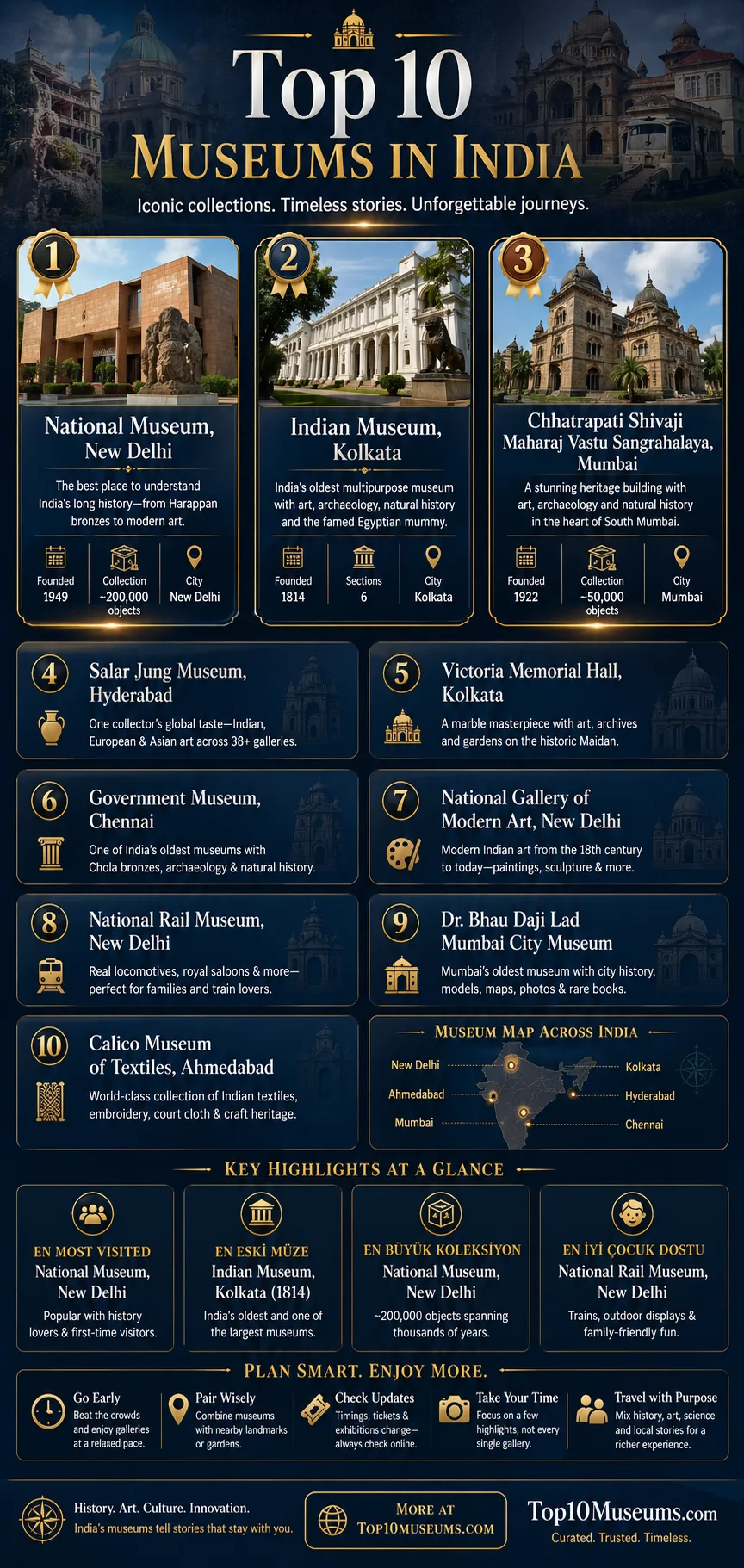
India rewards museum time with range: Harappan bronzes in Delhi, railway saloons in Chanakyapuri, Mughal textiles in Ahmedabad, and old city models in Mumbai. This list of the top 10 museums in India favors places that help a first-time traveler understand art, archaeology, science, design and everyday history without needing a specialist background before walking in.
[ayaz_safe_content id=”2755″ key=”p2755b1roxdrwmw”]
| Rank | Name | Founded | Collection Type | Website |
|---|---|---|---|---|
| 1 | National Museum, New Delhi | 1949 | Archaeology, art, manuscripts, coins, textiles, arms and cultural history | Official website |
| 2 | Indian Museum, Kolkata | 1814 | Art, archaeology, anthropology, zoology, geology and botany | Official website |
| 3 | Chhatrapati Shivaji Maharaj Vastu Sangrahalaya | Foundation stone 1905; opened 1922 | Art, archaeology, natural history, coins, decorative arts and manuscripts | Official website |
| 4 | Salar Jung Museum | 1951 | Indian, European, Middle Eastern and Far Eastern art, manuscripts and decorative objects | Official website |
| 5 | Victoria Memorial Hall | 1921 | Paintings, sculpture, historical relics, archives and Indo-British history | Official website |
| 6 | Government Museum, Chennai | 1851 | Archaeology, bronze sculpture, natural history, numismatics and South Indian heritage | Official website |
| 7 | National Gallery of Modern Art, New Delhi | 1954 | Modern and contemporary Indian art, sculpture, photography, prints and installations | Official website |
| 8 | National Rail Museum | 1977 | Railway locomotives, saloons, coaches, signal objects and transport heritage | Official website |
| 9 | Dr. Bhau Daji Lad Mumbai City Museum | 1857; current building 1872 | Mumbai city history, decorative arts, maps, clay models, photographs and rare books | Official website |
| 10 | Calico Museum of Textiles | 1949 | Historic Indian textiles, court cloth, regional embroidery, ritual art and crafts | Official website |
Why These Ten Stand Out Across India
The list balances national importance with visitor usefulness. A museum can be famous and still be tiring if the route is poor, the galleries feel scattered, or the collection needs too much advance reading; these ten were chosen because most travelers can connect the objects to India’s art, cities, trade, transport and everyday life within a single visit.
The ranking also gives weight to collection depth, not only building beauty. National Museum and Indian Museum help explain long historical timelines; CSMVS and Salar Jung are strong for object lovers; Victoria Memorial and Dr. Bhau Daji Lad Museum are useful for city history; NGMA and Calico give art and design travelers a more focused visual language to follow.
Families were considered too. A child may not care about dynastic labels, but a real locomotive, an Egyptian mummy, a bronze animal, a huge marble hall or a textile with gold thread can still make a museum day stick in memory — and that matters when choosing museums for mixed-age trips.
The 10 Best Museums in India
1. National Museum, New Delhi
Best for: First-time India travelers, archaeology readers, miniature painting fans, coin collectors and visitors who want one strong museum day in Delhi.
The National Museum is the most useful starting point for a traveler who wants India in long view. Established in 1949, it holds around 200,000 objects of Indian and foreign origin, with galleries reaching from prehistory to modern art; the Harappan section alone gives many visitors their first close look at Indus Valley material culture.
The museum is especially strong when you slow down for specific rooms instead of trying to finish every corridor. Look for the bronze Dancing Girl tradition in the Harappan material, Buddhist relic displays connected with Piprahwa, manuscripts, coinage, Central Asian antiquities and miniature paintings; each section gives a different route into how India recorded power, devotion, trade and daily life.
For families, the museum works best with a simple plan: pick three themes — for example archaeology, coins and arms — then stop before fatigue takes over. The building is close to India Gate and other central Delhi sights, so it fits neatly into a half-day culture plan without making the day feel like homework.
Nearby alternative: National Crafts Museum and Hastkala Academy — a practical follow-up near Pragati Maidan if you want textiles, folk craft, village-style structures and a softer pace after the National Museum.
2. Indian Museum, Kolkata
Best for: Old museum lovers, natural history fans, archaeology students, families with curious children and travelers who want Kolkata’s classic museum experience.
Founded in 1814, the Indian Museum is one of India’s great old cultural institutions and is often described as the earliest and largest multipurpose museum in the Indian subcontinent. Its six broad sections — Art, Archaeology, Anthropology, Zoology, Geology and Botany — make it feel less like a single-subject museum and more like a walk through the history of collecting itself.
The museum moved into its present Chowringhee building in the 19th century, and that older institutional feel is part of the draw. Visitors come for Bharhut sculptures, fossils, coins, Mughal paintings, zoological specimens and the famous Egyptian mummy; the mix can feel old-school, but it gives the place a cabinet-of-curiosities pull that newer galleries rarely have.
Families should not try to read every label. A better rhythm is to start with archaeology, move to natural history, then choose one art gallery before stepping out toward Park Street or Maidan; this keeps the visit active and manageable, especially in Kolkata’s warm months.
Nearby alternative: Asutosh Museum of Indian Art — a quieter university museum option for Bengal art, folk material and regional objects, best paired with a slower academic-style visit.
3. Chhatrapati Shivaji Maharaj Vastu Sangrahalaya, Mumbai
Best for: Art-and-architecture travelers, South Mumbai walkers, decorative art fans, natural history browsers and visitors who want one polished museum in Mumbai.
Chhatrapati Shivaji Maharaj Vastu Sangrahalaya, still widely called CSMVS, had its foundation stone laid in 1905 and opened to the public in 1922. The George Wittet-designed building is part of the experience: a Grade I heritage structure with Indo-Saracenic features, set in the Kala Ghoda area where galleries, bookshops and cafés sit close together.
The collection is broad, with roughly 50,000 objects across art, archaeology and natural history. A strong visit might include Indian sculpture, miniature paintings, Himalayan and East Asian material, European paintings, coins and decorative objects; the Tata family collections are one reason the museum feels richer than a standard city museum.
CSMVS is also one of the easier large museums in India to enjoy as a traveler because the neighborhood does some of the work for you. Start early, leave time for the gardens and museum shop, then walk toward the Gateway of India or Kala Ghoda; the museum becomes the anchor of a South Mumbai culture day rather than a standalone stop.
Nearby alternative: National Gallery of Modern Art, Mumbai — an easy Kala Ghoda add-on for modern Indian art, especially if you want a shorter gallery after CSMVS.
4. Salar Jung Museum, Hyderabad
Best for: Decorative art lovers, Hyderabad first-timers, manuscript readers, families, and visitors who enjoy one collector’s taste spread across many cultures.
The Salar Jung Museum opened to the public in 1951 and was declared an Institution of National Importance in 1961. Its identity is tied to the Salar Jung family, especially Nawab Mir Yousuf Ali Khan, Salar Jung III, whose collecting habits brought together art objects from India, Europe, the Middle East and East Asia.
The museum has more than 38 galleries, so pacing matters. Many visitors head for the Veiled Rebecca, the musical clock, jade, arms and armour, manuscripts, ivory work, Bidri ware and European furniture; the appeal is not one neat timeline but the sense of moving through a private collection on a grand scale.
Because it sits near the Musi River and not far from the Old City, Salar Jung pairs well with Charminar, Mecca Masjid and nearby food stops. For families, choose five highlight rooms before arrival; otherwise the range can turn from exciting to exhausting faster than expected.
Nearby alternative: Nizam’s Museum — a nearby Old City option for visitors who want royal Hyderabad objects, gifts, vehicles and palace-linked material after Salar Jung.
5. Victoria Memorial Hall, Kolkata
Best for: Architecture fans, colonial-history readers, garden walkers, first-time Kolkata visitors and travelers who want a museum that also feels like a landmark.
Victoria Memorial Hall opened to the public in 1921 and sits on a 57-acre campus at the Maidan. Its collection includes 28,394 artefacts displayed across nine galleries, with a focus on Indian history in the 18th, 19th and 20th centuries, plus paintings, sculpture, documents and archival material.
The building’s white Makrana marble presence is the first thing most visitors remember, but the museum is more than a photo stop. The galleries include works by artists such as Thomas and William Daniell, along with portraits, relics and documents that help explain how Kolkata looked and imagined itself under British rule.
Visit in the morning or late afternoon if you want to enjoy the gardens without heavy heat. Pairing Victoria Memorial with Indian Museum makes an excellent Kolkata history day: one gives the grand civic monument, the other gives the older multipurpose collection.
Nearby alternative: Birla Industrial and Technological Museum — a family-friendly science museum in Ballygunge, useful when children need hands-on exhibits instead of more history rooms.
6. Government Museum, Chennai
Best for: South Indian history readers, bronze sculpture fans, school-age children, archaeology visitors and travelers staying near Egmore.
The Government Museum, Chennai began in 1851, making it one of the oldest museums in India after Kolkata’s Indian Museum. Its origin story is wonderfully concrete: the museum started with 1,100 geological specimens from the Madras Literary Society before expanding into archaeology, art, numismatics and natural history.
The bronze galleries are a major reason to go. If you care about South Indian art, the Chola-period bronze tradition is the room to slow down in; for families, the natural history sections and older museum buildings add variety when children need a break from sculpture labels.
The Egmore location is practical for travelers moving around central Chennai. It is not the sleekest museum on this list, but it is deeply useful for understanding Tamil Nadu’s material culture, early collecting in Madras and the way museums grew under 19th-century institutions.
Nearby alternative: Fort Museum — a compact Fort St. George museum option for visitors who want colonial-era documents, portraits and city-history material after Egmore.
7. National Gallery of Modern Art, New Delhi
Best for: Modern Indian art followers, design students, solo travelers, quiet gallery visitors and anyone who wants a focused art stop near India Gate.
Established in 1954, the National Gallery of Modern Art in New Delhi is housed in Jaipur House near India Gate. Its collection includes more than 17,000 artworks by about 2,000 artists, covering Indian art from the mid-18th century to the present through painting, sculpture, photography, printmaking, digital work and installations.
This is the place to move from historical objects into modern visual language. Expect names such as Raja Ravi Varma, Amrita Sher-Gil, Rabindranath Tagore, Nandalal Bose and Jamini Roy to shape the visit; the building and lawns also give the gallery a calmer mood than many crowded tourist stops in Delhi.
NGMA works best when paired with National Museum, because the two museums ask different questions. National Museum shows long cultural memory; NGMA shows how artists reworked identity, form and politics into modern Indian art without needing a massive route across the city.
Nearby alternative: National Museum — a short central Delhi transfer if you want archaeology, manuscripts and coins before or after modern art.
8. National Rail Museum, New Delhi
Best for: Families with children, railway fans, engineering-minded teens, transport-history readers and visitors who need an outdoor museum break in Delhi.
The National Rail Museum opened in 1977 in Chanakyapuri and covers about 11 acres. Its official collection includes 91 real-size exhibits such as steam, diesel and electric locomotives, royal saloons, vintage coaches and railway equipment, making it one of the most kid-friendly museums in India.
The big draw is scale: children can see trains as machines, not just as images. Look for royal carriages, older locomotives and outdoor displays that show how rail shaped distance, trade and travel across India; the museum is especially good for visitors who need movement and fresh air between indoor galleries.
Because it is in the diplomatic district, it does not pair naturally with every Delhi sight, but it is worth the taxi ride for families. Go earlier in the day, check current ride and ticket options before leaving, and leave enough time for children to repeat favorite engines without rushing.
Nearby alternative: Air Force Museum, Palam — a transport-and-technology follow-up for visitors who want aircraft displays and military aviation history after the railway theme.
9. Dr. Bhau Daji Lad Mumbai City Museum
Best for: Mumbai history readers, architecture lovers, decorative arts visitors, slow museum-goers and travelers who enjoy smaller museums with strong local identity.
Dr. Bhau Daji Lad Mumbai City Museum is Mumbai’s oldest museum. Established in 1857 and opened at its present Byculla site in 1872 as the Victoria and Albert Museum, Bombay, it tells the city’s story through fine and decorative arts, clay models, dioramas, maps, lithographs, photographs and rare books.
The building itself deserves attention: the restored interiors, gilded details and Palladian exterior give the museum a very different mood from CSMVS. The collection is especially good at showing how Bombay’s communities, trades, crafts and urban forms were imagined in the late 18th to early 20th centuries.
This is a strong choice for visitors who like museums that feel specific to one city. Pair it with a Byculla visit or a South Mumbai museum day, but do not treat it as a rushed afterthought; its best rooms reward close looking rather than speed.
Nearby alternative: Mani Bhavan Gandhi Sangrahalaya — a quieter Gamdevi museum for visitors interested in Gandhi’s time in Mumbai, reachable by taxi from Byculla or South Mumbai.
10. Calico Museum of Textiles, Ahmedabad
Best for: Textile researchers, design students, craft lovers, fashion-history readers and patient travelers who are willing to plan ahead.
Founded in 1949 by Gautam Sarabhai with the assistance of Gira Sarabhai, the Calico Museum of Textiles is one of India’s most respected textile museums. Its collection is built around historic Indian textiles, including court cloth, regional embroidery, religious textiles, ritual art, crafts and material linked with textile techniques.
This is not a casual drop-in museum in the same way as a large national collection. It is best treated as a planned visit, especially because fragile textiles need careful light, climate and handling conditions; that controlled setting is part of why the collection remains so valuable for design and craft study.
Calico is the right final pick because it widens the list beyond sculpture, archaeology and painting. India’s textile history is not a side subject — it connects trade, religion, court culture, domestic life and hand skill — and this museum gives that story serious space.
Nearby alternative: Sardar Vallabhbhai Patel National Memorial — a Shahibaug-area museum option for visitors who want modern Indian history and a nearby second stop after Calico.
How to Tour These Museums
Best Delhi Art and Rail Route
Start with National Museum in the morning, when your attention is fresh enough for archaeology, manuscripts and coins. After lunch, move to NGMA near India Gate for modern Indian art; keep National Rail Museum for the next morning if you are traveling with children, because its outdoor displays deserve a slower pace.
Best Kolkata History Day
Visit Indian Museum first because it needs more mental energy and has a wider spread of galleries. Save Victoria Memorial Hall for late afternoon, when the Maidan setting and marble exterior feel more relaxed; this order also gives families a natural outdoor break after the heavier indoor museum.
Best Mumbai Museum Pairing
Use CSMVS as the main museum of the day and give it the morning. Then travel to Byculla for Dr. Bhau Daji Lad Mumbai City Museum, which is smaller but very strong on city identity; the contrast between Kala Ghoda’s large encyclopedic museum and Byculla’s city museum makes the route feel balanced.
Best South and West India Add-On Route
For a longer India trip, place Government Museum, Chennai on a South India history day, then use Hyderabad’s Salar Jung Museum as a major Deccan stop. Finish with Ahmedabad’s Calico Museum only if you can plan ahead; textile collections are best enjoyed when the day is not already overloaded.
Best Family Rhythm
Families should mix indoor and outdoor museums rather than stacking three heavy galleries in a row. National Rail Museum, Indian Museum’s natural history rooms, Victoria Memorial’s gardens and Salar Jung’s unusual objects give children more variety; for art-heavy days, keep the route shorter and add a café or garden pause.
Who Will Love These Museums?
- First-time India travelers: National Museum and Indian Museum give the broadest starting point for history, archaeology and cultural memory.
- Old-master and decorative-art lovers: CSMVS, Salar Jung Museum and Victoria Memorial Hall offer paintings, sculpture, furniture, manuscripts and historic objects with strong visual pull.
- Families with young kids: National Rail Museum, Indian Museum and Victoria Memorial Hall work well because trains, natural history and open grounds break up the day.
- STEM-curious teens: National Rail Museum and Government Museum, Chennai provide transport, geology, natural history and technical objects beyond standard art galleries.
- Modern Indian art followers: NGMA New Delhi is the cleanest pick for 19th- to 21st-century Indian art, with major names and a focused collection.
- Textile, fashion and craft researchers: Calico Museum of Textiles is the specialist choice for court textiles, regional embroidery, ritual cloth and design history.
- City-history readers: Dr. Bhau Daji Lad Museum and Victoria Memorial Hall are especially useful for understanding Mumbai and Kolkata through objects, maps, buildings and civic memory.
- Travelers short on time: Choose one city cluster — Delhi, Kolkata or Mumbai — instead of trying to force all ten into a single trip.