
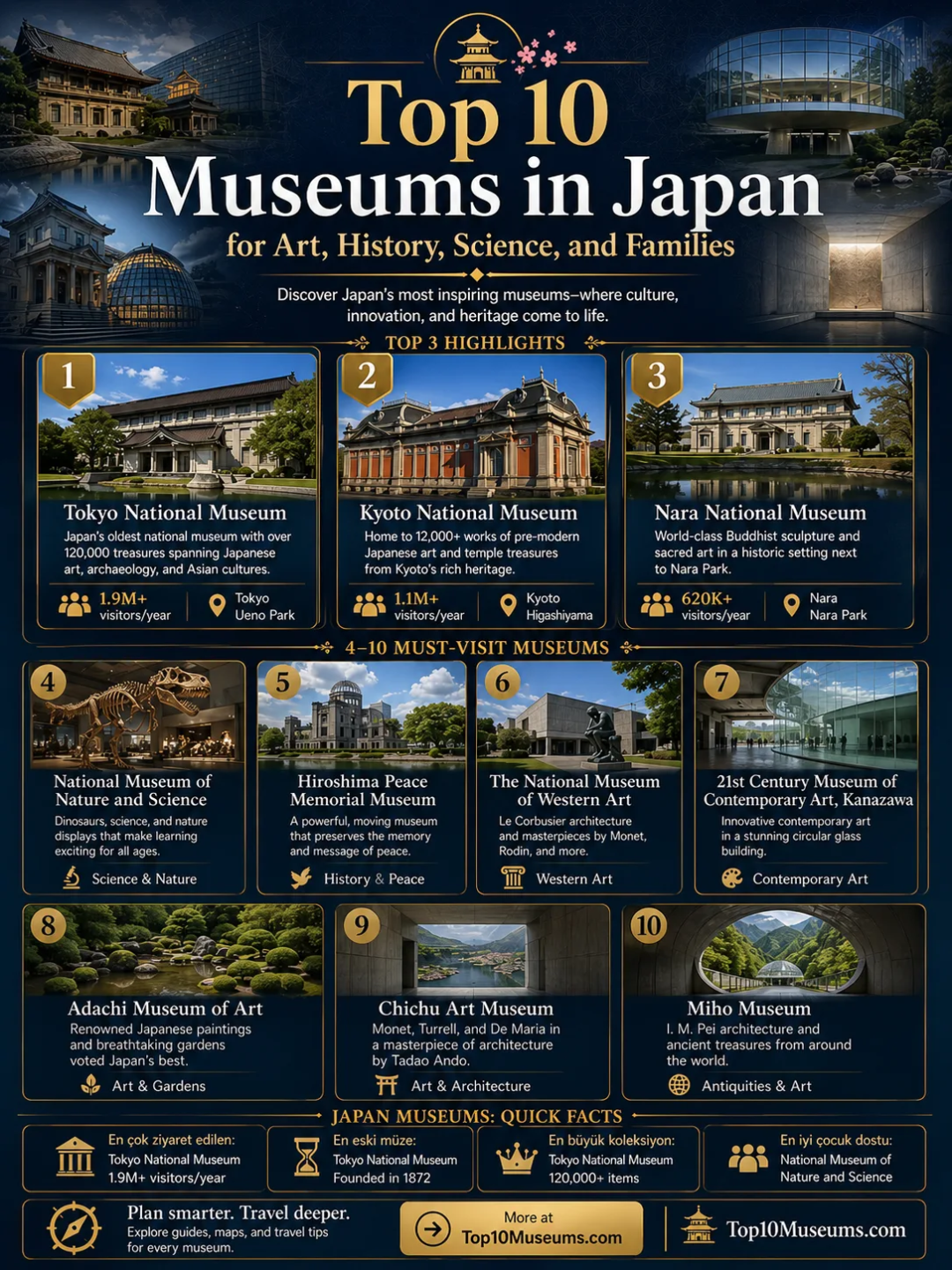
Japan is not a one-museum country. The Top 10 Museums in Japan range from Buddhist sculpture halls and national art collections to science galleries, peace archives, garden museums, and island spaces where the building is part of the artwork. A good Japan museum route should feel practical, varied, and honest: Tokyo gives you depth and scale, Kyoto and Nara add temple-connected art, Hiroshima brings memory into the present, and smaller destinations like Naoshima, Yasugi, and Shigaraki reward travelers who plan beyond the usual train-station loop.
[ayaz_safe_content id=”2753″ key=”p2753b1gxolhoph”]
| Rank | Name | Founded | Collection Type | Website |
|---|---|---|---|---|
| 1 | Tokyo National Museum | 1872 | Japanese and Asian art, archaeology, national treasures | Official Website |
| 2 | Kyoto National Museum | 1897 | Pre-modern Japanese art, temple treasures, crafts, archaeology | Official Website |
| 3 | Nara National Museum | 1889 | Buddhist sculpture, ritual objects, sacred art | Official Website |
| 4 | National Museum of Nature and Science | 1877 | Natural history, science, technology, fossils, specimens | Official Website |
| 5 | Hiroshima Peace Memorial Museum | 1955 | Peace history, atomic bombing archives, survivor materials | Official Website |
| 6 | The National Museum of Western Art | 1959 | Western painting, sculpture, prints, Le Corbusier architecture | Official Website |
| 7 | 21st Century Museum of Contemporary Art, Kanazawa | 2004 | Contemporary art, installation, architecture, public art | Official Website |
| 8 | Adachi Museum of Art | 1970 | Modern Japanese painting, ceramics, garden art | Official Website |
| 9 | Chichu Art Museum | 2004 | Site-specific art, Monet, Turrell, De Maria, architecture | Official Website |
| 10 | Miho Museum | 1997 | Japanese art, Silk Road art, antiquities, I. M. Pei architecture | Official Website |
Why These Ten Japan Museums Stand Above the Rest
These museums were chosen for collection depth, visitor value, geographic spread, and trip-planning usefulness. Tokyo has enough institutions to fill a full week, but a Japan-wide list should also make room for Kyoto’s temple-linked art, Nara’s Buddhist sculpture, Hiroshima’s peace archive, Kanazawa’s contemporary architecture, and island or garden museums that change the pace of a cultural trip.
The list also avoids treating every museum as the same kind of stop. Some are half-day anchors, some work best as part of a neighborhood route, and a few need careful planning because access depends on ferries, rural buses, or timed tickets. That mix is exactly what makes Japan’s museum scene useful for first-time travelers, families, art lovers, and return visitors who want more than another shopping district.
The 10 Best Museums in Japan
1. Tokyo National Museum — Japan’s Essential Art and History Museum
Best for: first-time visitors to Japan, old-master lovers, history travelers, and anyone who wants one museum to explain the long arc of Japanese art.
Tokyo National Museum is the strongest single museum choice for a first Japan trip because it combines scale, age, and national collection value. Founded in 1872, it is Japan’s oldest national museum, and its collection now holds more than 120,000 items, including National Treasures and Important Cultural Properties. The Ueno Park location also makes it easy to pair with science, Western art, and smaller galleries in the same district.
The museum is not one building with one theme. The Honkan covers Japanese art across periods, the Toyokan brings in Asian art, and the Gallery of Horyuji Treasures gives visitors a focused look at Buddhist materials connected to one of Japan’s oldest temple traditions. Armor, swords, lacquerware, ceramics, calligraphy, folding screens, archaeological objects, and Buddhist sculpture all appear here, so the visit feels dense but readable if you give it enough time.
For most visitors, the best approach is to start with the Honkan and choose one or two extra buildings instead of trying to see every gallery. Exhibits rotate often, so the exact objects change, but the museum’s role does not: it is the most reliable place in Japan to understand how Japanese art, religion, court culture, samurai culture, and craft traditions connect.
Nearby alternative: Tokyo Metropolitan Art Museum — a convenient Ueno Park option for special exhibitions, usually a short walk from Tokyo National Museum.
2. Kyoto National Museum — Temple Treasures and Pre-Modern Japanese Art
Best for: Kyoto visitors, temple-history readers, craft lovers, and travelers who want Japanese art with strong religious and court-culture context.
Kyoto National Museum opened in 1897 and focuses on pre-modern Japanese and Asian art, with a special strength in cultural properties connected to Kyoto’s temples, shrines, and long capital-city history. Its collection is often described at more than 12,000 items, across painting, sculpture, calligraphy, ceramics, textiles, lacquer, metalwork, and archaeology.
The museum is especially useful because Kyoto’s best art is not always easy to see inside active temples. Objects that might otherwise be hidden, rotated, or scattered across religious sites can appear here in a museum setting with clearer labels and better viewing conditions. The Heisei Chishinkan Wing, designed by Yoshio Taniguchi, gives the collection a calm, modern home without pulling attention away from the works.
This is a smart museum for travelers who have already visited Kiyomizu-dera, Sanjusangen-do, or the Higashiyama area and want a slower explanation of what they saw outside. It is not a loud museum; it rewards quiet looking, especially in sections on Buddhist art, calligraphy, ceramics, and Kyoto-linked decorative arts.
Nearby alternative: Kawai Kanjiro’s House — a smaller craft-focused museum within the Higashiyama area, useful if you want a more intimate stop after the national collection.
3. Nara National Museum — Buddhist Sculpture Beside Nara Park
Best for: Buddhist art fans, Nara day-trippers, architecture-minded travelers, and visitors who want a museum near Todai-ji and Nara Park.
Nara National Museum was established in 1889 and is one of Japan’s core museums for Buddhist art. Its Buddhist Sculpture Hall displays nearly 100 Buddhist sculptures, many from the Asuka through Kamakura periods, and the setting near Nara Park makes it easy to combine with Todai-ji, Kasuga Taisha, and the deer-filled park paths.
The museum’s strength is focus. Instead of trying to cover every part of Japanese culture, it gives visitors a close look at sacred sculpture, ritual bronzes, calligraphy, paintings, and temple-related objects. Seeing Buddhist statues here after visiting nearby temples helps the eye slow down: hand gestures, halos, robes, wood carving, and facial expression begin to feel readable rather than decorative.
The original museum building is also part of the appeal. Designed by Katayama Tokuma, it is a Meiji-era Western-style building and an Important Cultural Property. If your Nara visit is only one day, this museum works best as a late-morning or mid-afternoon stop, especially when temple walking becomes tiring.
Nearby alternative: Nara Prefectural Museum of Art — a compact art stop near Nara Park, useful if you want another indoor break without leaving central Nara.
4. National Museum of Nature and Science — Tokyo’s Best Science Museum for Families
Best for: families with kids, STEM-curious teens, dinosaur fans, natural-history visitors, and rainy-day Tokyo planners.
The National Museum of Nature and Science in Ueno is the strongest science museum choice in Japan for most visitors. Founded in 1877, it covers natural history, biodiversity, Japanese science, technology, astronomy, fossils, animals, minerals, and human history. The museum presents around 25,000 specimens and artifacts across the Japan Gallery and Global Gallery.
For families, the value is simple: there is enough variety to hold different attention spans. Dinosaur skeletons, taxidermy, meteorites, mechanical displays, Japanese natural environments, and science-history objects make the visit feel more active than a purely art-focused museum. The famous taxidermied Hachiko is also here, which gives many visitors a small but memorable Tokyo connection.
The location makes planning easy. You can pair it with Tokyo National Museum or the National Museum of Western Art, but it is better not to overload young children with three large museums in one day. For a family day, choose one big museum, lunch in Ueno, and a walk through the park.
Nearby alternative: The Ueno Royal Museum — a flexible nearby option for special exhibitions inside Ueno Park, often easier to add than another large national museum.
5. Hiroshima Peace Memorial Museum — A Direct, Human History Museum
Best for: history travelers, older students, peace studies readers, and visitors prepared for a serious museum experience.
Hiroshima Peace Memorial Museum opened in 1955 inside Peace Memorial Park and documents the atomic bombing of Hiroshima on August 6, 1945. It is one of Japan’s most visited and emotionally demanding museums; in fiscal 2025, it drew 2,580,926 visitors, a record figure for the museum.
The museum uses belongings, photographs, survivor materials, architectural context, and historical displays to explain the destruction and its human cost. It is not a museum to rush through between lunch and shopping. Many visitors need quiet time afterward, especially after sections centered on personal items and first-hand testimony.
Its strength is restraint. The museum’s best moments come from specific objects rather than broad claims: a stopped watch, damaged clothing, school materials, heat-marked surfaces, and written accounts. Pair it with the Peace Memorial Park, the Cenotaph, and the Atomic Bomb Dome, but avoid stacking it with too many tourist stops on the same morning.
Nearby alternative: Hiroshima Museum of Art — an accessible central Hiroshima art museum, useful if you want a calmer cultural stop after Peace Memorial Park.
6. The National Museum of Western Art — Le Corbusier, Rodin, Monet, and the Matsukata Collection
Best for: Western art fans, architecture travelers, Ueno Park visitors, and anyone interested in Le Corbusier’s only completed museum building in East Asia.
The National Museum of Western Art opened in 1959 in Ueno Park and is Japan’s national museum devoted to Western art. Its collection centers on the Matsukata Collection and now includes more than 6,000 works, with paintings, sculptures, drawings, and prints from the Middle Ages through the 20th century.
The museum’s building is just as important as its galleries. Designed by Le Corbusier, the main building became part of a UNESCO World Heritage inscription for the architect’s work. That means the museum is both an art stop and an architecture stop, especially for travelers interested in modernism, concrete forms, and postwar cultural exchange.
Inside, visitors usually come for Rodin, Monet, Renoir, Van Gogh, and other European names, but the museum’s value is broader than the famous labels. It shows how a Japanese public collection of Western art was built, returned, expanded, and presented in Tokyo. Since it sits near Tokyo National Museum and the science museum, it is one of the easiest high-value add-ons in the city.
Nearby alternative: Tokyo Metropolitan Art Museum — another Ueno Park institution, best for visitors who want a major temporary exhibition within walking distance.
7. 21st Century Museum of Contemporary Art, Kanazawa — Contemporary Art You Can Walk Through
Best for: contemporary art fans, architecture lovers, Kanazawa first-timers, design students, and travelers who like interactive museum spaces.
21st Century Museum of Contemporary Art, Kanazawa opened in 2004 and quickly became one of Japan’s most recognizable contemporary museums. Designed by SANAA, the circular building is about 112.5 meters in diameter, with glass walls and multiple entry points that make it feel more like a public plaza than a closed museum box.
The museum is famous for works such as Leandro Erlich’s Swimming Pool, but it also works because of its location. It sits near Kenrokuen Garden, Kanazawa Castle Park, and the city’s central cultural district, so travelers can move between garden design, samurai-era streets, and contemporary art without crossing the whole city.
This is one of the best Japan museums for people who think they do not like museums. The building lowers the barrier: some zones feel open, light, and casual, while ticketed galleries offer the more focused experience. For families and couples, it is also easier to discuss than many traditional collections because the works often invite direct reaction.
Nearby alternative: Ishikawa Prefectural Museum of Art — a short cultural-district walk away, good for regional craft, ceramics, and a quieter Kanazawa art stop.
8. Adachi Museum of Art — Japanese Painting and a Garden Treated Like a Living Artwork
Best for: garden lovers, Japanese painting fans, slow travelers, photographers, and visitors exploring Shimane beyond the usual Japan route.
Adachi Museum of Art in Yasugi, Shimane, was founded in 1970 by local businessman Adachi Zenko. It is best known for pairing modern Japanese painting with carefully maintained gardens, and its collection includes around 120 works by Yokoyama Taikan, one of the major names in modern Nihonga painting.
The gardens are not treated as a side feature. Visitors view them through windows, corridors, and framed openings, almost like scroll paintings changing with the weather. Dry landscape, moss, pond, pine, and borrowed scenery are arranged with a level of care that makes the museum feel half gallery, half garden composition.
Adachi is not as easy to reach as a Tokyo or Kyoto museum, which is part of why it suits slower trips. It works best for travelers going through Matsue, Izumo, or the Sanin region, and it deserves more than a rushed detour. If you enjoy Japanese gardens but want a controlled museum setting rather than a crowded temple garden, this is one of Japan’s most rewarding stops.
Nearby alternative: Shimane Art Museum — a strong Matsue option near Lake Shinji, practical if your route continues toward central Matsue after Yasugi.
9. Chichu Art Museum — Monet, Turrell, De Maria, and Tadao Ando on Naoshima
Best for: architecture travelers, island art visitors, Monet fans, Tadao Ando followers, and people who prefer fewer works with stronger atmosphere.
Chichu Art Museum opened in 2004 on Naoshima and was designed by Tadao Ando. Built mostly underground to reduce its impact on the Seto Inland Sea landscape, it permanently presents works by Claude Monet, James Turrell, and Walter De Maria. The museum is small in artist count but large in experience.
This is not a museum where you move from one labeled wall to the next. Natural light, concrete, silence, angles, and controlled movement shape the visit. Monet’s Water Lilies are not simply hung in a standard room; they are placed in a setting that changes with daylight, while Turrell’s works make perception itself part of the visit.
Planning matters here. Naoshima travel involves ferries, local buses, shuttle timing, and often timed museum reservations. Chichu is best treated as part of a full island day with Benesse House Museum, Lee Ufan Museum, or outdoor art stops, not as a casual spare-hour visit. The reward is a museum where architecture and artwork share the same sentence.
Nearby alternative: Benesse House Museum — another Naoshima art anchor, easy to combine with Chichu by island shuttle or local transport.
10. Miho Museum — I. M. Pei Architecture and Silk Road Art in Shiga
Best for: architecture fans, Kyoto repeat visitors, antiquities lovers, quiet museum travelers, and people willing to plan a rural day trip.
Miho Museum opened in November 1997 in the Shigaraki mountains of Shiga Prefecture. Designed by I. M. Pei, the museum is known for its tunnel approach, glass-and-steel forms, mountain setting, and a collection that includes Japanese art alongside ancient works from Egypt, Western Asia, Greece, Rome, South Asia, and China.
The collection began with founder Mihoko Koyama and is often described at about 3,000 works, with only a portion shown at a time. That rotation matters: Miho is not a place where every object is always on display, so visitors should check the current exhibition schedule before committing to the trip.
Miho is best for travelers who have already seen central Kyoto and want a museum day with architecture, landscape, and quieter galleries. It takes more planning than a city museum, but the arrival sequence itself is part of the visit. The museum turns travel time into anticipation, which is rare and very Japanese in its pacing.
Nearby alternative: Shigaraki Ceramic Cultural Park — a useful craft-focused add-on in the same wider Shigaraki area, especially for visitors interested in Japanese ceramics.
How to Tour These Museums
Best Tokyo Ueno Art and Science Day
Start with Tokyo National Museum in the morning, when attention is fresh and the galleries feel easier to absorb. After lunch in or near Ueno Park, choose either the National Museum of Nature and Science for a family-friendly afternoon or The National Museum of Western Art for a tighter art-and-architecture day. Do not try to do all three deeply unless you already know you enjoy long museum days.
Best Kyoto and Nara Culture Route
Give Kyoto National Museum its own half-day if you are already visiting Sanjusangen-do or the Higashiyama area. On a separate day, take the train to Nara and use Nara National Museum as a calm indoor pause between Todai-ji, Nara Park, and Kasuga Taisha. This route works better over two days than as one rushed temple-and-museum marathon.
Best History and Memory Day in Hiroshima
Visit Hiroshima Peace Memorial Museum early, then walk through Peace Memorial Park, the Cenotaph, and the Atomic Bomb Dome afterward. Keep the afternoon light: a river walk, a quiet lunch, or Hiroshima Museum of Art is more respectful to the pace of the day than packing in too many unrelated stops. This museum is short in distance but heavy in attention.
Best Contemporary Art and Architecture Route
Pair 21st Century Museum of Contemporary Art, Kanazawa with Kenrokuen Garden and Kanazawa Castle Park for an easy city route. For a separate art-island trip, build a full Naoshima day around Chichu Art Museum, Benesse House Museum, and outdoor installations, with ferry times checked before departure. These two destinations should not be forced into the same day; they belong to different travel regions.
Best Slow Museum Add-Ons Beyond the Big Cities
Choose Adachi Museum of Art if your Japan route includes Matsue, Izumo, or the Sanin coast. Choose Miho Museum if you are based in Kyoto and want a quieter day trip with architecture, mountain scenery, and antiquities. Both reward slower planning and are better treated as main events rather than quick side stops.
Who Will Love These Museums?
- First-time Japan travelers: Tokyo National Museum gives the clearest single-museum introduction to Japanese art, archaeology, and cultural history.
- Families with young kids: National Museum of Nature and Science offers dinosaurs, specimens, science displays, and enough variety to break up a Tokyo sightseeing day.
- Old-master and temple-art lovers: Kyoto National Museum and Nara National Museum are the strongest pair for Buddhist art, calligraphy, sculpture, and sacred cultural objects.
- Modern architecture fans: The National Museum of Western Art, Chichu Art Museum, 21st Century Museum of Contemporary Art, Kanazawa, and Miho Museum all make the building part of the visit.
- Contemporary art travelers: Kanazawa’s 21st Century Museum and Naoshima’s Chichu Art Museum offer two very different versions of Japanese contemporary museum culture.
- Peace and history readers: Hiroshima Peace Memorial Museum is the most direct and human-centered history museum on this list.
- Garden lovers: Adachi Museum of Art is the best choice here because the gardens are treated as carefully as the paintings.
- Repeat visitors to Japan: Miho Museum, Adachi Museum of Art, and Chichu Art Museum are ideal once Tokyo, Kyoto, and Nara basics are already familiar.