
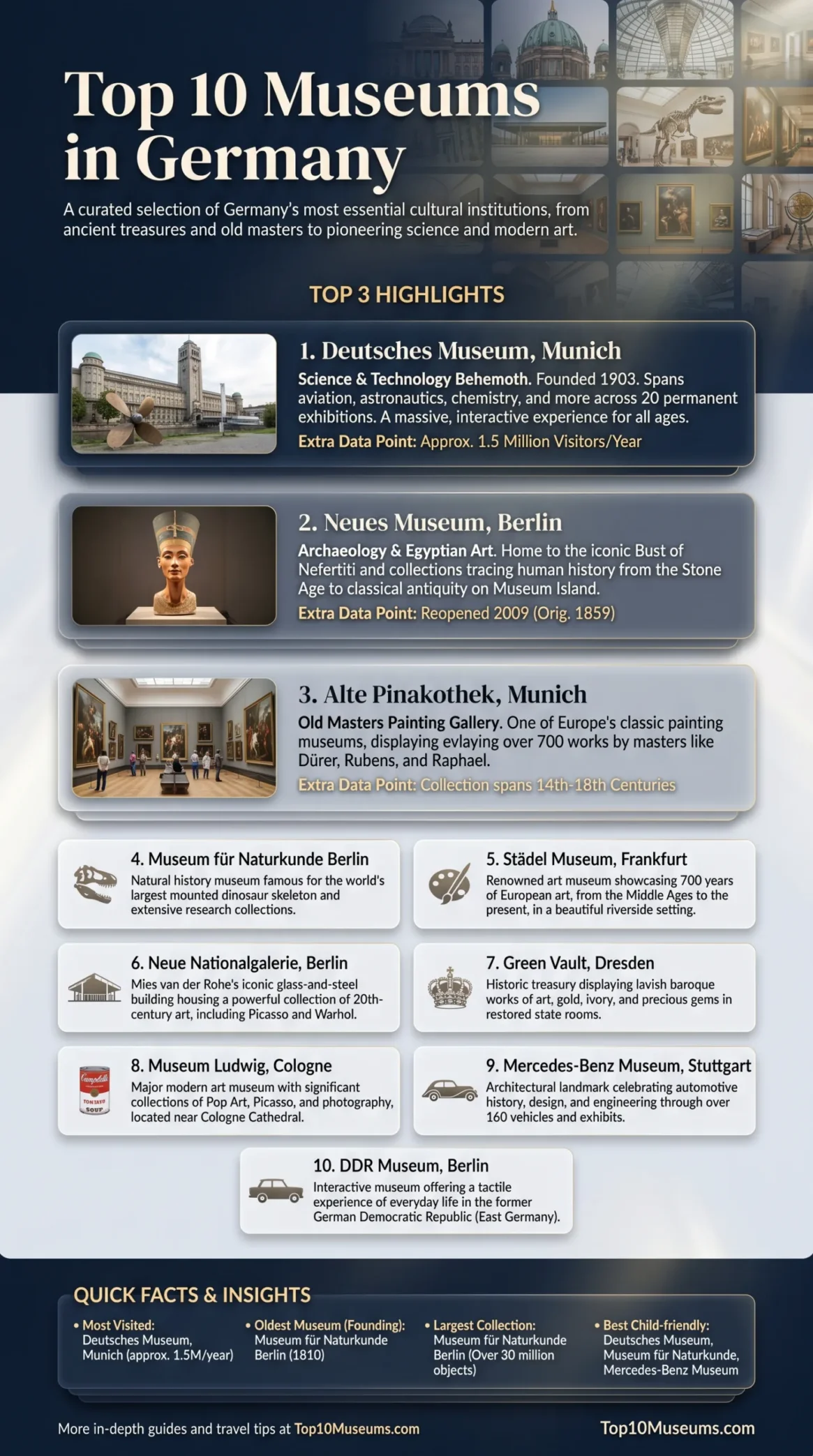
Germany does museums with real range—not just famous paintings, but ancient Egypt, giant dinosaurs, Cold War apartments, jewel rooms, design icons, and hands-on science that keeps kids busy for hours. This list of the top 10 museums in Germany leans toward places that feel worth the train ride, the ticket, and the time: museums with a clear identity, memorable objects, and enough practical appeal to fit a trip that lives outside a spreadsheet.
| Rank | Name | Founded | Collection Type | Website |
|---|---|---|---|---|
| 1 | Deutsches Museum, Munich | 1903 | Science & Technology | Official site ↗ |
| 2 | Neues Museum, Berlin | 1859 | Archaeology & Egyptian Art | Official site ↗ |
| 3 | Alte Pinakothek, Munich | 1836 | Old Masters | Official site ↗ |
| 4 | Museum für Naturkunde Berlin | 1810 | Natural History | Official site ↗ |
| 5 | Städel Museum, Frankfurt | 1815 | European Art Across 700 Years | Official site ↗ |
| 6 | Neue Nationalgalerie, Berlin | 1968 | 20th-Century Art | Official site ↗ |
| 7 | Green Vault, Dresden | 1723 | Treasury & Decorative Arts | Official site ↗ |
| 8 | Museum Ludwig, Cologne | 1976 | Modern & Contemporary Art | Official site ↗ |
| 9 | Mercedes-Benz Museum, Stuttgart | 2006 | Automotive History & Design | Official site ↗ |
| 10 | DDR Museum, Berlin | 2006 | Everyday Life & Cold War History | Official site ↗ |
Why These Ten Museums Earned Their Place
These museums were picked for a mix of collection strength, visitor pull, and how well they work for different kinds of travelers. Germany has superb small museums too, of course, but for a top-10 list, the goal is not to reward obscurity. It is to spotlight places that keep delivering whether the visitor is into old-master painting, archaeology, design, science, or family days with short attention spans.
There is also a practical reason behind the mix. A good national list should not turn into “Berlin and nothing else”. Munich, Frankfurt, Dresden, Cologne, and Stuttgart all bring something different to the table, and that makes the country easier to explore by theme: art-heavy weekends, museum-with-kids trips, or longer rail journeys that do not feel repetitive by day three.
The 10 Museums, Ranked for Art, Science, History, and Family Appeal
1. Deutsches Museum, Munich
The Deutsches Museum is the easiest number-one pick in Germany if the list is meant to work for more than one type of visitor. Founded in 1903, it now draws around 1.5 million visitors a year and spreads its subject matter across a huge range, from aviation and astronautics to chemistry, health, and agriculture. The main Museumsinsel site alone invites visitors into 20 permanent exhibitions across about 20,000 square metres, so this is the kind of place where a person who “doesn’t usually like museums” often ends up staying longer than planned. That breadth matters. It feels active rather than static, and it rewards both quick visits and full-day sessions.
It also works unusually well for mixed groups. Parents can keep the day moving, detail-hunters can settle into one gallery without feeling rushed, and teens usually find at least one zone that grabs them. In a national ranking, that kind of flexibility counts for a lot. There are art museums in Germany with greater intimacy and treasure rooms with more theatrical shock value, but very few places match the Deutsches Museum for sheer repeat-visit value.
Best for: curious families, STEM-loving teens, first-time Munich visitors, and travelers who want one museum that can fill half a day without forcing it.
Nearby alternative: BMW Museum — a sharper, more design-forward stop focused on cars and brand history, easy to pair with the U-Bahn ride to Olympiazentrum.
2. Neues Museum, Berlin
The Neues Museum earns its place because it gives Berlin one of its strongest museum experiences in a single building: ancient Egypt, prehistoric Europe, and one of the most talked-about objects in the country, the Bust of Nefertiti. The museum opened in 1859, and its collections now include about 6,000 exhibits on view that trace cultures from the Stone Age to classical antiquity. That makes it more than a “see Nefertiti and leave” address. You can absolutely visit for the headline piece, but the museum pays off best when you slow down and let the archaeological sequence build.
What many shorter lists miss is how satisfying the museum is as a full historical walk, not just an Egyptian photo-memory. The route through sculpture, funerary art, and prehistoric material gives it rhythm, and Museum Island adds a useful bonus: once you are there, the rest of the day is easy to shape. If Germany’s museum scene had only one place for travelers who like history told through objects rather than panels, this would be near the front of the line.
Best for: ancient-history lovers, Egypt fans, first-time Berlin travelers, and visitors who like landmark objects with a wider historical setting around them.
Nearby alternative: Altes Museum — an easy same-island add-on for Greek and Roman antiquities, just a short walk across Museum Island.
3. Alte Pinakothek, Munich
If the trip calls for old-master painting, the Alte Pinakothek is one of Germany’s safest bets. Opened in 1836, it remains one of Europe’s classic painting museums, and more than 700 paintings are on display at a time. Dürer and Rubens are the names most people reach for first, but the pleasure here is broader than a greatest-hits check. The rooms keep a steady pace, the building still feels dignified without turning stiff, and the hang gives enough space for paintings to breathe. That matters more than people think.
This is also a smart museum for travelers who want depth without overload. The collection is large, yet the visit still feels manageable, and Munich’s Kunstareal makes it easy to add another institution nearby without wasting energy on transport. In a national top 10, the Alte Pinakothek stays here because it is not just respected—it is still a genuinely enjoyable place to look at paintings for a long stretch of time.
Best for: old-master lovers, art-history travelers, couples planning a calm museum morning, and anyone who wants a classic European painting collection without the crush of bigger capitals.
Nearby alternative: Pinakothek der Moderne — a good contrast if you want to jump from Dürer and Rubens to design, modern art, and architecture on the same Munich museum day.
4. Museum für Naturkunde Berlin
The Museum für Naturkunde Berlin is one of those places that works on sight. It goes back to 1810, now cares for over 30 million objects, and still knows how to make a first impression: the Giraffatitan skeleton rises in the dinosaur hall beneath a historic atrium and is recorded by Guinness as the largest mounted dinosaur skeleton in the world. For families, that is the hook. For adults, the better surprise is that the museum does not stop at spectacle. Fossils, minerals, biodiversity, and current research all sit in the same experience, so the visit feels grounded rather than gimmicky.
It also has an unusually good balance between wonder and explanation. Kids can latch onto scale, adults can follow the science, and repeat visitors still have plenty to notice. Berlin has many museums with stronger historical weight, but for a museum that is easy to love on a first visit and still intellectually satisfying, this one belongs high on the list.
Best for: families with kids, dinosaur fans, natural-history travelers, and visitors who want science presented with a bit of theatrical scale.
Nearby alternative: Deutsches Technikmuseum — a strong follow-up for hands-on transport and engineering displays, reachable with a short U-Bahn or S-Bahn hop from central Berlin.
5. Städel Museum, Frankfurt
The Städel has a quieter reputation than some Berlin or Munich giants, but it is one of Germany’s most dependable art museums. Established in 1815, it offers a virtually complete walk through 700 years of art, and the permanent exhibition extends across more than 15,000 square metres. The museum’s drawings and prints department alone oversees about 100,000 works, which tells you something about the depth behind the public galleries. Yet the public-facing side never feels academic for the sake of it. It stays inviting, clear, and beautifully paced.
Frankfurt’s riverside museum setting helps, but the real reason it makes a national top 10 is trust. Visitors can come for one artist, one era, or a general art afternoon and still leave feeling the museum used their time well. That is not automatic. Plenty of good collections do not translate into good visits; the Städel usually does both.
Best for: travelers who want one serious art museum in Frankfurt, painting fans who like a long chronological sweep, and visitors who prefer elegant galleries over theatrical museum staging.
Nearby alternative: Liebieghaus Skulpturensammlung — a fine sculpture stop with a more intimate feel, just a short riverside walk from the Städel.
6. Neue Nationalgalerie, Berlin
The Neue Nationalgalerie is here for two reasons: the art and the building. Open since 1968 in Ludwig Mies van der Rohe’s glass-and-steel landmark, it holds a powerful 20th-century collection with artists such as Francis Bacon, Max Beckmann, Salvador Dalí, Pablo Picasso, and Andy Warhol. It is also no minor local favorite—around 600,000 people visited in 2025, making it Berlin’s most visited art museum that year. That number makes sense once you are inside. The museum feels clear, modern, and visually self-assured without trying too hard.
For visitors who are less interested in long historical surveys and more interested in modern art with room to breathe, this is one of Germany’s best museum hours—often two or three. The sculpture garden helps break up the visit, and the Kulturforum location makes it easy to turn the stop into a wider art day. It is sleek, but not cold.
Best for: modern-art fans, architecture lovers, repeat Berlin visitors, and travelers who would rather see one tight 20th-century collection than five mixed galleries in a row.
Nearby alternative: Gemäldegalerie — ideal if you want to pivot from modern art to European painting, all within the same Kulturforum zone.
7. Green Vault, Dresden
The Green Vault is the museum on this list most likely to produce an actual “wait, what?” reaction. August the Strong created the treasury between 1723 and 1729, and it has been open to the public for almost 300 years. Today, the Historic Green Vault lets visitors move through restored state rooms, while the New Green Vault displays selected objects under glass. This is not a museum you visit for a broad historical survey; it is a place for concentrated visual excess—gold, ivory, amber, rock crystal, carved wonders, and the largest green diamond ever found.
That narrower focus is exactly why it deserves a place. Germany’s museum culture is not only about big narrative institutions. Sometimes it is about a room that feels almost unreal and objects made to stun, charm, or show power. Dresden has other major museums, but the Green Vault is still the stop that feels most unlike anywhere else in the country.
Best for: decorative-arts lovers, jewel-room dreamers, baroque fans, and travelers who want one museum visit that feels lavish, unusual, and very Dresden.
Nearby alternative: Old Masters Picture Gallery — a strong next stop for Raphael, Vermeer, and more, just a short walk through Dresden’s old town to the Zwinger.
8. Museum Ludwig, Cologne
Museum Ludwig gives Cologne a museum with real international pull. The museum was founded in 1976 after Peter and Irene Ludwig donated 350 works of modern art to the city, and the collection has grown into one of Europe’s strongest modern-art holdings. The house is especially known for the most extensive Pop Art collection in Europe, the third-largest Picasso collection in the world, and a photography collection with unusual weight. That is a lot of firepower in one place, and it explains why the museum suits both dedicated art travelers and casual cathedral-area wanderers who decide to duck inside.
What makes it work so well is the mix. You can come in looking for Pop, stay for Expressionism, and leave talking about photography or postwar art instead. The Rhine city setting adds ease, but the museum itself does the heavy lifting. It feels broad without losing its center, which is harder than it sounds.
Best for: modern-art travelers, Picasso and Pop Art fans, Cologne weekend visitors, and people who like museums that move fast from room to room without turning thin.
Nearby alternative: Wallraf-Richartz Museum — a smart pairing if you want older European painting right after modern art, only a short walk from Cologne Cathedral.
9. Mercedes-Benz Museum, Stuttgart
The Mercedes-Benz Museum is proof that a brand museum can still be a first-rate general museum experience. Opened in 2006, it presents more than 160 vehicles and 1,500 exhibits across 16,500 square metres, with the visit organized through seven “Legend” rooms and companion collection galleries. Even people who do not care deeply about cars often connect with it because the story is not just mechanical. It is about design, labor, engineering, racing, travel, and the changing look of everyday life over more than 135 years. That wider frame gives the museum room to breathe.
It is also one of the easiest museums on this list for families and mixed-interest groups. The building keeps you moving, the displays are visually strong, and there is enough social history folded into the car history to keep it from feeling like a specialist stop. Stuttgart has other good museums, but this is the one that most cleanly turns industrial history into a memorable public visit.
Best for: car fans, design-minded travelers, families with older kids, and visitors who like museums where industry, style, and social change all meet.
Nearby alternative: Porsche Museum — another strong automotive stop with a different brand character, reachable by S-Bahn or U-Bahn if you want a full Stuttgart transport day.
10. DDR Museum, Berlin
The DDR Museum rounds out the list because it solves a problem many history museums never quite crack: how to make everyday life feel immediate. Open since 2006, it has welcomed more than 6.5 million visitors and draws on a collection of over 300,000 objects. The permanent exhibition is built around themes such as work, education, shopping, sport, ideology, and Stasi surveillance, and it includes a reconstructed prefabricated apartment plus a Trabi driving simulation. That hands-on approach is the point. You do not only read about East Germany here; you move through fragments of it.
Because of that, the museum works especially well for travelers who want context without the emotional distance that some political museums can create. It is not the last word on the GDR, and it does not try to be. What it does very well is turn a broad historical subject into a visit people remember afterward—sometimes because it was moving, sometimes because it was oddly familiar, and sometimes because it was more tactile than expected.
Best for: Cold War history fans, first-time Berlin visitors, teens who prefer interactive museums, and travelers who want daily life—not just high politics—to anchor the story.
Nearby alternative: Deutsches Historisches Museum — a broader national-history stop that adds longer context, easy to reach on foot from the riverside near Museum Island.
How to Tour These Museums
Best Berlin Museum Day
Start with the Neues Museum in the morning, when ancient collections are easier to enjoy before the island gets busier. After lunch, move to the DDR Museum for something more tactile and faster-paced. End with the Neue Nationalgalerie in the late afternoon, when modern art and the sculpture garden feel like a reset after a dense day of archaeology and history. This route keeps transport simple and gives the day a nice shift in mood.
Best Munich Art-and-Science Day
Do the Alte Pinakothek first if you want your freshest looking energy for painting. Break for lunch, then give the afternoon to the Deutsches Museum, which is easier to sample selectively than many visitors assume. Trying to do the science museum first can be a trap—you may burn hours there and rush the paintings later. For most travelers, art in the morning and science after lunch is the cleaner rhythm.
Best Family Day
If kids are part of the plan, the strongest trio is Museum für Naturkunde Berlin, the DDR Museum, and the Mercedes-Benz Museum. Dinosaurs first, interactive history second, transport and design third is a smart order over two or three separate city days. The common thread is movement: things to look up at, walk through, or test. That keeps museum fatigue from landing too early.
Best Two-Day Route
For a compact art-led trip, pair Munich and Berlin. Day one: Alte Pinakothek plus Deutsches Museum, keeping the afternoon flexible depending on energy. Day two: Neues Museum in the morning and Neue Nationalgalerie later on, with the DDR Museum added only if there is still appetite for one more stop. It is a busy plan, but the subjects change enough that the days do not blur together.
Best Longer Germany Museum Journey
Go city by city rather than chasing rank order: Berlin, then Dresden, Frankfurt, Cologne, Stuttgart, and Munich. That flow keeps rail travel sensible and avoids stacking too many similar art museums back to back. Put the Green Vault between Berlin and Frankfurt for a visual change of pace, and save the Deutsches Museum for late in the trip, when you may want one museum that can absorb a full final day.
[ayaz_safe_content id=”2751″ key=”p2751b1kuundu5q”]
Who Will Love These Museums?
• Old-master lovers — Alte Pinakothek and the Städel Museum are the clearest wins for travelers who want long runs of European painting rather than one-room highlights.
• Ancient-world fans — Neues Museum is the standout for visitors who want Egypt, archaeology, and one headline object that really lives up to its reputation.
• STEM-curious kids and teens — Deutsches Museum and Museum für Naturkunde Berlin give families the best mix of scale, interaction, and “look at that” moments.
• Modern-art travelers — Neue Nationalgalerie and Museum Ludwig are the pair to remember for 20th-century art, Pop, Picasso, photography, and postwar work.
• Travelers who like unusual museum formats — Green Vault and Mercedes-Benz Museum both feel highly staged, but in different ways: one through baroque treasure, the other through architecture and industrial storytelling.
• Cold War and everyday-history readers — DDR Museum is the strongest stop for visitors who want domestic life, state systems, and lived texture rather than only official chronology.
• First-time Germany visitors — If the goal is one short list that covers art, science, history, and family appeal without feeling repetitive, these ten are a very workable place to start.