
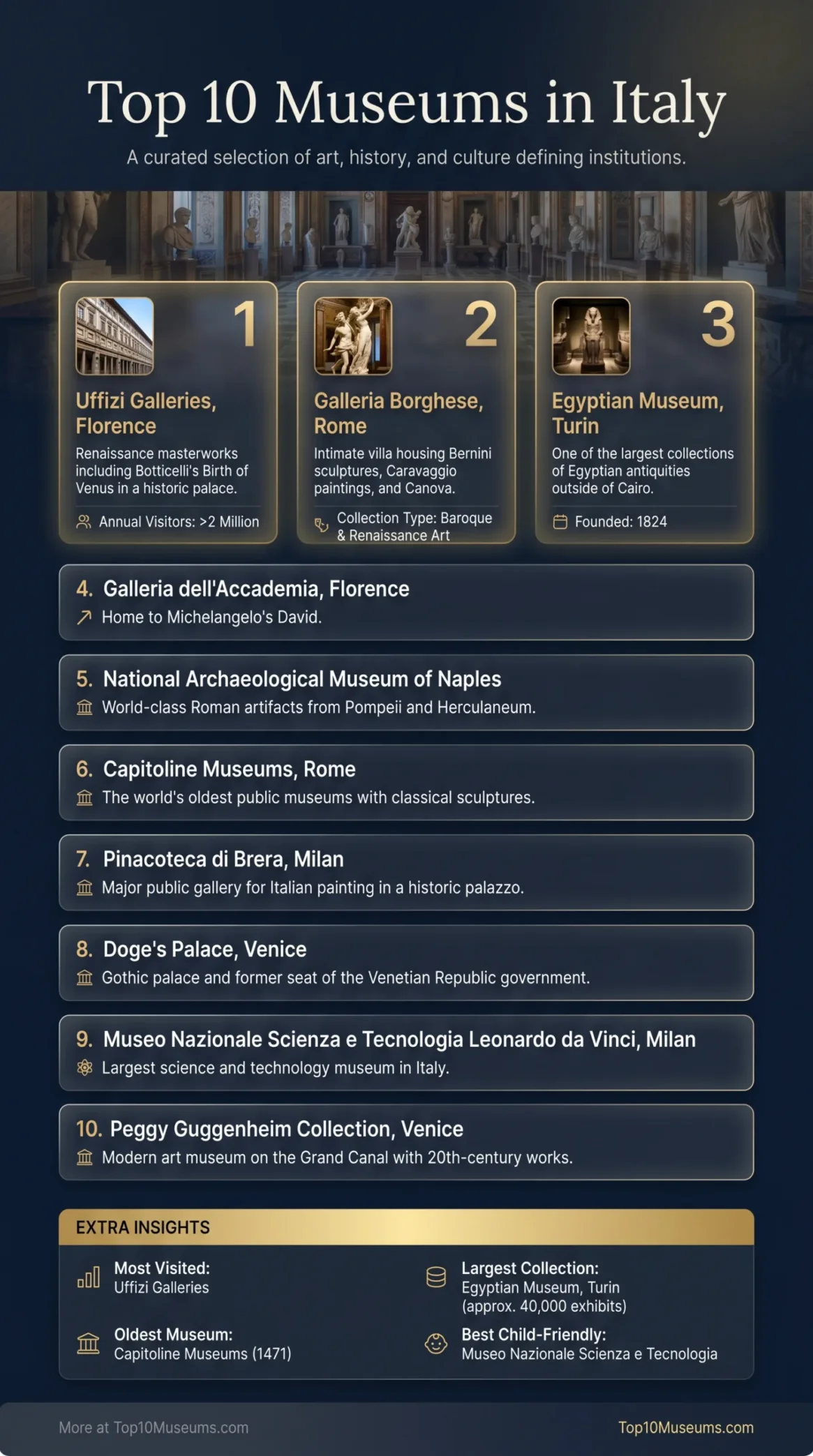
Italy is packed with museums, but a few are strong enough to shape an entire trip around them. This list of the Top 10 Museums in Italy Worth Planning a Trip Around focuses on places with rare collections, famous works, practical visitor value, and enough variety for art lovers, history fans, families, and travelers who want their itinerary to feel planned, not random.
| Rank | Name | Founded | Collection Type | Website |
|---|---|---|---|---|
| 1 | Vatican Museums | 1506 origins | Papal art, archaeology, Sistine Chapel, Raphael Rooms | Official site |
| 2 | Uffizi Galleries | 1769 | Italian Renaissance painting and European old masters | Official site |
| 3 | Museo Egizio | 1824 | Ancient Egyptian archaeology, art, and daily-life objects | Official site |
| 4 | National Archaeological Museum of Naples | 1816 | Greek, Roman, Pompeii, Herculaneum, Farnese Collection | Official site |
| 5 | Galleria Borghese | 1903 | Baroque sculpture, Renaissance painting, ancient sculpture | Official site |
| 6 | Galleria dell’Accademia di Firenze | 1784 | Michelangelo sculpture, Florentine painting, musical instruments | Official site |
| 7 | Pinacoteca di Brera | 1809 | Italian painting from the 13th to 20th centuries | Official site |
| 8 | Peggy Guggenheim Collection | 1980 | Modern art, Surrealism, Cubism, Abstract Expressionism | Official site |
| 9 | Capitoline Museums | 1471 roots / 1734 public opening | Roman archaeology, civic history, ancient sculpture | Official site |
| 10 | National Museum of Cinema | 1958 / current Mole display 2000 | Cinema history, optical devices, film technology, posters | Official site |
Why These Ten Make the Trip Worth It
This list is not built around fame alone. A museum earns a place here when it gives visitors a clear reason to travel: a one-of-a-kind collection, a famous work that still feels worth seeing in person, or a setting that adds meaning to the visit. The result is a route that moves from Renaissance Florence to papal Rome, Egyptian Turin, archaeological Naples, modern Venice, and cinema-focused Turin without feeling like a checklist.
The ranking also favors museums that work for different travel styles. Some are best for slow looking, some are ideal for families, and a few can carry an entire morning by themselves. Italy rewards patience, so these picks are better treated as anchors for a trip rather than quick stops between train rides.
Top 10 Museums in Italy Worth Planning a Trip Around
1. Vatican Museums, Rome
The Vatican Museums are more than a stop before the Sistine Chapel. Their roots are often traced to 1506, when Pope Julius II acquired the ancient sculpture group known as the Laocoön, and the museums now bring together papal art, classical sculpture, maps, tapestries, Egyptian objects, Etruscan pieces, and some of the most studied rooms in European art. The Sistine Chapel and Raphael Rooms are the famous draws, but the Gallery of Maps is often the section that makes first-time visitors slow down and say, wait, this is also part of the visit?
This museum is best treated as a half-day plan, especially if it is your first Rome visit. Crowds can be heavy, and trying to “do everything” usually turns the experience into a blur. A smarter route is to pick a few must-see areas: Sistine Chapel, Raphael Rooms, Pio-Clementino sculpture, and one quieter gallery that matches your interest.
Best for: First-time Rome visitors, Renaissance art lovers, Catholic history travelers, map fans, and anyone who wants one museum visit with several layers of art and archaeology.
Nearby alternative: Castel Sant’Angelo National Museum — a strong follow-up for visitors who want papal history, fortress architecture, and an easy walk from the Vatican area.
2. Uffizi Galleries, Florence
The Uffizi is the museum many travelers picture when they think of Italian Renaissance art. Opened to the public as a museum in 1769, it holds works by Botticelli, Leonardo, Raphael, Michelangelo, Titian, Caravaggio, and other artists whose names can make a room feel crowded even before visitors arrive. Botticelli’s Birth of Venus and Primavera are the headline works, but the real value is the way the galleries let visitors see Italian painting change across centuries.
The Uffizi works best when it is not squeezed between too many other Florence sights. Give it a full morning if possible, then cross toward the Arno for a slower afternoon. For travelers planning an art-first Italy route, this is one of the places where advance booking and a calm pace make a clear difference.
Best for: Renaissance beginners, Botticelli fans, old-master painting lovers, first-time Florence visitors, and travelers who want a museum that explains why Florence matters so much in art history.
Nearby alternative: Palazzo Pitti — a natural next stop across the Arno, especially for visitors who want palace rooms, the Palatine Gallery, fashion history, and a grander Medici setting.
3. Museo Egizio, Turin
Museo Egizio is one of Italy’s strongest reasons to go to Turin. Founded in 1824, it is dedicated to ancient Egyptian culture and is known for a vast collection that includes statues, coffins, papyri, daily-life objects, and archaeological material from several thousand years of history. For travelers who usually think of Italy as Roman ruins and Renaissance painting, this museum offers a different kind of Italy trip.
The museum is especially good for visitors who like objects with clear human detail: tools, writing, tomb goods, clothing fragments, and carefully displayed funerary material. It is also easier to manage than some of Italy’s busiest art museums, which makes it a good pick for families and older travelers who want depth without feeling rushed. Turin’s central layout helps, too — the museum sits close to cafés, squares, and other culture stops.
Best for: Egyptology fans, families with curious kids, archaeology travelers, school-age visitors, and anyone building a northern Italy route beyond Milan and Venice.
Nearby alternative: Palazzo Madama — a nearby choice for visitors who want decorative arts, medieval rooms, and a historic building right in the center of Turin.
4. National Archaeological Museum of Naples
The National Archaeological Museum of Naples, often called MANN, is one of the best museum matches for a trip to Pompeii or Herculaneum. Its official opening as the Real Museo Borbonico came in 1816, and the collection includes Roman sculpture, Greek objects, mosaics, frescoes, and material connected to the Vesuvian cities. The Farnese Hercules, the Farnese Bull, and the Pompeii mosaics make the museum feel closely tied to the ancient sites around Naples.
This is the museum that turns Pompeii from a ruined city into a fuller story. Many objects found in the area were moved to Naples, so visiting the archaeological sites without seeing MANN can leave part of the picture missing. It is a smart choice for travelers who enjoy evidence, context, and real objects more than polished display alone.
Best for: Pompeii visitors, Roman history fans, archaeology lovers, classical sculpture fans, and travelers who want Naples to be more than a food stop.
Nearby alternative: Museo e Real Bosco di Capodimonte — a strong Naples follow-up for painting, palace rooms, parkland, and a broader view of the city’s art history.
5. Galleria Borghese, Rome
Galleria Borghese is smaller than the Vatican Museums, but that is part of its appeal. The museum displays ancient sculpture, bas-reliefs, mosaics, and paintings and sculptures from the 15th through the 19th centuries, with a collection tied to the Borghese family and its villa setting. Bernini’s Apollo and Daphne, Canova’s Pauline Bonaparte as Venus Victrix, and paintings by Caravaggio make this one of Rome’s most rewarding focused visits.
The visit is usually structured by timed entry, and official visitor slots are limited, so this is not a museum to leave to chance. Its two-hour rhythm can actually help: you get a clear start and end, then step back into Villa Borghese for air and a slower walk. For many visitors, it feels like Rome without museum fatigue.
Best for: Bernini fans, Caravaggio fans, couples, short-stay Rome travelers, and visitors who prefer a focused museum with high-value rooms.
Nearby alternative: National Gallery of Modern and Contemporary Art — a nearby option across Villa Borghese for visitors who want 19th- and 20th-century Italian art after Baroque sculpture.
6. Galleria dell’Accademia di Firenze, Florence
The Galleria dell’Accademia is famous for one reason above all: Michelangelo’s David. The gallery dates back to 1784, and the original David was moved there from Piazza della Signoria in 1873, with a special tribune later created to house it. Even if the museum is smaller than the Uffizi, the experience of walking toward David is one of Florence’s clearest art moments.
There is more here than the statue, though. The museum also holds unfinished Michelangelo sculptures often called the Prisoners, Florentine paintings, and a musical instruments collection connected to historic craftsmanship. It works best as a shorter visit, especially when paired with the Uffizi on a two-day Florence plan rather than the same packed morning.
Best for: Michelangelo fans, first-time Florence visitors, sculpture lovers, art students, and travelers who want one unforgettable artwork as the center of a visit.
Nearby alternative: Museo di San Marco — a calm nearby choice for Fra Angelico frescoes, monastic rooms, and a quieter side of Florence’s art scene.
7. Pinacoteca di Brera, Milan
Pinacoteca di Brera is Milan’s strongest art museum for visitors who want Italian painting without the same crowd pressure found in Florence or Rome. Opened to the public in 1809, it is closely linked with the Brera Academy and holds works from the 13th to the 20th centuries. Standout pieces include Mantegna’s Lamentation over the Dead Christ, Raphael’s Marriage of the Virgin, and Caravaggio’s Supper at Emmaus.
Brera is especially useful for travelers who are flying into or out of Milan and want a museum that justifies extra time in the city. The surrounding district is walkable, with cafés, galleries, bookshops, and quiet courtyards nearby. It is a good example of how Milan can be more than design, shopping, and the Duomo.
Best for: Milan weekend travelers, Renaissance painting fans, slower museum visitors, students of Italian art, and travelers who want a less crowded old-master experience.
Nearby alternative: Museo Poldi Pezzoli — a refined house museum near central Milan, good for decorative arts, paintings, armor, and a shorter visit.
8. Peggy Guggenheim Collection, Venice
The Peggy Guggenheim Collection gives Venice a sharp modern-art counterpoint to churches, palaces, and old-master museums. Housed in Palazzo Venier dei Leoni on the Grand Canal, the collection opened under the Guggenheim Foundation in 1980 after Peggy Guggenheim’s death. Its rooms include works connected with Cubism, Surrealism, Abstract Expressionism, and modern sculpture, with artists such as Picasso, Pollock, Calder, Kandinsky, and Magritte represented.
This museum is compact, but it carries a lot of personality. It feels less like a giant institution and more like a collector’s eye turned into a public experience. For many travelers, it is the right Venice museum when they need a break from gold mosaics and church altarpieces without leaving the Grand Canal behind.
Best for: Modern art fans, Venice repeat visitors, design-minded travelers, couples, and visitors who want a smaller museum with a strong personal story.
Nearby alternative: Gallerie dell’Accademia — a nearby Dorsoduro option for Venetian painting, especially if you want Titian, Bellini, Veronese, and Tintoretto in one area.
9. Capitoline Museums, Rome
The Capitoline Museums have one of the strongest civic stories of any museum in Italy. Their roots go back to 1471, when Pope Sixtus IV donated bronze sculptures to the people of Rome, and the museums later opened to the public in the 18th century. The collection includes the Capitoline Wolf, the equestrian statue of Marcus Aurelius, ancient portraits, Roman sculpture, inscriptions, and views over the Roman Forum.
This is a smart museum for visitors who want ancient Rome without spending the whole day outdoors. The setting on the Campidoglio adds a lot, because the museum connects civic power, archaeology, sculpture, and city views in one place. It also pairs well with the Roman Forum, but it is better after lunch or in cooler hours when outdoor ruins feel harder to manage.
Best for: Ancient Rome fans, civic history readers, sculpture lovers, Forum visitors, and travelers who want a Rome museum with strong city context.
Nearby alternative: Trajan’s Markets Museum of the Imperial Fora — a nearby choice for visitors who want ruins, Roman urban planning, and a strong link to the Imperial Forums.
10. National Museum of Cinema, Turin
The National Museum of Cinema is the most playful museum on this list, and that is not a weakness. Founded in 1958 and now housed inside the Mole Antonelliana, it covers film history through optical devices, posters, set material, technology, and cinema culture. The building itself adds to the visit, since the Mole is one of Turin’s best-known landmarks and gives the museum a setting that feels made for spectacle.
This is a good museum for travelers who want a break from painting-heavy itineraries. It works especially well with teens, film fans, and families because the subject is easier to enter without prior knowledge. Turin also lets visitors pair it with Museo Egizio, turning the city into a surprisingly strong two-museum stop.
Best for: Film fans, families with teens, media students, architecture lovers, and travelers who want a museum that feels different from Italy’s classic art route.
Nearby alternative: MAO Museo d’Arte Orientale — a central Turin alternative for Asian art collections and a quieter cultural stop after the Mole Antonelliana.
How to Tour These Museums
Best Rome Museum Day
Start early with the Vatican Museums, because the visit is long and crowd levels can shape the whole day. Keep lunch simple near Prati or across the river, then save the Capitoline Museums for the afternoon when the Forum area is easier to understand from above. Put Galleria Borghese on a separate morning if possible, because its timed format deserves a fresh start.
Best Florence Classic Art Plan
Use the Uffizi as your main morning museum and keep the rest of that day light. Visit Galleria dell’Accademia on a separate morning or late afternoon, especially if seeing David is a top priority. Add Palazzo Pitti or San Marco only if you have a second full day, because Florence rewards short walks and slower rooms.
Best Northern Italy Museum Route
For a northern route, start in Milan with Pinacoteca di Brera, then take the train to Turin for Museo Egizio and the National Museum of Cinema. This works well as a two- or three-day plan because Turin has two very different museum anchors close to the center. Continue to Venice for the Peggy Guggenheim Collection if you want modern art after classic painting and archaeology.
Best Family-Friendly Route
Families may do better with Museo Egizio, the National Museum of Cinema, and the National Archaeological Museum of Naples than with back-to-back old-master galleries. These museums offer objects, stories, technology, and archaeology that are easier for kids and teens to connect with. Keep visits to two or three hours, then build in food, parks, or train time so the trip does not become one long museum march.
Best Seven-Day Museum-Focused Italy Trip
A balanced seven-day version could begin in Milan, continue to Turin, move to Venice, then head to Florence, Rome, and Naples. That route covers Brera, Museo Egizio, the National Museum of Cinema, Peggy Guggenheim, Uffizi, Accademia, the Vatican Museums, Galleria Borghese, Capitoline Museums, and MANN without forcing every museum into the same city rhythm. It is still busy, so pick one primary museum per day and treat any second stop as a bonus.
[ayaz_safe_content id=”2749″ key=”p2749b1hngk3eyy”]
Who Will Love These Museums?
• Old-master lovers: Uffizi Galleries, Pinacoteca di Brera, Galleria Borghese, and the Vatican Museums give the strongest painting-focused route.
• Ancient history fans: MANN, Capitoline Museums, Vatican Museums, and Museo Egizio are the best match for archaeology, Roman material, and ancient objects.
• Families with school-age kids: Museo Egizio and the National Museum of Cinema are the easiest picks, with MANN also working well for kids who are curious about Pompeii.
• First-time Italy travelers: Vatican Museums, Uffizi, Accademia, and Galleria Borghese offer the most recognizable works and the clearest “I finally saw it” moments.
• Modern art visitors: Peggy Guggenheim Collection is the best fit, especially for travelers who want Picasso, Pollock, Calder, and Surrealism in a Grand Canal setting.
• Train-route planners: Milan, Turin, Venice, Florence, Rome, and Naples can be linked into one museum-led route, with each city offering at least one trip-worthy anchor.