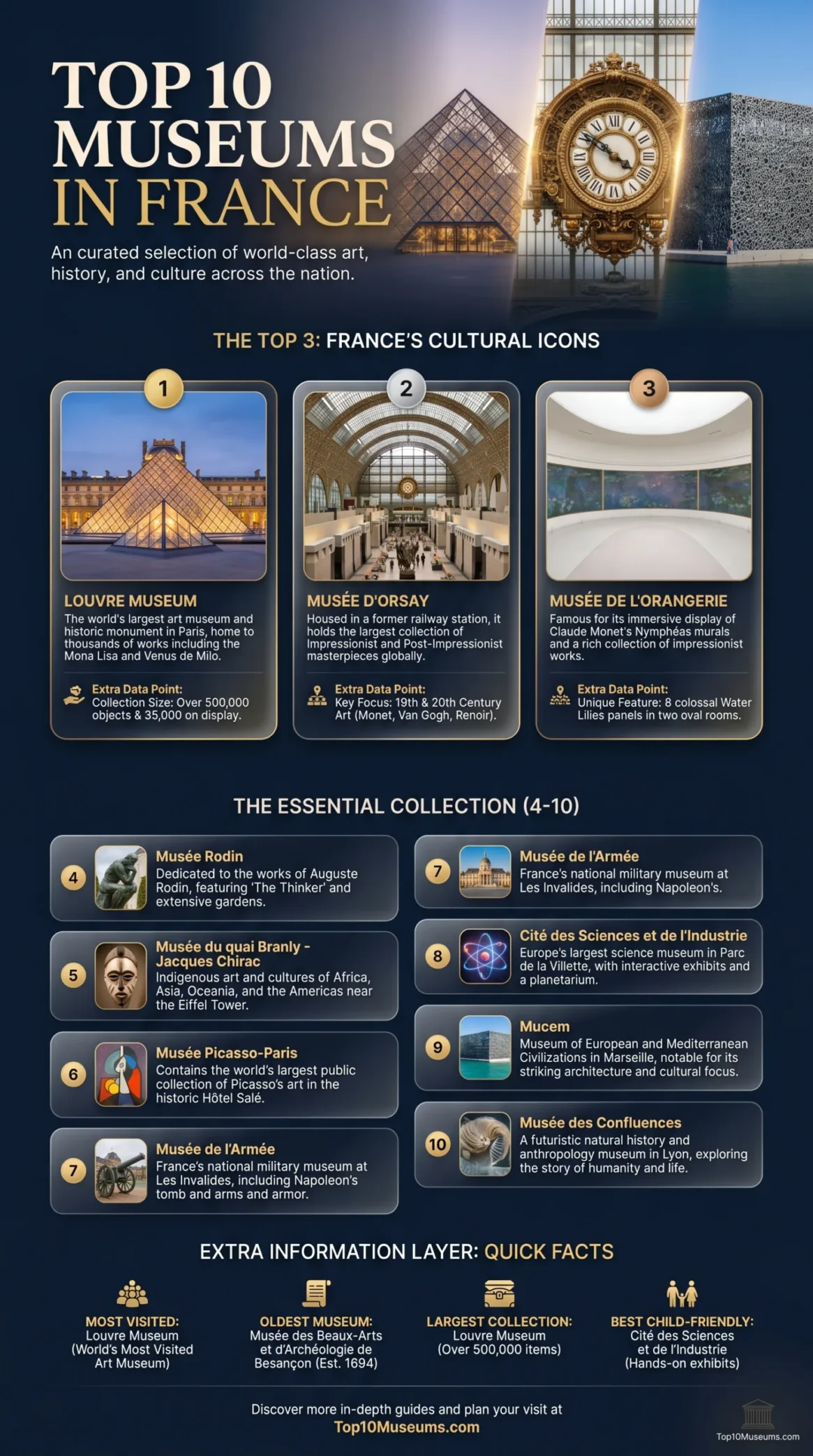
France does not do museums quietly. The Top 10 Museums in France cover everything from royal collections and Impressionist painting to anthropology, war history, children’s science spaces, and Mediterranean culture. This list leans toward places that are worth planning a real day around—not just famous names on paper, but museums that still deliver when you walk through the door with limited time, tired feet, or kids in tow.
| Rank | Name | Founded | Collection Type | Website |
|---|---|---|---|---|
| 1 | Louvre Museum | 1793 | World art, antiquities, painting, sculpture, decorative arts | Official website ↗ |
| 2 | Musée d’Orsay | 1986 | 19th-century art, Impressionism, Post-Impressionism | Official website ↗ |
| 3 | Musée de l’Orangerie | 1927 | Monet’s Water Lilies, Impressionist and early modern art | Official website ↗ |
| 4 | Musée Rodin | 1919 | Sculpture, drawings, archives, garden displays | Official website ↗ |
| 5 | Musée du quai Branly – Jacques Chirac | 2006 | Arts and civilizations of Africa, Asia, Oceania, and the Americas | Official website ↗ |
| 6 | Musée Picasso-Paris | 1985 | Picasso works, archives, modern art | Official website ↗ |
| 7 | Musée de l’Armée | 1905 | Military history, arms, armor, Napoleon, war art | Official website ↗ |
| 8 | Cité des Sciences et de l’Industrie | 1986 | Science, technology, family discovery, interactive exhibits | Official website ↗ |
| 9 | Mucem | 2013 | Mediterranean civilizations, society, design, history | Official website ↗ |
| 10 | Musée des Confluences | 2014 | Natural history, anthropology, science, world cultures | Official website ↗ |
Why These Ten Stand Out for a France Trip
There are hundreds of museums in France, so a top-ten list has to do more than repeat the usual names. These picks balance sheer collection quality, practical visitor appeal, family range, and the feeling that you walked away having really seen something—not just queued for it. A museum can be historic, huge, and still be a poor fit for a short stay; this ranking tried to avoid that trap.
Another filter mattered too: current visitability. Museums in long shutdowns or with heavily reduced access were left aside, while places that are open, usable, and still strong in 2026 moved up. That makes this list more useful for first-time visitors, weekend planners, and families who need a route that works in the real world.
The 10 Best Museums in France
1. Louvre Museum
The Louvre is the obvious heavyweight, but it earns the top spot on more than fame alone. Its collections database now lists well over 500,000 records, and the museum still manages to offer genuine variety inside one palace-sized stop: Egyptian antiquities, Greek sculpture, Near Eastern material, French decorative arts, and star works such as the Mona Lisa and the Venus de Milo. That breadth matters when a mixed group cannot agree on one period or style.
It is also the museum in France most likely to reward a targeted visit. Instead of trying to “do the Louvre,” pick two departments and one headline work, then leave before fatigue wins. For first-time visitors, that approach feels far better than rushing through endless galleries with a phone at 4%.
Best for: first-time visitors, bucket-list art lovers, mixed-interest groups, travelers who want one museum to cover many eras
Nearby alternative: Musée des Arts Décoratifs — a smart swap if you want fashion, furniture, and design in a quieter setting right beside the Louvre complex.
2. Musée d’Orsay
If the Louvre is broad, Musée d’Orsay is beautifully focused. It is the museum most people end up loving more than they expected, partly because the old railway-station setting keeps the visit readable, and partly because it holds the world’s largest collection of Impressionist works. Van Gogh, Monet, Manet, Degas, Caillebotte, and Renoir are not scattered here and there—they are the main event.
The sweet spot at Orsay is how much art history you can absorb in a few hours. Even small details stay with you: Van Gogh’s dedicated display rooms, that vast station clock, the shift from Realism to Symbolism, the river views from the upper level. For many travelers, this is the most satisfying single art museum visit in France.
Best for: Impressionist fans, couples, first-time Paris visitors, travelers who want a high-payoff museum without Louvre-scale overload
Nearby alternative: Musée de l’Orangerie — an easy add-on across the river and through the Tuileries if you want a shorter Monet-centered visit after Orsay.
3. Musée de l’Orangerie
Musée de l’Orangerie is smaller, calmer, and unusually memorable. Its calling card is Claude Monet’s eight great Water Lilies compositions, arranged across two elliptical rooms designed for immersion rather than quick viewing. That layout changes the pace of the visit; instead of darting from label to label, you settle down and let the paintings work on you.
The lower galleries add another reason to come: the Jean Walter and Paul Guillaume collection brings in Renoir, Cézanne, Matisse, Picasso, and Modigliani. Short on time? This is one of the best museum choices in France because it feels complete in under two hours, with a much lighter energy than the city’s giant institutions.
Best for: Monet lovers, slow-looking visitors, older travelers, anyone wanting a compact museum day in central Paris
Nearby alternative: Jeu de Paume — a good nearby change of pace on the edge of the Tuileries if photography and image-based shows sound more appealing that day.
4. Musée Rodin
Musée Rodin wins people over with atmosphere as much as sculpture. The museum’s seven-acre garden gives works like The Thinker and The Gates of Hell breathing room, which changes how you see them. Rodin’s art can feel dense indoors; here it gets air, weather, shadows, and a more human scale.
The museum was created in 1919, and its collections stretch beyond the famous bronzes into drawings, photographs, letters, and works linked to Camille Claudel. That makes the visit feel less like a greatest-hits stop and more like a peek into a sculptor’s working mind. For many visitors, it is the easiest “serious art” museum in Paris to enjoy on a sunny day.
Best for: sculpture fans, garden lovers, couples, visitors who prefer open-air museum time over dense galleries
Nearby alternative: Musée de l’Armée — a practical switch near Invalides if your group would rather see Napoleon, armor, and war history than sculpture.
5. Musée du quai Branly – Jacques Chirac
This is one of the most distinctive museums in France because it breaks up the usual Paris art circuit. The museum conserves almost 370,000 works from Africa, Asia, Oceania, and the Americas, and the permanent route presents about 3,500 pieces in a dark, carefully staged setting that feels very different from white-wall European galleries.
It is not the museum to choose if you want a fast checklist visit. It works better when you give yourself time for masks, textiles, carved objects, musical instruments, and the questions they raise about collecting, display, and cultural exchange. Its family tools and children’s materials also make it more approachable than many people assume. If you want your France museum list to go beyond Europe looking at Europe, this is the place.
Best for: travelers curious about world cultures, repeat Paris visitors, design lovers, older kids who enjoy objects with strong visual presence
Nearby alternative: Musée de l’Homme — a strong anthropology-focused option across the Seine if you want human history and science folded into the visit.
6. Musée Picasso-Paris
Picasso museums can feel uneven, but the Paris one is on another level because it holds more than 5,000 works plus around 200,000 archival items. That scale means you are not just seeing a handful of Blue Period pictures and moving on; you are seeing paintings, sculptures, ceramics, prints, notebooks, and the artist’s process laid bare.
The museum sits in the Hôtel Salé in the Marais, which gives the visit a lived-in Paris feel rather than a giant-monument feel. It is especially good for travelers who want to understand how Picasso kept changing—style after style, decade after decade—without spending a full day doing it. That mix of depth and manageable size is why it ranks so high.
Best for: modern-art fans, repeat Paris visitors, Marais walkers, travelers interested in one artist seen from many angles
Nearby alternative: Musée Carnavalet — a very good nearby pivot if the mood shifts toward the story of Paris itself rather than one artist’s career.
7. Musée de l’Armée
At Les Invalides, the Musée de l’Armée holds almost 500,000 items, from armor and uniforms to paintings, maps, and objects tied to Napoleon and the world wars. It is one of those museums that quietly surprises people: even visitors who do not think of themselves as “military museum people” often end up absorbed by the scale of the collections and the setting beneath the gold dome.
This is also one of the clearest history museums in France for non-specialists. You can visit for Napoleon’s tomb alone, for medieval arms alone, or for a broader walk through French conflict and state-building. Families with older children often find it easier to follow than more abstract art museums.
Best for: history lovers, Napoleon fans, older kids and teens, travelers who want a strong non-art museum in central Paris
Nearby alternative: Musée Rodin — close enough to pair on foot if half your group wants sculpture, gardens, and a softer pace after the Invalides complex.
8. Cité des Sciences et de l’Industrie
This is the family ace in the deck. Cité des Sciences is France’s big science museum, and its child-focused spaces, hands-on exhibits, and rotating shows make it a very real contender for anyone traveling with curious kids or STEM-minded teens. The Cité des enfants 5–10 now runs in 90-minute sessions, which is handy when you need structure rather than museum drift.
Adults do not need to treat it as a “kids only” stop either. Planetarium sessions, technology exhibits, themed temporary shows, and the scale of the building mean there is enough here for half a day. It may not have the romance of an old palace museum, but it absolutely earns its place on a modern France list because it works brilliantly for families.
Best for: families with children, STEM-curious teens, rainy-day planners, travelers who want something interactive rather than purely visual
Nearby alternative: Musée de la Musique — a clever nearby option in Parc de la Villette if you want instruments, sound, and a more object-based cultural stop.
9. Mucem
Marseille’s Mucem earns its place because it brings something no Paris museum does quite the same way. Its holdings include more than 350,000 objects and a documentary body that pushes the total to around one million works, documents, and objects. More importantly, the museum’s focus on Mediterranean societies gives the visit a strong point of view rather than a random mix.
The building itself helps. Between the sea light, the footbridge to Fort Saint-Jean, and the city-edge setting, Mucem feels tied to Marseille in a way many “good museums” never quite feel tied to their city. For travelers heading south, this is one of the best museum stops in France outside Paris.
Best for: Marseille visitors, architecture fans, social-history readers, travelers who want a museum with a strong sense of place
Nearby alternative: La Vieille Charité — a rewarding central Marseille option if you want a smaller museum stop in a historic complex with an easier pace.
10. Musée des Confluences
Lyon’s Musée des Confluences closes the list because it is one of France’s smartest cross-disciplinary museums. Its collections hold 3.5 million objects and specimens spanning natural history, anthropology, science, and technology. That range lets the museum build exhibitions around big human questions rather than one narrow school or period.
It is also visually striking without feeling cold. Families, adults, and older children can all find an entry point, whether that is fossils, world cultures, biodiversity, or the museum’s architecture at the meeting of the Rhône and Saône. If you want one museum in Lyon that feels fresh, broad, and genuinely memorable, this is the one.
Best for: curious generalists, families with older kids, science-and-culture travelers, Lyon visitors who want one standout museum
Nearby alternative: Lugdunum Museum and Roman Theatres — an excellent switch if your Lyon day is leaning more toward Roman history and archaeological remains.
How to Tour These Museums
Best Classic Art Day
Start with Musée d’Orsay in the morning, when the galleries are easier to enjoy before the middle-of-day rush. Walk through the Tuileries to Musée de l’Orangerie after lunch; it is shorter, calmer, and perfect for a slower second stop. If energy is still good, end with a late-afternoon exterior walk around the Louvre area rather than forcing a third full museum indoors.
Best Family Day
Give the morning to Cité des Sciences et de l’Industrie, especially if children are booked into a timed session at Cité des enfants. Keep lunch simple in or around La Villette, then leave the afternoon flexible: either stay for more science content or switch to Musée de l’Armée if older kids want planes, weapons, uniforms, and Napoleon. This route spreads out attention better than trying to drag children through giant painting museums all day.
Best Two-Day Paris Route
Day one: do Louvre Museum first thing, keep it selective, and save your feet for an easy evening. Day two: pair Musée Rodin and Musée de l’Armée in the Invalides area, or pair Musée d’Orsay with Musée de l’Orangerie if art is the priority. For a third Paris day, slot in Musée Picasso-Paris or quai Branly depending on whether your group wants modern art or global cultures.
Best France Beyond Paris Route
If the trip includes the south or east of the country, build one museum stop around Mucem in Marseille and another around Musée des Confluences in Lyon. They work well because they are different in subject, setting, and mood, so museum fatigue stays lower. One sea-facing museum day and one river-city museum day makes for a much better rhythm than stacking similar art museums back to back.
.leaflet-control-attribution { font-size: 9px !important; opacity: 0.4 !important; } .leaflet-control-attribution a { color: #999 !important; } .museum-directions-btn { display: inline-block; margin-top: 8px; padding: 5px 10px; background: #d35400; color: #fff !important; font-size: 12px; font-weight: 600; border-radius: 4px; text-decoration: none !important; } .museum-directions-btn:hover { background: #b94600; }Who Will Love These Museums?
- Old-master lovers: the Louvre Museum is still the first stop for big-name paintings, sculpture, and royal-scale collections.
- Impressionist fans: Musée d’Orsay and Musée de l’Orangerie make the strongest one-two punch in France for Monet, Renoir, Degas, and Van Gogh.
- Sculpture-first visitors: Musée Rodin is ideal for travelers who want famous works without the pressure-cooker pace of larger museums.
- World-culture explorers: Musée du quai Branly – Jacques Chirac offers a broader lens on art, ritual, and material culture beyond Europe.
- Modern-art followers: Musée Picasso-Paris suits visitors who enjoy seeing one artist across many media and many phases.
- Napoleon and military-history readers: Musée de l’Armée gives them a clear, object-rich visit in one of Paris’s most recognizable historic complexes.
- Families with young kids: Cité des Sciences et de l’Industrie is the easiest crowd-pleaser when a trip needs hands-on discovery rather than quiet looking.
- Architecture fans: Mucem and Musée des Confluences both deliver museum buildings that feel like part of the collection.
- Travelers going beyond Paris: Mucem in Marseille and Musée des Confluences in Lyon keep the list from becoming a Paris-only answer.
- Visitors who tire fast in giant museums: Musée de l’Orangerie, Musée Rodin, and Musée Picasso-Paris are strong picks because they feel rewarding without eating the whole day.
