
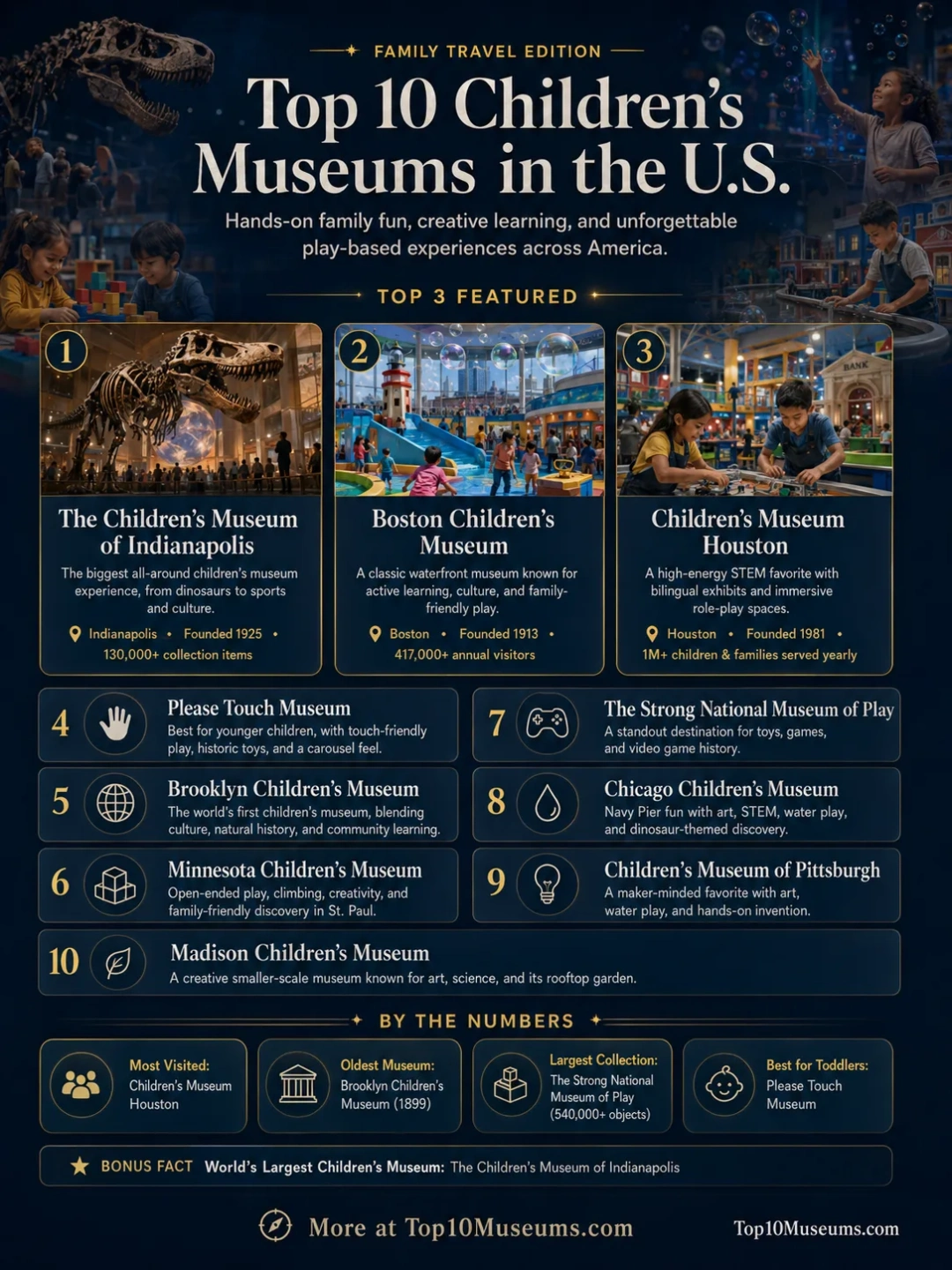
Children’s museums work best when kids are not asked to stand still, whisper, or admire things from a polite distance. The best ones turn science, art, culture, water play, building, pretend cities, toys, and local history into something children can touch, test, climb, splash, sort, invent, and sometimes happily repeat five times in a row. This Top 10 Children’s Museums list focuses on major U.S. museums with strong hands-on exhibits, family-friendly layouts, proven visitor appeal, and enough variety to keep toddlers, school-age kids, and grown-ups engaged without forcing everyone through the same kind of experience.
[ayaz_safe_content id=”2787″ key=”p2787b1sk0zonqo”]
| Rank | Name | Founded | Collection Type | Website |
|---|---|---|---|---|
| 1 | The Children’s Museum of Indianapolis | 1925 | Natural science, culture, history, toys, sports, dinosaurs | Official website |
| 2 | Boston Children’s Museum | 1913 | Hands-on play, Japanese house, art, science, culture | Official website |
| 3 | Children’s Museum Houston | 1981 | STEM, bilingual exhibits, pretend city, maker learning | Official website |
| 4 | Please Touch Museum | 1976 | Early childhood play, historic toys, carousel, creative learning | Official website |
| 5 | Brooklyn Children’s Museum | 1899 | Natural history, culture, art, music, performance | Official website |
| 6 | Minnesota Children’s Museum | 1981 | Open-ended play, toddler exhibits, maker art, role play | Official website |
| 7 | The Strong National Museum of Play | 1968 | Toys, games, video games, dolls, play history | Official website |
| 8 | Chicago Children’s Museum | 1982 | Art, STEM, water play, dinosaur dig, city play | Official website |
| 9 | Children’s Museum of Pittsburgh | 1983 | Maker learning, art, water play, kindness, technology | Official website |
| 10 | Madison Children’s Museum | 1980 | Art, science, culture, civic play, rooftop garden | Official website |
Why These Ten Made the List
These museums were chosen because they are not just rooms full of kid-sized props. They combine hands-on learning with real collections, original exhibits, careful age design, and enough room for children to move without every visit feeling like a rushed school worksheet. Several are collecting museums with tens of thousands of objects; others stand out because their exhibits are built around making, pretending, testing, climbing, and social play.
The list also favors museums that serve different family needs. A toddler who wants water play, a seven-year-old who loves dinosaurs, a tween who likes video games, and a parent who wants a museum with real cultural value should all find something useful here. That mix matters because the best children’s museum is rarely the one with the loudest marketing; it is the one where children stay curious longer.
Best Children’s Museums in the U.S.
1. The Children’s Museum of Indianapolis
Best for: dinosaur fans, families planning a full museum day, school-age kids, STEM-curious children, and parents who want one museum with many different learning zones.
The Children’s Museum of Indianapolis is often the first name that comes up in any serious children’s museum ranking, and for good reason: it is known as the world’s largest children’s museum. The museum’s collection includes more than 130,000 items, ranging from dinosaur material and cultural objects to toys, movie props, art, and historical artifacts. That collection depth gives the museum a different feel from a simple indoor play center; kids get spectacle, but they also meet real objects with real stories.
Dinosphere is the obvious draw for many families, especially children who want fossils, dramatic skeletons, and a sense of scale. The museum also has five floors of indoor exhibits and a 7.5-acre outdoor sports area, which helps families break up the day with movement instead of staying inside from morning to late afternoon. For families with mixed ages, that variety is the museum’s biggest strength: one child may care about dinosaurs, another about space or sports, and nobody has to pretend they are interested in the same thing all day.
Nearby alternative: Indiana State Museum — a good next stop for families who want more Indiana history, natural science, and IMAX-style museum energy in downtown Indianapolis.
2. Boston Children’s Museum
Best for: toddlers, early elementary kids, families visiting Boston’s waterfront, children who like building and climbing, and parents who want a classic museum with deep roots.
Boston Children’s Museum has been around since 1913, making it one of the oldest children’s museums in the United States. It holds more than 25,000 collection items and occupies a large waterfront building with exhibit and program spaces designed around active learning. The museum reported more than 417,000 visitors in fiscal year 2024, which says a lot about how well it still fits family travel in a city full of adult-focused museums.
The standout experience for many families is the museum’s mix of cultural and hands-on spaces. The Japanese House gives children a real architectural and cultural object to explore, while activity areas focus on construction, movement, art, bubbles, and pretend play. It is especially good for families who want a kid-friendly Boston museum that does not feel like a side activity squeezed between older historical sites.
Nearby alternative: Museum of Science — a strong follow-up for children who are ready for bigger STEM exhibits, live demonstrations, planetarium shows, and Charles River views.
3. Children’s Museum Houston
Best for: STEM-loving kids, bilingual families, energetic elementary-age children, pretend-play fans, and visitors who want a high-activity museum day.
Children’s Museum Houston began in 1981 and opened its main Museum District building to the public in 1992. It now serves more than 1 million children and families each year through on-site attendance and community programs. The museum operates 13 bilingual exhibits, which makes it especially useful for families looking for English-Spanish learning support in a city as diverse as Houston.
Kidtropolis, USA is the museum’s best-known experience: children role-play jobs, money, civic choices, and everyday systems in a pretend city. Other areas focus on invention, science labs, water systems, early learning, and maker activities. This is not a slow-looking museum; it works best when children want to move, decide, experiment, and talk through what they are doing.
Nearby alternative: Houston Museum of Natural Science — a practical Museum District pairing for families who want dinosaurs, gems, space exhibits, and a more traditional science museum after hands-on play.
4. Please Touch Museum
Best for: children ages six months to eight years, first museum visits, families with toddlers, carousel lovers, and kids who learn best through open play.
Please Touch Museum opened in 1976 and was built around a simple idea: young children should not have to experience a museum with their hands behind their backs. The museum’s own guidance says it is generally best for children from about six months through age eight. Its collection includes more than 25,000 historic toys and games, plus cultural artifacts and child-life objects that support exhibits and programs.
The setting adds extra charm. Since 2008, the museum has been housed in Memorial Hall in Fairmount Park, a National Historic Landmark connected to the 1876 Centennial Exposition. Families come for pretend play, creative spaces, early learning, and the historic Woodside Park Dentzel Carousel. It is a warm pick for younger children because the whole museum feels designed for touch, repetition, and parent-child play rather than passive looking.
Nearby alternative: The Franklin Institute — a better fit for older children who want science shows, hands-on physics, space exhibits, and a classic Philadelphia museum day.
5. Brooklyn Children’s Museum
Best for: families in New York City, children interested in animals and cultures, art-loving kids, local families, and visitors who want the original children’s museum model.
Founded in 1899, Brooklyn Children’s Museum is widely recognized as the world’s first children’s museum. It is also one of the few children’s museums in the United States with an educational collection, holding about 30,000 natural history and cultural objects. That means the museum can connect play with real specimens, artifacts, art, music, performance, and world cultures instead of relying only on temporary activity zones.
The museum serves about 300,000 children and caregivers annually, and its Crown Heights location gives it a strong neighborhood identity. Families will find sensory play, natural science, art-making, cultural programs, and spaces that reflect Brooklyn’s community life. It is a good choice for families who want a children’s museum with history, collection value, and local texture rather than a generic indoor attraction.
Nearby alternative: Brooklyn Museum — a short trip away for families who want larger art collections, Egyptian material, and a more traditional museum setting near Prospect Park.
6. Minnesota Children’s Museum
Best for: open-ended play families, toddlers, preschoolers, creative kids, children who like climbing, and parents who prefer less scripted learning.
Minnesota Children’s Museum opened its first home in 1981 and moved into downtown St. Paul in 1995. After a major expansion and renovation, it reopened in 2017 with 10 new exhibits and a stronger focus on child-directed play. In its 2025 annual report year, the museum welcomed more than 375,000 visitors, showing that its play-first approach still works for local families and visitors.
The museum is especially good at letting kids set the pace. The Scramble climbing area, Studio, Our World, and other exhibits are made for trying, failing, adjusting, and trying again. That makes it a strong fit for children who do not want every activity explained before they begin. Parents should expect movement, noise, teamwork, and loose-ended creativity—the good kind of museum chaos.
Nearby alternative: Science Museum of Minnesota — an easy downtown St. Paul pairing for families who want fossils, the human body, river science, and larger STEM exhibits.
7. The Strong National Museum of Play
Best for: toy lovers, video game fans, multi-age families, tweens, playful adults, and kids who like both exhibits and big interactive spaces.
The Strong National Museum of Play in Rochester is not a children’s museum in the narrowest sense, but it belongs on this list because it blends a major collection with high-interactivity exhibits. Founded in 1968, The Strong is devoted to the study and exploration of play. Its collections grew to more than 540,000 objects in 2024, and the museum welcomed nearly 700,000 guests that year.
The museum is home to the National Toy Hall of Fame, World Video Game Hall of Fame, International Center for the History of Electronic Games, and a huge range of toy, doll, game, and play-related materials. Children can enjoy large-scale play spaces, while older kids and adults may spend more time with games, toy history, and pop-culture objects. It is one of the rare family museums where a parent may quietly think, I would visit this even without children.
Nearby alternative: Rochester Museum & Science Center — a short drive away for families who want regional science, hands-on exhibits, and planetarium programming.
8. Chicago Children’s Museum
Best for: downtown Chicago families, art-focused kids, dinosaur dig fans, children under ten, and visitors who want a museum plus lakefront outing.
Chicago Children’s Museum was founded in 1982 after cuts to arts programming for children in Chicago. It later moved to Navy Pier in 1995, expanding to about 57,000 square feet. The museum says it has provided arts programs, STEM experiments, imaginative play, and other experiences to more than 11 million children and parents or caregivers over its history.
The museum is a practical pick for families staying downtown because Navy Pier is easy to combine with the lakefront, food stops, boat rides, and other Chicago attractions. Inside, children can dig for dinosaur bones, make art, explore water play, build, climb, and pretend. It works best for families with children from birth through around age ten who want active play in a central location rather than a full-day museum campus.
Nearby alternative: Peggy Notebaert Nature Museum — a short ride north in Lincoln Park, with nature exhibits, butterflies, and a calmer pace for younger children.
9. Children’s Museum of Pittsburgh
Best for: maker kids, creative families, older children with younger siblings, water-play fans, and children who like real tools and art materials.
Children’s Museum of Pittsburgh opened in 1983 with less than 5,000 square feet of exhibit space in the basement of the Old Post Office building. Today, it routinely welcomes more than 300,000 visitors and is known for hands-on areas such as the Studio, MAKESHOP, Waterplay, Nursery, Garage, Kindness Gallery, and Backyard. Its building also connects historic structures with newer design, giving the museum a memorable physical character.
The museum’s strongest feature is its respect for making. MAKESHOP and studio-style areas let children work with real processes rather than pre-packaged “craft time.” In 2019, the museum opened MuseumLab next door for children 10 and up, adding more advanced making, art, and technology experiences. That makes Pittsburgh especially useful for families with a wide age range—little kids can splash and pretend while older siblings still have something with bite.
Nearby alternative: Carnegie Science Center — a North Shore option for families who want robotics, space, sports science, and larger STEM exhibits after a creative museum visit.
10. Madison Children’s Museum
Best for: families who like smaller museums with personality, art-and-science learners, rooftop garden fans, local-history curious kids, and relaxed weekend visits.
Madison Children’s Museum was founded in 1980 and is the oldest children’s museum in Wisconsin. Its current Hamilton Street facility opened in August 2010 inside a five-story building that was originally built in 1929 as a Montgomery Ward department store. The museum’s own history notes a record-high attendance day of 3,200 visitors, which gives a sense of how loved it is in the Madison community.
This museum is not trying to be the biggest. Its appeal is the blend of art, science, health, history, culture, civic engagement, recycled materials, local builders, and a rooftop garden. Families who prefer a more human-scale museum often find it easier to enjoy than a giant attraction where everyone needs a meeting point and a snack schedule. It is a good weekend museum: friendly, creative, and easy to pair with downtown Madison.
Nearby alternative: Wisconsin Historical Museum — a walkable Capitol Square option for families who want state history, local stories, and a quieter museum stop nearby.
How to Tour These Museums
Best Midwest Family Route
Start with The Children’s Museum of Indianapolis because it is the largest and easiest to make into a full-day anchor. Then move north to Chicago Children’s Museum for a shorter downtown-lakefront day, followed by Madison Children’s Museum for a calmer creative stop. Finish with Minnesota Children’s Museum in St. Paul, where the open-ended play style gives children room to reset after bigger city museums.
Best East Coast Play-and-Culture Route
Begin in Boston Children’s Museum if your trip starts in New England, then continue to The Strong National Museum of Play in Rochester for toys, games, and play history. From there, head south to Brooklyn Children’s Museum, then finish with Please Touch Museum in Philadelphia. This route works best as a multi-day family trip, not a rushed museum sprint.
Best One-City Museum Pairings
In Houston, pair Children’s Museum Houston with the Houston Museum of Natural Science because both sit in the Museum District and serve different moods: active play first, larger science galleries after. In Pittsburgh, combine Children’s Museum of Pittsburgh with Carnegie Science Center if your children still have energy for robots, sports science, or space exhibits. In Chicago, do Chicago Children’s Museum earlier in the day, then use Navy Pier, the lakefront, or a nearby park as a low-pressure second half.
Best Toddler-Friendly Pace
For toddlers and preschoolers, choose Please Touch Museum, Boston Children’s Museum, Minnesota Children’s Museum, or Madison Children’s Museum before attempting the larger all-day museums. Arrive near opening, leave before the late-afternoon crash, and avoid packing two ticketed museums into the same day. A shorter, happier visit usually beats a long visit that ends in the gift shop with everyone bargaining over snacks.
Who Will Love These Museums?
• Dinosaur fans: The Children’s Museum of Indianapolis and Chicago Children’s Museum both work well for kids who want fossils, digging, and prehistoric themes.
• Toddlers and first-time museum visitors: Please Touch Museum, Boston Children’s Museum, and Minnesota Children’s Museum are strong choices because their exhibits are built around touch, movement, and repetition.
• STEM-curious children: Children’s Museum Houston, Carnegie-style pairings near Pittsburgh, and Boston’s waterfront museum setting give kids plenty of science, building, and problem-solving time.
• Toy, game, and video game lovers: The Strong National Museum of Play is the standout because its collections cover toys, dolls, board games, video games, and the history of play.
• Families who want culture with play: Brooklyn Children’s Museum is the best fit, thanks to its 1899 roots, natural history objects, cultural collections, art, music, and performance programs.
• Creative makers: Children’s Museum of Pittsburgh, Madison Children’s Museum, and Chicago Children’s Museum are especially good for children who would rather build, paint, test, or tinker than simply walk through galleries.
• Multi-age families: The Children’s Museum of Indianapolis, The Strong, and Children’s Museum of Pittsburgh offer enough range for younger children, older siblings, and grown-ups to find their own reasons to stay interested.