
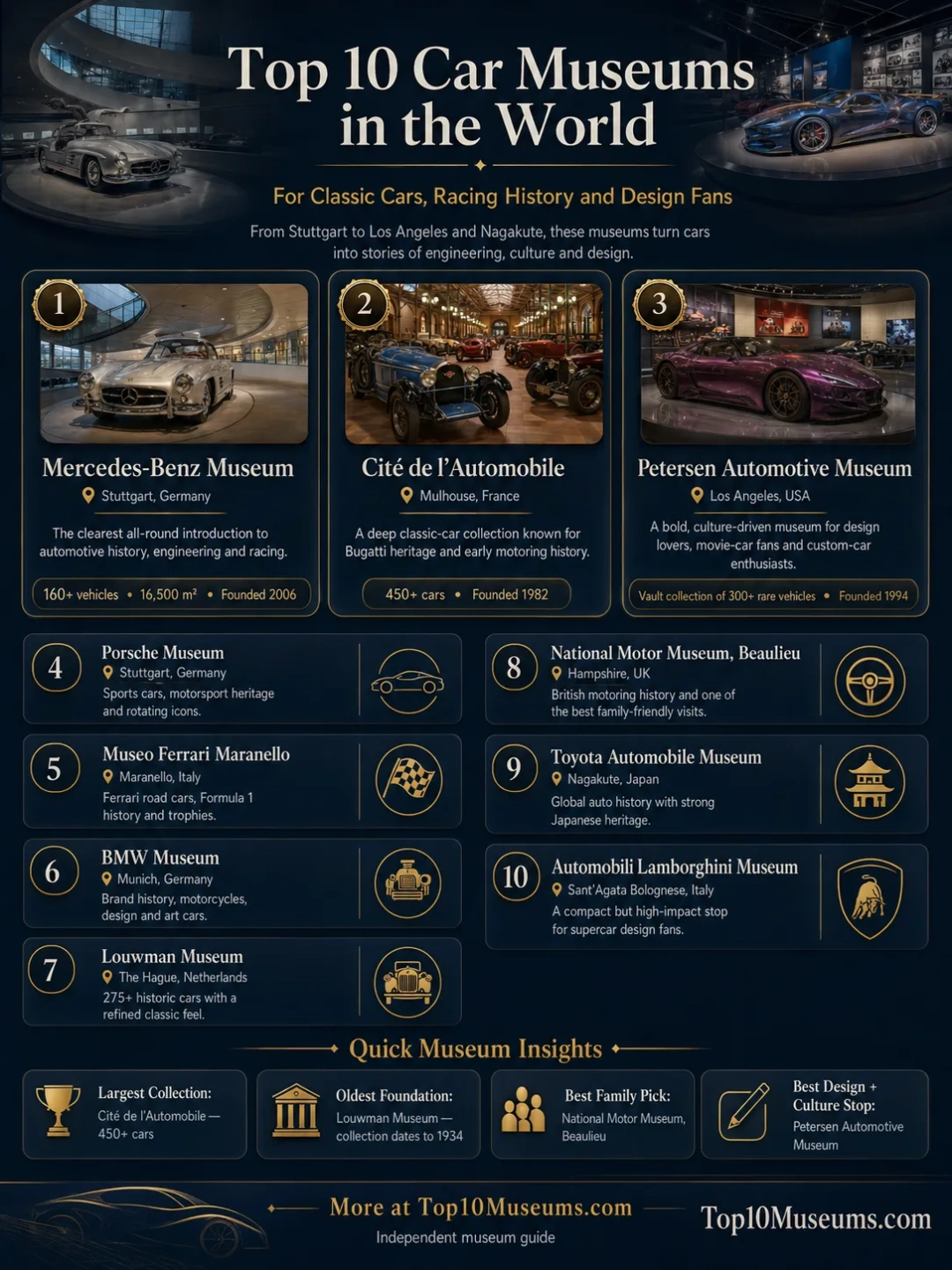
The Top 10 Car Museums in the World are not just garages with polished classics. The best ones tell you why cars changed cities, racing, design, family travel and even national identity. Some are perfect for sports-car dreamers, some are better for families, and a few are worth planning an entire trip around.
Map of the Top 10 Car Museums in the World
[ayaz_safe_content id=”2781″ key=”p2781b10grsxgnu”]
Top 10 Car Museums Table
| Rank | Name | Founded | Collection Type | Website |
|---|---|---|---|---|
| 1 | Mercedes-Benz Museum | 2006 | Automotive history, engineering, racing and brand heritage | Official Website |
| 2 | Cité de l’Automobile – Collection Schlumpf | 1982 | Historic automobiles, Bugatti, early motoring and Grand Prix cars | Official Website |
| 3 | Petersen Automotive Museum | 1994 | Automotive culture, design, Hollywood cars, custom cars and rare vehicles | Official Website |
| 4 | Porsche Museum | 1976 | Sports cars, motorsport, Porsche prototypes and rotating historic cars | Official Website |
| 5 | Museo Ferrari Maranello | 1990 | Ferrari road cars, Formula 1, trophies, exhibitions and brand history | Official Website |
| 6 | BMW Museum | 1973 | BMW cars, motorcycles, design, art cars and corporate history | Official Website |
| 7 | Louwman Museum | 1934 | Private historic-car collection, coachbuilt classics, motoring art and rare vehicles | Official Website |
| 8 | National Motor Museum, Beaulieu | 1952 | British motoring, land-speed record cars, motorcycles and popular-culture vehicles | Official Website |
| 9 | Toyota Automobile Museum | 1989 | Global automobile history, Toyota heritage, Japanese cars and working-condition vehicles | Official Website |
| 10 | Automobili Lamborghini Museum | 2001 | Lamborghini supercars, concept cars, hybrid models and factory-linked exhibits | Official Website |
Why These Ten Car Museums Stand Out
This list favors museums with strong collections, clear visitor value, reliable official information and enough variety to interest more than one type of traveler. A museum full of supercars is fun, but a great car museum also explains design, engineering, racing and everyday mobility.
The ranking also tries to balance brand museums with broader automotive collections. That is why a visitor can move from the Benz Patent-Motorwagen story in Stuttgart to Bugatti royalty in Mulhouse, custom culture in Los Angeles and Japanese car history near Nagoya without reading the same museum story ten times.
The Best Car Museums in the World
1. Mercedes-Benz Museum — Stuttgart, Germany
Best for: First-time automotive-history travelers, engineering fans, families with older kids and anyone who wants the car’s origin story in one polished museum.
The Mercedes-Benz Museum is the most useful first stop for anyone trying to understand why the automobile matters. Its route begins with the 1886 Benz Patent-Motorwagen, then moves through more than 160 vehicles and over 1,500 exhibits across 16,500 square meters.
What makes it special is the way it connects cars to daily life, not just to horsepower. You see early motorcars, racing machines, safety ideas, commercial vehicles and luxury models in a clear timeline, so even visitors who are not “car people” can follow the story without feeling lost.
The building itself helps. The double-helix layout lets you follow a chronological route or drift into themed galleries, which is handy if one person wants motorsport while another wants design and social history. Plan at least two hours; three is more comfortable.
Nearby alternative: Porsche Museum — a natural second stop in Stuttgart, usually reachable in about 20 to 30 minutes by car depending on traffic.
2. Cité de l’Automobile – Collection Schlumpf — Mulhouse, France
Best for: Classic-car collectors, Bugatti fans, early-motoring history readers and travelers who want a museum that feels grand without being flashy.
Cité de l’Automobile in Mulhouse is built around the famous Schlumpf Collection, one of the great historic automobile collections anywhere. The museum presents more than 450 exceptional cars, with a strong focus on Bugatti, prewar design and the early rise of the motorcar.
This is the place to slow down. Instead of chasing one famous model, visitors move through long galleries of brass-era cars, Grand Prix machines, coachbuilt bodies and rare French marques. The Bugatti story is the main draw, especially for anyone curious about the Type 35, the Royale and the brand’s Alsace roots.
The museum works well for visitors who enjoy visual comparison. You can see how proportions, headlights, wheels, radiators and cabins changed from fragile early machines to luxury road cars. It feels almost like a design archive, just with more chrome and better drama.
Nearby alternative: Cité du Train — a strong transport-history pairing in Mulhouse, only a short local ride away by car, tram or taxi.
3. Petersen Automotive Museum — Los Angeles, United States
Best for: Design lovers, movie-car fans, custom-culture readers, families in Los Angeles and visitors who prefer bold exhibits over quiet glass cases.
The Petersen Automotive Museum is one of the best car museums for people who care about culture as much as engineering. Opened in 1994 on Wilshire Boulevard, it sits in the middle of Los Angeles, a city where cars are part of the landscape, the film industry and everyday identity.
The museum’s regular galleries cover design, racing, lowriders, Hollywood cars, motorcycles and future mobility. Beneath the main museum, the Vault adds another layer with more than 300 rare vehicles from around the world, including classics, supercars, customs and oddities that change the mood of the visit.
Petersen is especially strong for visitors who like story-led exhibits. A famous car is rarely treated as just a famous car; it is usually connected to a designer, a film, a racing moment, a community or a change in taste. That makes the museum easier for mixed groups than many specialist collections.
Nearby alternative: The Nethercutt Collection — a classic-car and mechanical-music collection north of central Los Angeles, best reached by car with extra time for traffic.
4. Porsche Museum — Stuttgart, Germany
Best for: Sports-car fans, motorsport followers, Porsche 911 loyalists and travelers pairing Stuttgart’s two major car museums in one trip.
The Porsche Museum is smaller than the Mercedes-Benz Museum, but it feels sharper and more focused. The original Porsche museum dates to 1976, while the current museum building opened in 2009 with about 5,600 square meters of exhibition space.
Expect around 95 cars at a time, with regular rotation from Porsche’s wider historic collection. That means the museum can show icons such as the 356, 911 and 917, while also bringing out prototypes, racing cars and technical pieces that explain why Porsche has such a loyal following.
The best part is how close the museum feels to the factory story. You are not just seeing old cars in a neutral room; you are in Zuffenhausen, surrounded by the place where Porsche identity was built. For many visitors, that location gives the visit its extra pull.
Nearby alternative: Mercedes-Benz Museum — the broader automotive-history counterpoint, useful if you want one sports-car museum and one full-history museum in the same city.
5. Museo Ferrari Maranello — Maranello, Italy
Best for: Ferrari fans, Formula 1 followers, Italian Motor Valley travelers and visitors who want emotion, trophies and red paint in one compact stop.
Museo Ferrari Maranello opened in 1990 and became the official Prancing Horse museum in 1995. It sits in Maranello, near the Ferrari factory, which gives the visit a sense of place that a normal city museum could never copy.
The museum mixes Formula 1 cars, road cars, trophies, images and rotating exhibitions. It is not the largest museum on this list, but it understands its audience well: people come for Ferrari emotion, racing memory, design and the feeling of being close to the factory gates.
It works best when paired with nearby Motor Valley stops. A Ferrari-only visit can be done in a short session, but if you add Modena, Sant’Agata Bolognese or factory-area experiences, the day becomes much richer for Italian performance-car fans.
Nearby alternative: Museo Enzo Ferrari — the Modena companion museum, roughly 20 kilometers away, adds Enzo Ferrari’s personal and early-company story.
6. BMW Museum — Munich, Germany
Best for: Design-minded travelers, BMW owners, motorcycle fans, art-car followers and visitors already planning Munich’s Olympic Park area.
The BMW Museum opened in 1973, shortly after Munich’s Olympic year, and later reopened after a major renovation linked to BMW Welt. Its exhibition area is about 5,000 square meters, with displays that cover BMW cars, motorcycles, design, technology and brand history.
BMW’s strength here is presentation. The museum often feels like a mix of product archive, design studio and cultural display. Visitors can move from early BMW models to M cars, motorcycles and the BMW Art Car tradition, which gives the museum a wider appeal than a simple showroom.
Its location is also practical. BMW Welt sits next door, the BMW headquarters are nearby, and the Olympic Park is close enough to turn the museum into part of a larger Munich day. For families, that makes the visit easy to combine with food, walking time and open space.
Nearby alternative: Deutsches Museum Verkehrszentrum — a transport-focused museum in Munich that adds trains, bicycles and mobility history beyond BMW.
7. Louwman Museum — The Hague, Netherlands
Best for: Prewar-car lovers, coachbuilt-classic fans, design-history readers and travelers who want a calmer museum with rare details.
The Louwman Museum is based on a private collection that dates back to 1934. Today, it holds more than 275 historic and classic motor cars, along with motoring art, posters, miniatures and related objects.
This museum is less about loud spectacle and more about taste. The collection moves across more than 130 years of automotive history, with early vehicles, coachbuilt bodies, unusual survivors and elegant classics that reward careful looking. It is the kind of place where a quiet corner can be as memorable as a famous badge.
Louwman is a good choice for visitors who want automotive design as material culture. The cars are important, but the supporting art and objects help show how motoring became part of advertising, travel, luxury and personal style.
Nearby alternative: Museum Voorlinden — a refined art-and-design stop near The Hague, useful if your group wants a non-car museum in the same area.
8. National Motor Museum, Beaulieu — Hampshire, United Kingdom
Best for: British motoring fans, families, land-speed record readers and travelers who prefer a museum day with gardens and estate grounds.
The National Motor Museum at Beaulieu began from Lord Montagu’s motoring collection in the 1950s and grew into one of Britain’s best-known car museums. Its vehicle collection includes around 280 vehicles, covering early motorcars, family cars, motorcycles, racing machines and land-speed record icons.
Beaulieu is especially good for families because the museum is part of a wider visitor attraction. You can mix cars with Palace House, grounds, monorail-style estate views and other on-site exhibits, so the day does not depend on every person being obsessed with engines.
For car fans, the British angle is the real draw. The museum gives space to everyday motoring as well as performance and record-breaking. That makes it a strong counterweight to supercar-heavy museums, with plenty of room for nostalgia and social history.
Nearby alternative: Buckler’s Hard Museum — a nearby maritime-history stop on the Beaulieu estate, easy to pair with the motor museum if you have extra time.
9. Toyota Automobile Museum — Nagakute, Japan
Best for: Japanese-car fans, design students, engineering-minded families and visitors who want Toyota history beside global automobile milestones.
The Toyota Automobile Museum opened in April 1989 to mark Toyota Motor Corporation’s 50th anniversary. Despite the name, it is not only a Toyota brand display; its Automobile Gallery presents about 140 vehicles from Japan, Europe and the United States.
That wider approach makes the museum useful for understanding how car design spread across countries. You can compare early European models, American classics and Japanese vehicles in one place, while Toyota’s own story still gets plenty of attention through company heritage and culture displays.
The museum also keeps many vehicles in working condition and maintains a larger storehouse collection. For visitors who like engineering discipline as much as styling, that preservation angle gives the museum a quieter but very real charm.
Nearby alternative: Toyota Commemorative Museum of Industry and Technology — a Nagoya-area museum that explains Toyota’s textile-machinery roots before the company became known for cars.
10. Automobili Lamborghini Museum — Sant’Agata Bolognese, Italy
Best for: Supercar fans, Lamborghini loyalists, Italian Motor Valley travelers and visitors who want a compact museum tied closely to a factory site.
The Automobili Lamborghini Museum opened in 2001 inside Lamborghini’s home territory of Sant’Agata Bolognese. It focuses on more than 60 years of Lamborghini history, from early Ferruccio Lamborghini-era cars to modern supercars and hybrid models.
The draw is simple: Miura, Countach, Diablo, Murciélago, Aventador, Huracán, Sesto Elemento, Veneno and other headline cars appear through permanent and rotating displays. The museum is compact, but the models carry so much visual weight that it rarely feels thin.
This is best visited as part of a Motor Valley day, especially if you are already seeing Ferrari in Maranello or Modena. The museum’s factory-linked setting gives it a live-brand feeling, which is different from a historic collection that ended decades ago.
Nearby alternative: Museo Ferruccio Lamborghini — a founder-focused museum near Bologna, useful if you want more background on Ferruccio Lamborghini’s life and machines.
How to Tour These Museums
Best Southern Germany Route
Start with the Mercedes-Benz Museum in Stuttgart because it gives the broadest historical base. Add the Porsche Museum the same day only if you are fresh; otherwise, save it for the next morning. Finish the route in Munich with the BMW Museum and BMW Welt, giving yourself time around Olympic Park so the day does not feel rushed.
Best Italian Motor Valley Route
Use Bologna or Modena as a base and put Museo Ferrari Maranello first if Ferrari is your main reason for traveling. Add the Automobili Lamborghini Museum in Sant’Agata Bolognese later in the day, with enough buffer for rural-road driving and parking. If you have a second day, add Museo Enzo Ferrari in Modena for a better personal-history layer.
Best Classic-Car Europe Route
For a slower classic-car trip, pair Cité de l’Automobile in Mulhouse with the Louwman Museum in The Hague and the National Motor Museum at Beaulieu. This is not a one-day plan; treat it as a multi-stop Europe route with trains and car rental where needed. The reward is variety: Bugatti, coachbuilt classics, British motoring and social history.
Best Family-Friendly Plan
Choose Beaulieu if you need the easiest full-day family visit because it has more than just museum rooms. Petersen is a strong urban family choice in Los Angeles, especially for kids who like movie cars and bold displays. Mercedes-Benz and Toyota also work well for older children who enjoy timelines, technology and clear exhibit flow.
Best Once-in-a-Lifetime Car Fan Plan
If you can only build one dream trip, combine Stuttgart and Italy: Mercedes-Benz Museum, Porsche Museum, Ferrari Maranello and Lamborghini. That route gives you the birth of the automobile, sports-car heritage, Formula 1 emotion and modern supercar drama. Add BMW in Munich if your schedule allows one more German stop.
Who Will Love These Museums?
• Automotive-history beginners: Mercedes-Benz Museum gives the clearest start-to-finish story, from the 1886 Benz Patent-Motorwagen to modern mobility.
• Bugatti and prewar-classic fans: Cité de l’Automobile is the strongest choice, especially for visitors who love early racing and luxury coachwork.
• Movie-car and design fans: Petersen Automotive Museum fits Los Angeles perfectly, with exhibits tied to culture, custom cars and visual storytelling.
• Sports-car purists: Porsche Museum is the cleanest pick for 911, 917, racing engineering and a tightly focused brand story.
• Formula 1 and Ferrari loyalists: Museo Ferrari Maranello is the emotional stop, especially when paired with Modena and the wider Motor Valley area.
• Design students and BMW owners: BMW Museum works well for people interested in brand identity, motorcycles, art cars and modern presentation.
• Quiet classic-car collectors: Louwman Museum is ideal for visitors who enjoy rare survivors, early motoring art and coachbuilt detail.
• Families in the UK: National Motor Museum, Beaulieu is the easiest all-day choice because the wider estate gives non-car fans more to do.
• Japanese-car and engineering fans: Toyota Automobile Museum gives a balanced view of Toyota, Japan and global automobile development.
• Supercar dreamers: Automobili Lamborghini Museum is the compact, high-impact stop for Miura, Countach, Aventador and modern hybrid-era models.