
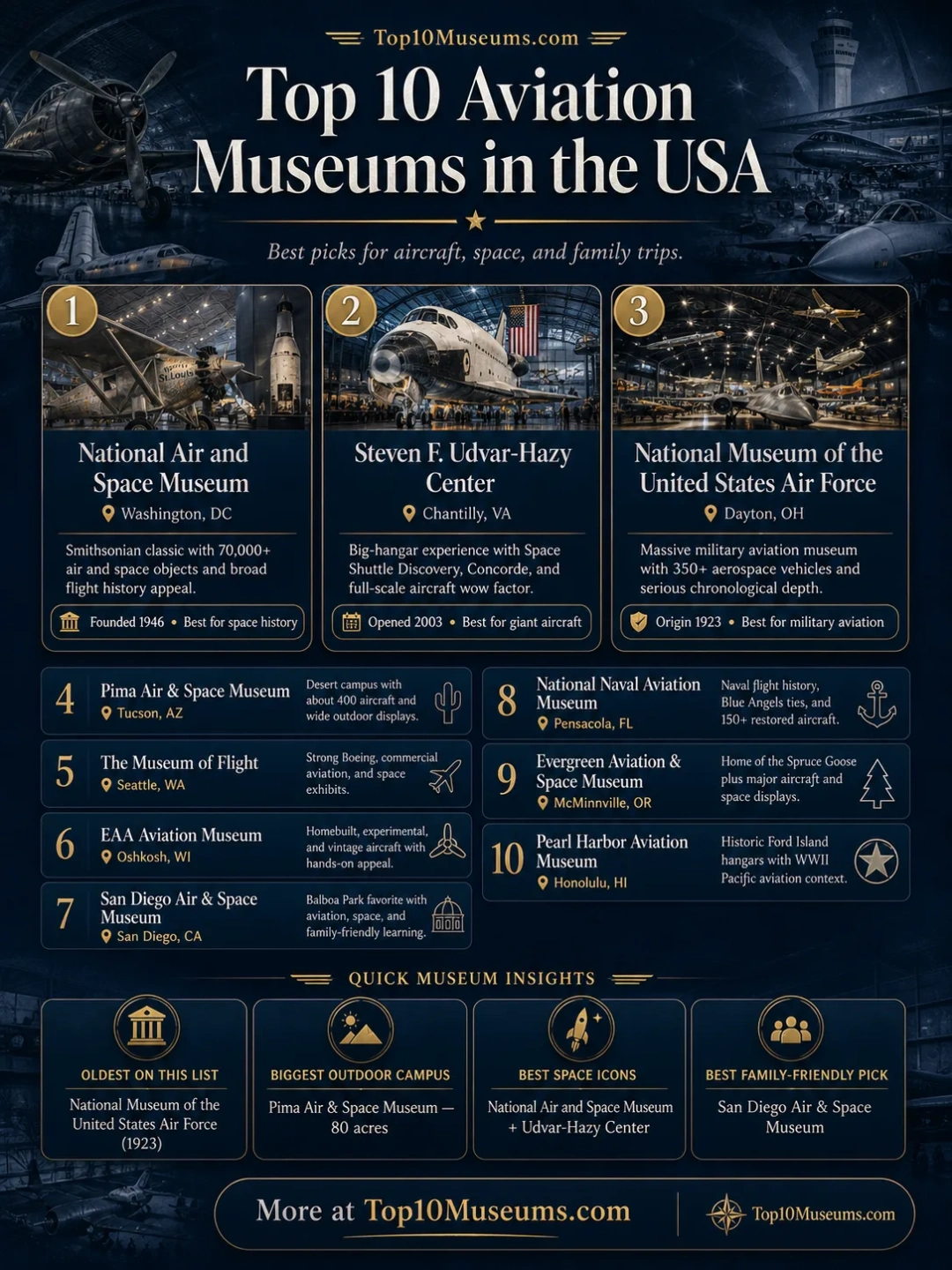
The top 10 aviation museums in the USA are not all built for the same kind of visit. Some are huge aircraft halls where you can stand under a space shuttle, some focus on military flight, and some are better for families who want hands-on science, simulators, and easy pacing. This list keeps the focus on museums with strong collections, clear visitor value, official public access, and enough aviation depth to be worth planning a trip around.
| Rank | Name | Founded | Collection Type | Website |
|---|---|---|---|---|
| 1 | National Air and Space Museum | 1946 | Air, space, Smithsonian artifacts | Official Website |
| 2 | Steven F. Udvar-Hazy Center | 2003 | Large aircraft, spacecraft, restoration | Official Website |
| 3 | National Museum of the United States Air Force | 1923 | Military aviation, missiles, space power | Official Website |
| 4 | Pima Air & Space Museum | 1976 | Civil, military, outdoor aircraft campus | Official Website |
| 5 | The Museum of Flight | 1965 | Commercial aviation, Boeing history, space | Official Website |
| 6 | EAA Aviation Museum | 1983 | Experimental, homebuilt, vintage aircraft | Official Website |
| 7 | San Diego Air & Space Museum | 1961 | Aviation, space, Balboa Park science | Official Website |
| 8 | National Naval Aviation Museum | 1962 | Navy, Marine Corps, Coast Guard aviation | Official Website |
| 9 | Evergreen Aviation & Space Museum | 1991 | Civil aircraft, military aircraft, space | Official Website |
| 10 | Pearl Harbor Aviation Museum | 1999 / opened 2006 | World War II, Pacific aviation, historic hangars | Official Website |
Why These Ten Aviation Museums Made the List
These museums were chosen because they offer more than a few aircraft behind glass. Each one has a clear reason to travel: a rare aircraft, a large hangar experience, a strong space section, a family-friendly learning angle, or a collection tied to a major aviation story. The goal is simple: help visitors decide where to spend their time without turning the article into a ticket pitch.
The list also balances artifacts, geography, and visitor type. A Smithsonian visitor in Washington, DC needs a different plan than a family driving through Wisconsin, a military aviation fan in Ohio, or a Hawaii traveler planning a Pearl Harbor day. That is why the ranking favors museums that feel memorable, practical, and worth building a day around.
The 10 Best Aviation Museums in the USA
1. National Air and Space Museum — Washington, DC
Best for: first-time Washington, DC visitors, space-history readers, and travelers who want a Smithsonian aviation stop on the National Mall.
The National Air and Space Museum is the most natural starting point for many visitors because it sits on the National Mall and belongs to the Smithsonian system. Its collection includes more than 70,000 air and space objects, with famous aircraft and spacecraft tied to flight, exploration, engineering, and American public memory. For a first visit, the appeal is not only the size of the collection; it is how close the museum is to other major DC stops.
This museum works well for travelers who want a broad overview before going deeper somewhere else. You can pair early flight, spaceflight, planetary science, and aviation design in one stop, then walk to other Smithsonian museums without changing neighborhoods. Families should still pace the visit carefully, because air and space exhibits can feel dense when every object has a story attached.
Nearby alternative: National Museum of American History — a short walk across the National Mall, good for invention, transportation, and technology context after the flight galleries.
2. Steven F. Udvar-Hazy Center — Chantilly, Virginia
Best for: aircraft-size lovers, space shuttle fans, Concorde seekers, and travelers who prefer big hangars over crowded city galleries.
The Steven F. Udvar-Hazy Center is the Smithsonian’s large-aircraft site near Washington Dulles International Airport. It displays thousands of aviation and space artifacts, including the Space Shuttle Discovery, a Concorde, and large aircraft that simply cannot fit inside the National Mall building. The scale is the reason to go: this is the place where aircraft feel like full machines, not small objects in a room.
Visitors who love engineering details usually get more out of Udvar-Hazy than a rushed city museum stop. The hangar layout makes it easier to look up, step back, and compare aircraft shapes side by side. It is also a good choice for families with kids who like big visual moments rather than long reading panels.
Nearby alternative: Sully Historic Site — a short drive from Chantilly, useful if your group wants a quieter local history stop after a hangar-heavy visit.
3. National Museum of the United States Air Force — Dayton, Ohio
Best for: military aviation fans, Cold War aircraft followers, veterans’ families, and visitors who want a free museum with serious depth.
The National Museum of the United States Air Force dates its origin to 1923, and today it is known for a huge collection of military aircraft, missiles, and aviation artifacts. The museum displays more than 350 aerospace vehicles and missiles, spread across large indoor galleries near Wright-Patterson Air Force Base. It is one of the strongest choices in the country for visitors who want a full military aviation day.
The museum’s strength is chronology. You can move from early military flight to World War II aircraft, jet-age design, presidential aircraft, Cold War machines, and space-related displays without feeling that the museum is jumping around. Because admission is generally free, many travelers give it more time than they first planned — and that is usually the right call.
Nearby alternative: Dayton Aviation Heritage National Historical Park — close to downtown Dayton, good for connecting the Wright brothers’ story with the aircraft collection.
4. Pima Air & Space Museum — Tucson, Arizona
Best for: outdoor aircraft-yard fans, desert road-trippers, military aircraft photographers, and visitors who like wide-open museum campuses.
Pima Air & Space Museum is one of the largest non-government-funded air and space museums in the world, with about 400 historic aircraft across an 80-acre campus. The mix is part of the fun: military jets, commercial aircraft, experimental designs, helicopters, and large outdoor displays all sit in the desert light. It feels very different from an indoor Smithsonian day, and that difference is exactly why many aviation fans love it.
The museum opened to the public in 1976, and it has grown into a serious Tucson anchor for aviation travelers. Plan for heat, walking, water, and sun protection, especially if you want to explore the outdoor rows at a relaxed pace. For kids, the aircraft variety helps, but the weather can decide how long the visit stays fun.
Nearby alternative: Titan Missile Museum — south of Tucson, good if Cold War aerospace engineering is your next stop after Pima.
5. The Museum of Flight — Seattle, Washington
Best for: Boeing history fans, airliner lovers, Seattle families, and visitors who want commercial aviation alongside space exhibits.
The Museum of Flight sits by Boeing Field and is one of the best aviation museums in America for visitors who care about commercial flight, aircraft design, and the Seattle aviation story. Its collection includes headline aircraft such as a Boeing 747, a Concorde, and the first presidential jet, SAM 970. That mix makes the museum feel broad without losing its Pacific Northwest identity.
This is also one of the easier museums to recommend to mixed groups. Aircraft fans can spend time with the machines, kids can enjoy the visual scale, and casual visitors still understand why Seattle matters in flight history. The museum’s roots go back to 1965, and the Boeing-related setting gives the visit a strong sense of place.
Nearby alternative: Boeing Future of Flight — north in Everett, a good add-on if airline production and factory-scale aviation interest your group.
6. EAA Aviation Museum — Oshkosh, Wisconsin
Best for: experimental-aircraft fans, homebuilt aviation followers, pilots, tinkerers, and families visiting Oshkosh outside AirVenture week.
The EAA Aviation Museum is tied to the Experimental Aircraft Association, which gives it a different flavor from many military or Smithsonian-style museums. The collection includes more than 200 historic airplanes, with attention to homebuilt aircraft, classics, antiques, warbirds, and the kind of flying culture that makes Oshkosh famous. If you like the human side of aviation — people building, restoring, testing, and flying — this museum feels especially personal and hands-on.
The museum opened in 1983, and its location beside Wittman Regional Airport matters because Oshkosh is already a major name among aviation people. It is a strong stop even when the big summer fly-in is not happening. For families, it can be easier to enjoy than a huge military museum because the stories often feel closer to garage, workshop, and cockpit life.
Nearby alternative: Pioneer Airport — on the EAA grounds, worth checking when seasonal access or special programming is available.
7. San Diego Air & Space Museum — San Diego, California
Best for: Balboa Park visitors, families with curious kids, space-and-science fans, and travelers who want a museum day without leaving central San Diego.
The San Diego Air & Space Museum was established in 1961 and later became California’s official air and space museum and education center. Its Balboa Park location makes it easy to pair with other museums, gardens, and family stops, which is a major advantage for visitors who do not want a full aviation-only day. The museum’s strength is the mix of aviation, space, education, and park convenience.
This is a good choice for travelers who want flight history in a broader San Diego itinerary. Instead of feeling like a remote aircraft hangar, it sits inside one of the city’s main cultural areas. The museum also works well for younger visitors because the subject matter connects naturally to science, exploration, and “how does that fly?” questions.
Nearby alternative: USS Midway Museum — a short ride from Balboa Park, useful for naval aircraft, carrier-deck context, and waterfront views.
8. National Naval Aviation Museum — Pensacola, Florida
Best for: naval aviation fans, Blue Angels followers, military families, and visitors who want a free aviation museum with carrier-based aircraft.
The National Naval Aviation Museum was formally established in 1962 and is located aboard Naval Air Station Pensacola. Its collection includes more than 150 restored aircraft representing Navy, Marine Corps, and Coast Guard aviation. If your interest is carrier flight, naval training, Blue Angels history, or sea-based aircraft, this museum belongs high on the list.
The museum’s setting matters, so visitors should check current access rules before planning around it. Once inside, the appeal is clear: aircraft are displayed with a strong sense of service branch identity and training history. It is especially strong for people who want military aviation but prefer the naval side of the story rather than an Air Force-only visit.
Nearby alternative: Pensacola Lighthouse and Maritime Museum — near NAS Pensacola, good for a shorter historic stop on the same side of town.
9. Evergreen Aviation & Space Museum — McMinnville, Oregon
Best for: Spruce Goose seekers, Oregon road-trippers, large-aircraft fans, and visitors who want a slower museum day outside a big city.
Evergreen Aviation & Space Museum is best known as the home of the Hughes H-4 Hercules, better known as the Spruce Goose. That single aircraft is enough to make the museum a serious aviation stop, but the campus also includes aircraft such as an SR-71 and A-10, plus space-related displays. The museum’s McMinnville setting gives it a calmer pace than many city museums, which helps when you want time to absorb one giant aircraft and the story around it.
The museum began in 1991, and its identity is closely tied to the way a rare aircraft can define a place. Visitors who enjoy aircraft scale, restoration stories, and Oregon road-trip stops tend to get the most from it. It pairs especially well with a Pacific Northwest route that also includes Seattle’s Museum of Flight.
Nearby alternative: Yamhill Valley Heritage Center — a short drive in McMinnville, good if your group wants local history after aircraft.
10. Pearl Harbor Aviation Museum — Honolulu, Hawaii
Best for: Pearl Harbor visitors, World War II aviation readers, Pacific history travelers, and families planning a full historic-site day on Oahu.
Pearl Harbor Aviation Museum sits on Ford Island, using historic hangars connected to the events of December 7, 1941. The museum opened to the public in 2006 and now offers access to more than 50 aircraft and exhibits, with a collection database that includes thousands of artifacts, books, archives, and photographs. This is not just an aircraft stop; it is an aviation museum tied closely to place.
The visit works best when planned as part of a broader Pearl Harbor day rather than squeezed in as an afterthought. The hangars, aircraft, and Pacific aviation material give context to a larger historic area. Families should allow enough time for transport logistics, because the location has its own access flow and does not feel like a simple street-corner museum.
Nearby alternative: Battleship Missouri Memorial — also in the Pearl Harbor area, useful if you want to pair aviation with naval history on the same day.
How to Tour These Museums
Best Smithsonian Two-Day Route
Start with the National Air and Space Museum on the National Mall, then save the Steven F. Udvar-Hazy Center for the next day. Trying both in one day is possible with a car and an early start, but it can feel rushed because each site deserves real time. This route is the best first choice for visitors who want spacecraft, famous aircraft, and Smithsonian depth without flying across the country.
Best Military Aviation Route
For a military-focused trip, choose the National Museum of the United States Air Force first, then plan separate stops for the National Naval Aviation Museum and Pearl Harbor Aviation Museum if your travel schedule allows. Dayton gives the broadest Air Force story, Pensacola covers naval aviation, and Pearl Harbor adds a Pacific setting that cannot be copied elsewhere. This is not a one-weekend route for most travelers; it is better as a theme list for several trips.
Best Western Aircraft Route
A practical western route can start with Pima Air & Space Museum in Tucson, move to San Diego Air & Space Museum, then continue north later for Seattle’s Museum of Flight and Evergreen Aviation & Space Museum in Oregon. Pima and San Diego pair well if you are already in the Southwest, while Seattle and McMinnville make a better Pacific Northwest pairing. Keep the route loose, because distance matters more than the museum count here.
Best Family-Friendly Aviation Weekend
For families, the easiest choices are usually The Museum of Flight, San Diego Air & Space Museum, and EAA Aviation Museum, depending on where the trip begins. These museums offer strong visuals, kid-friendly pacing, and enough variety for visitors who are not aircraft experts. If young children are part of the group, choose one major aviation museum per day instead of stacking two heavy stops back to back.
Best Cross-Country Order for Aviation Fans
If the goal is to visit all ten over time, the cleanest order is Washington, DC, Chantilly, Dayton, Oshkosh, Pensacola, Tucson, San Diego, Seattle, McMinnville, and Honolulu. This order keeps the Smithsonian pair together, groups the Midwest stops before the long southern and western legs, and leaves Hawaii as a separate final trip. It is not a casual vacation route; it is a long-term aviation travel plan.
[ayaz_safe_content id=”2783″ key=”p2783b1ioliwqjv”]
Who Will Love These Museums?
- First-time DC travelers: National Air and Space Museum gives the easiest Smithsonian aviation starting point.
- Large-aircraft fans: Steven F. Udvar-Hazy Center is the stronger pick for space shuttle, Concorde, and hangar-scale displays.
- Military aviation readers: National Museum of the United States Air Force offers the deepest Air Force-focused museum day.
- Outdoor aircraft photographers: Pima Air & Space Museum gives wide desert views and a huge open-air aircraft campus.
- Airliner and Boeing fans: The Museum of Flight connects Seattle’s aircraft story with commercial aviation and space exhibits.
- Homebuilt and experimental-aircraft fans: EAA Aviation Museum is the best match for pilots, makers, and Oshkosh visitors.
- Families in San Diego: San Diego Air & Space Museum works well because it sits inside Balboa Park and pairs easily with other stops.
- Naval aviation followers: National Naval Aviation Museum is the strongest choice for Navy, Marine Corps, Coast Guard, and Blue Angels history.
- Spruce Goose seekers: Evergreen Aviation & Space Museum is the museum to choose if the Hughes H-4 Hercules is the main draw.
- Pearl Harbor history travelers: Pearl Harbor Aviation Museum fits visitors who want aviation tied to Ford Island and the Pacific story.