
[ayaz_safe_content id=”2801″ key=”p2801b1lvdwf9n9″]
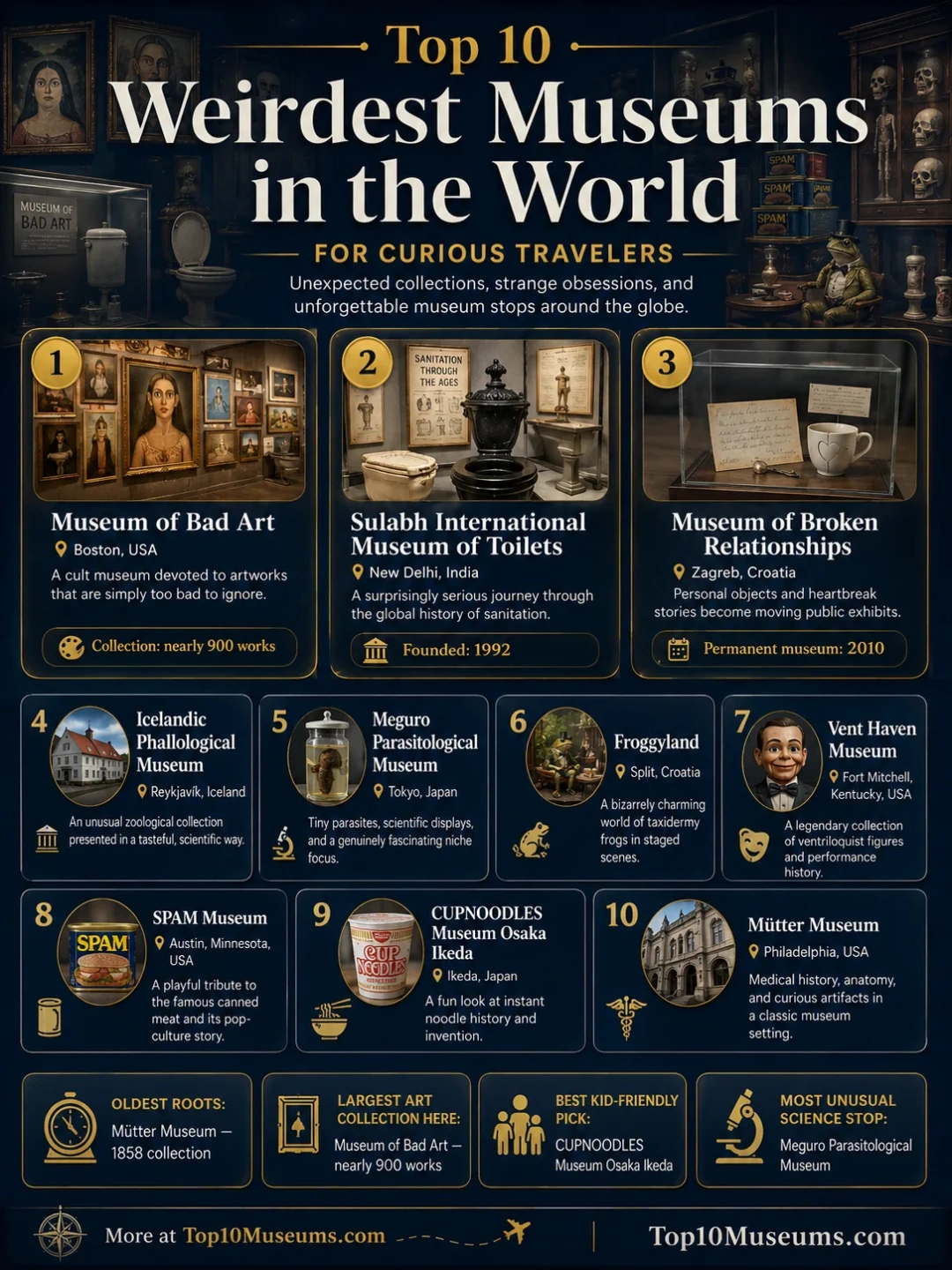
The Top 10 Weirdest Museums in the World are not weird because they lack purpose. They are weird because someone took a subject most people overlook — bad paintings, old toilets, heartbreak objects, parasites, canned meat, ventriloquist figures — and treated it with real museum care. That is what makes these places fun: each one starts with a strange idea, then turns it into a visit people remember long after the usual art halls blur together.
| Rank | Name | Founded | Collection Type | Website |
|---|---|---|---|---|
| 1 | Museum of Bad Art | 1994 | Odd art collection | Official website |
| 2 | Sulabh International Museum of Toilets | 1992 | Sanitation history | Official website |
| 3 | Museum of Broken Relationships | 2006 / 2010 permanent museum | Donated relationship objects | Official website |
| 4 | Icelandic Phallological Museum | 1997 | Zoological anatomy | Official website |
| 5 | Meguro Parasitological Museum | 1953 | Parasite specimens | Official website |
| 6 | Froggyland | 1910–1920 collection | Taxidermy frog scenes | Official website |
| 7 | Vent Haven Museum | 1973 | Ventriloquism figures | Official website |
| 8 | SPAM Museum | 2001 / current downtown site 2016 | Food brand history | Official website |
| 9 | CUPNOODLES Museum Osaka Ikeda | 1999 | Instant noodle history | Official website |
| 10 | Mütter Museum | 1858 collection / 1863 museum building | Medical anatomy and instruments | Official website |
Why These Ten Made the Weird List
These museums were picked because their subjects are unusual but not empty gimmicks. Each one has a real collection, a traceable location, and a clear reason to exist. Some are funny, some are scientific, some are quietly emotional, and a few are the kind of places that make visitors say, “I can’t believe this is a real museum.”
The ranking also favors museums that explain a narrow topic well. A bad-art gallery with almost 900 works, a sanitation museum covering thousands of years, and a parasite museum founded by a medical doctor all prove the same point: weird museums work best when the idea is specific.
1. Museum of Bad Art — Boston, USA
Best for: Art lovers with a dry sense of humor, thrift-store hunters, and visitors who enjoy small museums with a sharp idea.
The Museum of Bad Art is built around a beautifully simple rule: it collects art that is too bad to ignore. Since 1994, MOBA has gathered almost 900 pieces, although only about 50 to 70 can be shown at a time because the physical gallery space is small. The result is not a place that mocks artists; it is more like a rescue home for ambitious paintings where something went very, very sideways.
The museum’s charm comes from the labels as much as the paintings. A strange portrait, a confused landscape, or an awkward still life gets the kind of serious description normally saved for fine art. That contrast is the joke, but it also makes visitors look longer. MOBA is funny because it treats failure with care, and that is rarer than another wall of perfect canvases.
Nearby alternative: Isabella Stewart Gardner Museum — a polished art-house contrast to MOBA, reachable from Dorchester by a short ride across Boston.
2. Sulabh International Museum of Toilets — New Delhi, India
Best for: Social-history readers, design-minded travelers, public-health students, and anyone who likes odd museums with a serious point.
The Sulabh International Museum of Toilets sounds like a punchline until the subject opens up. Founded in 1992 by Dr. Bindeshwar Pathak, it follows sanitation history from roughly 2500 BC through the late 20th century. That gives the museum a strange but useful angle: toilets reveal class, engineering, urban planning, hygiene, and privacy all at once.
Displays include facts, images, models, and objects related to toilet systems across cultures. It is not a flashy museum, and that is part of the appeal. Visitors leave with a sharper sense of how much daily life depends on things most people would rather not discuss. Uncomfortable topic, useful museum — that is the whole magic here.
Nearby alternative: National Rail Museum — a larger outdoor museum in New Delhi that pairs well with Sulabh if the day needs a more familiar family-friendly stop.
3. Museum of Broken Relationships — Zagreb, Croatia
Best for: Reflective travelers, couples, solo visitors, writers, and people drawn to ordinary objects with heavy stories.
The Museum of Broken Relationships began as a 2006 art project and became a permanent Zagreb museum in 2010. Its collection is made of objects donated anonymously by people from around the world. A toy, a letter, a dress, a household item — each one comes with a personal story, turning private endings into small public acts of memory.
What makes it weird is not the look of the objects. Many are plain. The oddness is emotional: a museum where the exhibit is not a masterpiece, but the reason someone could not throw it away. Some stories are funny, some are bitter, and some are hard to shake. It is one of the rare unusual museums that can feel both awkward and tender within the same room.
Nearby alternative: Croatian Museum of Naïve Art — a short Upper Town walk away, offering a bright visual shift after the heavier emotional tone of Broken Relationships.
4. Icelandic Phallological Museum — Reykjavík, Iceland
Best for: Adult travelers, biology-minded visitors, oddity collectors, and people who can handle anatomy presented without nervous giggling.
The Icelandic Phallological Museum is often treated as a joke before people visit, but its structure is closer to a zoological collection. The collection began in 1974 after founder Sigurður Hjartarson received a bull specimen as a joke; by 1997, the museum opened in Reykjavík with 62 specimens. That origin story is funny, but the museum itself treats the material as biology, folklore, and cultural curiosity.
The museum’s subject is clearly adult, so it is not the safest choice for every family itinerary. For the right visitor, though, it is more organized and less crude than the reputation suggests. Expect preserved specimens, animal references, Icelandic humor, and a very direct reminder that museums can study almost anything when the collection is real.
Nearby alternative: Reykjavík Art Museum Hafnarhús — a nearby harbor-area stop for contemporary art if the group wants something less anatomical afterward.
5. Meguro Parasitological Museum — Tokyo, Japan
Best for: Science fans, biology students, medical-history readers, and older kids or teens who like gross-but-educational exhibits.
Meguro Parasitological Museum was founded in 1953 by medical doctor Satoru Kamegai. It is a private museum dedicated to parasites, with about 300 specimens and related materials on display across two exhibition floors. The subject can make visitors squirm, but the museum is serious, compact, and unusually focused — one topic, studied closely.
The first floor explains parasite diversity, while the second floor looks more closely at parasites connected to humans. That structure keeps the visit from becoming a simple shock show. It is still weird, of course; jars, specimens, life cycles, and infection diagrams are not everyone’s idea of a relaxed afternoon. But for curious travelers, it is one of Tokyo’s strangest small museums.
Nearby alternative: Tokyo Metropolitan Teien Art Museum — a calm art-and-architecture stop near Meguro that works well after a short, intense science visit.
6. Froggyland — Split, Croatia
Best for: Fans of odd taxidermy, families with older kids, visual-detail lovers, and travelers who enjoy tiny scenes with a strange backstory.
Froggyland displays 507 preserved frogs arranged in 21 human-like scenes. The collection was created by Ferenc Mere between 1910 and 1920, using a demanding taxidermy technique that avoided external incisions. The scenes show frogs at school, at work, in a circus, and in other everyday situations. It is funny at first glance, then oddly impressive once the detail sinks in.
This museum will not take a whole day, and that is fine. Its strength is the density of the idea: hundreds of frogs acting out human life in miniature. Some visitors may find the taxidermy unsettling, especially younger children. Others will see it as folk art with a crooked smile — strange, handmade, and hard to forget.
Nearby alternative: Split City Museum — a short walk inside the old center, useful if Froggyland leaves time for a more traditional city-history stop.
7. Vent Haven Museum — Fort Mitchell, USA
Best for: Performance-history fans, puppet collectors, comedy nerds, and visitors who like guided museums with a slightly eerie edge.
Vent Haven Museum opened to the public in 1973 after W.S. Berger spent more than 40 years building a private collection of ventriloquism material. Today it houses more than 1,200 ventriloquist dummies from the 19th, 20th, and 21st centuries, along with photos, scripts, playbills, recordings, and related memorabilia. The scale alone makes it unusual.
Visits are guided and usually last about 60 to 90 minutes, which helps the collection feel like performance history instead of a room full of staring faces. Still, there is no pretending the atmosphere is ordinary. Rows of silent ventriloquist figures can be funny, nostalgic, and mildly spooky at the same time.
Nearby alternative: Behringer-Crawford Museum — a short drive away in Northern Kentucky, with regional history exhibits that make an easy second stop.
8. SPAM Museum — Austin, USA
Best for: Food-history fans, road-trippers, families, brand-history readers, and anyone who likes playful museums that do not take themselves too seriously.
The SPAM Museum turns canned meat into a full visitor experience. The current downtown Austin museum opened in 2016 and covers about 14,000 square feet. Admission is free, which makes it an easy stop for road-trippers moving through southern Minnesota. It tells the story of the SPAM brand, Hormel Foods, military history, global food culture, and a product launched in 1937.
This is one of the friendliest weird museums on the list. The subject is silly, but the design is bright and interactive. It works especially well for families because the oddness is harmless: giant cans, food trivia, brand nostalgia, and enough SPAM jokes to last the drive home.
Nearby alternative: Hormel Historic Home — a local Austin stop that gives more background on the family and company behind the city’s food-history identity.
9. CUPNOODLES Museum Osaka Ikeda — Osaka, Japan
Best for: Families, food-design fans, Japan first-timers, product-history readers, and kids who like hands-on factory-style activities.
CUPNOODLES Museum Osaka Ikeda stands on the birthplace story of instant noodles. Momofuku Ando invented Chicken Ramen in 1958 in Ikeda, and the museum opened in 1999 to explain how that idea became a global food. The museum includes a recreation of Ando’s work shed, a history of instant noodles, and hands-on attractions such as the My CUPNOODLES Factory.
The weirdness here is cheerful rather than creepy. A whole museum about instant noodles sounds absurd until the visit shows how much design, packaging, food science, and pop culture sit behind a cup of noodles. It is one of the best unusual museums for kids, especially because general admission is free and the interactive areas make the subject feel playful.
Nearby alternative: Itsuo Art Museum — a quieter Ikeda-area museum that pairs well with CUPNOODLES if the day needs a more traditional cultural stop.
10. Mütter Museum — Philadelphia, USA
Best for: Medical-history readers, anatomy students, older teens, and travelers who can handle real human specimens with a respectful tone.
The Mütter Museum began with surgeon Thomas Dent Mütter’s donation of more than 1,700 objects and funds in the 1850s, with the first museum building completed in 1863. Its collection has grown to more than 25,000 objects, including anatomical specimens, medical instruments, models, and materials connected to the history of diagnosis and treatment. It is weird, but it is not a carnival stop.
Visitors should know the museum includes real human remains and medical specimens. For some, that makes it uncomfortable. For others, it makes the history of medicine feel direct and human. The best way to approach it is with curiosity and respect, not shock-hunting. It earns its place here because few museums are so unusual while still being so tied to education.
Nearby alternative: The Franklin Institute — a short walk away, with broader science exhibits that work well if the group wants a less intense second museum.
How to Tour These Museums
Best North America Oddities Route
Start with the Mütter Museum in Philadelphia, then fly or train toward Boston for the Museum of Bad Art. From there, Fort Mitchell and Austin work better as separate road-trip legs than a single smooth route. This is a five-to-seven-day plan if the goal is to enjoy the cities, not just collect museum stamps.
Best Europe Weird Museum Route
Pair Reykjavík, Zagreb, and Split only if the trip already includes flights across Europe. The Icelandic Phallological Museum fits into a Reykjavík city day, while the Museum of Broken Relationships and Froggyland can be joined in Croatia with a Zagreb-to-Split travel day between them. A slower seven-to-ten-day route makes more sense than rushing all three.
Best Asia Curiosity Route
Delhi, Tokyo, and Osaka are far apart, so treat this as a broad Asia itinerary rather than a museum sprint. Visit Sulabh International Museum of Toilets in New Delhi first, then fly to Japan for Meguro Parasitological Museum in Tokyo and CUPNOODLES Museum Osaka Ikeda near Osaka. The Japan pair is the easiest part, since Tokyo and Osaka are linked by fast rail.
Best Family-Friendly Weird Museum Day
For families, the softest choices are SPAM Museum, CUPNOODLES Museum Osaka Ikeda, and Museum of Bad Art. They are odd without being too heavy, and they give younger visitors clear things to notice. Meguro Parasitological Museum can work for older kids who enjoy biology, while the Mütter Museum and Icelandic Phallological Museum need more careful age judgment.
Who Will Love These Museums?
- Odd-art fans: Museum of Bad Art is ideal for visitors who enjoy strange paintings and clever labels.
- Public-health and design readers: Sulabh International Museum of Toilets turns sanitation into a practical history lesson.
- Reflective solo travelers: Museum of Broken Relationships fits people who like emotional stories attached to ordinary objects.
- Adult biology-minded visitors: Icelandic Phallological Museum works best for those comfortable with direct anatomical displays.
- Science-curious teens: Meguro Parasitological Museum offers a compact but memorable look at parasite life cycles.
- Taxidermy oddity fans: Froggyland is best for visitors who enjoy small scenes, craft detail, and very strange humor.
- Performance-history lovers: Vent Haven Museum is made for people interested in puppetry, comedy, stage craft, and ventriloquism.
- Road-trip families: SPAM Museum is playful, free to enter, and easy to enjoy without specialist knowledge.
- Food invention fans: CUPNOODLES Museum Osaka Ikeda is a strong choice for families, product-design lovers, and Japan travelers.
- Medical-history readers: Mütter Museum is best for older visitors who can approach real specimens with care and respect.