
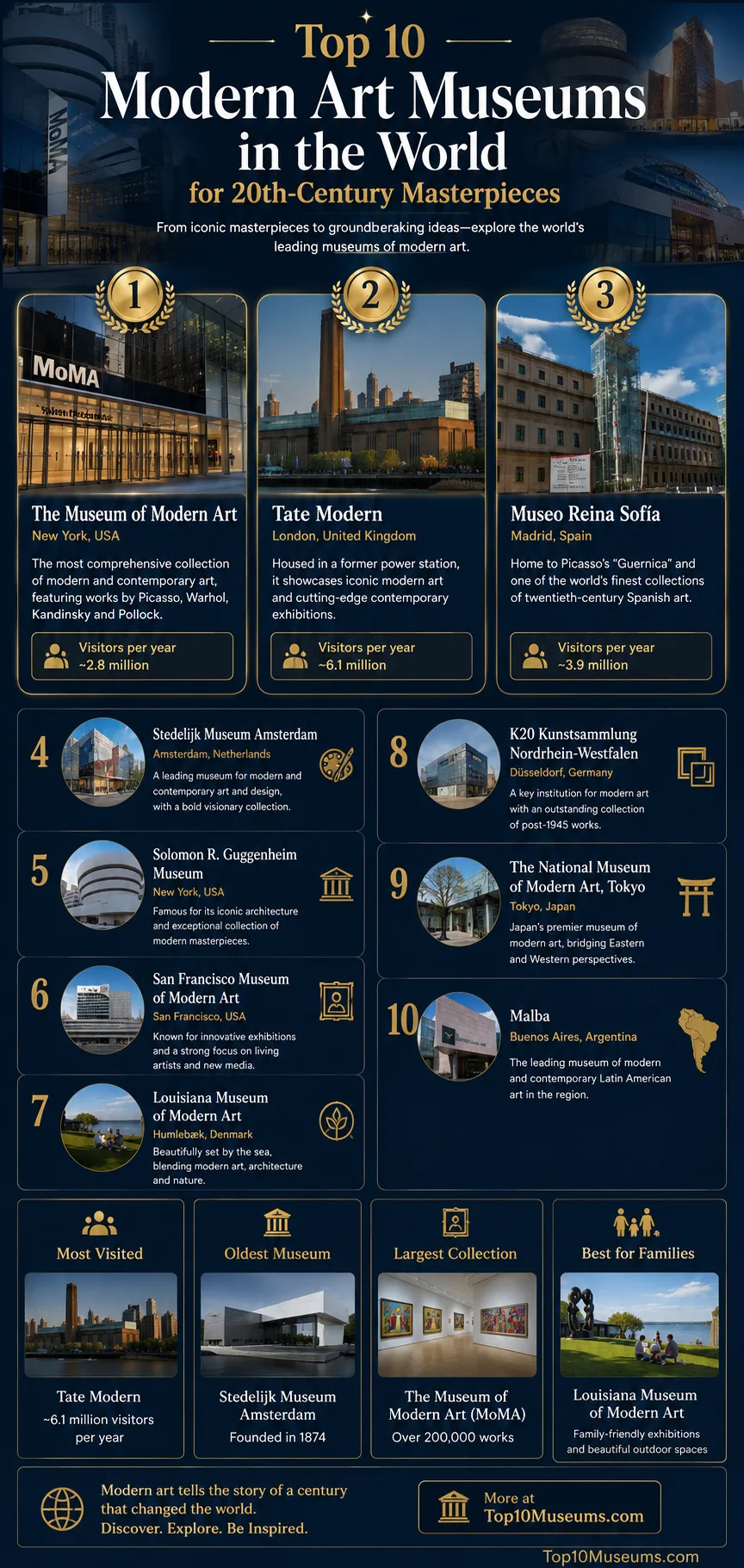
Modern art did not develop along one tidy route. Parisian Cubism, Dutch geometric abstraction, Spanish wartime art, American postwar painting, Japanese experiments with Western and local traditions, and Latin American modernism each require a different museum to be seen properly. The Museum of Modern Art in New York offers the broadest single overview, while institutions such as the Museo Reina Sofía, the National Museum of Modern Art in Tokyo and MALBA reveal parts of the twentieth century that disappear when the story is reduced to a Paris-to-New York timeline.
[ayaz_safe_content id=”3147″ key=”p3147b1zd1sk0yq”]
| Rank | Name | Founded | Collection Type | Website |
|---|---|---|---|---|
| 1 | The Museum of Modern Art | 1929 | Global modern art, design, photography and film | Official site |
| 2 | Tate Modern | 2000 | International modern and postwar art | Official site |
| 3 | Museo Nacional Centro de Arte Reina Sofía | 1990 | Spanish modernism, avant-garde and wartime art | Official site |
| 4 | Stedelijk Museum Amsterdam | 1895 | Modern art, De Stijl and design | Official site |
| 5 | Solomon R. Guggenheim Museum | 1939; current building 1959 | European abstraction and postwar art | Official site |
| 6 | San Francisco Museum of Modern Art | 1935 | American postwar art, photography and design | Official site |
| 7 | Louisiana Museum of Modern Art | 1958 | Postwar painting, sculpture and landscape | Official site |
| 8 | K20 Kunstsammlung Nordrhein-Westfalen | 1961 | Classical modernism and abstraction | Official site |
| 9 | The National Museum of Modern Art, Tokyo | 1952 | Modern Japanese art, Nihonga and Yōga | Official site |
| 10 | Malba | 2001 | Latin American modern and contemporary art | Official site |
What Separates a Great Modern Art Collection from a Famous Museum
The ranking gives the greatest weight to work made between 1900 and 2000. A high position requires more than a landmark building or one celebrated painting. The museum must connect several changes in twentieth-century art, place major works in useful context and give visitors enough collection material to understand why styles changed.
That produces different kinds of strengths. MoMA is the most convincing all-round choice for early modernism through Pop Art. Reina Sofía offers a much sharper account of Spanish avant-garde art and the Civil War. Stedelijk is stronger when art, furniture, typography and industrial design need to be read together. MOMAT and Malba shift attention away from the usual European and North American center.
2026 access note: Centre Pompidou would normally contend for a place near the top of this list. Its main Paris building closed to the public on September 22, 2025, and is scheduled to reopen in 2030 after renovation. Its collection remains active through loans and partner exhibitions, but it cannot currently offer the standard permanent-collection visit used for this ranking.
Display note: Ownership does not guarantee that a work will be hanging during a particular visit. Modern art museums rotate light-sensitive material, lend works, close galleries for reinstallation and rearrange collection rooms. Named masterpieces below are collection anchors to look for, not promises of permanent display. Checking the museum’s current floor plan is especially useful at the Guggenheim, Louisiana, MOMAT and MoMA.
Ten Museums That Explain the Twentieth Century Through Masterpieces
1. The Museum of Modern Art, New York
MoMA is the clearest first choice for seeing how twentieth-century art repeatedly broke its own rules. Its collection contains almost 200,000 works across painting, sculpture, drawing, printmaking, photography, architecture, design, film, media and performance. The scale matters because the museum can place a famous canvas beside the photographs, chairs, posters, films and printed material that formed the same visual culture.
The strongest route begins with the years before the First World War. Pablo Picasso’s Les Demoiselles d’Avignon fractures the inherited treatment of the human figure. Henri Matisse’s The Red Studio turns color into the structure of the room rather than a surface added to objects. From there, works linked to Futurism, Dada, Surrealism and geometric abstraction show how artists treated speed, dreams, machinery and non-representational form as separate answers to the same problem: what could painting do after realistic description was no longer its main task?
The postwar floors complete the argument. Jackson Pollock’s One: Number 31, 1950 makes the act of painting visible across a large field, while Andy Warhol’s Campbell’s Soup Cans removes the boundary between fine art and the repeated image of consumer culture. MoMA also gives architecture, product design and photography enough space to prevent modernism from becoming a parade of canvases. Visitors with limited time should choose one early-modern floor and one postwar floor rather than trying to clear the whole building.
The main weakness is abundance. A visit built only around the best-known works can become a race between crowded rooms. Two and a half to four hours is more realistic for a focused first visit, while specialists can spend most of a day moving between collection departments.
Best for: First-time visitors seeking the broadest route through twentieth-century art
Nearby alternative: Museum of Arts and Design — about a fifteen-minute walk west at Columbus Circle, with a tighter focus on materials, craft and product design.
2. Tate Modern, London
Tate Modern is strongest when modern art becomes large, spatial and difficult to separate from the room around it. The former Bankside Power Station opened as a museum in 2000, and its industrial scale suits postwar sculpture, installation and performance in a way that conventional galleries rarely can. The Turbine Hall remains the clearest example: it can accommodate commissions that visitors enter, cross or view from several levels.
The collection covers early modern art, but the visit becomes more distinctive after 1945. Tate’s holdings support direct comparisons between Abstract Expressionism, European postwar painting, Minimalism, Conceptual art, Arte Povera, performance and later installation practice. Mark Rothko, Louise Bourgeois, Joseph Beuys, Agnes Martin and artists working beyond the familiar Western European and American sequence can appear within the same thematic field.
This thematic arrangement is also the main difference from MoMA. Tate may place works from different decades and regions together because they address material, politics, the body or the idea of the artist’s studio. That can reveal connections a strict timeline would miss, though visitors who want a clean year-by-year account of Cubism, Surrealism and Pop Art may find the sequence less direct.
Admission to the main collection is free, so a focused return visit is practical. Two hours can cover selected collection displays and the Turbine Hall; a longer visit is needed when a major paid exhibition is added. The building involves long internal distances, and trying to cover every level in one pass usually reduces the value of the later rooms.
Best for: Postwar art, large installations and thematic comparisons across countries
Nearby alternative: Hayward Gallery — roughly twenty minutes west along the South Bank, with compact temporary exhibitions in a Brutalist building.
3. Museo Nacional Centro de Arte Reina Sofía, Madrid
Guernica is the central work at Reina Sofía, yet the painting is far more useful when approached through the rooms around it. The museum’s permanent collection opened in 1992 after the institution itself had opened in 1990. Picasso’s vast canvas became the point around which the museum could connect Spanish avant-garde art, the Civil War, the Republican pavilion in Paris, propaganda, exile and the wider European crisis of the 1930s.
The best approach is to resist walking straight to the painting. Photographs, drawings, posters, architectural material and work by Picasso’s contemporaries establish what the image was responding to. Guernica then reads as a public work made for a political setting rather than an isolated monochrome icon. Its scale, fractured bodies and compressed space become easier to understand when the surrounding evidence has already introduced the bombing of the Basque town and the Spanish pavilion for which the painting was created.
Salvador Dalí and Joan Miró extend the visit beyond Picasso. Their work shows that Spanish modernism did not form a single visual language: Dalí used exact detail to make irrational scenes appear physically real, while Miró reduced figures and signs into a looser vocabulary of line, color and symbol. Julio González adds a sculptural route through welded metal, and later rooms follow artists working through dictatorship, exile and democratic transition.
The Sabatini and Nouvel buildings form a large, sometimes confusing complex. Visitors mainly interested in the pre-1945 collection should begin with the floor plan and protect at least two hours. A half-day is justified when later Spanish art and temporary exhibitions are included.
Best for: Picasso, Spanish Surrealism and art shaped by the Spanish Civil War
Nearby alternative: CaixaForum Madrid — a short walk toward the Prado, useful for changing modern and contemporary exhibitions in a converted power station.
4. Stedelijk Museum Amsterdam
Stedelijk treats modern art and design as parts of the same cultural project. Its collection of about 100,000 works moves between painting, sculpture, photography, posters, furniture, typography, video and artist books. That breadth is especially useful for understanding movements that aimed to redesign daily life rather than produce a new style of painting alone.
De Stijl is the clearest example. Piet Mondrian’s reduction of the canvas to verticals, horizontals and primary colors becomes more informative beside Gerrit Rietveld’s furniture and the movement’s graphic work. The visitor can see how the same belief in order, reduction and universal form moved between a wall, a chair, a printed page and an interior. The museum’s Russian avant-garde and Malevich holdings add a parallel route into geometric abstraction, while Expressionism and postwar art prevent the display from becoming a single-school survey.
The design collection is not a secondary department. It helps explain why modernism entered offices, homes, transport, advertising and mass production. Students of architecture and visual communication can spend as much time with objects and printed material as with Mondrian, Chagall, Newman or Warhol. This makes Stedelijk a stronger choice than a painting-only museum for readers interested in how modern ideas became physical products.
The building combines the original 1895 museum with the large white extension opened in 2012. Collection displays may move between the two parts, so the floor plan matters. Two to three hours suits a first visit, though design specialists should allow longer.
Best for: De Stijl, geometric abstraction, graphic design and modern furniture
Nearby alternative: Moco Museum Amsterdam — beside Museumplein, with smaller displays centered on modern and contemporary popular names.
5. Solomon R. Guggenheim Museum, New York
The Guggenheim’s identity began with abstraction before Frank Lloyd Wright’s spiral building opened in 1959. The institution first operated as the Museum of Non-Objective Painting in 1939, shaped by Solomon R. Guggenheim’s collection and Hilla Rebay’s belief that non-representational art required a dedicated setting. Vasily Kandinsky remains essential to that origin, supported by artists such as Rudolf Bauer and later additions from several private collections.
The building changes how the art is encountered. A continuous ramp replaces a chain of rectangular rooms, giving the main exhibition a visible beginning, middle and end. Visitors can look across the rotunda and see other parts of the route while moving through it. Paintings are therefore experienced within a larger architectural field rather than as isolated objects on level walls.
That design has trade-offs. The rotunda is usually devoted to a temporary exhibition, so the character of the visit depends heavily on what occupies the ramp. The permanent collection, which numbers about 8,000 works across the Guggenheim Foundation, is not displayed as a fixed survey. Kandinsky, the Thannhauser Collection and postwar holdings may appear in side galleries or changing presentations, but visitors should confirm the current layout before expecting a particular masterpiece.
Allow about two hours for the building and the exhibitions on view. Architecture-focused visitors may need longer because the ramps, skylight, proportions and views across the central void reward slow movement. Those seeking the greatest density of famous twentieth-century paintings should still place MoMA first.
Best for: Kandinsky, non-objective painting and modern museum architecture
Nearby alternative: Neue Galerie New York — one block south, with German and Austrian art including Klimt, Schiele and early twentieth-century design.
6. San Francisco Museum of Modern Art
SFMOMA provides the strongest modern art collection on the United States West Coast and gives photography, architecture, design and media a place beside painting and sculpture. Founded in 1935, it can begin with early European modernism, move through Mexican and American art, and then devote substantial space to postwar artists whose careers continued across several decades.
Henri Matisse’s Femme au chapeau, Diego Rivera’s The Flower Carrier and Frida Kahlo’s Frieda and Diego Rivera establish several routes into the first half of the century. These works prevent the early-modern section from relying only on Parisian Cubism. The postwar collection then moves through Abstract Expressionism, Bay Area art, Pop, Minimalism and German painting.
The Doris and Donald Fisher Collection changes the scale of the visit. The group contains more than 1,100 works and is especially useful for seeing artists across multiple periods rather than through a single representative object. SFMOMA unveiled the first full reinstallation of the Fisher galleries since 2016 on April 18, 2026. The revised displays extend across several floors and include focused groupings around Alexander Calder, Ellsworth Kelly, Sol LeWitt and other postwar figures.
Seven gallery floors make selective planning necessary. Three hours is a sensible minimum for painting, sculpture and photography; a full half-day suits visitors who also want architecture, design, media art and a temporary exhibition. Families benefit from free admission for visitors aged eighteen and under, but the building’s size still favors a limited floor-by-floor plan.
Best for: American postwar art, photography and artists represented across several career stages
Nearby alternative: Museum of the African Diaspora — across the street, with focused exhibitions on art and culture shaped by African diasporic experience.
7. Louisiana Museum of Modern Art, Humlebæk
Louisiana is less encyclopedic than MoMA or Tate Modern, but few museums control the relationship between art, architecture and landscape as carefully. It opened in 1958 as a museum intended for modern Danish art, then shifted toward an international collection. Low galleries, glazed corridors, courtyards and the sculpture park extend across a coastal property overlooking the Øresund.
Alberto Giacometti is the defining artist inside the museum. The Giacometti Gallery places attenuated figures within a tall room where natural light, brick, timber and views into the landscape become part of the encounter. The works do not feel like examples inserted into a survey. Their spacing and the architecture encourage attention to scale, isolation and the distance between figures.
Other collection strengths include Asger Jorn and the CoBrA movement, Jean Dubuffet, Yves Klein, Francis Bacon, Henry Moore, Andy Warhol and German art of the 1980s. Sculpture continues outdoors, where works by Moore, Calder and others change with weather, season and viewpoint. The collection is shown in selective rotations rather than as a fixed chronology, so temporary exhibitions often shape a large part of the day.
Louisiana sits about 35 kilometers north of Copenhagen. Direct trains to Humlebæk take roughly forty minutes, followed by a walk to the museum. The transport time, sculpture park and changing exhibitions make this a half-day trip rather than a quick city stop. In good weather, three to five hours at the site is easy to justify.
Best for: Giacometti, postwar sculpture and visitors who value landscape as part of the display
Nearby alternative: Nivaagaards Malerisamling — south of Humlebæk, a smaller collection of European painting that works as a regional contrast to Louisiana’s postwar focus.
8. K20 Kunstsammlung Nordrhein-Westfalen, Düsseldorf
K20 offers a concentrated modern-art route built around an unusually strong starting point: the state of North Rhine-Westphalia acquired 88 works by Paul Klee in 1960, leading to the foundation of the Kunstsammlung Nordrhein-Westfalen in 1961. Klee is therefore not a lone famous name in the collection. His work forms the historical base from which the museum developed its holdings in classical modernism and postwar abstraction.
The collection links German Expressionism, Cubism and Surrealism with Matisse, Picasso, Kandinsky and later American art. This is one of the list’s best places to move from European experiments before the Second World War into Pollock, color-field painting, Minimalism and Pop without the scale of a huge multi-department museum. The black-granite K20 building on Grabbeplatz opened in 1986 and was later extended.
The current collection presentation gained about 800 square meters in late 2024, adding five rooms for more than thirty large works. It also places artists such as Etel Adnan, Lee Bontecou, Lygia Pape and Yayoi Kusama into dialogue with the older Western canon. This makes the display less linear while preserving the museum’s strength in abstraction.
Two to three hours is enough for a careful collection visit, making K20 easier to absorb than MoMA, Tate or SFMOMA. Visitors should distinguish K20 from the institution’s K21 venue, which is in another building and leans toward later art. Combining both sites turns the day into a broader twentieth- and twenty-first-century route.
Best for: Paul Klee, classical modernism and a compact route through abstraction
Nearby alternative: Kunsthalle Düsseldorf — beside K20 on Grabbeplatz, with changing exhibitions and a smaller, more experimental format.
9. The National Museum of Modern Art, Tokyo
MOMAT changes the geography of modern-art history. Established in 1952 as Japan’s first national art museum, it follows artists working through the Meiji, Taishō, wartime and postwar periods while showing how Japanese modernity developed through local debates rather than simple imitation of Europe.
Two categories are central to the visit. Nihonga refers to modern painting that continued or reworked Japanese materials and methods, while Yōga describes work made through Western-style oil painting and related techniques. The division is not a simple choice between tradition and progress. Artists on both sides altered inherited methods, responded to international exhibitions and debated what a modern national art should look like.
The museum holds more than 13,000 items and usually selects about 200 works for each MOMAT Collection period. Rotations allow fragile works on paper and silk to be shown while keeping the sequence fresh. The holdings include eighteen works designated as Important Cultural Properties, but not all appear during every cycle. Displays can connect the Great Kantō Earthquake, wartime production, occupation, postwar abstraction, photography and the rise of new media.
A chronological visit is more useful here than a hunt for internationally familiar names. Two hours will introduce the main collection; three hours allows closer attention to Nihonga, Yōga and postwar rooms. The location beside Kitanomaru Park and near the Imperial Palace makes the museum easy to combine with another central Tokyo institution without crossing the city.
Best for: Japanese modernism and the relationship between Nihonga, Yōga and postwar art
Nearby alternative: The Museum of the Imperial Collections, Sannomaru Shōzōkan — within the Imperial Palace East Gardens, offering a collection rooted in the Japanese imperial household.
10. Malba, Buenos Aires
Malba places Latin American modernism at the center of the story rather than treating it as a regional appendix. The museum opened in September 2001 with 220 works donated from Eduardo F. Costantini’s collection. Its holdings have since grown to more than 750 works representing artists from fifteen Latin American countries.
Tarsila do Amaral’s Abaporu is the collection’s defining early-modern work. Painted in 1928, the enlarged body, small head and cactus landscape became closely associated with Brazilian Anthropophagy, a movement that proposed absorbing foreign influences and transforming them for local use. Seen in Buenos Aires beside work from Argentina, Uruguay, Mexico, Cuba and other countries, the painting belongs to a regional exchange rather than a Brazilian story in isolation.
Antonio Berni’s Demonstration addresses labor and political crowd imagery through a very different visual language. Frida Kahlo, Remedios Varo, Wifredo Lam, Joaquín Torres García, Lygia Clark, Diego Rivera and Leonora Carrington extend the collection through Surrealism, Constructivism, social realism and experiments with the object and the body. These works show that Latin American modernism developed through urban growth, Indigenous and African cultural histories, migration, colonial legacies and changing political conditions.
The museum is smaller than most institutions above it, which is an advantage for a focused visit. Ninety minutes to two and a half hours can cover the main collection and one temporary exhibition without overload. Malba marks its twenty-fifth anniversary in 2026, but the reason to visit remains the collection’s ability to rearrange the geographic assumptions of twentieth-century art.
Best for: Latin American modernism, Brazilian Anthropophagy and regional Surrealism
Nearby alternative: Museo Nacional de Bellas Artes — about twenty minutes away on foot, with Argentine and European art that provides a broader historical comparison.
Choose the Museum by the Movement or Question
| Interest | First Choice | Strong Alternatives |
|---|---|---|
| Cubism and the early avant-garde | The Museum of Modern Art | Reina Sofía, K20 and the Guggenheim |
| Spanish Civil War and political modernism | Reina Sofía | MoMA for selected Picasso material |
| Surrealism | Reina Sofía | MoMA and Malba |
| De Stijl and modern design | Stedelijk Museum Amsterdam | MoMA |
| European abstraction | Solomon R. Guggenheim Museum | K20, Stedelijk and MoMA |
| Abstract Expressionism | MoMA | SFMOMA, Tate Modern and K20 |
| Postwar sculpture and installation | Louisiana Museum of Modern Art | Tate Modern and SFMOMA |
| Pop Art | MoMA | SFMOMA, Tate Modern and Louisiana |
| Japanese modernism | The National Museum of Modern Art, Tokyo | No other museum in the ranking offers equal depth |
| Latin American modernism | Malba | SFMOMA and MoMA for smaller selections |
| Architecture as part of the visit | Solomon R. Guggenheim Museum | Louisiana and Tate Modern |
| Broad first visit to modern art | The Museum of Modern Art | Tate Modern |
Practical Museum Pairings Without Overloading the Day
A single route cannot sensibly connect ten museums spread across four continents. The useful planning unit is the city or regional cluster. Large institutions should anchor the day, while a smaller nearby museum can provide contrast without forcing another long journey.
- New York: Give MoMA its own half-day in Midtown. Visit the Guggenheim on a separate morning, then continue one block to Neue Galerie. Combining MoMA and the Guggenheim is possible, but it produces a long day with two dense collections and a subway transfer.
- London: Start at Tate Modern when the galleries open, take a break along the South Bank, then continue west to Hayward Gallery if its current exhibition matches the trip. A paid Tate exhibition can easily turn Tate into the only major museum of the day.
- Madrid: Use Reina Sofía as the main morning or afternoon stop. CaixaForum is close enough for a shorter second visit, while adding the Prado on the same day suits only visitors comfortable with six or more hours of gallery time.
- Amsterdam: Stedelijk and Moco sit beside each other on Museumplein. The pairing is geographically easy, though Stedelijk deserves most of the time. Adding the Van Gogh Museum requires advance planning and creates a much fuller day.
- San Francisco: SFMOMA and the Museum of the African Diaspora form the simplest pairing on the list because they are across the street from one another. Begin with SFMOMA and use MoAD as the shorter second visit.
- Copenhagen and Humlebæk: Treat Louisiana as a dedicated half-day excursion. The train ride, walk, sculpture park and coastal setting make it impractical to squeeze between two major Copenhagen museums.
- Düsseldorf: K20 and Kunsthalle Düsseldorf share Grabbeplatz, so they can be visited without transit. Add K21 only if the day is reserved for art and the later collection is a priority.
- Tokyo: MOMAT works well in the morning, followed by Kitanomaru Park and the Museum of the Imperial Collections. This keeps the route around the Imperial Palace rather than adding a cross-city transfer to Roppongi or Ueno.
- Buenos Aires: Begin at Malba, then walk or take a short ride to the Museo Nacional de Bellas Artes. The first centers Latin America’s twentieth century; the second supplies a wider Argentine and European historical setting.
The strongest museum depends on the part of the century being investigated. MoMA remains the most effective single introduction, Reina Sofía makes political rupture inseparable from formal experiment, Louisiana turns sculpture into a spatial experience, MOMAT explains a modernity formed through Japanese debates, and Malba places Latin America within its own network of artists, cities and ideas.