
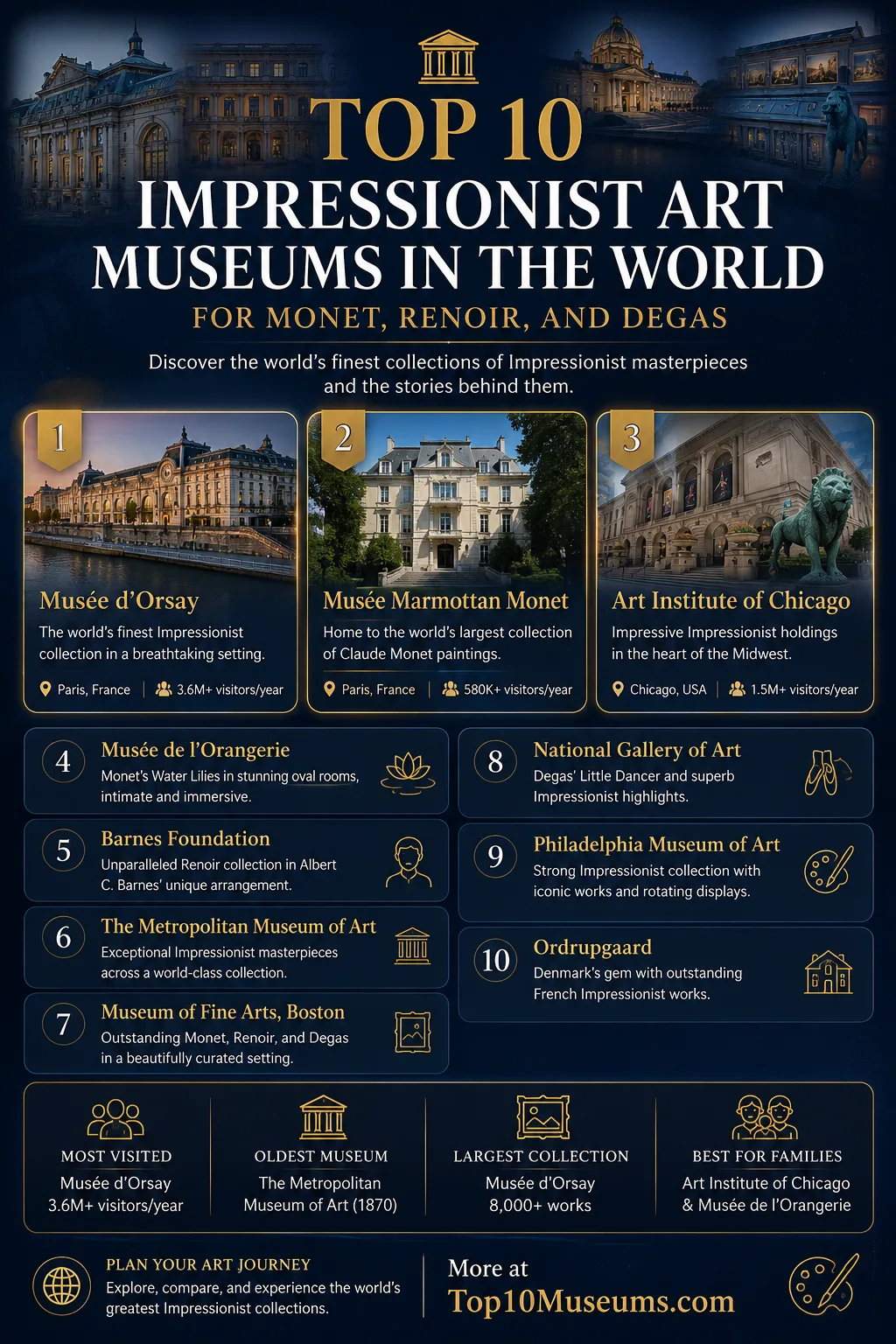
Seeing Monet, Renoir, and Degas in the same museum does not always produce the same Impressionist experience. One collection may reveal Monet’s repeated study of fog, water, and changing light; another may place dozens of Renoir figures within arm’s reach; a third may show Degas through paintings, pastels, prints, and sculpture rather than ballet pictures alone. These ten museums are ranked by permanent collection depth, the quality of the three-artist comparison, defining works, and the way the galleries help visitors understand how differently the artists treated modern life.
Musée d’Orsay is the strongest all-round starting point, but the ranking changes when one artist becomes the priority. Musée Marmottan Monet offers the clearest view of Monet’s career, the Barnes Foundation holds 179 Renoir paintings, and the National Gallery of Art preserves Degas’s original wax Little Dancer Aged Fourteen. Ownership does not guarantee display: loans, conservation, gallery changes, and light-sensitive works on paper can alter what is visible on a particular day.
[ayaz_safe_content id=”3151″ key=”p3151b1de3cfhwi”]
| Rank | Name | Founded | Collection Type | Website |
|---|---|---|---|---|
| 1 | Musée d’Orsay | 1986 | French art from 1848 to 1914, led by Impressionism | Official website |
| 2 | Musée Marmottan Monet | 1934 | Monet, Berthe Morisot, and French private collections | Official website |
| 3 | Art Institute of Chicago | 1879 | European painting with major French Impressionist holdings | Official website |
| 4 | Musée de l’Orangerie | 1927 | Monet’s Water Lilies and the Walter-Guillaume Collection | Official website |
| 5 | Barnes Foundation | 1922 | Renoir, Cézanne, modern painting, and decorative ensembles | Official website |
| 6 | The Metropolitan Museum of Art | 1870 | Global art with deep Impressionist painting and sculpture holdings | Official website |
| 7 | Museum of Fine Arts, Boston | 1870 | European art with one of the largest Monet groups outside France | Official website |
| 8 | National Gallery of Art | 1941 | Western art with free access to major Impressionist works | Official website |
| 9 | Philadelphia Museum of Art | 1876 | European and American art with landmark Impressionist works | Official website |
| 10 | Ordrupgaard | 1953 | French Impressionism, Danish art, design, and architecture | Official website |
The Ranking Changes with the Artist
Monet rewards sequence: several versions of a subject reveal how weather, season, and time altered his decisions. Renoir rewards concentration because changes in figure painting, portraiture, leisure scenes, and late nudes become easier to detect when many works share a room. Degas needs media variety. A museum with paintings alone may show his subjects, while a museum with pastel, print, drawing, and sculpture reveals how he built movement.
| Museum | Monet | Renoir | Degas | Defining Reason |
|---|---|---|---|---|
| Musée d’Orsay | Exceptional | Exceptional | Exceptional | The strongest three-artist historical comparison |
| Musée Marmottan Monet | Exceptional | Supporting | Supporting | Monet’s career from Impression, Sunrise to late Giverny |
| Art Institute of Chicago | Exceptional | Strong | Strong | Series paintings and a leading Monet group outside Paris |
| Musée de l’Orangerie | Exceptional | Strong | Limited | The only purpose-shaped setting for Monet’s panoramic Water Lilies |
| Barnes Foundation | Selective | Exceptional | Strong | The world’s largest holding of Renoir paintings |
| The Metropolitan Museum of Art | Strong | Strong | Exceptional | Paintings, pastels, prints, and sculpture within a broad 19th-century setting |
| Museum of Fine Arts, Boston | Exceptional | Strong | Strong | A large Monet holding with balanced Renoir and Degas galleries |
| National Gallery of Art | Strong | Strong | Exceptional | Degas’s original wax Little Dancer Aged Fourteen |
| Philadelphia Museum of Art | Strong | Strong | Strong | Three landmark works that show different artistic directions |
| Ordrupgaard | Strong | Strong | Strong | An intimate collection with delicate pastels in controlled light |
Display note: Permanent ownership does not mean permanent display. Pastels and drawings often rotate because light can damage them, while paintings may travel or enter conservation. Confirming the current gallery location of a priority work before travelling prevents a collection record from being mistaken for an on-view promise.
Ten Museums That Reveal Three Different Versions of Impressionism
1. Musée d’Orsay, Paris
Musée d’Orsay gives Monet, Renoir, and Degas enough space to disagree with one another. Monet’s landscape painting can be followed through open-air work, urban views, garden subjects, serial painting, and the approach to Giverny. Renoir moves between public leisure, portraits, dance, intimate figures, and the firmer drawing of his later career. Degas shifts the mood again: rehearsal rooms, cafés, racecourses, family portraits, women at work, bathers, pastels, and sculpture replace the idea that Impressionism was defined only by outdoor sunlight.
The museum opened in 1986 inside the former Gare d’Orsay, a railway station built for the 1900 Universal Exhibition. Its 1848–1914 date range matters because the artists appear beside Manet, Morisot, Pissarro, Caillebotte, Cézanne, and artists who moved away from Impressionism. Renoir’s Bal du moulin de la Galette can therefore be read as a painting of modern sociability rather than a detached festival image. Degas’s The Ballet Class and The Bellelli Family show the gap between observed movement and carefully planned structure. Monet’s works demonstrate why a series is more revealing than a single famous canvas.
Three hours is a sensible minimum for an Impressionist-focused visit, and four allows time for sculpture and works on paper. Since March 2026, the museum has remained open during a long reception-area and access improvement project planned through summer 2028. The collections remain available, but entrance routes and visitor flow may change during the work.
Best for: A first visit that needs Monet, Renoir, and Degas in equal depth
Nearby alternative: Musée Maillol — a smaller Left Bank museum where 20th-century art and temporary exhibitions provide a calmer follow-up within walking distance.
2. Musée Marmottan Monet, Paris
Musée Marmottan Monet works like a visual biography of Monet rather than a general survey of Impressionism. About one hundred works trace him from the 1870s through his final years, allowing visitors to compare early snow, railways, riverbanks, city views, the Rouen Cathedral series, London fog, Water Lilies, and late paintings of the Japanese bridge. The collection makes slow change visible: recognizable places gradually yield to denser surfaces, altered colour, and a less stable horizon.
Impression, Sunrise is the historical anchor. Its view of Le Havre supplied the word later used to label the movement, yet the painting becomes more useful when seen near later work. The brief strokes and hazy port do not lead in a straight line to abstraction; they begin a long investigation of how little information a scene needs before atmosphere takes control. Nearby paintings such as Rouen Cathedral, Effect of Sun, End of Day, London, Parliament, Reflections on the Thames, and late Giverny subjects reveal how Monet returned to the same problem under new conditions.
The museum also holds the leading public collection of Berthe Morisot, which adds a needed counterpoint to a Monet-first visit. Renoir and Degas are present, but they do not have equal weight here. That imbalance is the reason Marmottan ranks second rather than first overall. It is the better choice when the goal is to understand one artist across decades, and a weaker choice when only one Paris museum can be used to compare all three.
Allow about two hours for the permanent collections, longer when a temporary exhibition shares the visit. The museum occupies a former private house near the Bois de Boulogne, so the scale is more intimate than Orsay. Rooms can still feel dense around Impression, Sunrise; arriving near opening or using the Thursday evening schedule often gives the central Monet gallery more breathing room.
Best for: Following Monet from Impression, Sunrise to the late Japanese Bridge paintings
Nearby alternative: Musée Clemenceau — a small historic-house museum linked to Monet’s close friend Georges Clemenceau, whose support helped bring the Water Lilies project to the Orangerie.
3. Art Institute of Chicago
Chicago is the strongest destination outside Paris for seeing Monet think in series. The Art Institute owns the largest group of his Stacks of Wheat paintings and places them near views of the Thames, bridges, river mist, irises, and the water garden. Several versions of related subjects can be compared without depending on a temporary exhibition. The point is not repetition. Small changes in sun, cloud, moisture, season, and viewpoint alter the entire surface.
The museum’s connection with Monet developed early. Founded in 1879, it became the first American museum to buy one of his paintings in 1903. Chicago collectors also acquired French Impressionism when it still divided opinion in the United States. That history explains why the galleries contain both familiar images and enough related work to examine how the paintings were made and collected.
Renoir is not a minor supporting name. Two Sisters (On the Terrace) sets patterned clothing, flowers, foliage, and the Seine-side setting against one another without losing the two figures. Acrobats at the Cirque Fernando brings performance and labour into the same scene. Degas broadens the visit through The Millinery Shop, the largest of his paintings devoted to hatmakers, along with dancers, jockey studies, portraits, and works on paper. These objects keep Degas connected to shops, workrooms, entertainment, and urban observation.
Two and a half to three hours suits a visit centred on European painting, though the whole museum can absorb much longer. The Impressionist rooms are popular and easy to reach from the Michigan Avenue entrance. A useful sequence is Monet first, Renoir second, and Degas last; the shift from weather to people to controlled bodily movement becomes clearer when the artists are not mixed into one hurried pass.
Best for: Comparing Monet’s series paintings without travelling to France
Nearby alternative: Museum of Contemporary Photography — a short walk south that extends the discussion of cropping, urban observation, and modern image-making into photography.
4. Musée de l’Orangerie, Paris
The Orangerie is ranked for one installation rather than equal coverage of all three artists. Monet’s eight monumental Water Lilies compositions occupy two oval rooms designed around the paintings. The panels bend with the walls, horizons dissolve, and no single standing position controls the whole work. Benches at the centre encourage a slower form of looking than a normal sequence of framed canvases.
Monet offered the Water Lilies to the French state after the Armistice of 1918, and the installation opened in 1927, several months after his death. Natural light, long horizontal movement, and the transition between the two rooms are part of the work’s effect. A photograph can record the room, but it cannot reproduce the changing distance between the viewer and the painted surface. Close inspection reveals revisions, dragged paint, exposed canvas, and abrupt marks; stepping back turns them into reflections, branches, clouds, and water.
The lower level changes the emphasis through the Walter-Guillaume Collection. Renoir appears in portraits, figures, and later nudes alongside Cézanne, Modigliani, Matisse, Picasso, Soutine, and others. Degas is not a central force, which limits the museum as a three-artist survey. The high position comes from the fact that no other museum offers this particular Monet experience.
A focused visit can take ninety minutes, while two hours gives the oval rooms enough time before and after the lower galleries. The museum is compact, but timed entry is sensible during busy travel periods. Returning to the Water Lilies after seeing the Walter-Guillaume rooms often changes the second viewing; Renoir’s figures make Monet’s near-absence of people feel more deliberate.
Best for: Experiencing Monet’s late Water Lilies as an environment rather than separate pictures
Nearby alternative: Jeu de Paume — across the Tuileries axis, this museum for photography and image-based art offers a useful contrast with Monet’s continuous painted field.
5. Barnes Foundation, Philadelphia
The Barnes Foundation changes the Renoir question from “Which masterpiece should be seen?” to “How did one painter keep changing across a long career?” Its current collection count lists 179 Renoir paintings, the largest holding of his paintings anywhere. Early landscapes, portraits, family groups, bathers, reclining figures, and late work appear in a density no standard survey gallery can match.
Albert C. Barnes chartered the foundation in 1922 as an educational institution. He arranged paintings with furniture, metalwork, African sculpture, Pennsylvania German objects, and works from different centuries. These ensembles remain central to the visit. Labels are less dominant than in many museums, chronology is interrupted, and repeated shapes or colour relations determine what hangs together. Renoir may sit beside Cézanne, Matisse, a metal hinge, and a carved object rather than beside paintings from the same year.
This arrangement can be demanding. A visitor looking for a clean timeline has to build it mentally, while a visitor willing to compare edges, curves, colour patches, and figure placement may see Renoir with unusual clarity. Monet and Degas appear within the ensembles as well, though Renoir controls the balance. Degas benefits from the mixed-media setting because his interest in structure and silhouette can be read against objects that Barnes selected for formal comparison.
Reserve at least two hours and consider a highlights tour for a first visit. Photography restrictions and room rules deserve checking before arrival because the collection is installed differently from a normal picture gallery. The Philadelphia campus reproduces the scale and arrangement of the original Merion rooms, even though the building opened on Benjamin Franklin Parkway in 2012.
Best for: Seeing Renoir across many subjects, decades, and changes of style
Nearby alternative: Rodin Museum — a few minutes along Benjamin Franklin Parkway, with a focused sculpture collection that pairs well with Degas’s interest in modeled movement.
6. The Metropolitan Museum of Art, New York
The Met is most useful when Impressionism is treated as part of a larger 19th-century argument rather than an isolated style. Monet, Renoir, and Degas can be compared with Manet, Morisot, Cassatt, Caillebotte, Pissarro, and the academic painting against which the independent exhibitions were judged. The museum’s scale also allows the three artists to appear in painting, pastel, drawing, print, and sculpture.
Monet’s range includes early outdoor work, Argenteuil, the Rouen Cathedral series, London fog, the Japanese bridge, and late Water Lilies. Seeing Garden at Sainte-Adresse near later paintings helps separate his changing brushwork from the simpler claim that he merely painted light. Renoir’s Madame Georges Charpentier and Her Children shows how modern portraiture, fashion, interior design, and social position can occupy one canvas. Other figure paintings reveal the transition from broken colour toward a more controlled line.
Degas is the main reason the Met rises above museums with a similar number of famous paintings. The Dance Class is joined by rehearsal scenes, racehorses, portraits, bathers, pastels, prints, and bronze casts. The variety corrects two common errors: Degas was not confined to dancers, and his finished-looking compositions were rarely casual snapshots. Repeated studies, altered poses, and experiments across media show how carefully the apparent immediacy was constructed.
The Met cannot be treated as a short stop. A three-hour Impressionist and 19th-century route is realistic; adding unrelated departments can easily turn the visit into a full day. Check the gallery map on arrival because rotations and loans can separate related works. Starting with European paintings and ending with sculpture or works on paper reduces backtracking.
Best for: Studying Degas across paintings, pastels, prints, and sculpture
Nearby alternative: Neue Galerie New York — a short walk north for Austrian and German art around 1900, useful for seeing how European modernism developed beyond the French circle.
7. Museum of Fine Arts, Boston
Boston offers one of the most balanced American settings for the three artists, with Monet as the numerical centre. The Art of Europe department holds 35 Monet paintings, one of the largest groups outside France. That depth covers more than Water Lilies: coastlines, snow, river scenes, city views, haystacks, and Giverny show how his subjects and surfaces changed over time.
Renoir’s Dance at Bougival provides the human counterweight. The near life-size couple turns, but the painting does not explain their relationship or the crowd around them. Movement comes from the tilted bodies, sweeping clothing, and blurred background. Degas makes movement less celebratory. Dancers stretch, wait, adjust clothing, or prepare to perform, while sculpture and works on paper shift attention toward repetition, training, and the physical work behind the stage image.
The galleries make a useful three-way comparison: Monet records movement in water, weather, and reflected light; Renoir builds it through social contact; Degas studies bodies under discipline. That comparison gives the museum an advantage over collections that are much stronger in only one name. American collecting history also matters here. Boston collectors embraced French Impressionism early enough to form holdings that now reveal several stages of the artists’ careers.
Plan two and a half to three hours for European art, or longer when combining other departments. The museum’s Huntington Avenue building is large, but the Monet-focused gallery and nearby Impressionist rooms make this theme easier to manage than a whole-building visit. Families can use the clear figures, dance scenes, gardens, and weather changes as visual entry points without needing a long historical introduction.
Best for: A balanced American collection led by 35 Monet paintings
Nearby alternative: Isabella Stewart Gardner Museum — a short walk away, combining a private collector’s installation with works by Manet, Degas, and artists who shaped the same period.
8. National Gallery of Art, Washington, DC
The National Gallery’s strongest claim in this ranking is Degas’s original wax Little Dancer Aged Fourteen. The figure wears a real fabric costume and ribbon, and the mixed materials were part of what unsettled viewers when Degas exhibited it in 1881. Bronze versions in other museums are important, but the wax object preserves the physical choices that made the sculpture look uncomfortably close to a living student dancer.
Degas continues through Four Dancers, dance-class scenes, racehorses, bathers, drawings, prints, and modeled studies. The collection makes it possible to compare public performance with rehearsal, and a finished bronze with the rougher working process behind it. His dancers are not generic symbols of elegance. They are students, workers, and bodies repeatedly corrected into position.
Monet and Renoir remain strong enough to keep the visit balanced. Monet’s Woman with a Parasol—Madame Monet and Her Son, the Japanese footbridge, Seine landscapes, and later works show both figure-in-landscape painting and the move toward serial subjects. Renoir’s Girl with a Watering Can, portraits, landscapes, and urban scenes offer a quieter range than the Barnes but a clearer chronological setting.
The West Building opened in 1941 and admission remains free. Two hours is enough for an Impressionist route, though Degas specialists should allow longer for sculpture and any available works on paper. Most relevant galleries are in the West Building; crossing to the East Building is unnecessary unless modern and contemporary art is part of the same day.
Best for: Degas’s original wax Little Dancer Aged Fourteen and free repeat viewing
Nearby alternative: National Museum of Asian Art — nearby on the National Mall, with Japanese prints and paintings that help explain the cropped viewpoints and flattened spaces admired by many French artists.
9. Philadelphia Museum of Art
Three works make the Philadelphia Museum of Art especially useful for comparing where Monet, Renoir, and Degas eventually took their early experiments. Monet’s Japanese Footbridge and the Water Lily Pool, Giverny turns a garden that he designed into a dense field of reflection, foliage, and colour. Renoir’s Great Bathers moves away from the broken touch of his 1870s leisure scenes toward firmer contours and a more classical figure group. Degas’s Little Dancer, Aged Fourteen brings modern labour, training, sculpture, and real-world materials into the same conversation.
The contrast matters more than the fame of the individual works. Monet reduces stable depth, Renoir rebuilds solid bodies, and Degas turns a working-class ballet student into a freestanding object. The three artists no longer look like members of a uniform style. They become painters and sculptors who shared exhibitions and subjects but reached different late-career solutions.
The museum was founded in 1876 and moved into its Fairmount building in 1928. Its European galleries also connect the three artists with Mary Cassatt, Manet, Morisot, Cézanne, Van Gogh, and Toulouse-Lautrec. Works on paper are especially useful when displayed, though their exposure must be limited and rotations are normal. A visitor travelling for one drawing or pastel should confirm its status before arrival.
Allow two and a half hours for the relevant galleries and more for the building’s period rooms or American collections. Pairing this museum with the Barnes on the same day is possible, but both deserve more than a rushed hour. A better rhythm is one before lunch and one after a real break, with the smaller Rodin Museum used only when energy remains.
Best for: Comparing three landmark works that point in different post-Impressionist directions
Nearby alternative: Pennsylvania Academy of the Fine Arts — reachable along the Parkway and Broad Street corridor, with American painting that shows how Impressionist methods changed after crossing the Atlantic.
10. Ordrupgaard, Charlottenlund
Ordrupgaard is the smallest museum in the ranking, yet its French collection is unusually coherent. Wilhelm and Henny Hansen assembled it in only three years, from 1916 to 1918, linking Romanticism, realism, the Barbizon painters, Impressionism, and the artists who followed. The museum opened as a Danish state art museum in 1953, preserving the character of a private collection while later architecture added new ways to display it.
Monet’s Waterloo Bridge, Overcast belongs to the London series and shows why a grey subject can carry many colours. The bridge, river traffic, factories, smoke, and fog are less important as separate objects than as layers within one atmosphere. Renoir is represented by paintings and pastels including the study for Le Moulin de la Galette, portraits, street figures, and later subjects. The study is especially useful beside the finished Orsay painting because it exposes the planning behind an image that feels spontaneous.
Degas adds New Orleans, dancers, singers, women dressing, and works on paper. The Snøhetta extension, opened for the French collection in 2021, provides controlled light and humidity. Delicate pastels by Degas, Renoir, and other artists can therefore remain part of a more stable hanging than was possible in the older galleries. Zaha Hadid’s earlier extension and Finn Juhl’s House make architecture and design part of the visit without overwhelming the Impressionist rooms.
Ordrupgaard sits about 10 kilometres north of central Copenhagen, so it needs a planned half-day rather than a casual city-centre stop. Two to three hours covers the French and Danish collections; Finn Juhl’s House may require a separate timed tour on weekdays. The quieter scale is an advantage for close looking, particularly after visiting larger museums where the same artists draw dense crowds.
Best for: Close study of Impressionist painting and pastel in an intimate architectural setting
Nearby alternative: Øregaard Museum — a smaller museum in Hellerup with Danish art and local cultural history, useful for extending the northern Copenhagen trip without returning downtown.
Practical Routes for Combining the Collections
Paris: Orsay and Orangerie in One Day, Marmottan Separately
Begin at Musée d’Orsay near opening and reserve at least three hours. After lunch, cross the Seine toward the Tuileries and visit the Orangerie for ninety minutes to two hours. This pairing moves from the movement’s broad social and artistic setting to Monet’s final panoramic project without crossing Paris repeatedly. Musée Marmottan Monet belongs on another morning or afternoon because it sits in the 16th arrondissement and rewards a slower chronological visit. Compressing all three into one day turns the largest Monet collection into a checklist.
Philadelphia: Barnes and the Philadelphia Museum of Art
The Barnes Foundation and Philadelphia Museum of Art sit along the same Parkway corridor, with the Rodin Museum between them. Start at the Barnes with a timed entry and spend two hours learning the ensemble layout. Pause before walking west to the Philadelphia Museum of Art for the afternoon. The two collections complement each other: the Barnes supplies Renoir in concentration, while the larger museum supplies three carefully separated landmark works. Adding the Rodin Museum is realistic only as a short third stop, not as another full collection visit.
New York, Philadelphia, and Washington by Rail
A multi-city trip can follow the northeastern rail corridor without treating museums as day-trip errands. Give the Met its own New York day. Use one full Philadelphia day for the Barnes and Philadelphia Museum of Art, then reserve a separate Washington day for the National Gallery of Art. This sequence is especially effective for Degas: the Met establishes his range of media, Philadelphia shows a posthumous cast of the Little Dancer, and Washington preserves the original wax figure.
Chicago or Boston as a Single-City Art Weekend
The Art Institute of Chicago can fill most of one day when Monet’s series are the priority. Avoid scheduling another large encyclopedic museum immediately afterward. In Boston, place the Museum of Fine Arts first and the Isabella Stewart Gardner Museum on a second half-day. The short distance makes the pair easy, but their display methods are different enough to deserve separate attention rather than a hurried double visit.
What the 2026 Monet Centenary Changes
Claude Monet died on December 5, 1926, making 2026 the centenary of his death. The anniversary affects temporary programming, loans, and gallery traffic even when permanent holdings stay unchanged. Musée de l’Orangerie has scheduled Monet, Painting Time from September 30, 2026, through January 25, 2027. The exhibition examines his treatment of time and sits directly beside the permanent Water Lilies rooms, so advance booking is more useful than usual during that period.
London’s National Gallery, outside this top ten because its three-artist permanent holdings are narrower, is showing Monet and Renoir’s two 1869 La Grenouillère paintings side by side from July 27 through September 15, 2026. Its Renoir and Love exhibition follows from October 3, 2026, through January 31, 2027. These dated displays can change the best destination for a particular travel month, but they should not replace a ranking built on permanent collections.
Musée d’Orsay is also open during reception-area and access work scheduled from March 2026 through summer 2028. The project does not close the museum, though entry arrangements and movement through the building may change. Visitors travelling for a single work should verify both access information and current display status shortly before the visit.
Choose the Museum by the Question the Art Should Answer
- How did Monet change over six decades? Musée Marmottan Monet gives the clearest career sequence.
- How did Monet, Renoir, and Degas differ while sharing the same movement? Musée d’Orsay provides the strongest shared setting.
- What does a Monet series reveal that one painting cannot? The Art Institute of Chicago offers the most useful group outside Paris.
- How does a painting become an architectural environment? Musée de l’Orangerie is built around that experience.
- How varied was Renoir beyond a few famous social scenes? The Barnes Foundation answers through unmatched concentration.
- How did Degas move between media? The Met and National Gallery of Art provide the strongest two-part study.
- Where can all three artists be compared without the scale of Paris or New York? The Museum of Fine Arts, Boston and Ordrupgaard offer more manageable gallery experiences.