
[ayaz_safe_content id=”3129″ key=”p3129b1fuqy4zxn”]
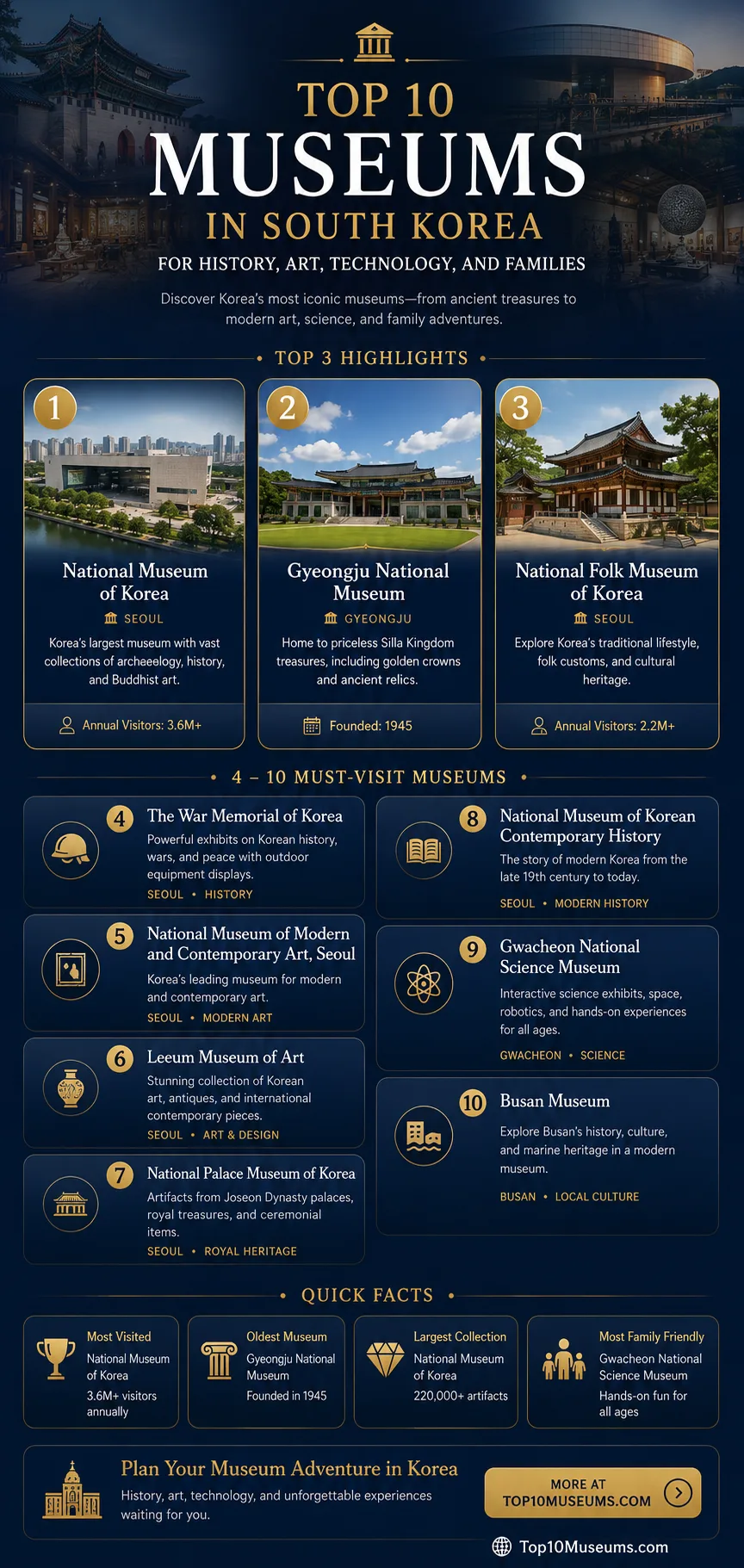
| Rank | Name | Founded | Collection Type | Website |
|---|---|---|---|---|
| 1 | National Museum of Korea | 1945; Yongsan home opened in 2005 | Korean archaeology, history, Buddhist art, calligraphy, Asian art | Official website |
| 2 | Gyeongju National Museum | 1945 | Silla Kingdom relics, gold crowns, Buddhist art, archaeology | Official website |
| 3 | National Folk Museum of Korea | 1946; current Gyeongbokgung site opened in 1993 | Daily life, folk customs, family cycles, traditional culture | Official website |
| 4 | The War Memorial of Korea | 1994 | Korean War history, military artifacts, memorial halls, outdoor equipment | Official website |
| 5 | National Museum of Modern and Contemporary Art, Korea – Seoul | 1969; Seoul branch opened in 2013 | Korean modern art, contemporary art, media, installation, architecture | Official website |
| 6 | Leeum Museum of Art | 2004 | Korean traditional art, modern art, international contemporary art | Official website |
| 7 | National Palace Museum of Korea | 2005 | Joseon royal culture, Korean Empire objects, court rituals, palace science | Official website |
| 8 | National Museum of Korean Contemporary History | 2012 | Modern Korea, independence, democracy, industry, media, public life | Official website |
| 9 | Gwacheon National Science Museum | 2008 | Science, technology, natural history, astronomy, children’s science | Official website |
| 10 | Busan Museum | 1978 | Busan history, regional archaeology, Buddhist relics, local heritage | Official website |
Why These Ten Museums Made the Cut
This ranking favors museums that help visitors understand Korea through objects, not slogans. The list starts with national collections, then adds royal culture, Silla archaeology, folk life, war memory, modern art, science, aviation-adjacent technology, and regional history. Several choices also work well for families because they offer outdoor space, interactive galleries, children’s areas, or clear English support.
The list is not limited to Seoul, even though Seoul has the densest museum cluster. Gyeongju matters because it was the capital of Silla for nearly a thousand years, while Busan adds port-city and regional history that Seoul museums cannot fully replace. Gwacheon also earns its place because science and technology are part of South Korea’s public culture, not a side topic.
Top 10 Museums in South Korea
1. National Museum of Korea
Best for: first-time visitors, Korean history learners, Buddhist art fans, families, and travelers who want one museum that explains the country in broad strokes.
The National Museum of Korea is the best single museum choice for a first visit to South Korea. Its permanent displays cover prehistory, ancient kingdoms, Goryeo celadon, Joseon painting, Buddhist sculpture, calligraphy, donated collections, and Asian art. The museum was founded in 1945 and reopened in its large Yongsan home in 2005, a site that gives the collection enough room to breathe rather than crowding objects into narrow palace buildings.
One practical reason it ranks first is scale. The permanent exhibition shows more than 12,000 objects across six major sections, while the collection as a whole is much larger. For many visitors, the standouts are the Pensive Bodhisattva displays, Silla gold objects, Goryeo celadon, Buddhist reliquaries, and the high central hall where stone pagodas feel almost architectural. It is also a forgiving museum for mixed groups: one person can study ceramics, another can take a shorter route, and children can break up the day with the outdoor grounds.
General admission to the permanent galleries is usually $0, while special exhibitions may require a paid ticket. The museum sits near Ichon Station and pairs easily with Yongsan, the Han River, or the War Memorial of Korea on the same day. Give it at least two hours; serious history fans can spend half a day without forcing it.
Nearby alternative: National Hangeul Museum — a focused language museum beside the National Museum of Korea, useful if you want a shorter stop about the Korean alphabet after the main galleries.
2. Gyeongju National Museum
Best for: Silla history fans, archaeology travelers, school-age children, cultural heritage trips, and anyone visiting Gyeongju for tombs and temples.
Gyeongju National Museum belongs near the top because Gyeongju is not just another Korean city; it was the heart of the Silla Kingdom. The museum opened as a national museum branch in 1945 and focuses on objects from a region where royal tombs, temple sites, palace ponds, and Buddhist remains still shape the city. For travelers who have already walked around Daereungwon or Wolji Pond, this museum turns those sites into a clearer story.
The museum is especially good for gold crowns, roof tiles, stone Buddhist sculpture, and excavated Silla objects. Its most famous large object is the Sacred Bell of Great King Seongdeok, often known in English as the Emille Bell. The galleries also connect well with nearby outdoor heritage areas, which makes the museum feel less isolated than a standard indoor attraction.
Families should look for the Children’s Museum, where young visitors can meet cultural objects through play rather than long labels. The museum works best before or after a tomb-area walk; the objects feel more alive when the city’s mounds, ponds, and temple ruins are still fresh in mind.
Nearby alternative: Wooyang Museum of Contemporary Art — a useful contrast in the Bomun area if you want modern Korean and international art after a Silla-focused day.
3. National Folk Museum of Korea
Best for: families, culture-first travelers, Gyeongbokgung visitors, everyday-life history fans, and readers who prefer customs over military or dynastic history.
The National Folk Museum of Korea is one of the easiest museums to add to a Seoul itinerary because it sits beside Gyeongbokgung Palace. The museum’s roots go back to the post-liberation period, and its current site opened in 1993. Instead of focusing only on kings, generals, or rare art, it explains how ordinary people lived, worked, celebrated, cooked, married, aged, and marked the seasons.
The collection is often cited at more than 98,000 folk-related objects, with galleries organized around Korean life, social customs, household routines, and rites of passage. That makes it a good museum for visitors who want to understand details behind hanbok, food culture, village life, farming tools, family rituals, and calendar customs. It also helps children because the objects are tied to familiar human activities rather than abstract dynastic names.
Because the museum is next to palace grounds, it is tempting to rush through it after Gyeongbokgung. That is fine for a short visit, but a full hour gives the displays more value. General admission is commonly $0, and the museum can be combined with Bukchon, Insadong, or the National Palace Museum of Korea without crossing the city.
Nearby alternative: National Palace Museum of Korea — an easy walk on the west side of Gyeongbokgung if you want royal objects after everyday-life exhibits.
4. The War Memorial of Korea
Best for: Korean War learners, military history readers, families with older children, veterans’ history travelers, and visitors staying around Yongsan or Itaewon.
The War Memorial of Korea is a museum, memorial site, and outdoor display area in Yongsan. It opened in 1994 on a site linked to Korea’s modern military history. The museum’s subject is serious, but the layout is clear enough for travelers who are not military specialists: indoor halls cover war history, the Korean War, expeditionary forces, donated artifacts, and national defense, while the outdoor grounds display large equipment.
The collection is substantial, with about 33,000 artifacts and roughly 10,000 items on display across indoor and outdoor areas. Visitors often remember the aircraft, armored vehicles, memorial names, and Korean War rooms, but the museum also places the 1950–1953 war within a longer military timeline. For families, the outdoor equipment can make a heavy topic easier to discuss carefully.
This is not a light museum, so it is best to avoid squeezing it between too many stops. Pairing it with the National Museum of Korea works geographically, but give yourself a meal or coffee break between the two. General entry is often $0, though special programs or temporary exhibitions can vary.
Nearby alternative: National Museum of Korea — a short ride away in Yongsan, better for broad cultural history if the War Memorial feels too heavy for the whole group.
5. National Museum of Modern and Contemporary Art, Korea – Seoul
Best for: contemporary art fans, architecture watchers, design-minded travelers, repeat Seoul visitors, and adults who want exhibitions near galleries and cafes.
The National Museum of Modern and Contemporary Art, Korea, often shortened to MMCA, was founded in 1969 and now operates several branches. The Seoul branch opened in 2013 near Gyeongbokgung, Bukchon, and the Samcheong-dong gallery area. That location makes it one of the most convenient art museums in the country for travelers who already plan to visit palace and hanok districts.
MMCA is strongest when you want Korean modern and contemporary art in a national-museum setting rather than a commercial gallery. Its network includes Gwacheon, Deoksugung, Seoul, and Cheongju branches, with opening dates that trace the growth of Korea’s public art infrastructure: Gwacheon in 1986, Deoksugung in 1998, Seoul in 2013, and Cheongju in 2018. The Seoul branch is especially useful for media art, installation, architecture-linked exhibitions, and temporary shows.
Check the exhibition calendar before visiting because the experience changes more than it does at archaeology or history museums. Some exhibitions are free, while others require a paid ticket, usually modest when converted to USD. The museum is best for travelers who like reading wall text and spending time with space, sound, video, and ideas rather than only famous masterpieces.
Nearby alternative: Seoul Museum of Craft Art — a short walk away, good for design, material culture, and craft-focused displays in the Anguk area.
6. Leeum Museum of Art
Best for: art lovers, architecture fans, design travelers, couples, and visitors who want traditional Korean art and international contemporary art in one stop.
Leeum Museum of Art opened in 2004 in Hannam-dong and is one of South Korea’s most polished private art museums. It is known for combining Korean traditional art, modern art, and international contemporary work in buildings associated with Mario Botta, Jean Nouvel, and Rem Koolhaas. The setting feels more intimate than a national museum, but the collection has real depth.
The museum is often discussed for its traditional Korean holdings, including ceramics, metalwork, Buddhist objects, and paintings, as well as contemporary exhibitions by Korean and international artists. A commonly cited strength is the presence of dozens of government-designated treasures in its traditional collection, which makes it more than a stylish private gallery. For visitors who only have time for one art museum beyond MMCA, Leeum is the most natural pick.
Leeum works best with advance planning because admission systems, special exhibitions, and reservations can change. It is less ideal for very young children than the folk or science museums, but older children with an interest in art, architecture, or design can enjoy the building almost as much as the objects.
Nearby alternative: D Museum — a Hannam-area alternative with photography, design, and contemporary visual culture that usually feels lighter and more casual.
7. National Palace Museum of Korea
Best for: palace visitors, Joseon history readers, royal culture fans, costume and ritual lovers, and travelers who want a compact museum near Gyeongbokgung.
The National Palace Museum of Korea opened at Gyeongbokgung in 2005 and focuses on the royal culture of the Joseon Dynasty and the Korean Empire. It is one of the best museums in Seoul for understanding how palace life actually worked: state rituals, court music, royal seals, architecture, science, dress, portraits, vehicles, and ceremonial objects all appear in a manageable space.
The museum holds more than 40,000 royal and court-related relics. That number matters because palace visits can otherwise feel architectural: gates, courtyards, halls, and guard-change ceremonies. The museum fills in the material side of royal life, including objects that show how administration, astronomy, etiquette, and display shaped the court.
This museum is easy to pair with Gyeongbokgung, but the order matters. Visit the palace first if you want context for the buildings; visit the museum first if you want to understand objects before walking through the grounds. General admission is commonly $0, making it one of the best-value cultural stops in central Seoul.
Nearby alternative: National Folk Museum of Korea — on the other side of the palace grounds, better for everyday customs and family life beyond the royal court.
8. National Museum of Korean Contemporary History
Best for: modern history readers, democracy and development topics, high-school and college students, first-time Seoul visitors, and travelers near Gwanghwamun.
The National Museum of Korean Contemporary History opened on December 26, 2012, near Gwanghwamun Square. Its focus is Korea from the late 19th century into the present, including independence, liberation, war, rebuilding, industrial growth, democratization, media, and public culture. It is especially helpful for visitors who know ancient Korea through palaces but want to understand the country that emerged after colonial rule and the Korean War.
The museum’s permanent exhibition is arranged as a modern-history timeline, with sections that move through national foundation, development, social change, and Korea’s place in the wider world. The location at 198 Sejong-daero also gives the museum extra meaning because it sits in a government and civic district, not a remote cultural complex.
This museum can be more text-heavy than art or science museums, so it rewards slower reading. It is a good match for older students and adults who want context for modern Seoul, Korean pop culture, elections, technology, and public memory. The rooftop and central-city location also make it easy to combine with Gwanghwamun, Cheonggyecheon, or Seoul Museum of History.
Nearby alternative: Seoul Museum of History — a strong city-history museum west of Gwanghwamun, useful if you want Seoul’s urban story rather than national modern history.
9. Gwacheon National Science Museum
Best for: families, STEM-curious children, teens, rainy-day plans, science teachers, and travelers who want a hands-on museum outside central Seoul.
Gwacheon National Science Museum opened on November 14, 2008, and is one of the strongest family museum choices near Seoul. It covers basic science, advanced technology, natural history, Korean traditional science, astronomy, insects, outdoor exhibits, and children’s learning areas. Unlike a small science center, it feels like a full-day option if your group has enough energy.
The museum is known for its large campus and more than 2,400 exhibits, with indoor halls plus a planetarium, observatory-related areas, eco-park features, and outdoor displays. That range matters for families because children can move between screens, models, hands-on stations, and outdoor walking rather than sitting through one type of exhibition.
Gwacheon is not in central Seoul, so plan transportation before you go. It is best as a half-day family trip, not a quick add-on between palaces. For museum lovers traveling with children, it may be the easiest way to add science and technology to a Korea itinerary without relying on theme parks or shopping malls.
Nearby alternative: National Museum of Modern and Contemporary Art, Korea – Gwacheon — a good nearby pairing for families or adults who want art and sculpture after science exhibits.
10. Busan Museum
Best for: Busan visitors, regional history fans, port-city travelers, families staying in Nam-gu, and anyone who wants a Korea museum outside Seoul and Gyeongju.
Busan Museum was founded on July 11, 1978, to collect, preserve, display, and research the cultural heritage of Busan. It is the best museum on this list for understanding Korea’s southern port city as more than beaches, seafood, and film-festival images. The museum connects Busan’s local archaeology, Buddhist objects, regional culture, and modern history in a city where trade, war, migration, and maritime routes all matter.
The museum houses around 45,000 artifacts, with roughly 1,300 objects shown in regular exhibition rooms. That balance means visitors see a curated version of a much larger collection rather than endless display cases. The area around UN Peace Memorial Hall and UN Memorial Cemetery also gives the district a broader historical tone, especially for visitors interested in the Korean War and Busan’s role as a temporary capital and refuge city.
Busan Museum is not as famous internationally as Seoul’s national museums, but it fills a real gap for travelers who spend several days in Busan. It is a better core choice than Busan Museum of Art right now because the art museum’s main building has had renovation-related closure notices, while Busan Museum remains a safer heritage stop for most itineraries.
Nearby alternative: UN Peace Memorial Hall — a nearby stop that adds international Korean War context and pairs naturally with Busan Museum’s regional history.
How to Tour These Museums
Best First-Time Seoul Museum Day
Start with the National Museum of Korea in the morning while your energy is high. After lunch in Yongsan or Ichon, continue to The War Memorial of Korea for a more focused modern-history stop. This is a strong two-museum day, but it can feel heavy, so keep the evening simple.
Best Palace District Route
Use Gyeongbokgung as the anchor and visit the National Palace Museum of Korea before or after the palace. Add the National Folk Museum of Korea if you want everyday life and customs, then finish with the National Museum of Korean Contemporary History near Gwanghwamun. This route is walkable for many visitors and avoids long subway transfers.
Best Art Day in Seoul
Begin at MMCA Seoul near Samcheong-dong, then leave time for nearby galleries or coffee before crossing to Hannam-dong for Leeum Museum of Art. This route works better in two slower blocks than as a rushed checklist. Book or check tickets in advance because both museums depend heavily on current exhibitions.
Best Family and STEM Day
Choose Gwacheon National Science Museum as the main stop and avoid adding too many other museums afterward. Families with extra time can pair it with MMCA Gwacheon or Seoul Grand Park nearby, but the science museum alone can fill several hours. This route is best for children who need movement, interactive exhibits, and outdoor breaks.
Best Two-City Heritage Route
For a Korea history trip, combine National Museum of Korea in Seoul with Gyeongju National Museum on a separate Gyeongju day. Add Busan Museum if your route continues south. This gives you national history, Silla heritage, and regional port-city culture without repeating the same type of museum.
Who Will Love These Museums?
- First-time Korea visitors: National Museum of Korea gives the broadest introduction before palace, temple, or city walks.
- Silla history fans: Gyeongju National Museum is the strongest match for gold crowns, Buddhist art, and royal-tomb archaeology.
- Families with young children: National Folk Museum of Korea and Gwacheon National Science Museum offer easier themes, movement, and child-friendly learning.
- Korean War readers: The War Memorial of Korea and Busan’s nearby UN Peace Memorial Hall provide military and memorial context.
- Modern art travelers: MMCA Seoul and Leeum Museum of Art are the best pairing for Korean contemporary art and international exhibitions.
- Palace-focused visitors: National Palace Museum of Korea explains royal objects, rituals, court culture, and Joseon-era material life.
- Modern Korea learners: National Museum of Korean Contemporary History helps connect colonial history, liberation, war, industry, democracy, and today’s public culture.
- STEM-curious teens: Gwacheon National Science Museum is the best science and technology choice on this list.
- Busan-based travelers: Busan Museum gives local history depth without requiring a trip back to Seoul.
- Slow museum visitors: Leeum, MMCA Seoul, and the National Museum of Korea reward longer viewing rather than fast photo stops.