
[ayaz_safe_content id=”3127″ key=”p3127b19hlumavs”]
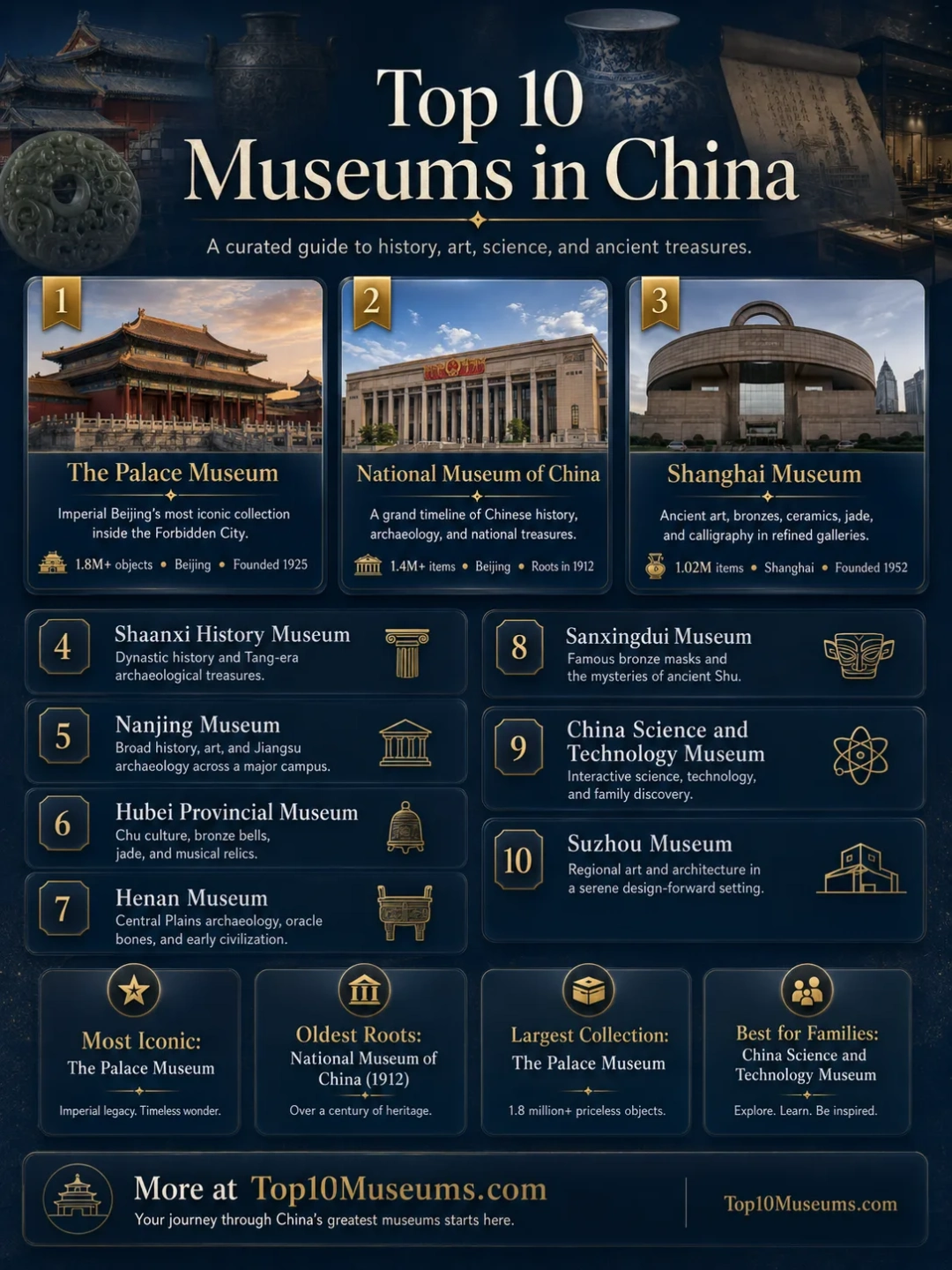
| Rank | Name | Founded | Collection Type | Website |
|---|---|---|---|---|
| 1 | The Palace Museum | 1925 | Imperial palace, Chinese art, ceramics, paintings, court objects | Official website |
| 2 | National Museum of China | 1912 roots; current museum formed in 2003 | Chinese history, archaeology, revolutionary history, national treasures | Official website |
| 3 | Shanghai Museum | 1952 | Ancient Chinese art, bronzes, ceramics, calligraphy, jade, coins | Official website |
| 4 | Shaanxi History Museum | 1991 | Dynastic history, Tang treasures, bronzes, murals, archaeological finds | Official website |
| 5 | Nanjing Museum | 1933 | History, art, Jiangsu archaeology, Ming and Qing objects, digital galleries | Official website |
| 6 | Hubei Provincial Museum | 1953 | Chu culture, bronze bells, jade, lacquer, archaeology, musical relics | Official website |
| 7 | Henan Museum | 1927 | Central Plains archaeology, Shang-Zhou bronzes, oracle bones, jade, music | Official website |
| 8 | Sanxingdui Museum | 1997 | Ancient Shu civilization, bronze masks, gold, jade, archaeological treasures | Official website |
| 9 | China Science and Technology Museum | 1988 | Science, technology, hands-on exhibits, family learning, special-effect theaters | Official website |
| 10 | Suzhou Museum | 1960 | Regional art, archaeology, paintings, calligraphy, garden-linked architecture | Official website |
Why These Ten Belong on a China Museum Shortlist
This list gives priority to museums with deep collections, clear visitor value, and strong subject variety. China has many excellent city and provincial museums, but these ten cover the widest range for first-time travelers: imperial Beijing, national history, ancient bronzes, regional archaeology, science education, and modern museum architecture.
The selection also avoids a common planning mistake: choosing only art museums or only palace sites. A strong China museum route needs objects, buildings, context, and discovery. That means pairing the Forbidden City with the National Museum of China, balancing Shanghai Museum’s refined ancient art with Shaanxi’s Tang-era material, and giving Sanxingdui its own place because its bronze masks and sacred trees look unlike almost anything else in Chinese archaeology.
Families are considered too. Several museums here are free or reservation-based, and the China Science and Technology Museum adds a hands-on STEM stop for children and teens. For long-distance travelers, the list also works as a route map: Beijing, Shanghai, Xi’an, Nanjing, Wuhan, Zhengzhou, Suzhou, and Sichuan can each anchor a separate cultural day.
The Ten Best Museums in China
1. The Palace Museum, Beijing
The Palace Museum is the museum most visitors picture before they arrive in China, yet it is much more than a palace walk. Set inside the Forbidden City, it preserves over 1.8 million collection pieces, with imperial ceramics, paintings, bronzes, clocks, textiles, jade, furniture, and court archives spread across halls and galleries. The site itself was the Ming and Qing imperial palace, so the building and the collection explain each other: a throne hall is not just a room, and a jade vessel is not just an object.
Plan more time than feels reasonable. The central axis gives the famous ceremonial route, but the side galleries are where many visitors find the strongest museum experience: clocks, treasure rooms, paintings, Buddhist objects, and smaller palace spaces. A regular high-season ticket is roughly US$8, based on the standard CNY 60 ticket, though special galleries and booking rules should always be checked before visiting.
Best for: first-time China visitors, imperial history fans, architecture lovers, photographers, and travelers who want the most iconic museum setting in Beijing.
Nearby alternative: Prince Kung’s Palace Museum — a strong Qing-era mansion follow-up near Shichahai, best reached by taxi or subway after a Forbidden City morning.
2. National Museum of China, Beijing
The National Museum of China sits on the east side of Tian’anmen Square and works best as the historical counterweight to the Palace Museum. Its collection includes more than 1.4 million pieces or sets, covering archaeology, ancient history, modern history, revolutionary material, rare books, coins, folk art, and national-level cultural relics. It is one of the most useful museums in China for placing dynasties, objects, and political history into a single timeline.
The museum’s roots go back to 1912, while the current institution was formed through the merger of earlier history and revolution museums. For travelers, the practical advantage is location: it can be paired with Tian’anmen Square or the Forbidden City area, though doing both the Palace Museum and the National Museum fully on the same day is tiring. Main admission is generally free with real-name reservation, while special services or exhibitions may use separate rules.
Best for: history-focused travelers, students, museum completists, and visitors who want one place to understand China’s long timeline before seeing regional museums.
Nearby alternative: Beijing Planning Exhibition Hall — a compact city-history and urban-planning stop south of Tian’anmen Square, useful when the National Museum is fully booked.
3. Shanghai Museum, Shanghai
Shanghai Museum is one of the best art museums in China for visitors who want objects rather than palace scale. Founded in 1952, it holds nearly 1.02 million items across 33 categories, including bronzes, ceramics, paintings, calligraphy, jade, seals, coins, sculpture, furniture, and minority arts. The museum is especially rewarding for people who want to compare forms: ritual bronze shapes, brushwork styles, glaze colors, and jade carving details become easier to read after a slow visit.
For current planning, Shanghai Museum has two main sites: the People’s Square site and Shanghai Museum East in Pudong. The East site at 1952 Century Avenue has become especially useful for visitors because of its larger modern galleries and current exhibition program. Main admission is usually reservation-based or free-entry depending on the site and event, while ticketed special exhibitions may vary.
Best for: ancient Chinese art lovers, design-minded travelers, ceramic collectors, calligraphy fans, and visitors who prefer calm galleries over palace crowds.
Nearby alternative: Aurora Museum — a refined Pudong museum with strong ancient Chinese art displays, easy to combine with a riverside or Lujiazui visit.
4. Shaanxi History Museum, Xi’an
Shaanxi History Museum is the natural museum partner to Xi’an’s Terracotta Army day. Opened to the public in 1991, it brings together material from a province that served as the power center for several dynasties, including Zhou, Qin, Han, Sui, and Tang. The museum houses more than 1.7 million relics, with bronzes, pottery figures, gold and silver objects, coins, murals, seals, and Tang-era treasures among its strongest draws.
The most satisfying way to visit is by period, not by room count. Start with early settlement and bronze objects, then give extra time to the Han and Tang sections. Xi’an can overwhelm visitors with sites, but this museum ties many of them together: tomb objects, court life, trade, ritual, and daily material culture all become clearer here. Standard entry is often free by reservation, while special treasure galleries may require a paid ticket in the range of a few US dollars.
Best for: Xi’an visitors, Tang dynasty fans, archaeology travelers, students of early China, and anyone pairing museums with the Terracotta Army.
Nearby alternative: Xi’an Museum — a quieter history museum beside the Small Wild Goose Pagoda, useful when Shaanxi History Museum reservations are hard to get.
5. Nanjing Museum, Nanjing
Nanjing Museum deserves a high place because it combines history, art, archaeology, regional identity, and modern display design in one large campus. Established in 1933, it was one of China’s earliest national museum projects and now holds more than 430,000 pieces or sets. The collection spans the Paleolithic period through later imperial and modern material, with strong Jiangsu archaeology, ceramics, painting, calligraphy, jade, and Ming-Qing objects.
The museum is especially useful for travelers who want more than dynastic labels. Its halls can move from ancient Jiangsu material to art galleries, folk culture, digital interpretation, and Republican-era streetscape displays. That mix makes it more varied than many single-theme museums. Main admission is generally free with reservation, and the museum works well as a half-day anchor before visiting nearby Ming-era and Republic-era sites.
Best for: travelers who like broad museum campuses, Jiangnan culture fans, families, digital-gallery visitors, and anyone building a Nanjing history day.
Nearby alternative: Six Dynasties Museum — a focused Nanjing history stop closer to the old city core, good for visitors who want a shorter museum visit.
6. Hubei Provincial Museum, Wuhan
Hubei Provincial Museum is one of the strongest reasons to add Wuhan to a culture-focused China trip. Founded in 1953, the museum now holds over 460,000 objects, including more than 1,000 Grade-One National Cultural Relics. Its best-known treasure is the Bianzhong, the set of bronze chime bells from the Tomb of Marquis Yi of Zeng, a 65-bell instrument group that still changes how visitors think about ancient music, bronze casting, and ritual life.
The museum is not only about the bells. Chu culture, jade, lacquerware, bronze weapons, tomb finds, calligraphy, and regional archaeology fill out the visit. The Sword of Goujian is another major draw: a bronze sword famous for its condition after more than two thousand years. Main admission is commonly free with reservation, and visitors should allow at least three hours if they want to see both the permanent halls and the musical-object displays with care.
Best for: music-history fans, bronze lovers, archaeology travelers, families with older children, and visitors who want a museum stop beside East Lake.
Nearby alternative: Hubei Museum of Art — an easy East Lake-area companion for visitors who want to pair ancient relics with modern and contemporary art.
7. Henan Museum, Zhengzhou
Henan Museum is essential for understanding the Central Plains, one of the core regions of early Chinese civilization. Founded in 1927, the museum’s English site lists a collection of 249,000 pieces or sets, with prehistoric relics, Shang and Zhou bronzes, ceramics, jade, oracle-bone material, murals, and musical heritage among its strongest areas. Its objects speak to early settlement, ritual, writing, bronze technology, and state formation in a way few museums can match.
The museum’s most memorable items include the Jiahu bone flute, oracle-bone inscriptions, the Lotus-Crane Square Pot, and Shang-Zhou bronze vessels. It is a smart stop before or after visiting Anyang, Luoyang, or other Henan heritage sites because it gives those places a museum-quality base. Main admission is usually free with reservation, making it one of the best-value history museums in central China.
Best for: early civilization readers, bronze and oracle-bone enthusiasts, Luoyang/Anyang travelers, and visitors who want depth beyond Beijing and Xi’an.
Nearby alternative: Zhengzhou Museum — a useful city-history option with archaeological material, especially good if Henan Museum reservations are limited.
8. Sanxingdui Museum, Guanghan
Sanxingdui Museum is the most visually startling museum on this list. Located at the Sanxingdui archaeological site in Guanghan, Sichuan, it presents the ancient Shu civilization through bronze masks, gold objects, jade, sacred trees, ritual vessels, and other finds that do not feel like a simple extension of Central Plains material culture. The museum opened to the public in 1997, and the site has yielded around 1,200 artifacts from major pits and related areas.
The famous bronze tree stands nearly four meters tall, and the large bronze masks have become some of the most recognizable archaeological images in China. Sanxingdui works best as a half-day trip from Chengdu or as part of a Sichuan heritage route. Admission is paid; visitors should expect a ticket in the rough range of US$10–15, with exact pricing checked on the official booking channel before travel.
Best for: ancient treasure hunters, Bronze Age fans, Chengdu-based travelers, visual learners, and visitors who want something different from standard dynastic museums.
Nearby alternative: Jinsha Site Museum — a Chengdu archaeology museum that pairs well with Sanxingdui because both help explain ancient Shu culture.
9. China Science and Technology Museum, Beijing
China Science and Technology Museum gives this list a much-needed science stop. It opened in 1988, and the current Olympic Green building opened in 2009 at 5 Beichen East Road. The museum is China’s only national-level broad science and technology museum, with permanent themes such as Science Paradise, The Glory of China, Exploration and Discovery, Sci-tech and Life, and Challenges and the Future.
This is the best choice on the list for hands-on learning. Children can move through interactive exhibits, while older visitors can focus on engineering, physics, technology, space, energy, and scientific thinking. Its special-effect theaters and large building also make it a good rainy-day option in Beijing. Tickets are normally modest, often around a few US dollars depending on hall and theater choices, but exact booking rules should be checked before visiting.
Best for: families with children, STEM-curious teens, rainy-day planners, science teachers, and Beijing visitors who need a break from palace-heavy sightseeing.
Nearby alternative: China National Arts and Crafts Museum — an Olympic Green-area museum suited to visitors who want design, craft, and material culture after a science stop.
10. Suzhou Museum, Suzhou
Suzhou Museum is smaller than the national and provincial giants above, but it earns its place through atmosphere, architecture, and regional focus. Founded in 1960, it was originally located in the Zhong Wang Fu palace complex, and its newer building designed by I. M. Pei opened in 2006. The museum sits close to the Humble Administrator’s Garden and Lion Forest Garden, so it fits naturally into a Suzhou old-city route.
The collection includes regional archaeology, paintings, calligraphy, ceramics, crafts, Buddhist objects, and Suzhou-linked cultural material. The building itself is part of the visit: white walls, dark rooflines, water, stone, and controlled light create a museum that feels connected to the garden city without copying it. Main admission is generally free with reservation, and the museum is best visited early in the day before nearby garden crowds build up.
Best for: architecture fans, garden-route travelers, regional art lovers, slow museum visitors, and anyone visiting Suzhou from Shanghai by train.
Nearby alternative: Suzhou Museum West — a larger modern branch that works well for visitors staying longer in Suzhou or traveling with children.
How to Tour These Museums
Best Beijing Museum Day
Start early at The Palace Museum because it demands the most walking and the most energy. After lunch, choose either the National Museum of China for history or the China Science and Technology Museum for a family-friendly shift in pace. Trying to do all three in one day is possible only as a surface visit; two museums will give a better experience.
Best Ancient Art Route
Use Shanghai Museum as the cleanest introduction to bronzes, ceramics, calligraphy, jade, and painting. Then take the train to Suzhou for Suzhou Museum, where the scale is calmer and the architecture adds another layer to the art. This route works especially well over two days from Shanghai.