
[ayaz_safe_content id=”3123″ key=”p3123b1ki0fmblr”]
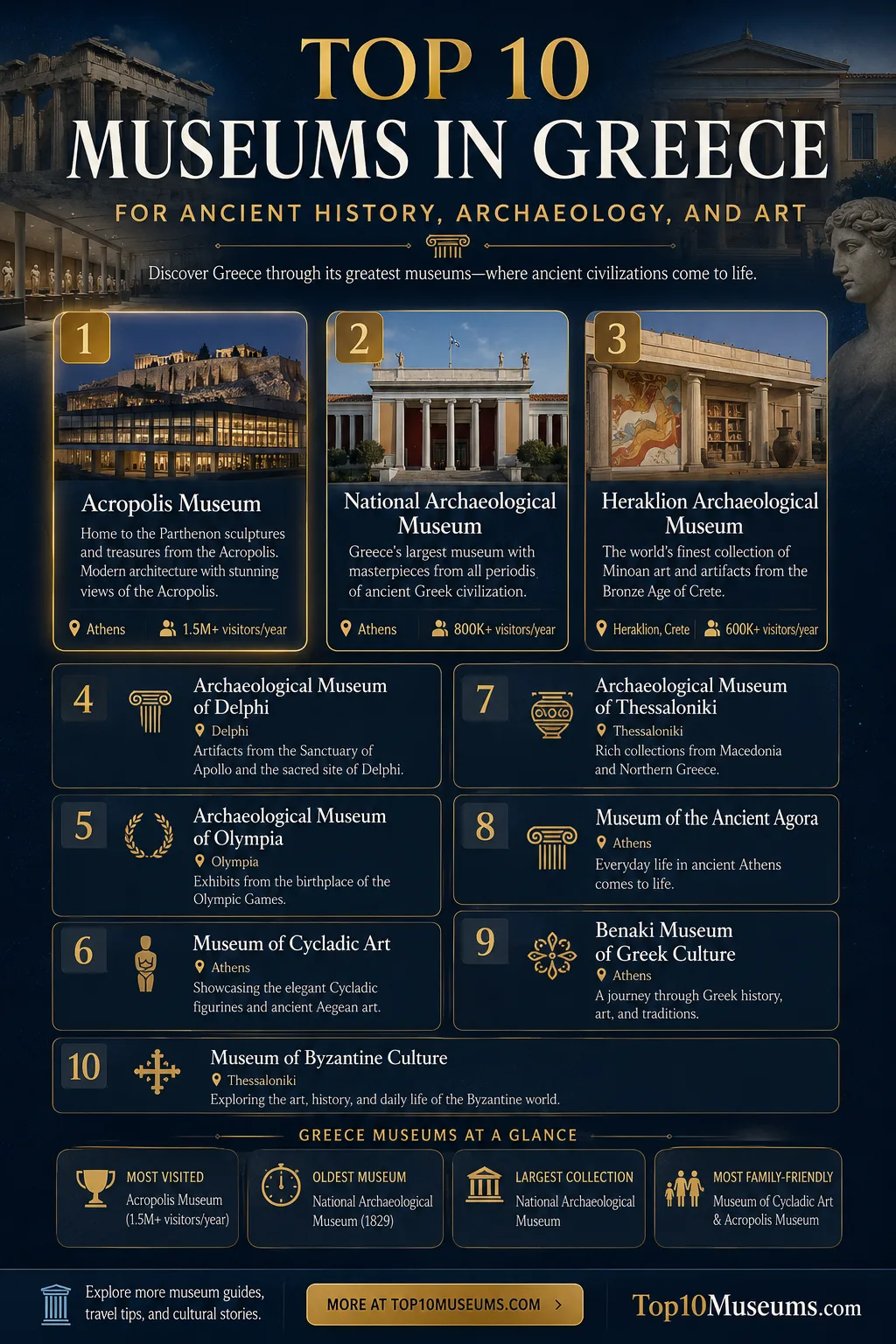
| Rank | Name | Founded | Collection Type | Website |
|---|---|---|---|---|
| 1 | Acropolis Museum | 2009 | Acropolis finds, Parthenon sculpture, archaeological excavation | Official website |
| 2 | National Archaeological Museum | 1829 | Greek antiquities, sculpture, bronze, ceramics, Mycenaean art | Official website |
| 3 | Heraklion Archaeological Museum | 1883 | Minoan art, Cretan archaeology, Bronze Age frescoes | Official website |
| 4 | Archaeological Museum of Delphi | 1903 | Sanctuary finds, temple sculpture, bronze art | Official website |
| 5 | Archaeological Museum of Olympia | 1888; current museum 1982 | Olympic sanctuary finds, temple sculpture, bronze offerings | Official website |
| 6 | Museum of Cycladic Art | 1986 | Cycladic figurines, ancient Greek art, Cypriot antiquities | Official website |
| 7 | Archaeological Museum of Thessaloniki | 1962 | Macedonian archaeology, gold, sculpture, prehistoric finds | Official website |
| 8 | Museum of the Ancient Agora | 1957 | Athenian democracy, civic objects, pottery, inscriptions | Official website |
| 9 | Benaki Museum of Greek Culture | 1930 | Greek art, material culture, costumes, icons, historical objects | Official website |
| 10 | Museum of Byzantine Culture | 1994 | Byzantine art, icons, mosaics, coins, daily-life objects | Official website |
Why These Ten Museums Work So Well Together
This list favors museum visits that change how a traveler reads Greece on the ground. The Acropolis Museum and the Museum of the Ancient Agora make central Athens easier to understand; the National Archaeological Museum widens the timeline with Mycenaean, Cycladic, Classical, Hellenistic, and Roman material; and the Museum of Cycladic Art turns small marble figures into one of the cleanest introductions to Aegean prehistory.
Outside Athens, the route becomes more regional and more useful. Heraklion explains Minoan Crete better than any single palace visit can, Delphi turns a mountain sanctuary into a sequence of votive gifts and sculpture, Olympia connects sport with religion and marble art, while Thessaloniki’s two major museums show Macedonia and Byzantium without forcing every story through Athens.
The Top 10 Museums in Greece
1. Acropolis Museum, Athens
Best for: first-time Athens visitors, Parthenon-focused travelers, architecture fans, families who want a clear ancient-history route.
The Acropolis Museum is the cleanest starting point for anyone trying to understand Athens before or after walking up to the Parthenon. Unlike larger national collections, it focuses on material from one archaeological site: the Athenian Acropolis. That narrow focus is its strength, because the visitor can move from the slopes of the hill to the Archaic Gallery and then to the Parthenon Gallery without feeling lost in too many periods at once.
The museum opened in 2009 and stands about 300 meters southeast of the Parthenon, with glass floors revealing archaeological remains below. Its best-known display is the Parthenon Gallery, where the building’s alignment allows visitors to compare surviving sculptural pieces with the temple itself. The museum also expanded the visitor story through the excavation area beneath the building, where everyday objects from an ancient Athenian neighborhood help balance temple art with ordinary life.
Do not rush the Caryatids. The originals from the Erechtheion are displayed inside the museum, while replicas stand on the Acropolis itself. For many visitors, that single contrast explains why museum conservation matters: the hill gives the setting, but the gallery gives the close reading.
Nearby alternative: Ilias Lalaounis Jewelry Museum — a short walk south of the Acropolis Museum, good for visitors who want Greek craft, goldwork, and design after the archaeological galleries.
2. National Archaeological Museum, Athens
Best for: serious archaeology travelers, sculpture lovers, Mycenaean history readers, visitors who want the broadest ancient Greek collection in one building.
The National Archaeological Museum is the heavyweight of Greek antiquities. It was founded in 1829, and the current Athens building became the central home for objects from across Greece in the late 19th century. The museum’s collections are large enough that a casual visitor should choose a route before entering, otherwise the marble, bronze, pottery, jewelry, frescoes, and funerary material can become too much in one visit.
The museum displays thousands of objects, including major pieces from the Mycenaean, Cycladic, Archaic, Classical, Hellenistic, and Roman periods. The Mask of Agamemnon, the bronze Poseidon or Zeus, the Jockey of Artemision, the Antikythera Mechanism, and the Thera wall paintings are the kind of objects that stay in memory because each belongs to a different kind of evidence: royal burial, bronze casting, shipwreck recovery, early mechanical knowledge, and Bronze Age painting.
Plan at least two hours, and three is better. Families can still enjoy it, but the museum is best for visitors who like reading labels, comparing periods, and moving slowly through sculpture rooms. The café garden also helps break up a long visit, especially in warm months.
Nearby alternative: Epigraphic Museum — located beside the National Archaeological Museum, it is a quieter stop for travelers interested in Greek inscriptions, civic records, and stone texts.
3. Heraklion Archaeological Museum, Crete
Best for: Minoan civilization fans, Crete road-trippers, Bronze Age art lovers, visitors pairing a museum day with Knossos.
Heraklion Archaeological Museum is the main reason many travelers should not visit Knossos without also entering a museum. The palace site gives scale and setting; the museum gives the art, tools, ritual objects, seals, pottery, and frescoes that make Minoan Crete legible. Founded in 1883, it is one of the country’s older archaeological museums and remains the clearest museum route into Cretan prehistory.
The collection covers about 5,500 years of history, but its Minoan galleries are the heart of the visit. The Snake Goddess figurines, bull-leaping imagery, Kamares ware, seal stones, Linear A tablets, and restored fresco fragments show a culture that worked with color, movement, ritual, and palace administration in ways that still feel fresh to modern eyes.
Visit the museum before Knossos if you like context first. Visit it after Knossos if you prefer seeing the physical site and then studying the objects in cooler, calmer galleries. Either order works, but doing both on the same day gives Crete’s Bronze Age story much more weight.
Nearby alternative: Historical Museum of Crete — near Heraklion’s waterfront, it continues the island’s story through later periods and works well after the archaeological museum.
4. Archaeological Museum of Delphi
Best for: mythology readers, mountain-route travelers, sanctuary history fans, visitors who want one museum tied tightly to one ancient site.
The Archaeological Museum of Delphi turns the sanctuary of Apollo into a readable sequence of offerings, architecture, sculpture, and political memory. The first museum opened in 1903, following the major French excavations, and the present display guides visitors from early material through the sanctuary’s long use into Late Antiquity.
The museum’s best-known object is the Charioteer of Delphi, a bronze figure dated to around 480–470 BC and displayed with fragments of the original chariot group. It is one of those rare ancient bronzes that survived well enough to show surface, posture, clothing, and expression together. Other highlights include the Sphinx of Naxos, the frieze of the Siphnian Treasury, kouroi, votive objects, and architectural sculpture connected to the sanctuary’s treasuries.
Delphi works best when the museum and site are treated as one visit. Walk the archaeological site first if the weather is cool; do the museum first if midday sun is strong. The museum is compact compared with Athens’ largest collections, but the objects carry a lot of historical density.
Nearby alternative: Archaeological Museum of Amfissa — about a short regional drive from Delphi, it is a useful smaller stop for local Phocis finds and a calmer museum pace.
5. Archaeological Museum of Olympia
Best for: Olympic history travelers, sculpture fans, families visiting the archaeological site, anyone interested in Greek sanctuaries beyond Athens.
The Archaeological Museum of Olympia is not only about sport. Its collection comes from the Sanctuary of Zeus, where athletic competition, religious ritual, votive gifts, architecture, and sculpture met in one of the ancient Greek world’s best-known sacred landscapes. The first museum at Olympia opened in 1888, while the current museum building belongs to the later 20th-century arrangement of the site’s finds.
The museum’s strongest rooms are built around the sculpted decoration of the Temple of Zeus, the Nike of Paionios, and the famous Hermes with the infant Dionysus traditionally associated with Praxiteles. There are also bronze offerings, armor, terracotta objects, tools linked with Phidias’ workshop, and material that helps explain how the sanctuary functioned before the visitor walks among the ruins.
Olympia is an excellent family museum because the theme is easy to grasp. Children may not follow every sculptural label, but the link between games, victory, gifts to the gods, and monumental temples is direct. Adults interested in art history should allow time for the pediments and metopes rather than treating them as a quick add-on to the stadium.
Nearby alternative: Museum of the History of the Olympic Games of Antiquity — in Ancient Olympia, it pairs well with the main archaeological museum for visitors focused on athletics and ritual competition.
6. Museum of Cycladic Art, Athens
Best for: design-minded travelers, prehistoric art fans, families who prefer a smaller Athens museum, visitors curious about the Aegean islands.
The Museum of Cycladic Art is smaller than the National Archaeological Museum, but it gives prehistoric Aegean art a sharper spotlight. Founded in 1986 to house the collection of Dolly and Nikolaos Goulandris, the museum is best known for its marble Cycladic figurines, many of which date to the 3rd millennium BC.
The permanent collections include around 3,000 Cycladic, ancient Greek, and ancient Cypriot artifacts, ranging from the 4th millennium BC to roughly the 6th century AD. The Cycladic figures are the headline objects, but the ancient Greek and Cypriot galleries make the museum more than a one-theme stop. Pottery, weapons, jewelry, vessels, and daily-life displays help visitors understand how form, burial, identity, and island exchange fit together.
This is one of the easiest Athens museums to recommend for visitors short on time. The scale is manageable, the display is clean, and the objects reward close looking. It also works well for travelers who enjoy modern design, because the simplicity of Cycladic forms has long attracted artists, architects, and collectors.
Nearby alternative: Byzantine and Christian Museum — a short walk along Vasilissis Sofias Avenue, it is a strong follow-up for icons, mosaics, manuscripts, and later religious art.
7. Archaeological Museum of Thessaloniki
Best for: Macedonia history readers, Thessaloniki city-break visitors, goldwork fans, travelers who want archaeology outside the Athens route.
The Archaeological Museum of Thessaloniki is the central archaeological museum of northern Greece. Its modernist building opened to the public in 1962, and its permanent exhibitions cover Macedonia from prehistory through Late Antiquity. For visitors used to Athens-centered itineraries, this museum is a useful correction: northern Greece has its own material rhythm, royal networks, burial customs, urban growth, and artistic production.
The museum’s collections include sculpture, pottery, metalwork, glass, coins, grave goods, and especially the Gold of Macedon material. Its ceramics, metalwork, and minor arts collections alone include more than 10,000 artifacts, giving visitors a wide view of daily life, burial practice, and elite display. The prehistoric sections also help explain the region before the rise of Classical Macedonian power.
Pair it with a walk through central Thessaloniki rather than treating it as an isolated stop. The city’s Roman, Byzantine, Ottoman, and modern layers are close together, and the museum helps make that layered urban walk more readable.
Nearby alternative: Museum of Byzantine Culture — directly nearby, it is the easiest second museum for the same day and continues the region’s story into Byzantine art and daily life.
8. Museum of the Ancient Agora, Athens
Best for: democracy history readers, Athens walkers, travelers who like small site museums, visitors combining ruins with compact galleries.
The Museum of the Ancient Agora is housed in the reconstructed Stoa of Attalos, a building based on a 2nd-century BC stoa donated to Athens by Attalos II of Pergamon. The museum has been housed there since 1957, and its collection is closely tied to excavations in the Athenian Agora, the civic heart of ancient Athens.
The museum’s objects range from the Neolithic era to Post-Byzantine times, but its most memorable material relates to public life: juror allotment devices, ostraka used in ostracism, weights, measures, inscriptions, coins, pottery, and sculpture. These are not always the flashiest objects in Greece, yet they explain how a city worked in practice.
This museum is best visited with the Agora ruins, not as a stand-alone gallery. Walk the site, then use the museum to connect the open space with courts, stoas, shops, voting practices, and civic administration. It is one of the most useful short museum visits in Athens because the objects sit almost exactly where their story happened.
Nearby alternative: Kerameikos Archaeological Museum — west of the Agora area, it adds funerary sculpture, cemetery finds, and another archaeological landscape to the same Athens walking route.
9. Benaki Museum of Greek Culture, Athens
Best for: art-and-culture travelers, visitors who want Greek history beyond antiquity, costume and craft lovers, repeat Athens visitors.
The Benaki Museum of Greek Culture is different from the archaeological museums on this list because it follows Greek material culture across a longer arc. Founded in 1930 by Antonis Benakis, the museum’s main Greek Culture building presents art, craft, domestic objects, icons, textiles, jewelry, costumes, manuscripts, and historical material inside a neoclassical mansion near the National Garden.
The wider Benaki collection contains tens of thousands of works, with the museum’s searchable collection listing 84,946 works of art across many categories. For this top ten, the Museum of Greek Culture matters because it helps visitors move from antiquity into Byzantine, Ottoman-era, and modern Greek objects without leaving the language of material culture.
Come here when you want texture after archaeology. Marble sculpture and temple fragments explain one part of Greece; embroidery, icons, domestic interiors, clothing, and painting explain another. The Benaki is also a strong choice for travelers staying near Syntagma or Kolonaki because it fits easily into a half-day Athens route.
Nearby alternative: National Gallery — a short trip from the Benaki area, it is the better choice for visitors who want Greek and European painting from later periods.
10. Museum of Byzantine Culture, Thessaloniki
Best for: Byzantine art fans, icon and mosaic lovers, Thessaloniki visitors, travelers who want daily life as well as religious art.
The Museum of Byzantine Culture opened in 1994 and gives Thessaloniki one of the best museum pairings in Greece: archaeology next door, Byzantine culture here. Its permanent exhibition is arranged across 11 galleries, covering worship, burial customs, architecture, public and private life, commerce, art, and the long afterlife of Byzantine forms.
The museum’s collection numbers more than 46,000 movable monuments and artworks, including coins, icons, wall paintings, mosaics, manuscripts, textiles, sculpture, and smaller objects. Its numismatic collection is especially large, with about 30,000 coins, many tied to Thessaloniki and Macedonia. That density makes the museum useful not only for religious art, but also for everyday economic and urban history.
This is the museum that helps Thessaloniki make sense. The city’s churches, walls, mosaics, and late Roman-to-Byzantine layers are easier to read after seeing the galleries. It is also a good indoor choice on a hot or rainy day because the route is logical and not overly tiring.
Nearby alternative: Archaeological Museum of Thessaloniki — directly beside it, this is the natural companion for visitors who want Macedonian archaeology before or after Byzantine material.
How to Tour These Museums
Best First Athens Day
Start with the Acropolis Museum in the morning, then walk to the Acropolis and down toward the Ancient Agora. Visit the Museum of the Ancient Agora after seeing the ruins, because its civic objects make more sense once the site is fresh in your mind. Save the Benaki Museum or Museum of Cycladic Art for late afternoon if you still have energy.
Best Athens Archaeology Day
Use the National Archaeological Museum as the anchor and avoid packing too many large collections around it. After lunch, choose the Museum of Cycladic Art for a smaller, cleaner second visit. This route works well for travelers who care more about objects and less about covering every central ruin in one day.
Best Crete Day
In Heraklion, pair the Heraklion Archaeological Museum with Knossos, but decide the order based on weather. Museum first is better for context; Knossos first is better if you want the open-air site before the strongest sun. Do not add too many extra stops that day, because the Minoan material deserves a slower pace.
Best Mainland Sanctuary Route
Delphi and Olympia are better as a multi-day route than a rushed single-day checklist. Delphi works well as an overnight or long day from Athens, while Olympia usually needs a separate Peloponnese plan. In both places, visit the archaeological site and museum as one unit rather than treating the museum as optional.
Best Thessaloniki Museum Pairing
Visit the Archaeological Museum of Thessaloniki and the Museum of Byzantine Culture on the same day because they sit close together and divide the city’s story neatly. Start with archaeology for Macedonia’s earlier material, then move to Byzantine art and daily life. Leave time afterward for a walk toward the waterfront or central monuments.
Who Will Love These Museums?
- Parthenon-focused first-timers: Acropolis Museum gives the clearest museum route into the Acropolis, the Caryatids, and the Parthenon sculpture story.
- Serious ancient-history readers: National Archaeological Museum offers the broadest single-building collection for Greek antiquity, from Mycenaean gold to Classical bronze.
- Minoan civilization fans: Heraklion Archaeological Museum is the strongest choice for Knossos-related art, frescoes, seals, and Bronze Age Cretan material.
- Mythology and sanctuary travelers: Archaeological Museum of Delphi turns Apollo, votive gifts, treasuries, and the Charioteer into a focused museum visit.
- Olympic history visitors: Archaeological Museum of Olympia links the ancient games with Zeus, sanctuary offerings, temple sculpture, and victory monuments.
- Design-minded art lovers: Museum of Cycladic Art is ideal for visitors drawn to clean forms, marble figures, Aegean prehistory, and smaller gallery routes.
- Macedonia route planners: Archaeological Museum of Thessaloniki is the best stop for northern Greek archaeology, goldwork, sculpture, and regional history.
- Democracy history readers: Museum of the Ancient Agora is perfect for visitors who want ostraka, civic tools, inscriptions, and objects tied to public life.
- Culture-beyond-antiquity travelers: Benaki Museum of Greek Culture suits visitors who want costumes, icons, craft, domestic objects, and later Greek art.
- Byzantine art fans: Museum of Byzantine Culture is the strongest Thessaloniki stop for icons, mosaics, coins, burial customs, and daily-life displays.