
[ayaz_safe_content id=”3117″ key=”p3117b14ps316qp”]
Ten Museums That Cover the Netherlands Well
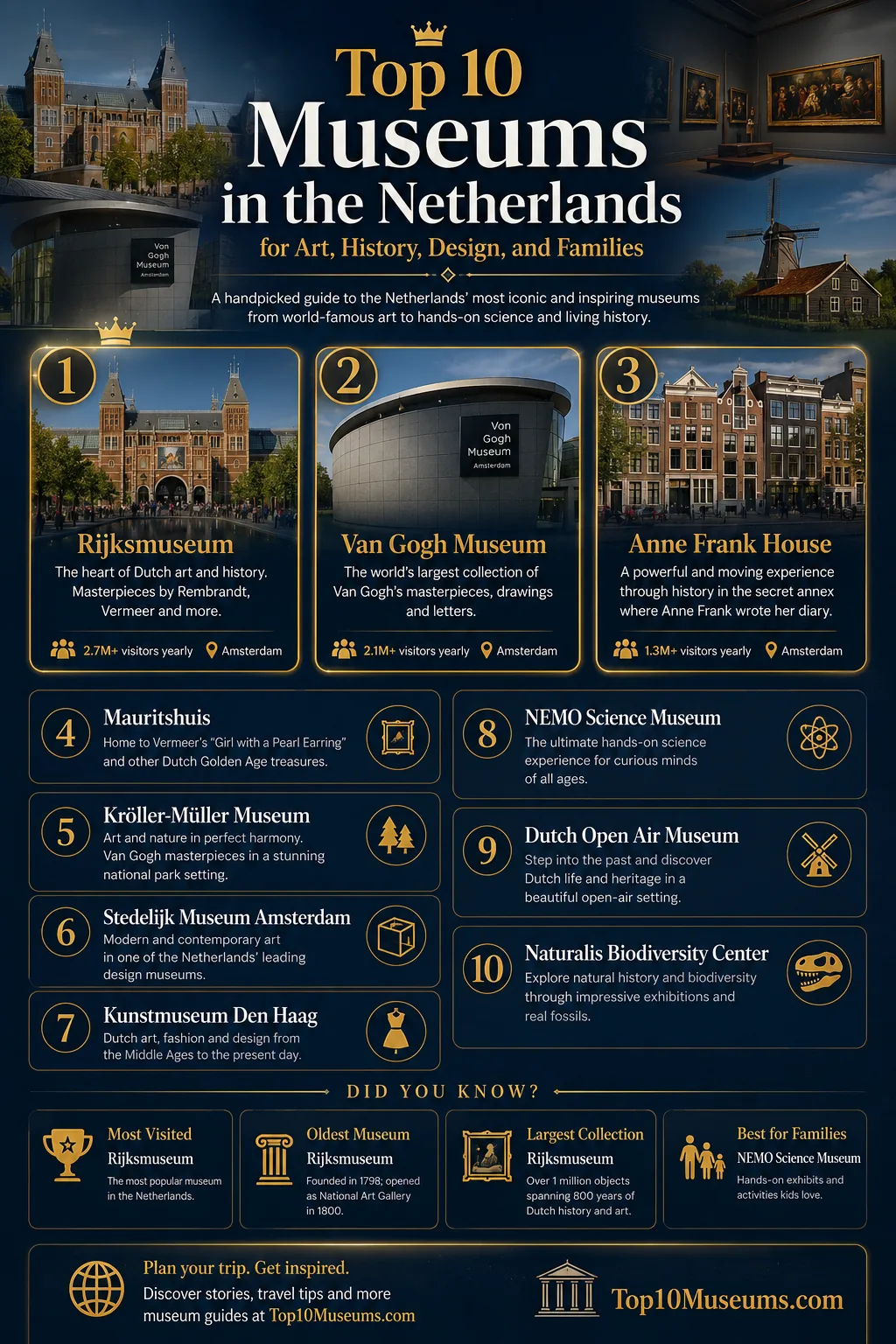
This table is built for planning, not bragging rights. It mixes blockbuster art museums with history houses, design collections, science galleries, and outdoor heritage sites, so a traveler can choose by interest rather than by fame alone.
| Rank | Name | Founded | Collection Type | Website |
|---|---|---|---|---|
| 1 | Rijksmuseum | 1798; opened as National Art Gallery in 1800 | Dutch art, national history, decorative arts | Official site |
| 2 | Van Gogh Museum | 1973 | Van Gogh paintings, drawings, letters, artist context | Official site |
| 3 | Anne Frank House | 1960; foundation established in 1957 | Historic house, World War II history, diary context | Official site |
| 4 | Mauritshuis | 1822 | Dutch and Flemish Golden Age paintings | Official site |
| 5 | Kröller-Müller Museum | 1938 | Van Gogh, modern art, sculpture garden | Official site |
| 6 | Stedelijk Museum Amsterdam | 1895; collection roots from 1874 | Modern art, contemporary art, graphic and industrial design | Official site |
| 7 | Kunstmuseum Den Haag | 1866; Berlage building opened in 1935 | Modern art, Mondrian, fashion, decorative arts, design | Official site |
| 8 | NEMO Science Museum | 1923; current Renzo Piano building opened in 1997 | Hands-on science, technology, experiments, family learning | Official site |
| 9 | Dutch Open Air Museum | 1912; opened to the public in 1918 | Open-air social history, historic buildings, crafts, tram heritage | Official site |
| 10 | Naturalis Biodiversity Center | 1820 roots; modern center in Leiden | Natural history, fossils, biodiversity, research collection | Official site |
Why These Ten Museums Work Well Together
A good Netherlands museum list should not be only Amsterdam. The capital has the strongest density, but The Hague adds courtly painting and design history, Leiden adds science and nature, Arnhem adds daily-life heritage, and Otterlo adds one of Europe’s best art-and-landscape combinations.
The list also avoids one-note collecting. Rijksmuseum and Mauritshuis cover Dutch old masters; Van Gogh Museum and Kröller-Müller show two different Van Gogh experiences; Stedelijk and Kunstmuseum Den Haag give modern art and design real space; Anne Frank House anchors the history side; NEMO, Naturalis, and the Dutch Open Air Museum keep families from spending the whole trip whispering in painting galleries.
Top 10 Museums in the Netherlands
1. Rijksmuseum, Amsterdam
Best for: Dutch Golden Age painting, first-time Amsterdam visitors, art-and-history travelers, and older children who enjoy famous objects.
Rijksmuseum is the national museum of the Netherlands, and it tells 800 years of Dutch history through art, objects, ships, furniture, weapons, prints, and domestic design. The museum displays about 8,000 works, which is enough to feel grand without needing to see the full collection in one visit.
The headline works are easy to name: Rembrandt’s The Night Watch, Vermeer’s The Milkmaid, and paintings by Frans Hals, Jan Steen, and Van Gogh. The better way to visit is not to chase every famous label, but to move from the Gallery of Honour into Delftware, ship models, and the Asian Pavilion, where the scale of Dutch collecting becomes clearer.
Families can make this work with a short route. Start with the Gallery of Honour, take a break in the free garden, then choose one extra section rather than trying to finish every floor. The building itself, opened in 1885, also gives visitors a strong piece of Dutch museum architecture before they even reach the paintings.
Nearby alternative: Amsterdam Museum — a useful follow-up for visitors who want more city history after seeing the national collection; it is easiest to pair on a separate central Amsterdam walk.
2. Van Gogh Museum, Amsterdam
Best for: Van Gogh fans, first-time art travelers, students, couples, and visitors who prefer one artist told in clear stages.
The Van Gogh Museum holds the world’s largest Van Gogh collection, with more than 200 paintings and almost 500 drawings by the artist. That size matters because the museum can show Van Gogh’s development across the Netherlands, Paris, Arles, Saint-Rémy, and Auvers-sur-Oise without turning the visit into a random greatest-hits wall.
The strongest experience is chronological. Early Dutch works, Paris color experiments, Provençal landscapes, self-portraits, flower paintings, and late works all feel connected when seen in sequence. Visitors who only know Sunflowers usually leave with a better sense of Van Gogh as a reader, letter writer, and fast-changing painter.
It is one of the easiest museums to combine with others. Rijksmuseum, Stedelijk, and Moco are all close on Museumplein, but the Van Gogh Museum deserves its own mental space. Book timed entry early, arrive rested, and keep the visit focused rather than squeezing it between too many large museums.
Nearby alternative: Moco Museum — a compact Museumplein option for visitors who want modern and street-art-leaning works after Van Gogh.
3. Anne Frank House, Amsterdam
Best for: World War II history readers, diary readers, thoughtful teens, families with older children, and visitors seeking a quiet historic-house experience.
Anne Frank House is not a typical museum visit. The building at Prinsengracht 263-267 preserves the place connected to the Secret Annex, where Anne Frank hid for more than two years during World War II and wrote her diary. The museum visit is usually about one hour, but the emotional weight is much larger than the time slot suggests.
The house works best when visitors know the basic story before arriving. The rooms are restrained, the route is narrow, and the strongest moments come from connecting the physical space with Anne’s writing and the lives of the people in hiding. Tickets are sold online for timed entry, so this should be planned before any Amsterdam museum day is built around it.
Families should judge the visit by age and readiness. Older children and teens often respond deeply to the diary, the hidden rooms, and the careful presentation. For very young children, the subject may be too heavy, and a lighter museum can be paired elsewhere in the day.
Nearby alternative: Museum of the Canals — a calmer nearby option for visitors who want Amsterdam house interiors, canal history, and a shorter central-city stop.
4. Mauritshuis, The Hague
Best for: Vermeer admirers, Rembrandt lovers, old-master beginners, The Hague day-trippers, and visitors who prefer a smaller museum with famous paintings.
Mauritshuis is compact but loaded with Dutch and Flemish painting. The museum has been open as a museum since 1822 and is housed in a 17th-century city palace beside the Hofvijver in The Hague. Its scale is one of its gifts: visitors can see Vermeer’s Girl with a Pearl Earring, Fabritius’s The Goldfinch, and Rembrandt’s late self-portrait without crossing a giant campus.
The collection is ideal for slow looking. Instead of racing through hundreds of rooms, visitors can compare light, fabric, faces, and domestic scenes across a tight group of masterworks. The museum welcomes almost 500,000 visitors in many years, so early entry or late-day visiting can make the famous rooms feel calmer.
Mauritshuis pairs well with a city walk. The Binnenhof area, Noordeinde, and The Hague’s palace-and-government streets are nearby. It is also one of the easiest Dutch art museums to recommend to travelers who think they do not have enough stamina for a large museum.
Nearby alternative: Escher in Het Paleis — a short walk away and a strong choice for optical art, graphic puzzles, and a lighter follow-up after old masters.
5. Kröller-Müller Museum, Otterlo
Best for: Van Gogh return visitors, modern art fans, sculpture lovers, nature-focused travelers, and families who need outdoor time.
Kröller-Müller Museum offers the Netherlands’ best art-and-landscape day. It sits inside De Hoge Veluwe National Park and holds the second-largest Van Gogh collection in the world, with almost 90 paintings and more than 180 drawings. That gives it a very different rhythm from the Van Gogh Museum in Amsterdam.
The museum opened in 1938, and Van Gogh has been central to its identity from the beginning. Visitors may see works such as Café Terrace at Night and other paintings that feel quieter here than they would in Amsterdam. The sculpture garden adds another layer, especially for travelers who like modern art but do not want to spend the full day indoors.
Plan the transport carefully. Otterlo is not a casual add-on to Museumplein; it works best as a separate day from Arnhem, Utrecht, or Amsterdam. Families often do better here than expected because the visit can be split between galleries, park paths, bikes, and sculpture.
Nearby alternative: Nederlands Tegelmuseum — a small Otterlo museum focused on Dutch tiles, useful if you want a short decorative-arts stop near the park area.
6. Stedelijk Museum Amsterdam
Best for: modern art fans, design students, graphic design lovers, contemporary art visitors, and travelers already visiting Museumplein.
Stedelijk Museum Amsterdam is the Netherlands’ main stop for modern and contemporary art and design. Its collection features about 100,000 works, covering painting, sculpture, photography, posters, graphic design, industrial design, moving image, and artist books.
The museum’s own building opened in 1895, and the collection now stretches from late 19th-century art into present-day visual culture. Visitors can connect Mondrian, Malevich, Chagall, Appel, and contemporary installations with design objects and typography, which makes Stedelijk especially useful for anyone interested in how art moves into everyday life.
Stedelijk is best after, not before, the old masters. Seeing Rijksmuseum first gives visitors the older Dutch visual language; Stedelijk then shows how artists and designers pulled that language apart. For families, pick one or two floors and let children respond to color, shape, and scale rather than forcing a full art-history route.
Nearby alternative: Moco Museum — a close Museumplein option with a shorter visit length and a more pop-culture-friendly tone.
7. Kunstmuseum Den Haag
Best for: Mondrian fans, design travelers, fashion-history readers, architecture lovers, and visitors spending a full day in The Hague.
Kunstmuseum Den Haag is one of the best design-and-modern-art museums in the country. Its collection contains more than 160,000 pieces, including fine art, decorative arts, fashion, musical instruments, photography, and design. That range makes it more varied than visitors may expect from a museum often associated mainly with Mondrian.
The Mondrian collection is the anchor. With almost 300 Mondrian items, the museum can show his path from early landscapes to abstraction and Victory Boogie Woogie. The building, designed by H.P. Berlage and opened in 1935, is also part of the visit; its yellow brick, measured rooms, and daylight make architecture feel like part of the collection.
This is the museum to choose when “design” matters. Fashion, period rooms, decorative arts, and Berlage-related material give the visit a broader feel than a pure painting museum. It pairs naturally with Mauritshuis, but only if the day is not rushed.
Nearby alternative: Fotomuseum Den Haag — located close by and useful for visitors who want photography after Mondrian, design, and decorative arts.
8. NEMO Science Museum, Amsterdam
Best for: families with children, curious teens, hands-on learners, rainy days, and visitors who need a break from silent gallery behavior.
NEMO Science Museum is the largest science center in the Netherlands. Its roots go back to 1923, when artist Herman Heijenbrock founded the Labour Museum, and its current copper-green building by Renzo Piano opened in 1997. The museum is built around interaction: experiments, demonstrations, technology, physics, chemistry, and human behavior.
This is the easiest museum on the list for active children. Instead of asking visitors to look quietly for hours, NEMO asks them to test, touch, build, compare, and ask questions. The roof terrace also gives a useful pause with views across Amsterdam’s waterfront.
NEMO works best as a half-day family anchor. Pair it with the nearby National Maritime Museum if energy is high, or keep it as the main event if children are young. Adults without kids can still enjoy it, but the museum’s strongest rhythm is clearly made for playful science learning.
Nearby alternative: National Maritime Museum — a short walk away and a strong companion for ships, navigation, Dutch trade history, and harbor views.
9. Dutch Open Air Museum, Arnhem
Best for: families, social-history fans, architecture spotters, outdoor museum visitors, and travelers who want Dutch life beyond city centers.
The Dutch Open Air Museum turns social history into a walkable landscape. The Arnhem museum park covers 44 hectares and contains around 100 historic buildings, farmhouses, mills, workshops, and interiors moved from across the Netherlands. It is not only about objects in cases; it is about how people lived, worked, cooked, traveled, and kept traditions alive.
The museum was founded in 1912 and opened to the public in 1918. Its historic tram, craft demonstrations, shops, and houses make it especially friendly for mixed-age groups. Children can move around, adults can focus on regional architecture and everyday material culture, and nobody has to pretend that a full day indoors is easy.
Weather changes the visit. A dry day lets the park breathe, while rain makes the indoor areas and tram more useful. For visitors based in Amsterdam, Arnhem is better as a day trip with an early start than as an afterthought.
Nearby alternative: Airborne Museum Hartenstein — a strong history option in nearby Oosterbeek for visitors interested in the Battle of Arnhem and World War II memory.
10. Naturalis Biodiversity Center, Leiden
Best for: dinosaur fans, science-minded families, natural history readers, school-age children, and travelers adding Leiden to a Netherlands route.
Naturalis Biodiversity Center is both a museum and a research institute. Its national collection has grown over more than 200 years and includes more than 43 million objects from nature, archives, rare books, and related materials. That gives the galleries real scientific weight behind the public displays.
The museum is especially strong for families. Fossils, biodiversity galleries, specimens, and visible research culture help children connect museum displays with living science. Leiden is also easier to handle than Amsterdam when visitors want a calmer city day with a strong museum at the center.
Naturalis pairs well with Leiden’s historic core. The museum sits near Leiden Centraal, so it can be reached without a complex transfer. After the visit, the old university city, canals, and Rijksmuseum van Oudheden make the day feel varied rather than science-only.
Nearby alternative: Rijksmuseum van Oudheden — a central Leiden archaeology museum that works well after Naturalis for Egypt, classical antiquity, and Dutch archaeological history.
How to Tour These Museums
Best Amsterdam Art Day
Start with Rijksmuseum in the morning, while attention is fresh and the Gallery of Honour is easier to enjoy. After lunch around Museumplein, visit the Van Gogh Museum with a timed ticket, then finish with a shorter Stedelijk stop if modern art and design are part of the goal. Do not add Anne Frank House to this same day unless the ticket time is fixed and the group has strong museum stamina.
Best Amsterdam Family Day
Build the day around NEMO Science Museum. Use the morning for hands-on exhibitions, take a roof or lunch break, then walk to the National Maritime Museum if children still have energy. This plan works better for young families than forcing Rijksmuseum, Van Gogh Museum, and Anne Frank House into one overloaded day.
Best The Hague and Leiden Day
Choose Mauritshuis first if Vermeer is the priority. It is compact, central, and easy to enjoy before lunch in The Hague. Kunstmuseum Den Haag deserves a separate afternoon if Mondrian, fashion, and design are the focus; Naturalis in Leiden is better as a second day unless the group is comfortable moving by train and keeping each museum visit short.
Best Art-and-Nature Day
Use Kröller-Müller Museum as a full-day plan. Travel early, give the Van Gogh rooms proper time, then use the sculpture garden and national park to reset the pace. This is the best route for travelers who want art without another city-center museum day.
Best Two-Day Route Beyond Amsterdam
Day one can pair The Hague museums: Mauritshuis in the morning and Kunstmuseum Den Haag in the afternoon. Day two can move east to Arnhem and Otterlo, using the Dutch Open Air Museum for social history and Kröller-Müller for art in the park. This route is more satisfying by car, though it can be done with trains and buses if the schedule is planned carefully.
Who Will Love These Museums?
- Old-master lovers: Rijksmuseum and Mauritshuis give the strongest route for Rembrandt, Vermeer, Frans Hals, and Dutch Golden Age painting.
- Van Gogh-focused travelers: Van Gogh Museum gives the life story; Kröller-Müller Museum gives a quieter second Van Gogh experience inside a national park.
- Design and modern art visitors: Stedelijk Museum Amsterdam and Kunstmuseum Den Haag are the best pair for graphic design, industrial design, Mondrian, fashion, and modern visual culture.
- Families with active children: NEMO Science Museum, Naturalis Biodiversity Center, and the Dutch Open Air Museum offer the most movement, interaction, and variety.
- World War II history readers: Anne Frank House is the most focused and emotionally direct museum on the list, especially for visitors who know the diary before arriving.
- Architecture-minded travelers: Rijksmuseum, Kunstmuseum Den Haag, NEMO, and Mauritshuis each make the building part of the museum experience.
- Travelers leaving Amsterdam: Mauritshuis, Kunstmuseum Den Haag, Naturalis, Dutch Open Air Museum, and Kröller-Müller Museum make the Netherlands feel much larger than a capital-city itinerary.