
[ayaz_safe_content id=”3119″ key=”p3119b1lg8xmf6p”]
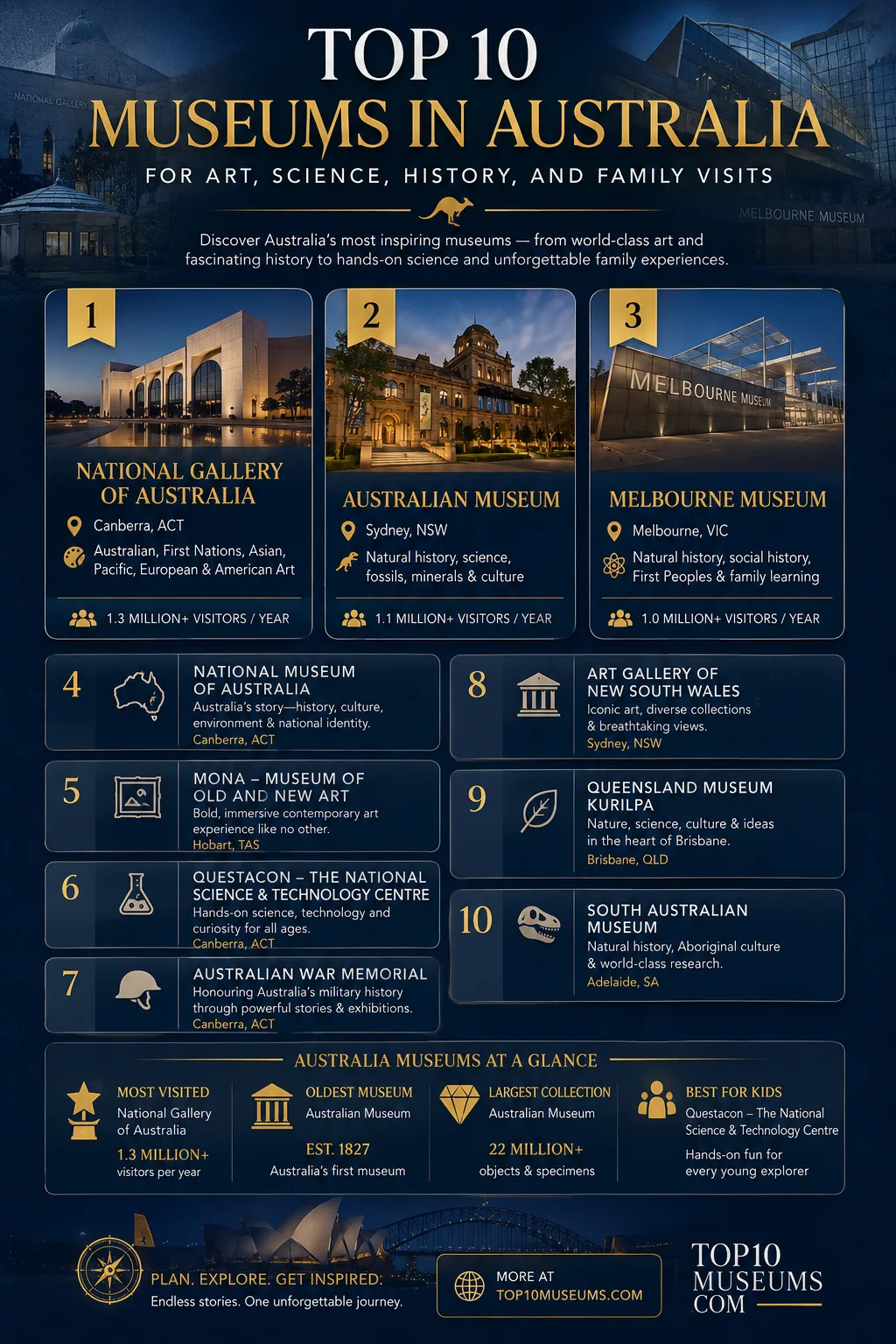
| Rank | Name | Founded | Collection Type | Website |
|---|---|---|---|---|
| 1 | National Gallery of Australia | 1967 | Australian, First Nations, Asian, Pacific, European and American art | Official website |
| 2 | Australian Museum | 1827 | Natural history, science, minerals, fossils and cultural collections | Official website |
| 3 | Melbourne Museum | 2000 | Natural history, social history, First Peoples stories and family learning | Official website |
| 4 | National Museum of Australia | 1980 / 2001 | Australian history, culture, environment and national identity | Official website |
| 5 | Mona – Museum of Old and New Art | 2011 | Ancient, modern and contemporary art | Official website |
| 6 | Questacon – The National Science and Technology Centre | 1988 | Interactive science, technology and STEM exhibitions | Official website |
| 7 | Australian War Memorial | 1925 / 1941 | Military history, memorial galleries, archives and national collection | Official website |
| 8 | Art Gallery of New South Wales | 1871 | Australian, Aboriginal and Torres Strait Islander, Asian and international art | Official website |
| 9 | Queensland Museum Kurilpa | 1862 | Queensland natural history, cultural heritage, science and discovery | Official website |
| 10 | South Australian Museum | 1856 | Natural history, Australian Aboriginal heritage, minerals and polar collections | Official website |
Why These Ten Make the Cut
This list is not built around one city or one type of visitor. It gives Australia’s national art collection, the country’s oldest museum, major state museums, a leading science centre, and places that work well for children who need objects, movement and hands-on exhibits.
The ranking also considers range. A museum like the Australian Museum gives fossils, minerals, climate science and Pacific cultures in one stop, while Mona gives an art visit that feels unlike a standard gallery. Canberra appears often because the city holds several national institutions close together, making it unusually efficient for museum-heavy travel.
Best Museums in Australia for Art, Science, History and Families
1. National Gallery of Australia — Canberra
The National Gallery of Australia is the strongest first pick for visitors who want one art museum to represent the country at national scale. Its collection includes more than 155,000 works, with major holdings in Australian art, Aboriginal and Torres Strait Islander art, Asian art, Pacific art, European modernism and American art. For many visitors, the reason to start here is simple: it shows Australian art beside global art, instead of treating the country as a side note.
The gallery is especially good for slower looking. Sidney Nolan’s Ned Kelly series, the large Aboriginal and Torres Strait Islander collection, sculpture areas and changing exhibitions give enough range for a half-day visit. Families can still enjoy it, but it works best when adults choose a few rooms rather than trying to cover every wall.
Best for: Australian art lovers, First Nations art learners, design-focused adults, Canberra culture weekends and visitors who want a national collection.
Nearby alternative: National Portrait Gallery — a close Canberra option for faces, identity and Australian public life, reached by a short walk around King Edward Terrace.
2. Australian Museum — Sydney
The Australian Museum is Australia’s first museum, founded in 1827, and it remains one of the country’s best choices for science, nature and family visits. Its holdings pass 22 million scientific specimens and cultural objects, covering natural history, minerals, fossils, First Nations cultures, Pacific collections and current research. That scale gives the museum a different feel from a city attraction; it is both a public museum and an active scientific institution.
Children usually connect quickly with the animal displays, dinosaur material, minerals and interactive learning areas. Adults get more out of the museum by slowing down in the First Nations and Pacific sections, where objects sit within living cultural stories rather than being treated as isolated display pieces. It is also one of Sydney’s easiest museum stops, sitting opposite Hyde Park and close to other central attractions.
Best for: families with children, dinosaur fans, natural history readers, science-minded teens and first-time Sydney visitors.
Nearby alternative: Hyde Park Barracks — a strong history stop near Macquarie Street, easy to pair with the Australian Museum on foot.
3. Melbourne Museum — Melbourne
Melbourne Museum works because it does not rely on one subject. It brings together natural history, social history, First Peoples stories, science, design and a strong family layout inside the Carlton Gardens precinct. The current museum opened in 2000, while Museums Victoria’s roots go back to 1854 and a collection now counted at more than 15 million items.
The museum is particularly useful for mixed groups. One person may want dinosaurs and geology, another may want Melbourne’s urban history, and children may simply need a museum where moving around feels normal. The First Peoples exhibition gives the visit more depth, while the nearby Royal Exhibition Building adds architecture and World Heritage context without requiring a long transfer.
Best for: families, school-age children, natural history fans, Melbourne first-timers and visitors who want culture without a formal gallery mood.
Nearby alternative: Royal Exhibition Building — next door in Carlton Gardens, useful for architecture, exhibition history and a short add-on after the museum.
4. National Museum of Australia — Canberra
The National Museum of Australia is the best stop on this list for visitors who want Australian history told through objects rather than dates alone. The museum opened on Acton Peninsula in 2001 and holds the National Historical Collection, with about 250,000 objects connected to Australian history, culture, memory and the environment.
The museum is especially good at showing how one object can carry public history and personal emotion at the same time. Visitors may encounter material linked to First Nations cultures, exploration, sport, popular culture, environmental change and daily life. The building’s lakeside position also makes it a practical Canberra stop when paired with the National Gallery or Questacon.
Best for: Australian history readers, culture-focused travellers, families with older children, road-trip planners and visitors building a Canberra museum route.
Nearby alternative: Museum of Australian Democracy at Old Parliament House — a short drive across Lake Burley Griffin for political history and parliamentary spaces.
5. Mona — Museum of Old and New Art — Hobart
Mona is the outlier on the list, and that is exactly why it belongs here. Opened in 2011 on the Berriedale peninsula near Hobart, it mixes ancient, modern and contemporary art from the David Walsh collection inside a partly underground building. It is one of Australia’s most discussed museums because the visit is shaped by mood, architecture, sound, darkness, humour and surprise as much as by labels on walls.
This is not the easiest family pick for very young children, and some works may feel better suited to adults or older teens. For art travellers, though, Mona gives Tasmania a museum identity that is hard to confuse with anywhere else. The ferry from Hobart’s waterfront is part of the experience, turning the visit into a half-day cultural trip rather than a quick gallery stop.
Best for: contemporary art fans, adult travellers, architecture lovers, Hobart weekend visitors and older teens comfortable with challenging art.
Nearby alternative: Tasmanian Museum and Art Gallery — a central Hobart option near the waterfront, easy to visit before or after the Mona ferry.
6. Questacon — The National Science and Technology Centre — Canberra
Questacon is the most direct family science pick in Australia’s museum landscape. Its national centre in Canberra officially opened in 1988, and its roots go back to an earlier hands-on science operation that began with a small group of exhibits. Today the appeal is still clear: visitors learn by touching, testing, building, watching and reacting.
For children, Questacon is often more memorable than a traditional museum because the visit feels active. For adults, the best approach is to treat it as shared play rather than a quiet exhibition. It pairs very well with the National Gallery of Australia because the two are close together but offer completely different energy levels.
Best for: children, STEM-curious teens, school groups, rainy-day family plans and adults visiting Canberra with kids.
Nearby alternative: National Portrait Gallery — a calm art-and-identity stop within the same central Canberra museum zone.
7. Australian War Memorial — Canberra
The Australian War Memorial is both a museum and a place of remembrance. It was established in 1925 and opened to the public in 1941, combining galleries, archives, memorial spaces and ceremonial areas. Its galleries display thousands of objects from the National Collection, so the visit can move quickly from aircraft and uniforms to letters, photographs and personal stories.
This is one of the more emotionally serious museums on the list, so families may want to plan the visit carefully depending on children’s ages. The museum is strongest when visitors allow time for both the exhibition galleries and the commemorative spaces. It is also one of Canberra’s most recognisable cultural landmarks, aligned with Anzac Parade and Parliament House in the distance.
Best for: military history readers, archive-minded visitors, older children, remembrance travel and Canberra history routes.
Nearby alternative: Canberra Museum and Gallery — a compact Civic option for local history and regional art, reached by a short drive from the Memorial.
8. Art Gallery of New South Wales — Sydney
The Art Gallery of New South Wales began in 1871 and remains one of Sydney’s strongest art stops. Its collection covers Australian, Aboriginal and Torres Strait Islander, Asian, contemporary and international art, with tens of thousands of works across the broader collection. The expanded campus also makes the gallery feel more open than many older civic museums.
For visitors, the main advantage is location. The gallery sits beside The Domain and near the Royal Botanic Garden, so it can be part of a Sydney walk rather than a separate museum commute. It is also a good companion to the Museum of Contemporary Art Australia: one gives a broad art history experience, while the other focuses more tightly on contemporary practice.
Best for: art lovers, Sydney walkers, Australian art readers, visitors interested in Asian art and travellers who prefer free-flowing gallery time.
Nearby alternative: Museum of Sydney — a short trip toward Circular Quay for city history, colonial Sydney stories and harbour context.
9. Queensland Museum Kurilpa — Brisbane
Queensland Museum Kurilpa is the main Brisbane pick for natural history, science, culture and family learning. Queensland Museum dates to 1862, and its collections include cultural artefacts, historical objects, biological specimens and geological material. The Kurilpa location in South Bank is useful for visitors because it sits near other major cultural venues, river walks and public transport.
The museum works well for families because the subject matter is varied: prehistoric animals, Queensland environments, science displays, Discovery Centre material and cultural collections can all sit within one visit. It is also a practical choice for travellers who have limited time in Brisbane but want something more grounded than a general city attraction.
Best for: Brisbane families, dinosaur fans, Queensland history readers, science-curious children and South Bank day plans.
Nearby alternative: Gallery of Modern Art — part of the same South Bank cultural precinct, easy to pair with Queensland Museum on foot.
10. South Australian Museum — Adelaide
The South Australian Museum is one of the best reasons to build a museum day around Adelaide’s North Terrace. Founded in 1856, it holds more than four million specimens and cultural items, with strengths in natural history, minerals, Australian Aboriginal heritage, Pacific material and polar collections. Its location beside other cultural institutions makes it easy to combine with art, library and university-area stops.
The museum is a strong family visit because it gives children animals, fossils, minerals and discovery without needing a long transfer across the city. Adults should allow time for the Aboriginal heritage collections and the science-led displays, which give the museum a depth beyond a simple natural history stop. For a compact city, Adelaide offers a very efficient museum route.
Best for: Adelaide visitors, natural history fans, families, mineral lovers and travellers interested in Aboriginal heritage collections.
Nearby alternative: Art Gallery of South Australia — next door on North Terrace, ideal for turning the visit into a full art-and-history afternoon.
How to Tour These Museums
Best Canberra Museum Day
Start early at the Australian War Memorial, because it is emotionally heavier and benefits from fresh attention. Move to the National Gallery of Australia before lunch, then choose Questacon in the afternoon if children are with you. If the group is mostly adults, replace Questacon with the National Museum of Australia for a fuller history route.
Best Sydney Art and Science Day
Begin at the Australian Museum near Hyde Park, then walk or take a short ride to the Art Gallery of New South Wales. Save the Museum of Contemporary Art Australia for late afternoon around The Rocks and Circular Quay. This route gives science, classic art, contemporary art and harbour atmosphere without overloading the day.
Best Family Route
For children, the strongest three-museum combination is Questacon, Australian Museum and Melbourne Museum, but it works as a multi-city plan rather than one day. Each gives movement, objects and discovery, which matters when attention spans are uneven. Families with younger children should plan one major museum per day and leave space for parks, food and rest.
Best Two-City Art Route
Pair Sydney and Canberra for the most efficient art-heavy route. Use Sydney for the Art Gallery of New South Wales and Museum of Contemporary Art Australia, then continue to Canberra for the National Gallery of Australia. Add Mona only if the trip includes Tasmania, because Hobart deserves its own travel time rather than being treated as a quick detour.
Best Add-On Cities
Brisbane, Adelaide and Hobart each work well as single-city museum add-ons. Queensland Museum Kurilpa fits neatly into South Bank, the South Australian Museum sits on Adelaide’s museum-friendly North Terrace, and Mona can shape half a day from Hobart by ferry. These are not filler stops; they are the museums that make each city’s cultural map feel distinct.
Who Will Love These Museums?
- Old-master and modern art lovers: National Gallery of Australia and Art Gallery of New South Wales give the broadest art range.
- First Nations art and culture learners: National Gallery of Australia, Melbourne Museum, National Museum of Australia and South Australian Museum are especially strong choices.
- STEM-curious children: Questacon is the clearest hands-on science pick, with Australian Museum and Queensland Museum Kurilpa close behind.
- Dinosaur and natural history fans: Australian Museum, Melbourne Museum, Queensland Museum Kurilpa and South Australian Museum are the best matches.
- Military history readers: Australian War Memorial is the main national stop for war history, remembrance and archival material.
- Contemporary art travellers: Mona and the Museum of Contemporary Art Australia offer the strongest non-traditional art experiences.
- Weekend city-break visitors: Sydney, Canberra, Melbourne, Brisbane, Adelaide and Hobart all have museum clusters that can fit into short itineraries.
- Families with mixed ages: Melbourne Museum, Australian Museum, Questacon and Queensland Museum Kurilpa offer the easiest balance of learning and movement.