
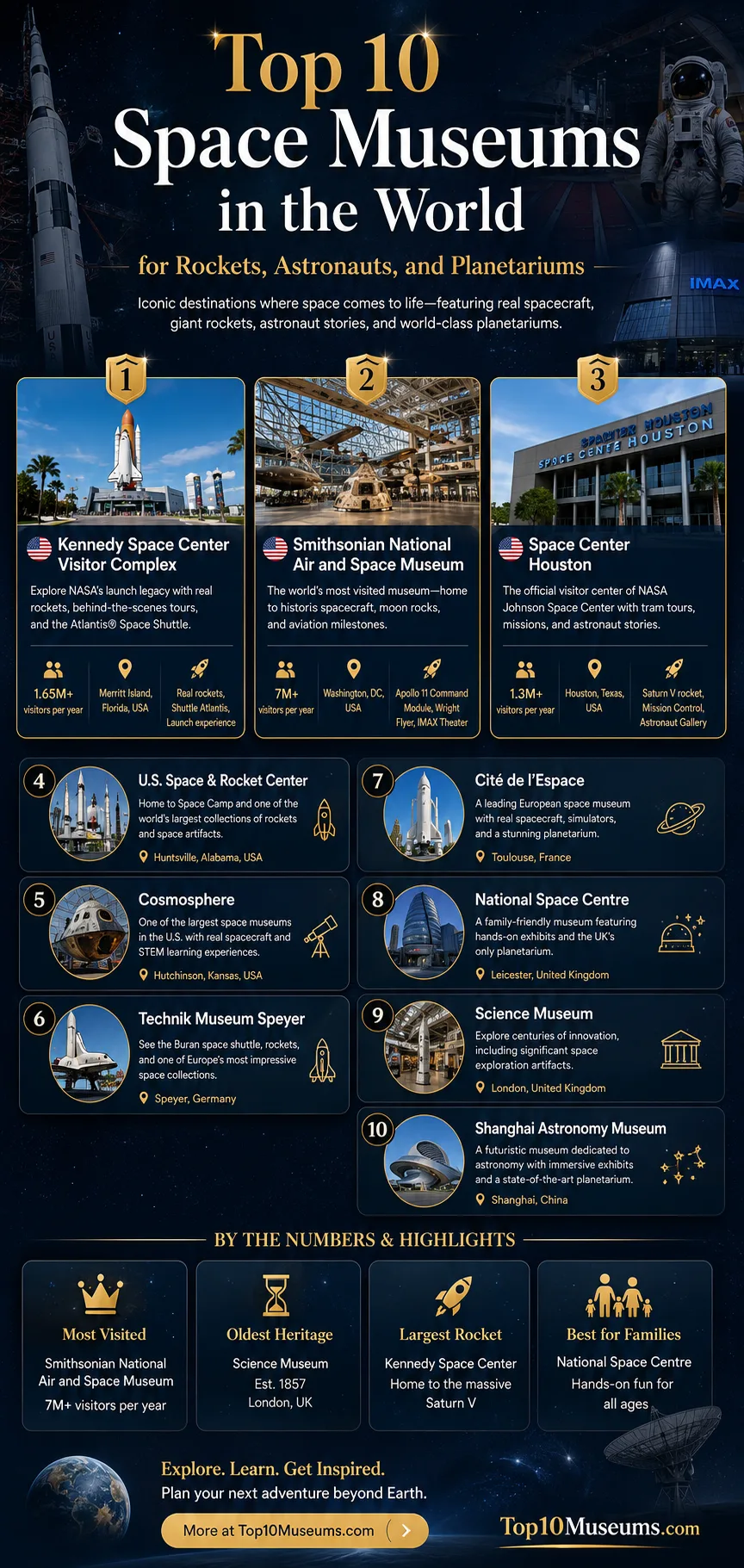
A space museum can preserve a capsule that crossed the atmosphere, an unfired rocket built for testing, a full-scale station model, or a control room where a lunar mission was directed. The best choices depend on what matters most: standing beneath a Saturn V, examining a scorched return capsule, following an astronaut’s working day, or entering a planetarium designed to make orbital motion understandable. These ten institutions are ranked by the strength of their permanent space collections, the status of their hardware, the quality of the visitor experience, and the practical value of making the trip.
[ayaz_safe_content id=”3159″ key=”p3159b1yhuekwh3″]
| Rank | Name | Founded | Collection Type | Website |
|---|---|---|---|---|
| 1 | Kennedy Space Center Visitor Complex | 1967 | Flown shuttle, Apollo hardware and active spaceport interpretation | Official website |
| 2 | Smithsonian National Air and Space Museum | 1946 | Apollo, Mercury, Gemini, shuttle and aviation collections | Official website |
| 3 | Space Center Houston | 1992 | Mission Control, astronaut training and shuttle transport history | Official website |
| 4 | U.S. Space & Rocket Center | 1970 | Rocket engineering, Saturn V and Space Camp | Official website |
| 5 | Cosmosphere | 1962 | Flown Mercury, Gemini and Apollo spacecraft | Official website |
| 6 | Technik Museum Speyer | 1991 | Buran test vehicle, Soyuz capsule and European spaceflight | Official website |
| 7 | Cité de l’Espace | 1997 | Full-scale spacecraft models, simulations and planetariums | Official website |
| 8 | National Space Centre | 2001 | British rocketry, Moon material and fulldome astronomy | Official website |
| 9 | Science Museum | 1909 | Apollo and Soyuz capsules with current space technology | Official website |
| 10 | Shanghai Astronomy Museum | 2021 | Astronomy, planetary science and dome experiences | Official website |
Flown Spacecraft, Test Vehicles, Replicas and Preserved Workplaces
The word “real” needs care in a space museum. A flown spacecraft crossed the atmosphere or operated in orbit. Atlantis, Discovery, Apollo 11’s Columbia, Apollo 13’s Odyssey, Apollo 10’s command module, Gemini X and the Soyuz capsules in Speyer and London belong to this group. Their scorched surfaces, repairs and mission-specific fittings are part of the evidence.
An original test vehicle was built for a real program but did not complete an orbital mission. Huntsville’s Saturn V dynamic test vehicle and Speyer’s Buran OK-GLI are valuable because engineers used them to solve structural, aerodynamic or landing problems. A full-scale replica reproduces size and layout without claiming a flight history; the Ariane 5, Mir and lunar hardware displays in Toulouse use scale to explain systems that would otherwise be difficult to enter or view. A preserved workplace, such as Apollo Mission Control in Houston, keeps the room, consoles and operating environment through which a mission was managed.
The ranking rewards all four forms when the museum labels them clearly. A replica that visitors can enter may explain daily life better than a sealed original, while a flown capsule carries physical traces that no reconstruction can reproduce.
The Ten Strongest Space-Museum Experiences
1. Kennedy Space Center Visitor Complex
Kennedy joins museum-scale objects to the geography of a working launch center. The first priority is Space Shuttle Atlantis, displayed with its payload doors open, Canadarm extended and the orbiter rotated 43.21 degrees. That position exposes the spacecraft as astronauts saw it in orbit rather than presenting it like an aircraft parked on a floor. Atlantis flew 33 missions between 1985 and 2011, so the thermal protection tiles, payload bay and docking equipment can be read as working parts of a reusable spacecraft rather than decorative surfaces.
The Apollo/Saturn V Center requires the included bus journey beyond the main visitor area. Its restored Saturn V uses authentic program hardware that was prepared for the Moon effort but did not fly as a complete launch vehicle. Walking from the five F-1 engines toward the upper stages makes the sequence of launch, stage separation and lunar departure easier to grasp than a diagram alone. The building also holds Apollo-era command modules, suits, a lunar module and a touchable Moon sample, while a recreated firing-room presentation explains why launch control depended on timed decisions made across many consoles.
A visit works best as a full day. Atlantis, the Rocket Garden and the Apollo/Saturn V Center already fill several hours, and the bus route introduces launch pads, the Vehicle Assembly Building and the distances needed to operate a spaceport safely. Launch schedules can alter access and traffic, so a launch-day visit should be planned around the visitor complex’s current notices rather than assuming every area will run normally.
Best for: Visitors who want a flown shuttle, a Saturn V and an active launch-site setting in one day
Nearby alternative: American Space Museum & Space Walk of Fame in Titusville — a smaller institution that adds personal mission artifacts, worker stories and Space Coast history within a short drive.
2. Smithsonian National Air and Space Museum
The Smithsonian’s strength comes from objects that define separate stages of crewed spaceflight. At the National Mall building, Apollo 11’s command module Columbia is the spacecraft that carried Neil Armstrong, Buzz Aldrin and Michael Collins back through Earth’s atmosphere. The lunar module Eagle remained behind, so Columbia is the surviving crewed spacecraft from the mission. Neil Armstrong’s pressure suit, a Saturn V F-1 engine, Mercury and Gemini hardware, Skylab and the Destination Moon galleries place that capsule inside a longer engineering sequence.
The museum’s second site, the Steven F. Udvar-Hazy Center in Virginia, changes the scale. Space Shuttle Discovery is displayed as a complete orbiter after 39 missions, surrounded by hangar space that permits views from several levels. The two locations should not be treated as adjacent branches: the National Mall building is in central Washington, while Udvar-Hazy is near Washington Dulles International Airport. Trying to inspect both collections properly in one compressed day means losing much of the value of each.
The Washington building reached an important stage in its renovation on July 1, 2026, when five new galleries opened for the museum’s 50th anniversary at that location. Two remaining renovated galleries are scheduled for autumn 2026. That makes current gallery planning important, since the institution is operating with far more of the National Mall building available than during earlier renovation phases. The National Mall visit suits a half or full day; Udvar-Hazy can also occupy most of a day for visitors who examine both aviation and space objects.
Best for: Artifact-focused visitors comparing Apollo, early capsules and a flown space shuttle
Nearby alternative: Smithsonian National Museum of American History — a short walk across the National Mall for technology, transport and American social history beyond aerospace.
3. Space Center Houston
Houston explains the work that happens after a spacecraft leaves the launch pad. Its most valuable historical space is the restored Apollo Mission Operations Control Room at NASA Johnson Space Center. The consoles, wall displays and viewing room show how flight directors and specialist teams followed guidance, communications, electrical systems and life support while crews were far beyond direct physical help. Access is through a specific tram experience, and the Mission Control option is currently an added-cost tour that should be reserved in advance.
Independence Plaza needs the same careful object labeling used throughout this article. The upper vehicle, Independence, is a shuttle replica. The Boeing 747 beneath it is NASA 905, an original Shuttle Carrier Aircraft used to move orbiters across the United States. Visitors can enter both, compare the replica flight deck with the carrier aircraft interior, and see why the orbiter required a reinforced aircraft, external attachment points and altered aerodynamics. It is the only public display where visitors can enter a shuttle mounted on an original carrier aircraft.
Other tram routes may reach astronaut training areas, Rocket Park or parts of the Johnson Space Center campus, but operating needs can change the available stops. A full day leaves room for the tram, Independence Plaza, spacesuits, lunar material and current human-spaceflight interpretation. Families gain more from the hands-on areas when the day is not built around a tight departure time.
Best for: Visitors interested in Mission Control, astronaut operations and the shuttle transport system
Nearby alternative: Lone Star Flight Museum — an aerospace museum near Ellington Airport that adds aircraft, Texas aviation history and flight-focused exhibits within the wider Houston area.
4. U.S. Space & Rocket Center
Huntsville is the strongest choice for understanding rockets as tested engineering systems. The Saturn V in the Davidson Center is SA-500D, a dynamic test vehicle used to study how the launch vehicle behaved under vibration and structural loads. It did not carry a crew or fly to the Moon. Its value lies in the fact that it helped engineers prove the vehicle before operational launches, and it is protected as a National Historic Landmark.
The horizontal display exposes the launch vehicle stage by stage. Visitors can move beneath the five-engine first stage, follow the shrinking diameter and changing engine arrangements, and compare the rocket with the Apollo 16 command module and other Moon-program hardware. Outside, Rocket Park traces earlier missile and launch-vehicle families that helped turn Huntsville into “Rocket City.” The display works as a walkable timeline, especially for visitors who want to see how Redstone, Jupiter and later launch systems relate to one another.
Space Camp gives the institution a different role from a conventional collection museum. Its mission simulations, teamwork and training activities are separate programs rather than casual gallery add-ons, so families considering camp should plan independently from a normal museum day. The INTUITIVE Planetarium adds live astronomy and fulldome programming. Four to six hours is reasonable for the museum and planetarium; a visitor reading technical labels closely can use a full day.
Best for: Rocket engineering, Saturn V structure and families considering Space Camp
Nearby alternative: Huntsville Museum of Art — a downtown collection that provides a quieter art-focused visit after the large indoor and outdoor engineering displays.
5. Cosmosphere
Cosmosphere places three flown American spacecraft from the Mercury, Gemini and Apollo programs within one institution. Liberty Bell 7 carried Gus Grissom on a 15-minute suborbital flight in 1961, sank after splashdown and remained more than 16,000 feet below the Atlantic for 38 years. It was recovered in 1999 and conserved in Hutchinson. The surface condition is therefore part spaceflight evidence and part marine-recovery history.
Gemini X represents the two-person program that developed rendezvous, docking and long-duration skills needed for Apollo. Apollo 13’s Odyssey carries a different kind of mission record. After the oxygen-tank failure forced the Moon landing to be abandoned, the command module was powered down to conserve resources and reactivated for the crew’s final return through the atmosphere. Seeing Odyssey beside earlier capsules makes changing cabin volume, heat-shield form and mission needs visible without relying on scale drawings.
The Hall of Space also includes Soviet hardware, suits, engines, a Mission Control console and restored or replicated objects produced by the museum’s SpaceWorks team. Labels distinguishing flown, genuine, engineering-model and replica material deserve attention because the galleries intentionally mix several types of evidence. The renovated Hall of Space galleries are open, and the Justice Planetarium and live science programming make the institution workable for mixed-age groups. Plan at least three hours; add more time for a dome program or detailed study of the Cold War galleries.
Best for: Comparing flown Mercury, Gemini and Apollo capsules in a single museum
Nearby alternative: Strataca — an underground salt museum a short drive away that changes the pace with industrial geology, mining history and a subterranean visit.
6. Technik Museum Speyer
Speyer’s defining object is Buran OK-GLI, an original atmospheric test vehicle built for the Soviet shuttle program. It completed powered test flights and automatic landings but never entered orbit. The orbital Buran that flew unmanned in 1988 was a different vehicle. This distinction does not reduce OK-GLI to a display copy: its engines, flight-test role and airframe record a development path that differed from NASA’s shuttle program.
The museum’s Soyuz TM-19 descent module did return from space. German ESA astronaut Ulf Merbold used it to come home from Mir in November 1994, and its compact shape, heat effects and tight three-person layout contrast sharply with the broad Buran airframe. The space hall also includes Spacelab material, suits, documents, Vostok and Apollo replicas, a lunar rover reconstruction and Moon material. This mix makes the authenticity labels essential rather than optional.
Technik Museum Speyer is much larger than its space exhibition. Aircraft, locomotives, marine hardware, vehicles and walk-in exhibits can turn a planned two-hour Buran stop into a full-day visit. Space specialists should go to the space hall early, then decide how much energy remains for the wider technology collection. The museum opened in 1991 and occupies large indoor halls and outdoor grounds, so comfortable walking time matters.
Best for: Soviet shuttle development, a flown Soyuz capsule and European human-spaceflight hardware
Nearby alternative: Historical Museum of the Palatinate — a museum near Speyer Cathedral covering regional archaeology, history and changing exhibitions within the old city.
7. Cité de l’Espace
Toulouse uses full-scale models and bodily simulation to explain spacecraft that cannot be made available as walk-in originals. The outdoor Ariane 5 replica establishes the dimensions of a European heavy-lift launch vehicle. A full-scale Mir model lets visitors move through connected modules and confront the narrow passages, equipment density and absence of ordinary floor-and-ceiling cues found in an orbital station.
LuneXplorer addresses a different question: what launch and lunar-flight acceleration feel like. Its rotating system can produce forces approaching 2G during the simulated sequence. The value is not the story layered around the ride but the physical lesson that a seated body, restrained and pressed into a couch, experiences controls and movement differently as acceleration rises. Visitors who are sensitive to motion or have relevant health restrictions should check the attraction rules rather than treating it as a required part of admission.
Planetarium programs, an observatory, Mars and lunar displays, weather and Earth-observation material broaden the site beyond crewed flight. Because many central objects are replicas or models, the museum works best for visitors who want access, scale and explanation rather than a collection dominated by flown capsules. Most people should allow a full day, especially when combining outdoor exhibits, a dome show and LuneXplorer. The site lies outside central Toulouse, so travel time should be included in the schedule.
Best for: Families seeking full-scale spacecraft interiors, physical simulations and planetarium programming
Nearby alternative: Aeroscopia — a large aviation museum across the Toulouse metropolitan area near Blagnac, useful as a separate half-day for Airbus and civil-aircraft history rather than a walkable add-on.
8. National Space Centre
Leicester’s 42-metre Rocket Tower was designed around Blue Streak and Thor Able, allowing the rockets to be read vertically across four exhibition decks. Blue Streak began as a British ballistic-missile project and later became the first stage of the European Europa launcher. The vehicle displayed in Leicester did not fly, but it preserves hardware from Britain’s abandoned attempt to develop a major launch system.
The tower also contains a lunar-lander display, real Moon material and galleries tracing the Space Race and British participation in space science. Helen Sharman’s story gives the national account a human scale: she became the first British person in space in 1991 and spent eight days aboard Mir. Displays connected with British astronauts, satellites and university research prevent the collection from ending with cancelled rocket projects.
The Sir Patrick Moore Planetarium is the United Kingdom’s largest fulldome planetarium, while newer immersive attractions extend the visit into simulated travel and current mission themes. The centre is manageable in three to five hours, though a scheduled dome show fixes the rhythm of the day. It is especially practical for families because the site combines real material, large hardware and interactive interpretation without the distances found at an active space center.
Best for: British space history, vertical rocket displays and a strong fulldome planetarium
Nearby alternative: Abbey Pumping Station — a neighboring industrial museum with preserved steam engines, transport displays and Leicester sanitation history.
9. Science Museum
London’s Space gallery creates a direct comparison that is difficult to find elsewhere: Apollo 10’s command module and Soyuz TMA-19M sit beside one another. Apollo 10 orbited the Moon in May 1969 as the rehearsal for Apollo 11 and returned at a speed exceeding 39,800 kilometres per hour. The Soyuz carried Tim Peake, Yuri Malenchenko and Tim Kopra to the International Space Station in 2015 and returned to Earth in 2016. Both capsules retain visible re-entry effects.
The contrast is physical. Apollo’s wider conical cabin supported a three-person lunar mission architecture and an ocean splashdown. Soyuz returns by parachute to land, with a compact descent module surrounded during flight by other sections that do not come back. The Soyuz parachute displayed overhead helps connect the charred capsule to the final stages of descent. Nearby objects include Helen Sharman’s Sokol suit, Moon material, rocket engines and prototypes connected with newer British and international missions.
The new Space gallery opened in September 2025 and is free but ticketed. A visitor focused only on space can spend about 90 minutes to two hours here, yet the surrounding Science Museum can easily fill half a day. This is the most practical high-level space collection for a traveler already staying in central London, and it works well when a full-day trip to a dedicated space center is not possible.
Best for: Comparing Apollo and Soyuz capsule design during a central London museum day
Nearby alternative: Natural History Museum — directly beside the Science Museum, offering geology, meteorites, planetary material and natural-science collections in a separate institution.
10. Shanghai Astronomy Museum
Shanghai earns its place through astronomy and spatial design rather than a collection led by famous flown capsules. The museum is organized around three architectural instruments. The entrance Oculus tracks a moving circle of sunlight. The Sphere contains the planetarium theater and appears to float with much of its support concealed. The Inverted Dome opens the end of the visitor route toward the real sky, shifting attention from projection back to direct observation.
The permanent narrative moves through Home, Cosmos and Odyssey, with additional areas covering Chinese astronomy, planetary science and Mars exploration. Meteorites, models, digital visualization and large-scale media explain processes that cannot be represented by a single spacecraft. The planetarium is therefore part of the central museum argument, not an unrelated film theater attached to the building.
The museum opened in 2021 in Lingang, far from central Shanghai. Travel time and ticket procedures should be planned before departure, and popular dome sessions may require a separate reservation through the current official booking system. A half day is the minimum sensible visit; architecture and astronomy-focused visitors can use longer. Those seeking flown Apollo, shuttle or Soyuz hardware should prioritize another institution on the list, while visitors interested in how a building can demonstrate celestial motion will find Shanghai distinct from the other nine.
Best for: Planetarium visitors, astronomy learners and travelers interested in architecture shaped by celestial motion
Nearby alternative: China Maritime Museum — a large Lingang museum within a short drive, with shipbuilding, navigation and maritime-science displays.
Choosing by the Space Hardware You Want to See
- A flown space shuttle: Kennedy Space Center Visitor Complex displays Atlantis in an orbital pose; the Smithsonian’s Udvar-Hazy Center displays Discovery as a complete retired orbiter.
- Apollo command modules: The Smithsonian has Apollo 11’s Columbia, Cosmosphere has Apollo 13’s Odyssey, and the Science Museum has the Apollo 10 command module.
- Saturn V scale and engineering: Kennedy provides the Moon-launch setting and mission sequence; Huntsville provides the dynamic-test story and a close study of structural development.
- Soviet and Russian crewed flight: Technik Museum Speyer pairs Buran OK-GLI with a flown Soyuz return capsule, while Cosmosphere places Soviet material beside American Space Race hardware.
- Mission operations: Space Center Houston is the clear priority because Apollo Mission Control survives as a working environment rather than a detached console display.
- Planetarium-led astronomy: Shanghai Astronomy Museum places the dome at the center of the experience. National Space Centre, Cité de l’Espace and the U.S. Space & Rocket Center combine dome programs with major rocket displays.
- Hands-on family learning: Kennedy, Huntsville, Toulouse and Leicester offer the broadest mix of large objects, simulations and scheduled programs, though each needs more time than a compact gallery visit.
Realistic Space-Museum Routes by Region
Washington and the Florida Space Coast
Use two days for the Smithsonian: one for the National Mall building and one for the Udvar-Hazy Center. The Virginia site is near Dulles Airport rather than central Washington, so placing it on an arrival or departure day can reduce backtracking. Fly to central Florida afterward and reserve a separate full day for Kennedy Space Center Visitor Complex. Titusville’s American Space Museum can fit on the evening before Kennedy or on a following half day, but it should not replace time needed for the KSC bus route.
A Southern and Central United States Route
Huntsville, Houston and Hutchinson form a strong thematic sequence but not a compact weekend drive. Allow one museum day in each city and treat the long transfers as separate travel days or use flights where practical. Huntsville supplies rocket development, Houston supplies operations and astronaut training, and Hutchinson supplies flown capsules from three early American programs. A seven- to ten-day trip is more realistic than trying to force all three into a few days.
London and Leicester by Rail
Spend the first day in South Kensington with the Science Museum’s Space gallery and one neighboring museum. Travel to Leicester the next morning and give the National Space Centre most of the day, including a preselected planetarium session. The institutions are linked by rail at the city level, but the Leicester museum still requires local transport from the station. Returning to London the same evening is possible; adding a second full London museum after Leicester is not a comfortable plan.
Speyer and Toulouse as Separate European Stops
Technik Museum Speyer needs a full day because the space hall is only part of a much larger technology museum. Cité de l’Espace also merits a full day and sits outside central Toulouse. They belong in a longer European aerospace trip, not a same-day pairing. A workable plan places Speyer near a Frankfurt or Rhine itinerary, then uses a flight or long rail transfer before two or three nights in Toulouse. Aeroscopia can occupy a second Toulouse half day.
Shanghai as a Standalone Astronomy Day
Shanghai Astronomy Museum is in Lingang, so it should be assigned its own half or full day rather than inserted between central-city attractions. Reserve the museum and any desired dome program first, then arrange the long metro or road journey around that time. China Maritime Museum can be added only if the astronomy visit finishes early and energy remains; combining both large museums in detail is likely to make the day rushed.
A Scheduled 2026 Change to Watch
California Science Center is absent because Space Shuttle Endeavour is not currently on public display. The Samuel Oschin Air and Space Center is scheduled to open on November 13, 2026, with Endeavour presented vertically in a full launch stack with external tank and solid rocket boosters. Once the center is open and its visitor flow can be assessed, it will deserve a fresh comparison with Atlantis at Kennedy and Discovery at the Smithsonian. Until then, planning a Los Angeles trip around seeing Endeavour would create a false expectation.