
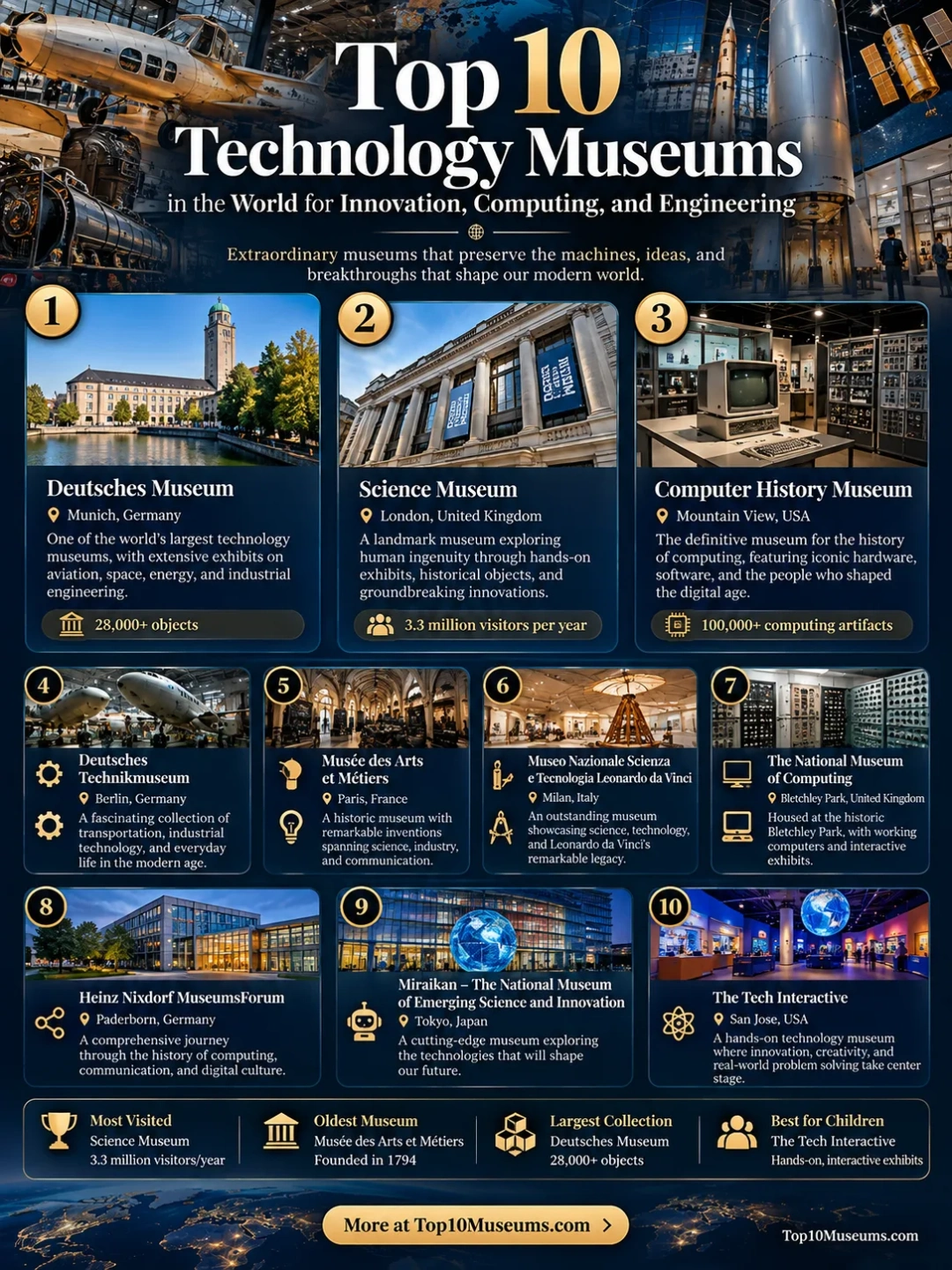
Technology museums differ sharply in what they preserve and how they explain it. Some are built around original engines, aircraft, communications equipment, and industrial machines; others trace computing through working hardware, software, and semiconductor history; a smaller group uses laboratories, robotics, biotechnology, and design challenges to explore technology still being developed. These ten museums stand out for the depth of their permanent displays, the quality of their technical objects, and their usefulness to visitors focused on innovation, computing, or engineering rather than general science alone.
| Rank | Name | Founded | Collection Type | Website |
|---|---|---|---|---|
| 1 | Deutsches Museum | 1903 | Engineering, electronics, aviation, energy | Official website |
| 2 | Science Museum | 1909 | Industrial technology, communications, engineering | Official website |
| 3 | Computer History Museum | 1996 | Computing hardware, software, digital history | Official website |
| 4 | Deutsches Technikmuseum | 1983 | Transport, aviation, manufacturing, communications | Official website |
| 5 | Musée des Arts et Métiers | 1794 | Inventions, mechanics, energy, transport | Official website |
| 6 | Museo Nazionale Scienza e Tecnologia Leonardo da Vinci | 1953 | Engineering, transport, space, Leonardo models | Official website |
| 7 | The National Museum of Computing | 2007 | Working historic computers and codebreaking machines | Official website |
| 8 | Heinz Nixdorf MuseumsForum | 1996 | Information technology and computer history | Official website |
| 9 | Miraikan – The National Museum of Emerging Science and Innovation | 2001 | Robotics, digital systems, Earth and future technology | Official website |
| 10 | The Tech Interactive | 1998 | Hands-on innovation, AI, robotics, biotechnology | Official website |
How These Museums Divide Between Machines, Computing, and New Technology
The strongest choices depend on what “technology museum” means to the visitor. Deutsches Museum, Science Museum, Deutsches Technikmuseum, Musée des Arts et Métiers, and the Milan museum are strongest when the goal is to see original machines, engineering systems, transport technology, energy equipment, and the physical history of invention. Their galleries make it possible to compare technical change across several industries rather than staying inside one field.
Computer History Museum, The National Museum of Computing, and Heinz Nixdorf MuseumsForum are better for visitors who want the development of information technology itself. Miraikan and The Tech Interactive lean toward newer science and technology, with robotics, AI, biotechnology, environmental systems, and hands-on design playing a larger role than long rows of historic machines.
Ten Technology Museums Worth Planning a Trip Around
1. Deutsches Museum — Munich, Germany
Deutsches Museum has the breadth expected from a national museum of science and technology, but its engineering focus keeps it useful even for visitors who normally skip general science museums. Founded in 1903 and opened on Museum Island in 1925, the Munich site now presents 20 permanent exhibitions across roughly 20,000 square metres. Current galleries cover fields such as electronics, robotics, energy and motors, aviation, astronautics, bridges, mathematics, chemistry, optics, and coding-related communication systems.
The most useful way to approach the museum is by technical field rather than trying to see every room. The Electronics exhibition includes an original Apple I and follows the shrinking scale of electronic components into modern devices. On the ground floor, the Energy – Motors section includes the first diesel engine, while aviation and astronautics add large-scale engineering objects that change the pace of the visit. One planning detail matters for computer-history visitors: the older dedicated Computers exhibition remains closed during the museum’s second renovation phase, scheduled to continue until 2028. Computing is still represented through Electronics and Image Script Codes, but a visitor focused mainly on historic computers will get more from the dedicated museums farther down this list.
Best for: engineering-focused visitors who want one museum to cover electronics, energy, aircraft, space technology, and mechanical systems
Nearby alternative: Deutsches Museum Verkehrszentrum — a separate Munich branch at Bavariapark devoted to cars, trains, bicycles, urban transport, and the engineering of mobility.
2. Science Museum — London, United Kingdom
London’s Science Museum works best when treated as a history-of-technology museum with several strong science galleries around it. The institution was established as the Science Museum in 1909 after the South Kensington collections were reorganized. Its location on Exhibition Road also makes it unusually easy to combine with other major museums without losing time crossing the city.
For technology visitors, Making the Modern World is the central starting point, following roughly 250 years of science and technology through machines and objects tied to industrial change. Information Age shifts the emphasis to more than two centuries of communications and information technology, while Energy Hall uses full-size steam engines and models to explain industrial power. Engineers, Flight, Mathematics, and the newer Space gallery add further routes through design, transport, calculation, and aerospace. The collection is broad enough for a half-day, but a visitor interested in both industrial machinery and communications can easily stay longer.
Best for: visitors who want industrial engineering, communications history, flight, and space in a central London museum
Nearby alternative: Victoria and Albert Museum — directly across Exhibition Road, with design, materials, decorative arts, and manufactured objects that provide a useful design-side counterpart to the Science Museum’s engineering story.
3. Computer History Museum — Mountain View, California, USA
The Computer History Museum is the most focused choice on the list for the development of computing itself. Its California organization dates to 1996, when the historical collection of Boston’s Computer Museum moved west and became an independent nonprofit center; the Computer History Museum name followed in 2000. The Mountain View location places the collection inside Silicon Valley rather than treating the region only as a backdrop.
The core exhibition, Revolution: The First 2000 Years of Computing, occupies about 25,000 square feet and uses 19 galleries and roughly 1,100 objects to move from early calculation to modern digital systems. Hardware matters here, but the interpretation also covers software, companies, interfaces, networks, and the people who built them. Make Software: Change the World! gives software a stronger physical presence, while Chatbots Decoded connects older computing ideas with current AI systems. A technically curious visitor can spend three to four hours without needing temporary exhibitions to carry the experience.
Best for: programmers, hardware enthusiasts, and visitors who want computing history from early calculation to AI
Nearby alternative: Intel Museum — in nearby Santa Clara, with a smaller exhibit focused on semiconductor manufacturing, chip history, and what happens inside a modern silicon fabrication environment.
4. Deutsches Technikmuseum — Berlin, Germany
Berlin’s Deutsches Technikmuseum is especially strong when technology is understood as transport, manufacturing, communications, and the systems that made an industrial city work. It opened in 1983 as the Museum of Transportation and Technology and has since expanded across a large site in Kreuzberg. Permanent exhibitions cover rail transport, aviation, shipping, road transport, computers, telecommunications, printing, machine tools, textiles, wind power, and other applied technologies.
The scale of the transport collections is a major part of the visit. The aviation section includes the Jeannin Stahltaube, described by the museum as the oldest surviving aircraft manufactured in Germany, along with a Junkers Ju 52. Rail displays occupy historic locomotive sheds and include imperial rolling stock, while smaller galleries on printing and telecommunications show the infrastructure behind information exchange. Some photography, film technology, and chemistry-and-pharmacy areas are unavailable during current renovation work, so the best reason to visit now is the museum’s transport, industrial, computer, and communication holdings rather than those closed rooms.
Best for: mechanical engineering, rail, aviation, communications, and industrial-production enthusiasts
Nearby alternative: Museum für Kommunikation Berlin — a short trip toward central Berlin, with exhibits tracing communication from early messaging systems to digital networks.
5. Musée des Arts et Métiers — Paris, France
Musée des Arts et Métiers is one of the best places to see invention as a sequence of physical solutions rather than as a timeline of famous inventors. Its roots go back to the Conservatoire national des arts et métiers, founded in 1794 as a repository for useful inventions. Today the museum displays more than 2,400 objects organized into seven areas: scientific instruments, materials, energy, mechanics, construction, communication, and transport.
The collection rewards close looking because many objects expose how a technical problem was solved before modern standardization hid the mechanism inside a finished product. The museum holds the 1851 sphere used in Léon Foucault’s pendulum experiment, and demonstrations recreate the pendulum under the vault of the former Saint-Martin-des-Champs church. Transport displays include Cugnot’s 1771 steam vehicle, while communications and mechanics galleries connect automation, recording, telegraphy, and machine design. The historic architecture adds atmosphere without turning the visit into an architecture-first museum.
Best for: visitors interested in invention, mechanisms, early transport, scientific instruments, and engineering design
Nearby alternative: Cité des sciences et de l’industrie — not next door, but straightforward to reach by Metro and a better Paris choice for interactive contemporary science and family-oriented technology exhibits.
6. Museo Nazionale Scienza e Tecnologia Leonardo da Vinci — Milan, Italy
Milan’s national science and technology museum combines a broad engineering collection with a large body of material devoted to Leonardo da Vinci’s technical thinking. The museum opened in 1953 in a former monastery complex, and its Leonardo galleries remain one of the clearest reasons to choose it over a more general science center.
The current Leonardo da Vinci Galleries present 170 historical models, artworks, books, and immersive installations that examine his work as an engineer and humanist. Elsewhere, the museum moves into full-scale industrial objects: locomotives, aircraft, space hardware, communications technology, energy systems, and the S 506 Enrico Toti submarine. The submarine can be visited on guided tours, and its size changes the character of a visit that might otherwise feel dominated by display cases and models. Four hours is a more realistic allowance than a quick two-hour pass if Leonardo, transport, and space are all priorities.
Best for: visitors who want Leonardo engineering models combined with full-size transport and industrial technology
Nearby alternative: ADI Design Museum — elsewhere in central Milan, with Italian industrial design, prototypes, product development, and objects that show how engineering decisions become everyday products.
7. The National Museum of Computing — Bletchley, United Kingdom
The National Museum of Computing is a working-machine museum rather than a display of silent computer cases. Located in Block H on the Bletchley Park estate, it opened officially in 2007 and focuses on functional historic computers, wartime codebreaking equipment, mainframes, personal computing, and the development of British digital technology.
The working exhibits make the museum different from a conventional computer collection. The rebuilt Colossus and Turing-Welchman Bombe are interpreted alongside Enigma and Lorenz systems, while the 1951 Harwell Dekatron computer — better known as WITCH — is recognized as the world’s oldest original working digital computer. Volunteers and demonstrations are part of the value because the machines reveal switching, storage, input, and processing in ways that modern sealed devices do not. Allow at least two hours; visitors who stop for demonstrations and later computing galleries will need more.
Best for: early-computing specialists, codebreaking history, and visitors who want to see historic machines operating
Nearby alternative: Bletchley Park — on the same estate but run separately, with a broader museum experience centered on wartime intelligence, codebreaking operations, people, and the site itself.
8. Heinz Nixdorf MuseumsForum — Paderborn, Germany
Heinz Nixdorf MuseumsForum takes a longer view of information technology than most computer museums. Opened in 1996 in the former headquarters of Nixdorf Computer AG, it uses about 6,000 square metres of exhibition space to connect writing, calculation, office machines, punched-card systems, early computers, personal computing, and present-day robotics.
More than 2,000 objects are shown within a story that the museum describes as 5,000 years of information technology. That span matters because it puts computers beside older methods of storing, organizing, and transmitting information rather than starting with vacuum tubes or microprocessors. Typewriters, calculating machines, the Commodore 64, office systems, and robots create a steady transition from mechanical information handling to digital devices. The former Nixdorf setting also gives business computing and office technology more weight than they receive in many technology museums.
Best for: visitors interested in the long history of information technology, office computing, and European computer development
Nearby alternative: Deutsches Traktoren- und Modellauto-Museum — another Paderborn technology museum, with more than 120 historic tractors, working steam-engine models, and a large model-vehicle collection.
9. Miraikan – The National Museum of Emerging Science and Innovation — Tokyo, Japan
Miraikan is the list’s strongest choice for technology that is still being researched, debated, and introduced into daily life. The museum opened in 2001 in Tokyo’s Odaiba area and is operated by the Japan Science and Technology Agency. Its permanent exhibitions have covered robotics, digital systems, Earth data, environmental change, aging, and the relationship between science, technology, and society.
Geo-Cosmos is the museum’s most recognizable installation: a six-metre spherical Earth display rebuilt with 10,362 LED panels and used for programs based on scientific data. Recent permanent areas have included Hello! Robots, Nanairo Quest, Planetary Crisis, and Park of Aging, making Miraikan better suited to visitors interested in emerging technology than to those looking for historic machinery. There is an immediate planning issue, however: Miraikan is scheduled to close for a museum-wide refurbishment on October 1, 2026, and reopen on April 23, 2027. A Tokyo trip during that closure should use another science or technology museum instead.
Best for: robotics, future technology, Earth-data visualization, and visitors who prefer current research to industrial history
Nearby alternative: Science Museum in Kitanomaru Park — across central Tokyo rather than in Odaiba, with hands-on exhibits on electricity, motors, construction, industrial technology, and experimental science.
10. The Tech Interactive — San Jose, California, USA
The Tech Interactive is less object-driven than the other museums on this list. Its permanent San Jose building opened in 1998 as The Tech Museum of Innovation and was renamed The Tech Interactive in 2019. Instead of relying on historic machines, it uses labs, design challenges, digital installations, and hands-on engineering tasks to make visitors work through problems themselves.
Current exhibit areas cover AI, robotics, cybersecurity, biotechnology, health technology, environmental problem-solving, and creative engineering. Social Robots lets visitors build with sensors and actuators, Cyber Detectives introduces digital investigation and internet safety, and the BioTinkering Lab uses real laboratory tools in facilitated activities. The Tech Studio is especially useful for families who want engineering as a process of designing, testing, and rebuilding rather than a collection of finished inventions. Adults interested mainly in historic artifacts will prefer the Computer History Museum farther north, while families and school-age visitors often get more direct participation here.
Best for: families, school-age visitors, and hands-on learners interested in AI, robotics, biotech, and engineering design
Nearby alternative: Children’s Discovery Museum of San Jose — within the same downtown area and better suited to younger children who need shorter, more play-based science and technology activities.
Practical Technology-Museum Routes That Avoid Unnecessary Backtracking
London and Bletchley: Broad Engineering First, Working Computers Second
Use separate days for the Science Museum and The National Museum of Computing. The Science Museum can fill most of a day if Making the Modern World, Information Age, Flight, Engineers, and Space are all priorities. On another day, trains from London Euston reach Bletchley directly, and the computing museum is a short walk from the station. Combining TNMOC with Bletchley Park works geographically, but both contain enough material that a rushed half-day split is poor value.
Silicon Valley: Computer History Museum and The Tech Interactive
Mountain View and downtown San Jose form the easiest two-museum pairing in North America on this list. Put the Computer History Museum first if hardware, software, or semiconductor history is the priority, then use The Tech Interactive for a more participatory second visit. They can be combined in one long day by car, but two half-days produce a less rushed experience. The Intel Museum in Santa Clara fits naturally between them for visitors specifically interested in chip fabrication.
Germany: Munich for Breadth, Paderborn for Computing, Berlin for Transport
A Germany-focused technology trip works best as a multi-city route rather than an attempt to compress the museums into consecutive day trips. Deutsches Museum deserves the longest stop because its collections span several technical fields. Heinz Nixdorf MuseumsForum is the most focused computer-history destination, while Deutsches Technikmuseum gives transport engineering, aviation, rail, printing, and communications much more physical space. Three museum days plus travel time is the practical minimum.
Paris and Milan: Invention History Followed by Industrial Design and Full-Scale Machines
Musée des Arts et Métiers works well as a half-day focused on mechanisms, instruments, energy, and early transport. Milan’s Museo Nazionale Scienza e Tecnologia Leonardo da Vinci needs a longer visit because its Leonardo galleries sit alongside locomotives, aircraft, space displays, and a submarine. Travelers already moving between Paris and northern Italy can treat the pair as two different views of engineering: invention and mechanism in Paris, then model-making, industrial scale, and transport in Milan.
Tokyo: Check Miraikan’s Refurbishment Dates Before Building the Day Around Odaiba
Miraikan normally works as a half-day Odaiba destination rather than a central-Tokyo museum stop. Because the announced closure runs from October 1, 2026, through April 22, 2027, visitors during that period should switch to the Science Museum in Kitanomaru Park for hands-on industrial and engineering exhibits. After Miraikan reopens on April 23, 2027, its refreshed galleries will again make it the better Tokyo choice for robotics, data visualization, and technology aimed at the near future.