
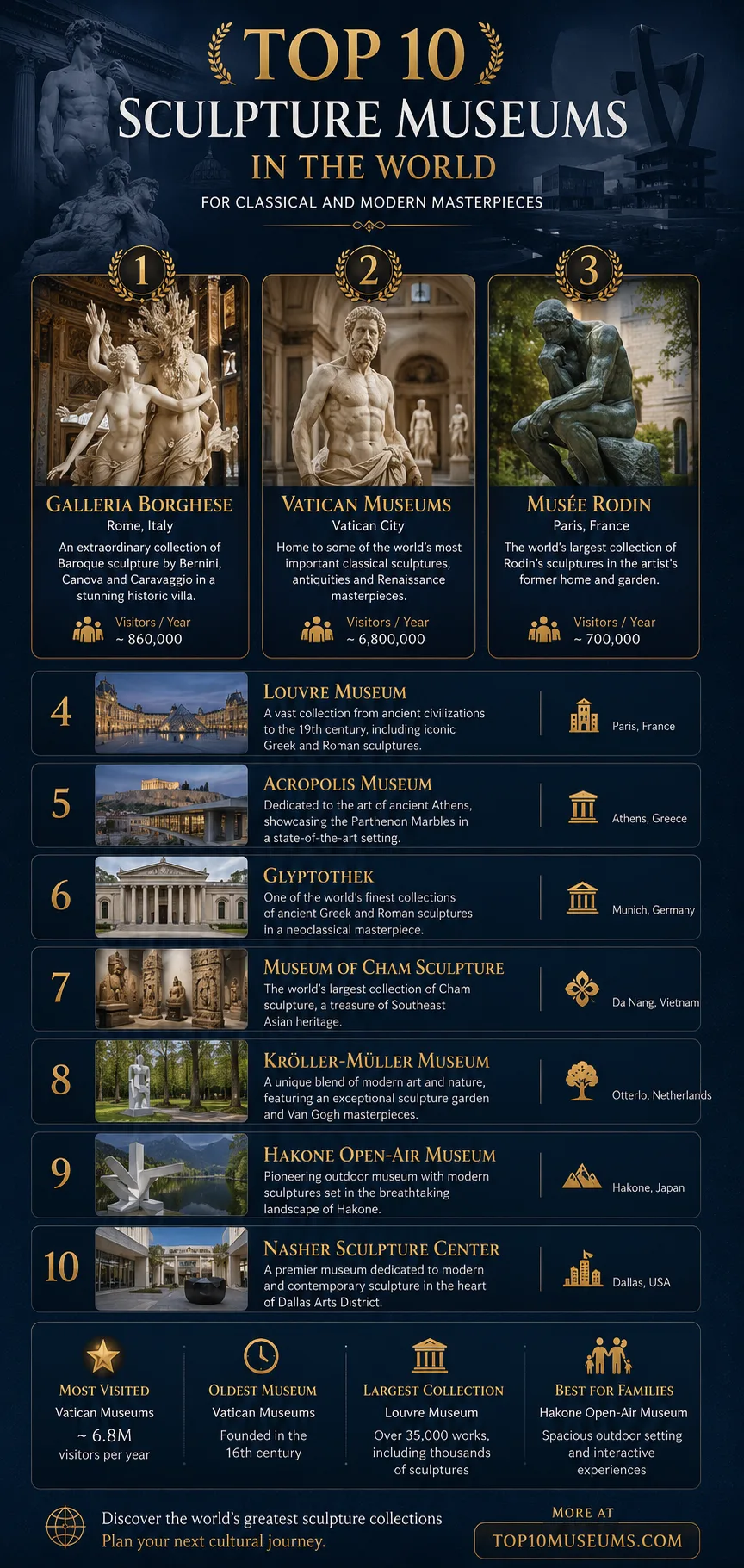
The best sculpture museums are not always the institutions with the largest floor plans. Sculpture changes when it is seen in a frescoed Roman villa, beside the architecture it once adorned, or outdoors where rain, shadow and distance alter the surface. This ranking compares museums devoted mainly to sculpture with broader art museums whose sculptural holdings can shape an entire visit. Galleria Borghese offers the most concentrated encounter with Baroque marble; the Vatican Museums and Glyptothek are stronger for classical bodies and fragments; Kröller-Müller and Hakone show how modern sculpture works in open landscape.
[ayaz_safe_content id=”3155″ key=”p3155b1jq0z4jsy”]
| Rank | Name | Founded | Collection Type | Website |
|---|---|---|---|---|
| 1 | Galleria Borghese | 1902 as a state museum | Baroque, Neoclassical and ancient sculpture | Official website |
| 2 | Vatican Museums | 1506 collection origins | Greek and Roman antiquities | Official website |
| 3 | Musée Rodin | 1919 | Rodin, his process and related artists | Official website |
| 4 | Louvre Museum | 1793 | Ancient, Renaissance and Neoclassical sculpture | Official website |
| 5 | Acropolis Museum | 2009 | Archaic and Classical architectural sculpture | Official website |
| 6 | Glyptothek | 1830 | Ancient Greek and Roman sculpture | Official website |
| 7 | Museum of Cham Sculpture | 1919 | Cham Hindu and Buddhist sandstone sculpture | Official website |
| 8 | Kröller-Müller Museum | 1938 | Modern and contemporary outdoor sculpture | Official website |
| 9 | Hakone Open-Air Museum | 1969 | Modern sculpture in a mountain landscape | Official website |
| 10 | Nasher Sculpture Center | 2003 | Modern and contemporary sculpture | Official website |
Why These Ten Produce Different Sculpture Experiences
A museum can be exceptional for sculpture in several ways. Galleria Borghese has fewer rooms than the Louvre, yet its Bernini groups remain tied to decorated interiors that control distance, movement and sightlines. The Acropolis Museum gains its strength from restoring architectural logic: visitors can distinguish a frieze from a metope and see where each element belonged. The open-air museums at Otterlo and Hakone replace the gallery wall with trees, water, weather and long views.
The ranking therefore weighs the density of major works, the place of sculpture within the institution, the relationship between object and setting, the range of periods or materials, and the chance to encounter something difficult to reproduce elsewhere. It also avoids treating European marble as the only sculptural tradition. Da Nang’s Cham collection brings sandstone temple sculpture, Hindu and Buddhist imagery, and Southeast Asian workshop styles into the same conversation as Greek, Roman, Baroque and modern work.
Ten Museums Where Sculpture Shapes the Visit
1. Galleria Borghese, Rome
Galleria Borghese gives sculpture unusual authority. Bernini’s groups are not isolated against neutral walls; they occupy the centers of frescoed rooms inside a villa built for Cardinal Scipione Borghese. Marble floors, painted ceilings, ancient reliefs and colored surfaces remain part of the encounter. The setting narrows the distance between sculpture, architecture and theatrical staging, which is why a relatively compact museum can feel more concentrated than a much larger collection.
The central sequence is Aeneas, Anchises and Ascanius, Pluto and Proserpina, David, and Apollo and Daphne. Each explores a different problem. In David, the body twists toward an opponent who exists outside the stone, so the surrounding room becomes part of the action. In Pluto and Proserpina, fingers press into a thigh that appears softer than marble should allow. Apollo and Daphne changes material before the viewer’s eyes: polished skin becomes bark, fingers divide into leaves, and hair seems to scatter into air.
Walking around the works matters. From one side, Apollo and Daphne reads as pursuit; from another, transformation takes over. Bernini designs these shifts rather than relying on a single frontal view. Canova’s Pauline Bonaparte as Venus Victrix then provides a useful contrast. Its cool polish, controlled pose and long reclining silhouette replace Baroque strain with Neoclassical restraint.
Entry is timed, advance reservation is required, and the standard visit is organized in a two-hour slot. That limit is workable because the museum is compact, though it rewards choosing several works for close study rather than trying to inspect every painting and antiquity. From June 23 to September 20, 2026, Metamorphoses: Ovid and the Arts places Bernini’s mythological sculpture within a wider history of transformation. The temporary exhibition adds context without changing the permanent reason to visit.
Best for: Visitors who want the strongest single encounter with Bernini and Baroque marble.
Nearby alternative: Museo Carlo Bilotti — a smaller modern art museum inside Villa Borghese that works well after the timed visit without leaving the park.
2. Vatican Museums, Vatican City
The Vatican Museums contain far more than sculpture, but the Pio-Clementino Museum and Octagonal Court form one of the defining routes through the classical body. The court developed from the papal collection of antique statues assembled around the time of Julius II. It places works such as the Laocoön and Apollo Belvedere within a history of collecting that influenced Renaissance workshops, academies and later ideas of ideal form.
The Laocoön group, discovered in Rome in 1506, turns pain into a network of twisting limbs, strained torsos and serpents. It is useful to compare that dense action with the measured stance of the Apollo Belvedere. The Belvedere Torso adds a third lesson: a headless and limbless fragment can command attention through compressed muscles and a seated turn. Artists studied the torso precisely because the missing parts forced them to imagine continuation.
This is also a museum for understanding copies, restorations and the afterlife of Greek sculpture. Many admired Greek compositions survive through Roman versions. Earlier restorers sometimes supplied missing limbs to make an object appear whole; later curators have been more willing to preserve visible breaks. Looking at joins, changes in marble tone and repaired surfaces reveals how the modern idea of an “ancient masterpiece” was often constructed over several periods.
The sculpture route sits inside a very large museum complex, so a brief stop can become exhausting if it is combined with every major gallery. An early entry and a planned route through Pio-Clementino are more realistic than treating the classical courts as an afterthought after the Sistine Chapel. Visitors with a narrow sculpture interest should reserve most of their attention for the Octagonal Court, the Gallery of Statues and the surrounding antiquities rooms.
Best for: Classical sculpture readers interested in ideals, fragments, Roman copies and restoration history.
Nearby alternative: Museo Nazionale di Castel Sant’Angelo — a reachable papal and military museum where sculpture is seen within a fortress rather than an antiquities court.
3. Musée Rodin, Paris
Musée Rodin is especially useful because it reveals sculpture as a process rather than a single finished object. The galleries in the Hôtel Biron contain plaster studies, marbles, bronzes, portraits and repeated figures. The garden then changes the scale, placing major casts among lawns, trees and long views. Moving between the two explains how Rodin enlarged, recombined and recast forms throughout his career.
The Thinker began in 1880 as a much smaller figure associated with The Gates of Hell. Conceived as a poet looking down over the portal, it was closely tied to Dante before becoming an independent work in enlarged bronze versions. That history explains why more than one authorized cast exists and why the familiar outdoor figure should not be understood as a solitary idea that appeared fully formed.
Rodin’s method moved through clay modeling, plaster, molds, enlargement, carving and casting. A bronze is not the artist’s hand pressed directly into metal; it preserves the modeled surface through a chain of technical stages. Repetition was part of the method. Hands, torsos and heads could be reused in new combinations, while changes in scale produced new meanings. The museum’s study material makes those decisions visible in a way that a single monumental cast cannot.
The garden, covering more than three hectares, is not merely a place to rest. The Burghers of Calais, Monument to Balzac, The Gates of Hell and The Thinker depend on distance, changing viewpoints and open sky. Inside, close-range studies reward attention to fingerprints and rough modeling. Outdoors, silhouette and mass become more important. A half day gives enough time for both conditions without reducing the visit to two famous titles.
Best for: Visitors who want to understand casting, enlargement, repetition and Rodin’s working method.
Nearby alternative: Musée Maillol — an artist-centered museum a short walk away that offers a calmer comparison with another French sculptor’s treatment of the figure.
4. Louvre Museum, Paris
The Louvre offers the broadest historical span in the ranking, but its sculpture is spread across a palace large enough to overwhelm an unplanned visit. A sculpture-led route works better than trying to “complete” the museum. Begin with the Winged Victory of Samothrace at the top of the Daru staircase, then move through Michelangelo’s Slaves, Canova’s Psyche Revived by Cupid’s Kiss, the French sculpture courts, and the Venus de Milo.
The setting of the Winged Victory shows how architecture can create an arrival. The figure stands above the stair, its missing head and arms outweighed by the forward drive of the torso, the spread wings and the folds pressed back as if by sea wind. The museum display is modern, yet it echoes the sculpture’s original role in a sanctuary where the figure was designed to be approached from below.
The Venus de Milo raises a different question. Its missing arms have encouraged countless reconstructions, but the present fragment has become more recognizable than any proposed completion. Michelangelo’s Dying Slave and Rebellious Slave shift attention toward unfinished surfaces. Smooth limbs emerge beside areas where the stone remains visibly worked, allowing viewers to see the tension between completed body and block.
The Cour Marly and Cour Puget bring large French garden and architectural sculpture into covered courtyards. Their scale is easier to grasp by moving away from the bases and looking across several works at once. Canova, by contrast, rewards slow circling at close range: the crossing arms and leaning heads in Psyche Revived by Cupid’s Kiss form a changing composition from every side. These contrasts make the Louvre better for comparison than for a narrow single-artist study.
Allow at least half a day for this route, and more if antiquities or French sculpture are a main interest. Gallery access can change, so the practical priority is to choose several anchor works rather than build a minute-by-minute plan around every room.
Best for: Visitors comparing ancient, Renaissance, Baroque and Neoclassical sculpture in one institution.
Nearby alternative: Musée de l’Orangerie — a compact museum across the Tuileries that provides a manageable modern-art visit after a long Louvre session.
5. Acropolis Museum, Athens
The Acropolis Museum restores connections that ordinary display cases often erase. Its upper Parthenon Gallery is aligned with the temple visible through the glass walls, while the rectangular inner core follows the orientation and approximate dimensions of the Parthenon’s cella. Sculpture is therefore read as part of a building, procession and civic setting rather than as a sequence of detached marble fragments.
Three sculptural zones need to be kept separate. The frieze forms a continuous band and carries the Panathenaic procession around the building. Metopes are individual panels placed outside the frieze, each containing a distinct scene. Pedimental sculpture occupied the triangular ends of the roof and required figures to fit changing heights from center to corner. Understanding those positions makes the gallery far easier to read.
The display combines original pieces held in Athens with plaster casts representing sections kept elsewhere. The contrast makes absence visible rather than hiding it. It also allows the surviving sequence to be followed around the gallery. Damage, breaks and replacement casts become part of the history of the Parthenon sculptures, including their removal, dispersal and later conservation.
Earlier galleries add the Archaic statues and the building remains uncovered beneath the museum. Look closely at hair, patterned clothing and traces of pigment. Classical sculpture was not conceived as plain white marble: painted details and metal attachments contributed to how figures were originally seen. Natural light in the museum helps reveal tool marks and surface changes, though the strongest reason to visit remains the direct visual link between the upper gallery and the Acropolis.
Around three hours is a practical first visit. Pairing the museum with the Acropolis archaeological site on the same day creates useful context, but both deserve enough time and shade breaks during warmer months.
Best for: Visitors who want to understand how sculpture functioned on the Parthenon’s architecture.
Nearby alternative: National Museum of Contemporary Art Athens — a short journey away for a deliberate shift from classical architectural sculpture to present-day media and installation.
6. Glyptothek, Munich
Munich’s Glyptothek was built specifically for ancient sculpture and opened in 1830. Fourteen rooms arranged around an inner courtyard create a chronological path without the noise of a vast mixed collection. The sequence moves from Archaic Greek stiffness through Classical balance and Hellenistic drama to Roman portraiture, making changes in bodily pose and facial character easy to compare.
The Aegina pediment figures are central to the museum’s identity. They once formed battle scenes within triangular temple ends, where kneeling, falling and reclining bodies solved the problem of narrowing architectural space. Seen at eye level in Munich, they allow close study of carved armor, smiles and changing approaches to movement, but their original placement should remain in mind.
The Barberini Faun offers a sharp contrast with the controlled public body represented by the Apollo Belvedere in the Vatican. This figure sleeps with limbs spread and the torso exposed, combining physical beauty with vulnerability, fatigue and intoxication. Nearby works such as the Kouros of Tenea, Medusa Rondanini and Roman portraits extend the study from ideal types to individualized faces.
The restrained postwar interior keeps attention on stone, proportion and spacing. Two to three hours is enough for a careful visit, making the Glyptothek easier to study than larger antiquities collections. It is especially useful for students who want to compare periods without walking through unrelated departments between each example.
Best for: Art-history students tracing the changing body from Archaic Greece to Roman portraiture.
Nearby alternative: Staatliche Antikensammlungen — directly opposite on Königsplatz, it complements the sculpture with Greek pottery, metalwork and smaller antiquities.
7. Museum of Cham Sculpture, Da Nang
The Museum of Cham Sculpture changes the geographic and material balance of the list. Its collection documents the religious art of Champa, whose kingdoms developed across parts of central and southern Vietnam. Most of the best-known objects were connected to Hindu or Buddhist temple sites, so altars, deities, guardians, dancers and architectural carvings need to be understood as parts of sacred complexes rather than isolated decoration.
Sandstone gives the collection a different visual rhythm from polished European marble. Grain, erosion and deep carving affect the way jewelry, crowns, hair and cloth are read. In works from Mỹ Sơn, Trà Kiệu and Tháp Mẫm, the surface can alternate between broad bodily volumes and dense ornamental passages. Weathering is not merely damage; it records the long outdoor life of objects originally exposed to tropical conditions.
The galleries are organized largely by archaeological region and style. The Mỹ Sơn E1 altar is valuable for its narrative reliefs and early sculptural language. The Trà Kiệu works, including dancing figures and architectural elements, reveal a different treatment of movement. Images of Shiva, Vishnu, Brahma, Tara, Garuda and temple guardians reward basic attention to crowns, multiple arms, sacred animals, hand gestures and the bases beneath the figures.
The first purpose-built museum structure opened in 1919, and the collection now covers works produced across roughly a millennium. In 2026, the museum safeguards 12 of Da Nang’s 19 designated national treasures. Those objects include several altars and deity images that anchor the regional galleries. The museum is manageable in two to three hours, though archaeology-focused visitors may stay longer to compare inscriptions and workshop styles.
Best for: Visitors studying Southeast Asian sacred sculpture, sandstone carving and temple iconography.
Nearby alternative: Da Nang Museum — a nearby institution that adds local history and urban context to the older Cham material.
8. Kröller-Müller Museum, Otterlo
Kröller-Müller treats the sculpture garden as a landscape of changing encounters rather than a row of outdoor objects. Set within De Hoge Veluwe National Park, the 25-hectare garden holds around 200 sculptures and installations. Paths, clearings, water, pavilions and tree cover control when a work appears, how closely it can be approached, and whether it is seen against foliage or open sky.
Barbara Hepworth’s pierced and rounded forms use empty space to frame their surroundings. Marta Pan’s work engages horizontal water and reflection. Jean Dubuffet’s Jardin d’émail moves beyond the idea of sculpture as an object on a base, creating a painted environment that visitors can enter when access conditions permit. The Rietveld and Aldo van Eyck pavilions demonstrate how lightweight architecture can frame sculpture without turning it back into an indoor gallery.
Weather changes the collection. Bronze darkens after rain, painted surfaces become sharper under flat light, and concrete can shift from warm to severe as shadows move. A photograph from one viewpoint therefore gives only a partial reading. Walk away from a work, return from another path, and notice how scale changes when trees or people enter the same field of vision.
The museum and sculpture garden deserve most of a day because arrival involves the national park and because the outdoor area is larger than it first appears. In 2026, the Rietveld Pavilion hosts 16 large concrete and steel works by Ruud Kuijer from May 23 through October 4. The temporary display is well matched to the site’s interest in weight, construction and open-air placement.
Best for: Modern sculpture enthusiasts who want to study material, weather and landscape together.
Nearby alternative: Museonder — inside De Hoge Veluwe National Park, this natural-history museum explains the landscape and geology surrounding the sculpture garden.
9. Hakone Open-Air Museum, Hakone
Hakone Open-Air Museum uses mountain slopes, seasonal vegetation and broad views as active parts of its display. Opened in 1969 as Japan’s first open-air museum, it presents around 120 works across roughly 70,000 square meters. The terrain gives large bronzes and abstract forms room to establish their silhouettes without losing contact with paths, trees and distant ridgelines.
Henry Moore is the clearest reason to study the collection closely. The museum owns 26 of his sculptures, with a rotating selection displayed outdoors. His reclining figures often resemble eroded landforms: holes through the body frame sky or greenery, while long horizontal masses echo hills. Walking around them changes the relationship between solid bronze and the landscape seen through each opening.
The outdoor route is balanced by indoor galleries containing artists such as Brancusi and Giacometti. Their vertical, reduced or sharply modeled forms create a useful counterpoint to Moore’s broad reclining bodies. The museum also includes the Picasso Pavilion, though the overall visit remains strongest when sculpture and setting are treated as the main thread rather than as a checklist of famous names.
Families benefit from the open space and changes of pace, but the visit depends more on weather than an indoor museum. Rain can intensify bronze and stone surfaces, while heat or snow affects how long visitors stay on the paths. Chokoku-no-Mori Station is only a short walk from the entrance, making the museum practical without a car. Allow at least half a day; a full day works better when the indoor pavilions and outdoor circuit are both priorities.
Best for: Travelers who want Henry Moore and modern sculpture set against mountain scenery.
Nearby alternative: Okada Museum of Art — a nearby museum of Japanese and East Asian art that provides an indoor option when weather limits the open-air route.
10. Nasher Sculpture Center, Dallas
Nasher Sculpture Center offers a compact survey of modern sculpture without the distances of a national museum or large park. The Raymond and Patsy Nasher Collection contains more than 300 works by artists including Calder, Giacometti, Hepworth, Matisse, Miró, Moore, Picasso, Rodin and Serra. Because displays rotate, the exact works on view can change, but the collection’s strength lies in repeated comparisons across material and scale.
Bronze can preserve Rodin’s modeled surface or become a hollow, simplified body in Moore. Steel introduces edge, balance and industrial weight in works associated with artists such as Serra. Stone brings mass and carved voids; plaster can retain revision and handling more openly than a finished cast. Looking by material rather than chronology helps the galleries avoid becoming a procession of names.
Renzo Piano’s building uses controlled natural light, while Peter Walker’s garden gives sculpture a second set of conditions outdoors. The transition is short enough to compare how the same material behaves under gallery light and Texas sun. The scale is manageable in about two hours, making the Nasher easier to combine with another museum than the Louvre, Vatican Museums or Kröller-Müller.
The center sits in the Dallas Arts District, directly across Flora Street from the Dallas Museum of Art. That location makes it the most practical two-museum pairing in the ranking. Check the current collection display before visiting when a particular artist is the main reason for the trip, since the permanent holdings are not all shown at once.
Best for: Visitors comparing modern sculpture materials in a focused indoor-and-garden setting.
Nearby alternative: Dallas Museum of Art — directly across Flora Street, it adds broader modern and historical collections without requiring another journey across the city.
Practical Sculpture Routes Across These Destinations
Rome and Vatican City: Separate the Two Major Visits
Book Galleria Borghese for one day and build the schedule around its fixed two-hour entry. The surrounding Villa Borghese gives time for a slower transition, and Museo Carlo Bilotti can be added without another cross-city transfer. Use a different morning for the Vatican Museums. Enter early, go to Pio-Clementino before fatigue sets in, and decide in advance whether the Sistine Chapel or later sculpture galleries will receive the remaining time. Trying to treat both institutions as one rushed sculpture day weakens the experience at each.
Paris: One Louvre Route and One Rodin Half Day
Give the Louvre at least half a day and follow a limited sculpture sequence rather than crossing departments repeatedly. The Winged Victory, Michelangelo’s Slaves, Canova, Cour Marly and Venus de Milo already create a demanding route. Visit Musée Rodin on another morning or afternoon. Its indoor galleries and garden form a more compact visit, and Musée Maillol can be added nearby if energy remains. This division preserves the contrast between an encyclopedic palace and a single-artist museum.
Munich and Otterlo: Compact Study Versus Full-Day Landscape
Glyptothek and the Staatliche Antikensammlungen face each other across Königsplatz, so they form a realistic same-day antiquities pairing. Start with sculpture while attention is fresh, then cross the square for pottery and smaller objects. Kröller-Müller requires a different rhythm. Travel through De Hoge Veluwe National Park, reserve most of the day, and alternate indoor galleries with the sculpture garden rather than postponing the outdoor circuit until the end.
Athens, Da Nang, Hakone and Dallas: Match the Route to Scale
In Athens, combine the Acropolis Museum with the archaeological site, but avoid adding another large museum on the same day. Da Nang’s Museum of Cham Sculpture is smaller; pairing it with Da Nang Museum is manageable if the first visit begins early. Hakone should be treated as the day’s main destination because weather, terrain and the outdoor circuit resist tight scheduling. In Dallas, Nasher Sculpture Center and the Dallas Museum of Art sit opposite each other and make the cleanest same-day pairing in the list.
How Material Changes the Museum Experience
Sculpture is easier to compare when material is treated as more than a label. The same subject can feel controlled in polished marble, vulnerable in weathered sandstone, or unstable in steel that leans and balances. These museums provide especially clear places to study those differences.
| Material | Best Museums | What to Notice |
|---|---|---|
| Marble | Galleria Borghese, Vatican Museums, Louvre, Acropolis Museum, Glyptothek | Polish, drill work, translucent edges, repairs, unfinished areas and the shift between flesh, cloth, hair and stone. |
| Bronze | Musée Rodin, Hakone Open-Air Museum, Nasher Sculpture Center | Cast surfaces, seams, patina, repeated editions, hollow construction and how rain or sunlight changes color. |
| Sandstone | Museum of Cham Sculpture | Grain, erosion, deep ornament, iconographic details and the effects of long exposure at temple sites. |
| Steel | Kröller-Müller Museum, Nasher Sculpture Center | Weight, balance, cut edges, corrosion, painted surfaces and the way industrial material defines surrounding space. |
| Concrete | Kröller-Müller Museum | Formwork traces, aggregate, shadow, mass and the changing relationship between built form and garden setting. |